How to Enforce a Civil Court Decree in Pakistan: Attachment, Sale and Arrest
Won a civil case in Pakistan but not paid? Section 51 lets a court enforce the decree by sale, attachment, arrest or a receiver. See the steps and exemptions.
Short answer: If you hold a civil court decree and the other side does not pay, apply to the court to execute it. Section 51 of the Code of Civil Procedure lets the court order delivery of property, attachment and sale, arrest and detention, a receiver, or another manner the relief needs.
Winning is half the job. Many people hold a decree for years because they did not know the next step. The step is called execution, and it starts with your own application.
We read the Code of Civil Procedure on the Pakistan Code website on 14 October 2026. We did not read the detailed rules of Order 21 or the time limit for an execution application, so ask your lawyer about both.
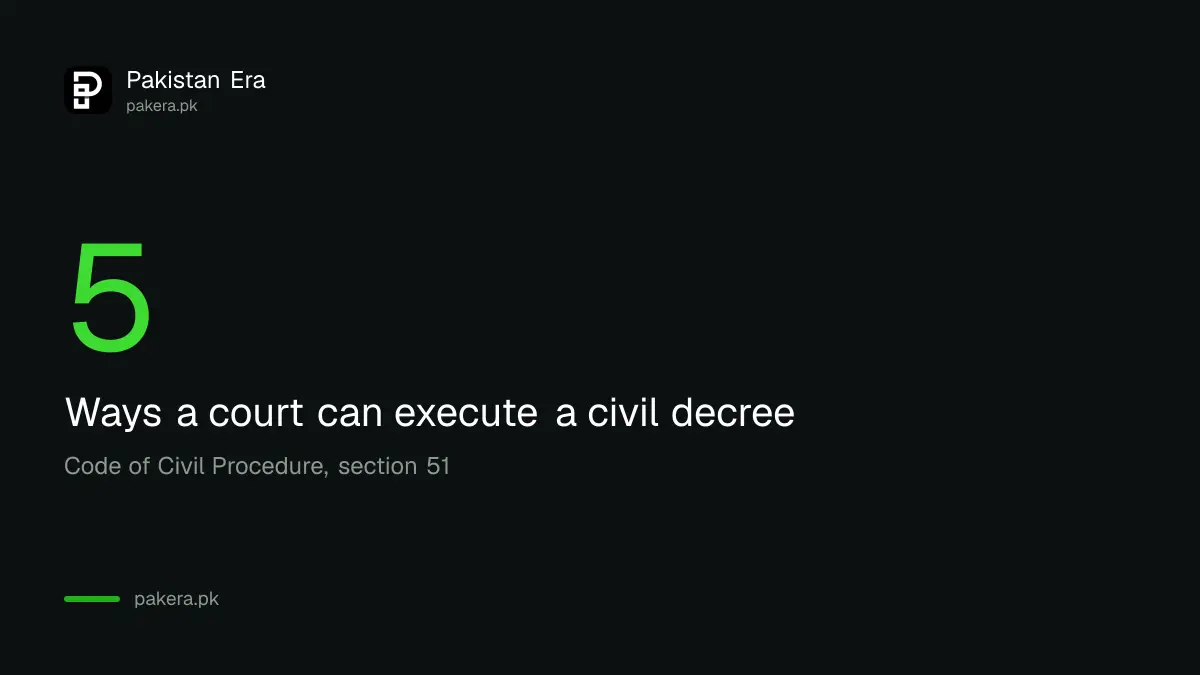
Section 51 gives the court five ways to enforce a decree
On the decree-holder's application, the court may order execution by delivery of property specifically decreed, attachment and sale or sale without attachment, arrest and detention in prison, appointing a receiver, or any other manner the relief requires.
The decree-holder is the person who won. The judgment-debtor is the person who must pay or give up property. The court acts only when the decree-holder asks, and subject to conditions and limits the law sets.
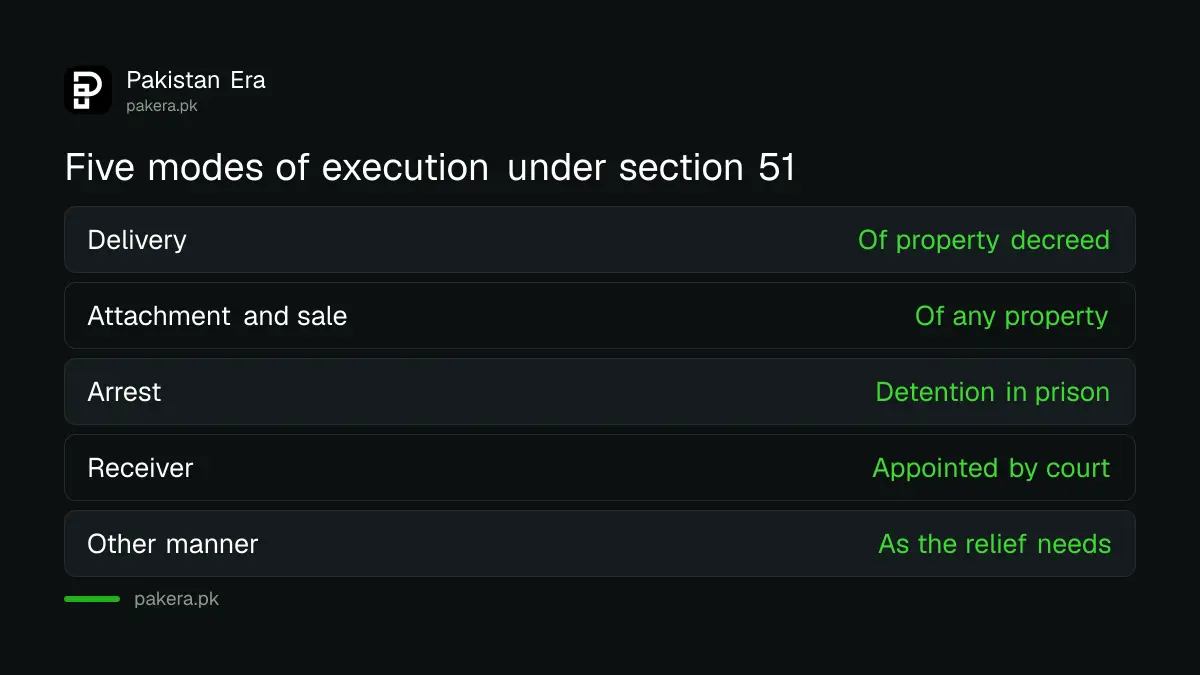
| Mode | Best used when |
|---|---|
| Delivery of property | The decree orders a specific thing handed over |
| Attachment and sale | The debtor owes money and has property |
| Arrest and detention | The court finds the debtor can pay and refuses, or is hiding assets |
| Receiver | Property or income needs to be managed for payment |
| Other manner | The nature of the relief calls for it |
Most property can be attached, with some exceptions
Section 60 says lands, houses, goods, money, cheques, shares, debts and other saleable property of the judgment-debtor can be attached and sold. Held in another name for his benefit still counts. Certain items are exempt, such as tools of artisans and labourers' wages.
The exemptions in the proviso include necessary clothing, cooking vessels and bedding, tools of artisans, the farm tools and cattle an agriculturist needs, books of account, a mere right to sue for damages, and the wages of labourers and domestic servants.
Salary is protected in part. The text says the first hundred rupees and one half of the remainder can be attached. For a government servant, long attachment can lead to an exemption for a time. These figures come from an old text, so ask your lawyer how courts apply them now.
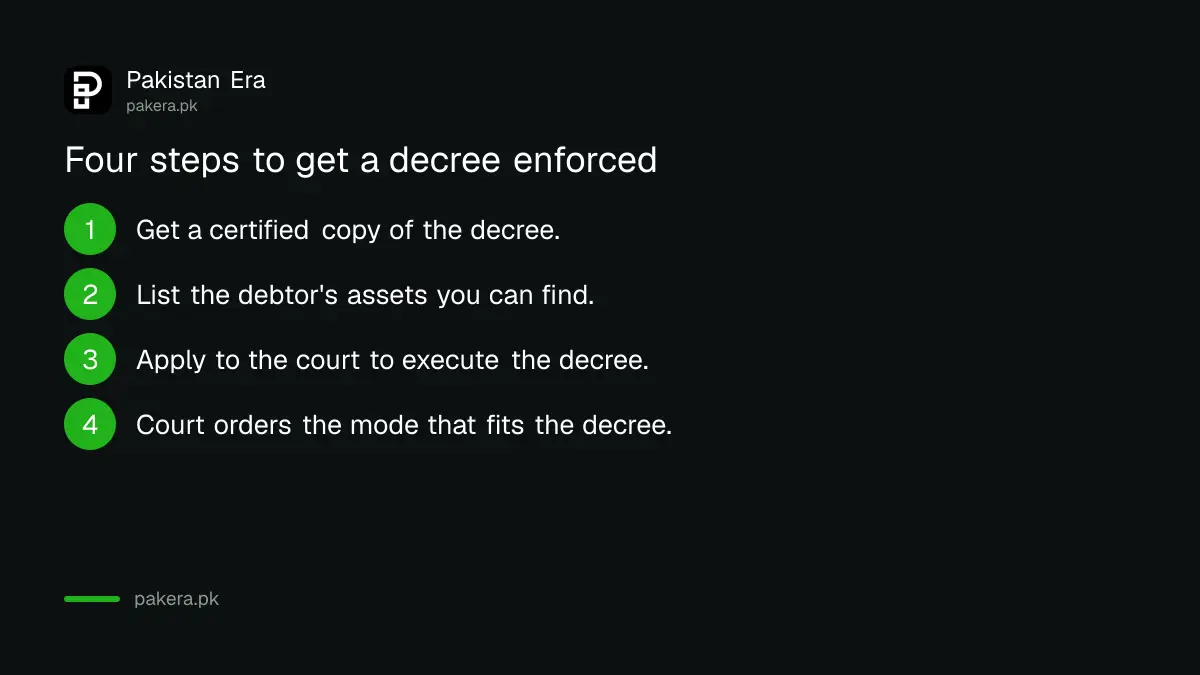
- Get a certified copy of the decree. See how to get a certified copy of a court order in Punjab.
- List what the debtor owns: land, a house, a vehicle, bank money, shop goods.
- Check land records for property you plan to name. See how to download an old property registry in Punjab.
- Ask your lawyer to file the execution application and name the mode you want.
- Follow the case dates with the online case status check.
Arrest is allowed only after the debtor can show cause
The court must give the judgment-debtor a chance to show cause before ordering detention. It must record reasons: he is likely to abscond, hid property, or has means to pay and refuses. A debtor who held money as a trustee may also be held.
So prison is not the first step. The court looks at the debtor's means, but leaves out property that the law exempts from attachment. A person with no means cannot be jailed just because he owes money.
This is a heavy step and judges use it with care. Prepare proof that the debtor has means, such as a car, a shop, or property transfers made after the case began.
A decree against a dead person's estate reaches the estate
Section 52 says a decree against someone as the legal representative of a dead person can be executed on the dead person's property. If none remains in his hands, the representative must satisfy the court that he applied it properly.
This matters for family debts. If a decree was passed against a man who has died, the heirs are not personally liable beyond the property they received, unless they cannot account for it. Read who gets what in an inheritance if you are an heir.
Family courts have their own routes for money decrees such as maintenance. See how to claim maintenance in a Punjab family court and how to recover haq mehr and dowry.
Common questions
How do I enforce a civil court decree in Pakistan?
File an application with the court asking it to execute the decree under section 51, and name the mode you want.
Can the court jail the debtor?
Only after giving a chance to show cause, and on recorded reasons such as likely absconding, hidden property, or refusal to pay with means.
What property cannot be attached?
Items such as necessary clothing and bedding, tools of artisans, books of account and labourers' wages are exempt under section 60.
Can part of a salary be attached?
The text allows attachment of the first hundred rupees and half the remainder, with limits for government servants. Ask a lawyer about current practice.
Is there a time limit to apply?
Yes, there is one, but we did not read it. Ask your lawyer on the day you receive the decree.
How we verified this
What we checked, where we read it, and what we could not confirm.
Last checked on 14 October 2026, Pakistan time. We read the Code of Civil Procedure, 1908 on the Pakistan Code, sections 51, 52 and 60. We did not read Order 21, court fees, the time limit for an execution application or any judgment. This page explains the law and is not legal advice.
About the author

Senior Writer, Public Services and Technology
Shahid joined us in 2024 as an author. He is a senior contributor to Pakistan's leading technology websites. He writes detailed articles, mostly covering his expertise in the latest tech, mobiles, apps, gadgets, and step-by-step guides. His ideology is to help people understand the latest trends and explain complex methods through very easy-to-understand guides.