How to Recover Haq Mehr and Dowry in a Punjab Family Court
Recover haq mehr and dowry in a Punjab Family Court: Rs 15 court fee, six month target, recovery as land revenue, what khula changes and the time limit to sue.
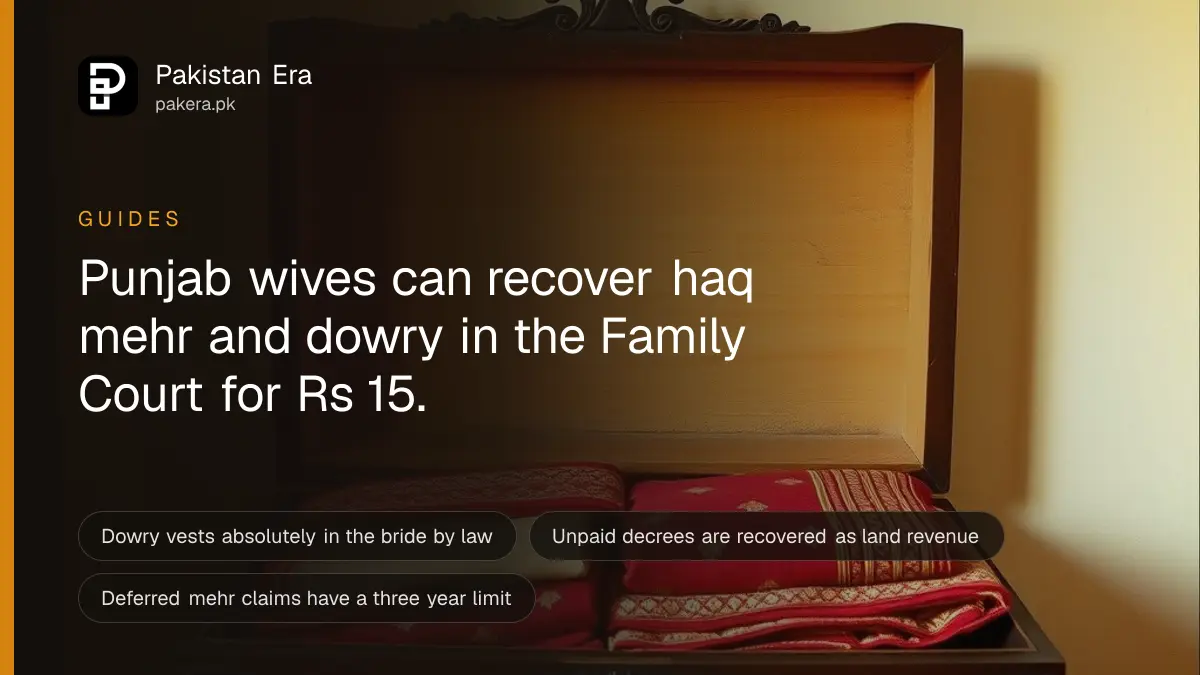
A wife in Punjab can recover her haq mehr (dower) and her dowry by filing a suit in the Family Court. The court fee is Rs 15, the court must try to finish within six months, and unpaid money can be recovered from the husband as arrears of land revenue.
Mehr is her right under the nikah. Dowry is the property her parents gave her. In law, both belong to her alone, not to her husband or his family. Many women only find this out when the marriage breaks down and the jahez is still locked in her in-laws' house.
We read the Family Courts Act 1964, the Muslim Family Laws Ordinance 1961 and the Limitation Act 1908 on the Punjab Code, and the Dowry and Bridal Gifts (Restriction) Act 1976 on the Pakistan Code, on 1 October 2026.
Mehr and dowry belong to the wife alone
Dowry, bridal gifts and presents given to the bride vest absolutely in her under the Dowry Act. Mehr is a separate debt the husband owes under the nikah. Neither can be kept by the husband or his family once she asks for it.
- Dowry is property her parents gave her in connection with the marriage, before, at or after it.
- Bridal gifts are gifts from the groom or his parents to the bride. The Act says these do not include mehr.
- Mehr is the amount written in the nikahnama. Prompt mehr (muajjal) is payable when she asks. Deferred mehr (muwajjal) is payable when the marriage ends.
Section 5 of the Dowry and Bridal Gifts (Restriction) Act 1976 says all of it vests absolutely in the bride, and her interest cannot be restricted, conditional or limited.
Section 10 of the Muslim Family Laws Ordinance adds a rule worth knowing. If the nikahnama does not say how the mehr is to be paid, the whole amount is presumed to be payable on demand. Check the mehr columns of the nikahnama carefully. A registered nikah makes this much easier to prove.
How to file a suit for mehr and dowry in Punjab
File a plaint in the Family Court of the area, list every item and amount you claim, pay the Rs 15 court fee, and attach your evidence. You can join these claims with a khula or divorce case, or file them alone.
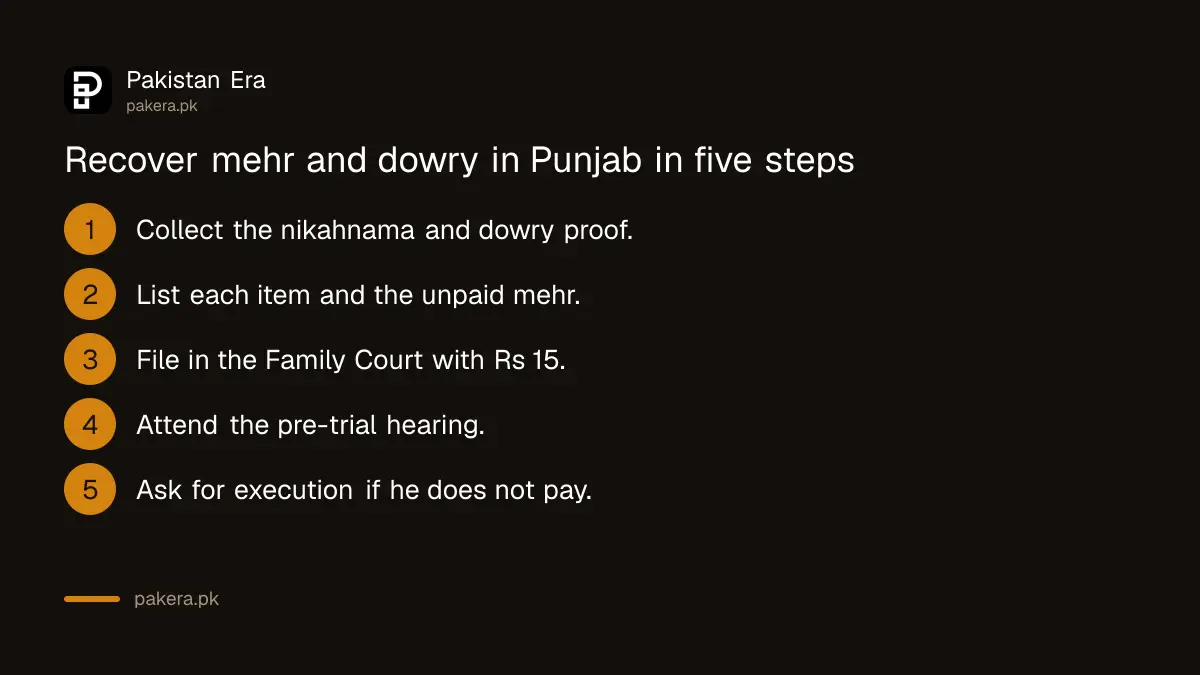
- Collect your proof. The nikahnama, a list of dowry items, receipts, photos of the jahez, and names of people who saw it given.
- Write the list of claims. Give each item with its value, and the mehr amount still unpaid.
- Get a lawyer if you can. If not, ask about a free lawyer in Punjab through legal aid.
- File the plaint in the Family Court. Section 7 says it must list your witnesses and a short summary of what each will say.
- Pay the court fee. Section 19 fixes it at Rs 15 for any suit or appeal under the Act.
- Attend the pre-trial hearing. The court first tries to settle the case. If that fails, it records evidence.
- Get the decree and ask for execution if he does not pay.
Section 7 also lets a plaint for dissolution of marriage include all claims for dowry, maintenance, dower, personal property and custody. One case is quicker and cheaper than three. If you are also claiming support, the rules to claim maintenance in a Punjab family court apply in the same suit.
What the Family Court can order
The Family Court can order payment of mehr, return of dowry items or their value, and return of her personal belongings. If the husband does not pay within the time given, up to thirty days, the money is recovered as arrears of land revenue.
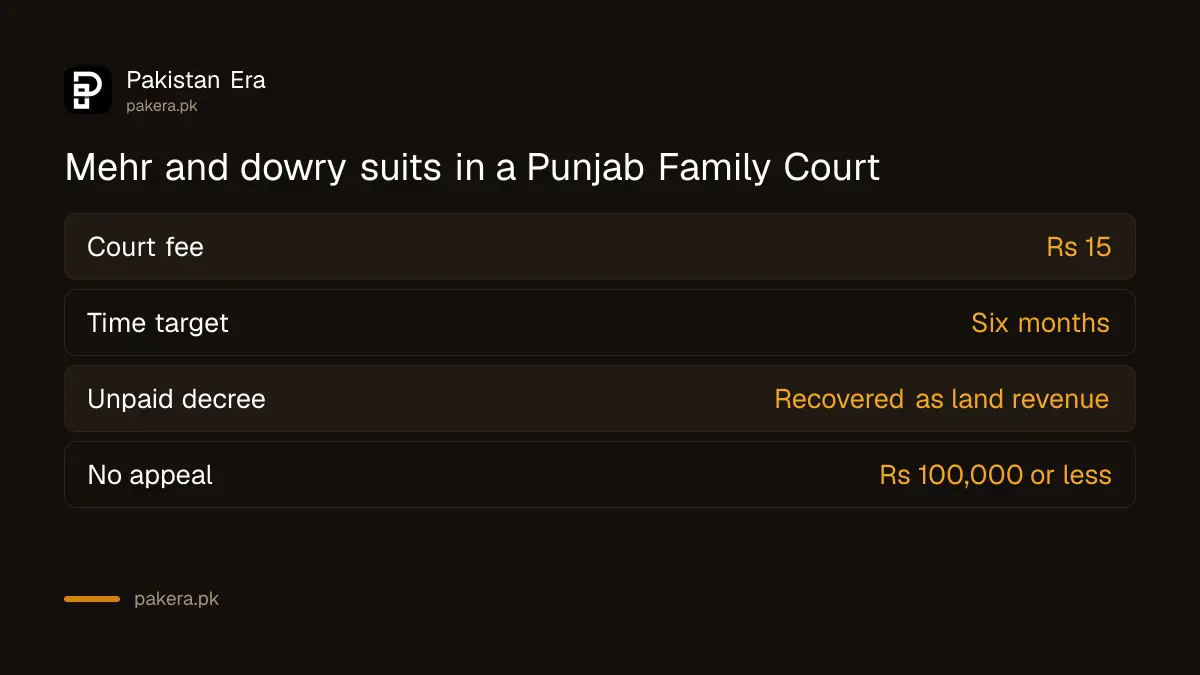
| Rule | What the law says | Where |
|---|---|---|
| Which court | Family Court has exclusive jurisdiction over dower, dowry and the wife's personal property | Family Courts Act, s.5 and Schedule |
| Court fee | Rs 15 | s.19 |
| Time target | Six months from filing | s.12A |
| Unpaid decree | Recovered as arrears of land revenue after up to 30 days | s.13(3) |
| Instalments | The court may allow payment in instalments | s.13(5) |
| No appeal | Dower or dowry decree of Rs 100,000 or less | s.14(2)(b) |
The six month target is not a guarantee. If the case runs longer, section 12A lets either party apply to the High Court for directions.
Recovery as arrears of land revenue is the strong part. It means the state collects the money, as it would collect an unpaid land tax.
Khula changes how much mehr you keep
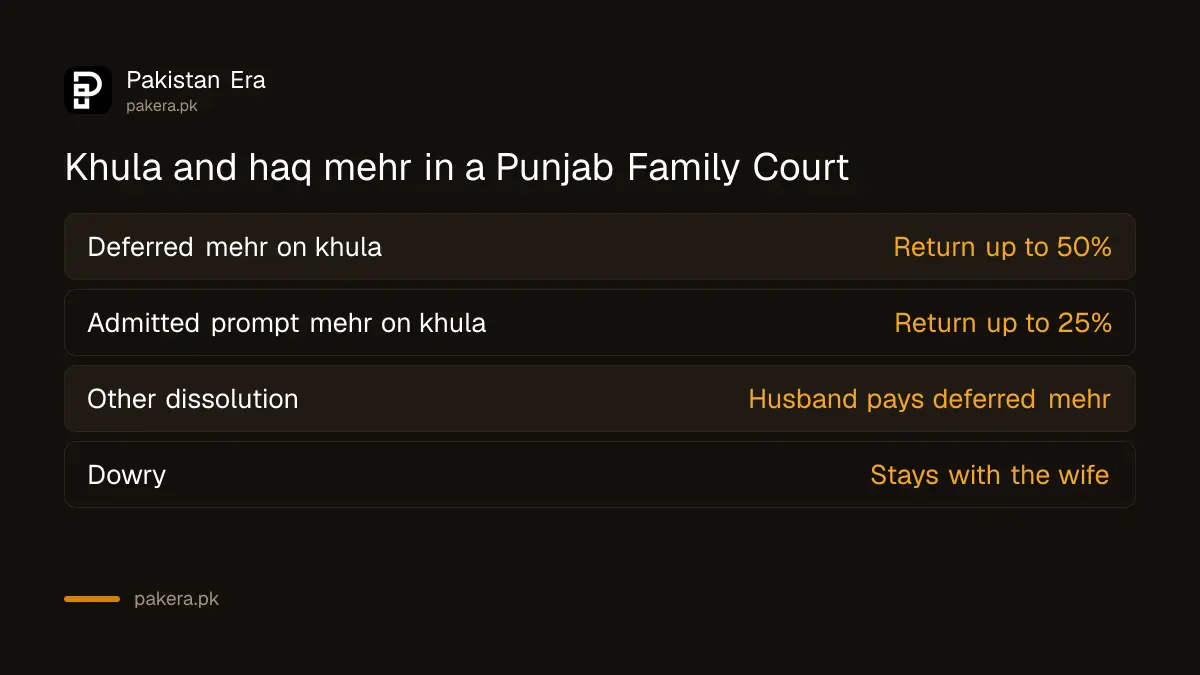
When the court grants khula, it may direct the wife to give back up to 50% of her deferred mehr, or up to 25% of her admitted prompt mehr. In any other dissolution, the court must order the husband to pay outstanding deferred mehr.
This is in section 10(5) and 10(6) of the Family Courts Act 1964 as it applies in Punjab. The words are "up to", so the court can order less, or nothing. The section speaks only of mehr. It says nothing that lets the husband keep her dowry.
The full route to file for khula is a separate process. After the decree, she will need a NADRA divorce certificate to update her records.
Do not wait too long to claim deferred mehr
The Limitation Act gives three years to sue for deferred mehr, counted from the day the marriage ends by death or divorce. For prompt mehr, the time runs from the day she demands it and he refuses.
These are Articles 103 and 104 of the Limitation Act 1908. If she never demanded prompt mehr during the marriage, the time for it runs from the day the marriage ends.
One more rule protects a first wife. Under section 6 of the Muslim Family Laws Ordinance, a man who marries again without the Arbitration Council's permission must pay his existing wife's entire mehr at once, prompt and deferred. If he does not, it is recoverable as arrears of land revenue.
Common questions
Can I claim my dowry without asking for divorce?
Yes. Dowry and mehr are separate matters in the Family Court Schedule. You can file for them alone.
What is the court fee for a mehr or dowry case in Punjab?
Rs 15, under section 19 of the Family Courts Act.
What if I have no receipts for my jahez?
Use other proof: photos, a list signed at the wedding, and witnesses who saw the items given. The court weighs all the evidence.
Do I lose my mehr if I take khula?
Not all of it. The court may direct you to return up to half your deferred mehr or up to a quarter of admitted prompt mehr. It can order less.
Can the husband appeal a mehr decree?
Not if the dower or dowry decree is Rs 100,000 or less. Above that, an appeal lies.
When is prompt mehr payable?
On demand. If the nikahnama does not say how mehr is paid, the whole amount is presumed payable on demand.
How we verified this
What we checked, where we read it, and what we could not confirm.
Last checked on 1 October 2026. On punjablaws.punjab.gov.pk we read the Family Courts Act 1964 as amended in Punjab, sections 5, 7, 10, 12A, 13, 14 and 19 and the Schedule, the Muslim Family Laws Ordinance 1961, sections 6 and 10, and Articles 103 and 104 of the Limitation Act 1908. On pakistancode.gov.pk we read sections 2 and 5 of the Dowry and Bridal Gifts (Restriction) Act 1976. We did not check court timelines in practice, which vary by district.
About the author

Public Services and Education Journalist
Fajr Riaz is a journalist and content writer at Pakistan Era, based in Lahore. She covers the questions people meet in everyday life in Pakistan: how a public service works, what a change in the rules means, and where to find a reliable answer.