What to Do When Your Landlord Raises the Rent
What decides a rent dispute is the agreement. How to document a tenancy, pay in a way that leaves a record, and where disputes actually go.

What decides a rent dispute is the agreement, and most tenants in Pakistan do not have a proper one. A verbal arrangement, or a plain sheet signed at the start and never registered, leaves you arguing about what was said. A written, stamped and registered agreement leaves you pointing at a clause.
Rented premises law is provincial. Punjab, Sindh, Khyber Pakhtunkhwa and Balochistan each have their own statute and their own rent tribunals, so the detail differs by where you live. What follows is the shape that holds across them, with the parts we could not verify marked as such.
The agreement is the whole game
Before arguing about an increase, look at what you actually signed.
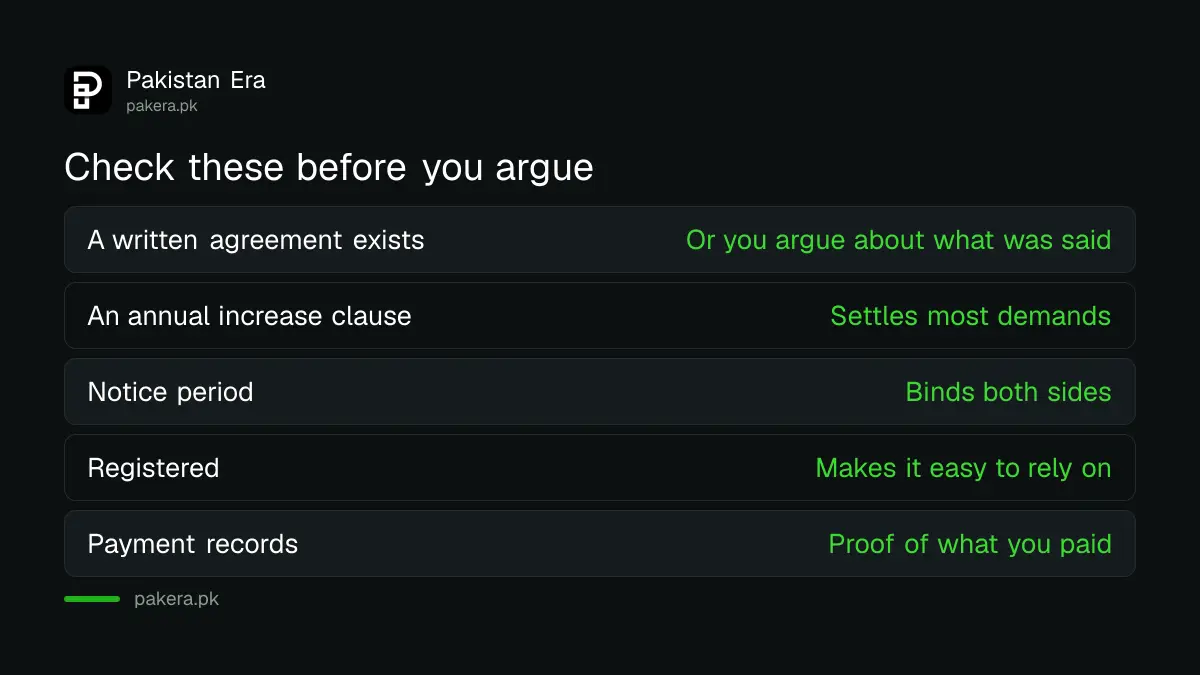
| Check | Why it decides things |
|---|---|
| Is there a written agreement at all | A verbal tenancy is far harder to defend |
| The term, and when it ends | Increases usually attach to renewal |
| Any annual increase clause | A stated percentage settles most disputes |
| Notice period for ending it | Both sides are bound by it |
| Whether it was registered | Registration is what makes it easy to rely on |
If your agreement contains an annual increase clause and the landlord is asking for that, the conversation is short. If it does not, or the demand exceeds it, you are in a negotiation rather than an obligation, whatever tone the demand arrives in.
Get it in writing, and get it registered
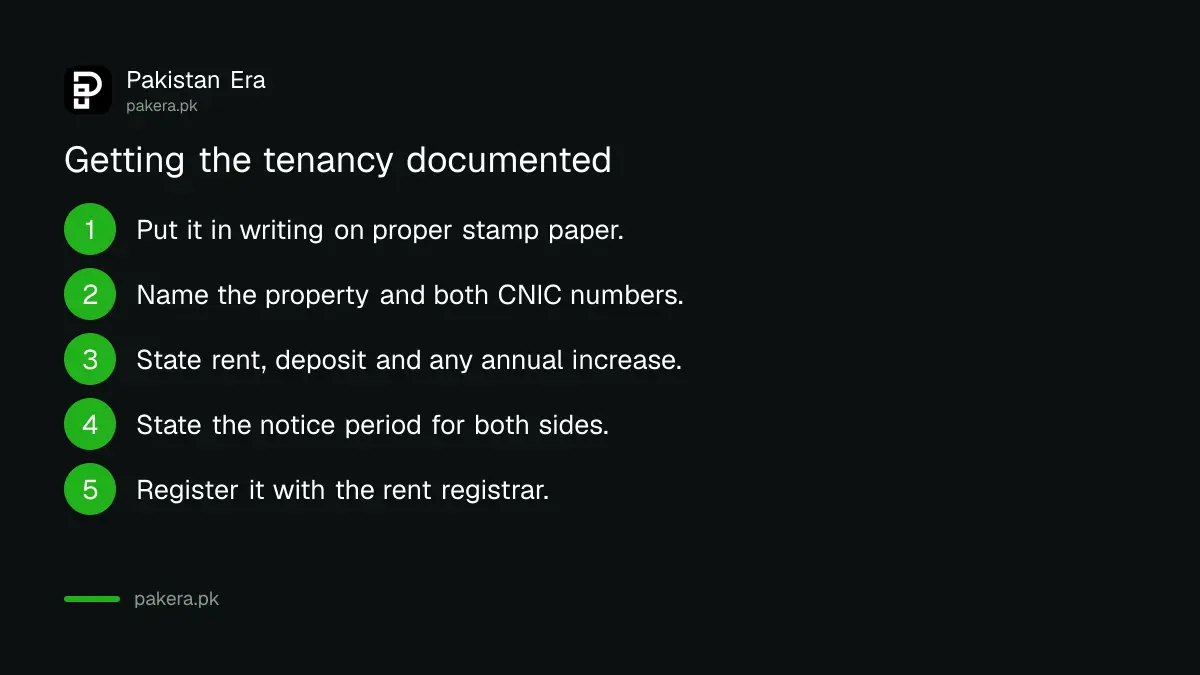
- Put the tenancy in writing, on proper stamp paper rather than a plain sheet.
- Name the property precisely, and both parties with CNIC numbers.
- State the rent, the security deposit and any annual increase as a figure or percentage.
- State the notice period each side must give.
- Register it with the rent registrar for your area.
Our guides to rent agreements and stamp paper and to issuing e-stamp paper cover the mechanics. Doing this at the start costs a little and settles almost everything later.
Pay in a way that leaves a record
Cash rent with no receipt is the second big weakness. If a dispute reaches a tribunal, you may be asked to prove what you paid and when, and a stack of dates in your own handwriting is not proof.
Pay by bank transfer where you can, with the month in the reference. If the landlord insists on cash, ask for a signed receipt each time and keep them together. A landlord who refuses to give receipts is telling you something useful about how a future dispute will go.
When the increase is unreasonable
Start by asking for it in writing. A demand made in person can be anything later; a demand in a message or a letter is a fixed position you can respond to.
Reply in writing too, and keep it factual. Set out what the agreement says, what you are willing to pay, and from when. Most of these end in a negotiated figure, and a tenant who has documented everything negotiates from a much better place than one who has not.
Where it cannot be resolved, the rent tribunal for your area is the forum, not the police. Rent disputes are civil matters between landlord and tenant, and taking one to a police station usually produces pressure rather than a resolution.
Eviction has a process, and it is not the landlord's to shortcut
A landlord who wants you out has to follow the process set by the provincial law, which runs through the rent tribunal. Changing the locks, cutting the water or electricity, or removing your belongings are not steps in that process.
If services are cut to force you out, record it with dates and photographs and take advice promptly. We are not going to tell you exactly what remedy applies, because that depends on your province and your facts, and getting it wrong would cost you.
The security deposit
Note the deposit amount in the agreement and note the condition of the property at the start, in photographs with dates. Deposit disputes are almost always arguments about what the place looked like when you moved in.
Ask, in the agreement, when the deposit is returned and what may be deducted. A clause saying it is refunded within a stated number of days of vacating, less agreed damages, prevents a very common problem.
Common questions about rent increases
Can my landlord raise the rent whenever he likes?
What governs is your agreement and the provincial rented premises law. An increase outside an agreed clause is a demand you can negotiate rather than an automatic obligation.
Is a verbal tenancy valid?
People do rent verbally, but proving terms becomes very hard. Get it in writing, and if you are already renting verbally, propose putting it in writing now rather than during a dispute.
Does the agreement have to be registered?
Registration is what makes an agreement straightforward to rely on and is expected under the provincial regimes. Confirm the requirement for your own province.
Where do rent disputes go?
To the rent tribunal or rent controller for your area under the provincial law, not to the police.
Can the landlord cut the electricity to make me leave?
That is not part of any lawful eviction process. Record it and take advice quickly rather than responding in kind.
How we verified this
What we checked, where we read it, and what we could not confirm.
Last checked 27 August 2026. Rented premises law in Pakistan is provincial, with separate statutes and tribunals in Punjab, Sindh, Khyber Pakhtunkhwa and Balochistan. We did not read a provincial rented premises statute at source on that date, so no section, notice period, percentage cap or time limit is quoted anywhere on this page, and the guidance is limited to what holds generally: document the tenancy, register it, keep payment records, and use the tribunal rather than the police. This is general information and not legal advice, and the remedy available to you depends on your province and your facts.
About the author

Senior Writer, Public Services and Technology
Shahid joined us in 2024 as an author. He is a senior contributor to Pakistan's leading technology websites. He writes detailed articles, mostly covering his expertise in the latest tech, mobiles, apps, gadgets, and step-by-step guides. His ideology is to help people understand the latest trends and explain complex methods through very easy-to-understand guides.