How to Evict a Tenant in Balochistan: 7 Grounds Before the Rent Controller and the 25% Fair Rent Cap
Evicting a tenant in Balochistan needs a Rent Controller order on one of 7 grounds. See the 15 and 60 day rent rule, the 25% fair rent cap and the appeal limit.
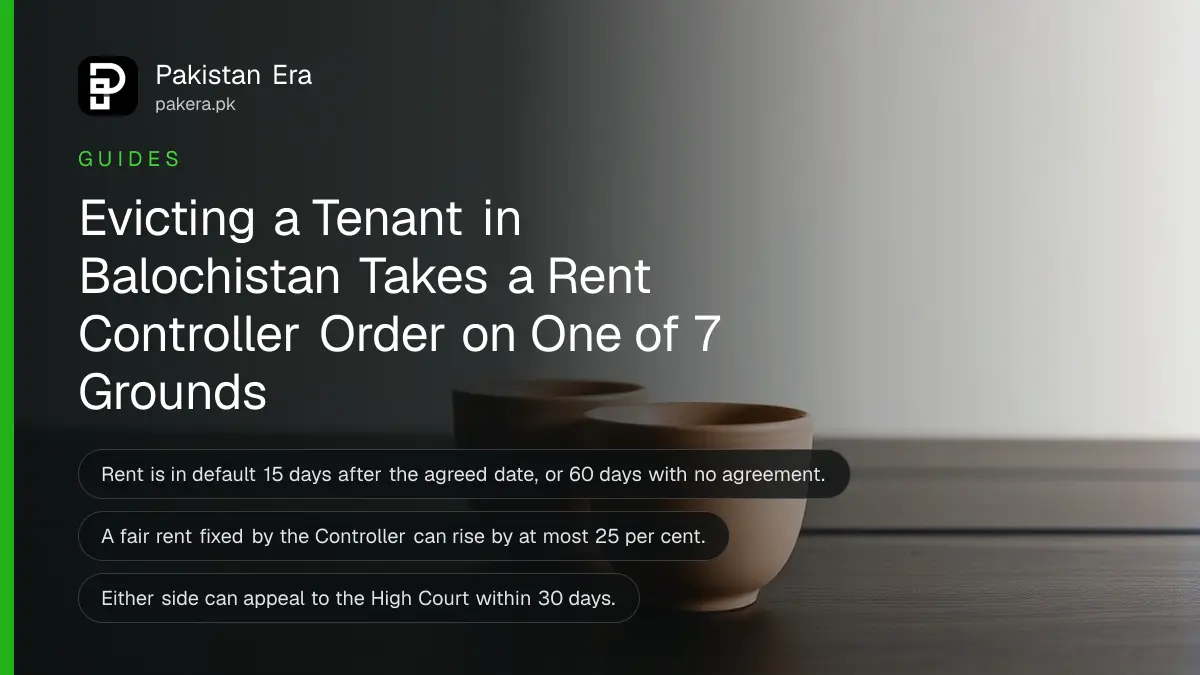
Short answer: In Balochistan, a landlord can evict a tenant only through an order of the Rent Controller, under the Balochistan Urban Rent Restriction Ordinance, 1959. The main grounds are unpaid rent, subletting without written consent, damage, nuisance, four months of non-use, rebuilding, and the landlord's own genuine need. Changing the locks or cutting utilities is not one of them.
The Rent Controller is a judicial officer appointed by the provincial government to hear rent cases. The Ordinance covers urban areas run by a municipal corporation, municipality or town committee, including Quetta. We read the full Ordinance on the Balochistan Code on 20 October 2026. Here is what it allows landlords, and what it protects tenants from.
Seven grounds let the Rent Controller order an eviction
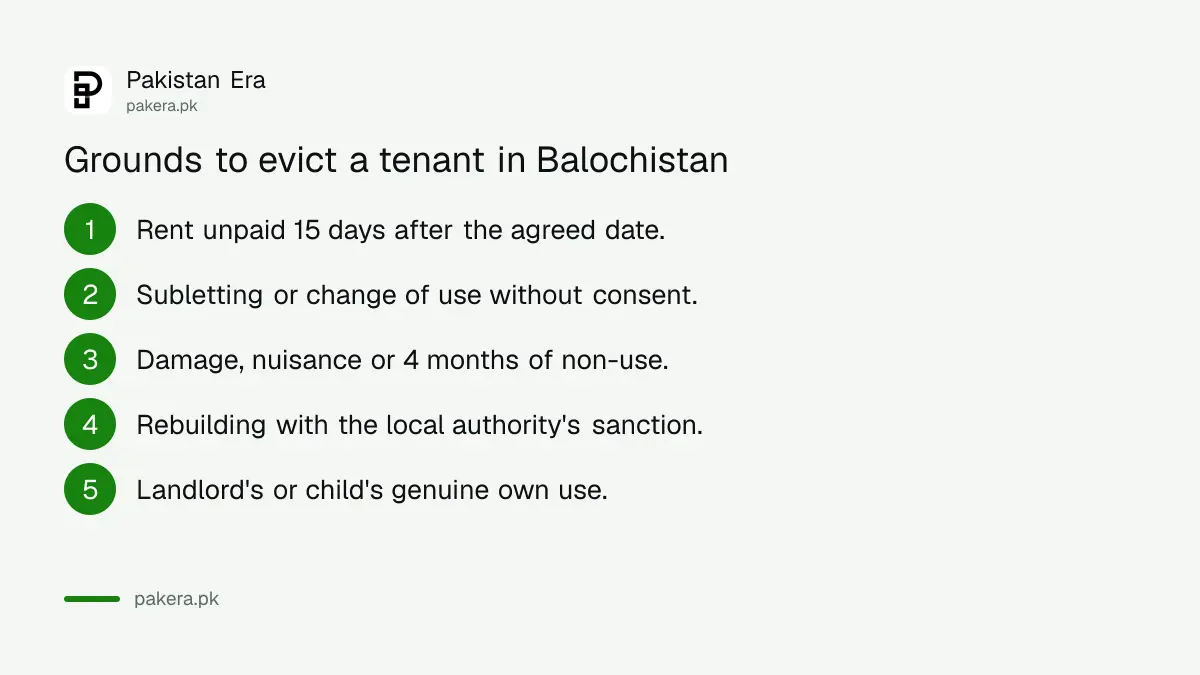
Section 13 lists the grounds. The landlord applies to the Controller, the tenant gets a chance to answer, and the Controller decides. The first six grounds are about the tenant's conduct or rebuilding. The seventh, under section 13(3), is the landlord's own need.
| Ground | What the landlord must show |
|---|---|
| Unpaid rent | Rent not paid within 15 days of the date in the agreement, or within 60 days if there is no agreement |
| Subletting or misuse | Tenant sublet, transferred or changed the use without written consent |
| Damage | Acts likely to materially reduce the building's value or use |
| Nuisance | Conduct that is a nuisance to neighbours |
| Non-use | Tenant left the building empty for 4 months in a row without reasonable cause |
| Rebuilding | Landlord needs it in good faith to rebuild and has the local authority's sanction |
| Own use | Landlord or a child needs it in good faith and has no other suitable building in that town |
Water and electricity charges that the tenant pays to the landlord count as rent for the unpaid rent ground. So a tenant who skips the bills can be treated as a defaulter. The four month ground does not apply in a hill station.
A first-time defaulter can stop the case by paying
If the case is about unpaid rent, the tenant admits the debt on the first hearing and has never defaulted before, the Controller must let the tenant deposit the arrears by a fixed date. Once paid, the application is rejected. A second default does not get this chance.
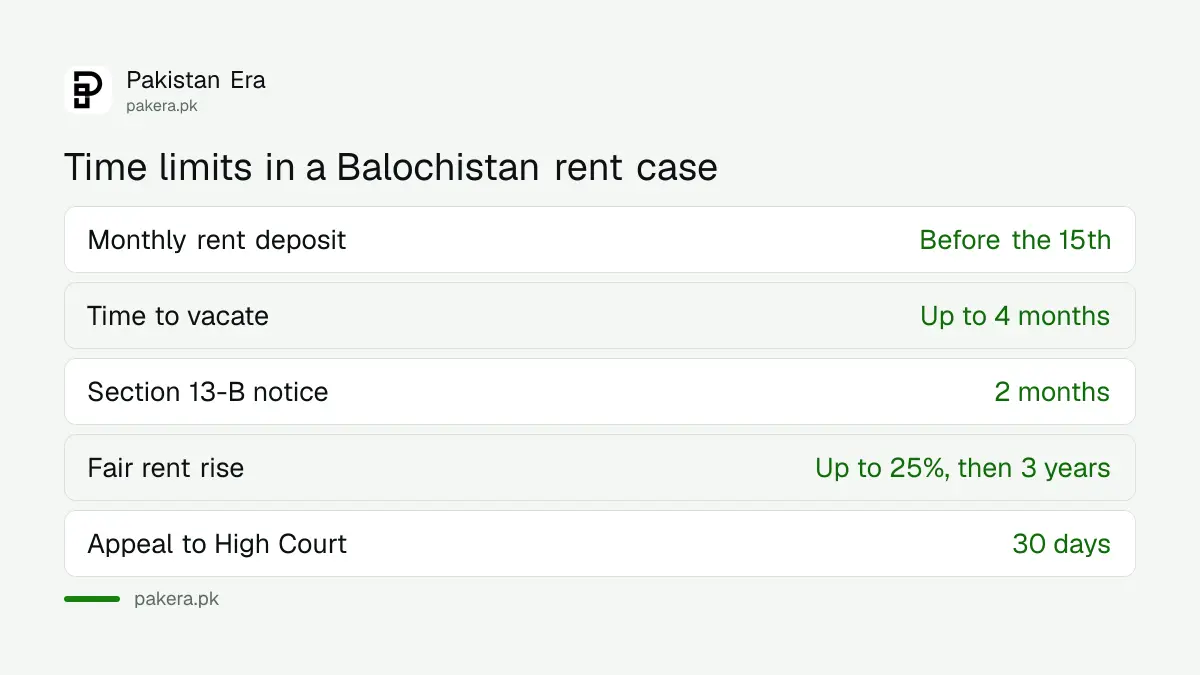
Throughout the case, the Controller orders the tenant to deposit all rent due and then each month's rent before the 15th. If the tenant fails, the defence is struck off and the landlord is put in possession without further proceedings. This is the rule that ends most cases quickly, so tenants should never stop paying rent during a dispute.
A tenant whose landlord refuses rent can send it by money order or deposit it in the Rent Controller's office. Either counts as properly paid. The same approach works elsewhere, as in Sindh, where a tenant can deposit rent with the Rent Controller.
Own use and rebuilding come with conditions
A landlord who wants the building for personal or family use must need it in good faith and must not already occupy another suitable building in the same town. If the tenancy is for a fixed term, the landlord cannot apply until that term ends.
The Ordinance punishes misuse of these grounds. If the landlord or child does not move in within one month, or relets within two months to someone else, the evicted tenant can ask to be put back. A landlord who evicts to rebuild must demolish within 4 months and build within 2 years, or face up to six months in jail, a fine or both.
The Controller can give a tenant up to four months in total to hand over possession. If the Controller finds a landlord's case frivolous or vexatious, it can order compensation of up to ten times the monthly rent to the tenant.
Widows, orphans and retiring employees get a faster route
Section 13-B gives a quicker path to three kinds of landlord: the widow or minor child of a landlord who has died, and a salaried employee who has retired or will retire within six months. Their spouse or minor child can use it too. They serve a written notice asking the tenant to leave within two months.
If the tenant stays on, the Controller orders summary ejectment once satisfied the need is genuine. The notice must come within six months of the death, or within six months of the retirement. It works for one building only. Reletting within a year to someone new carries a fine of up to Rs 5,000, or a full year's rent if that is more.
How a landlord files and what the tenant can claim back
Start with a written tenancy agreement and a record of every payment. Most disputes turn on dates, and the Controller will look for them. A stamped rent agreement on stamp paper is the simplest proof of the due date.
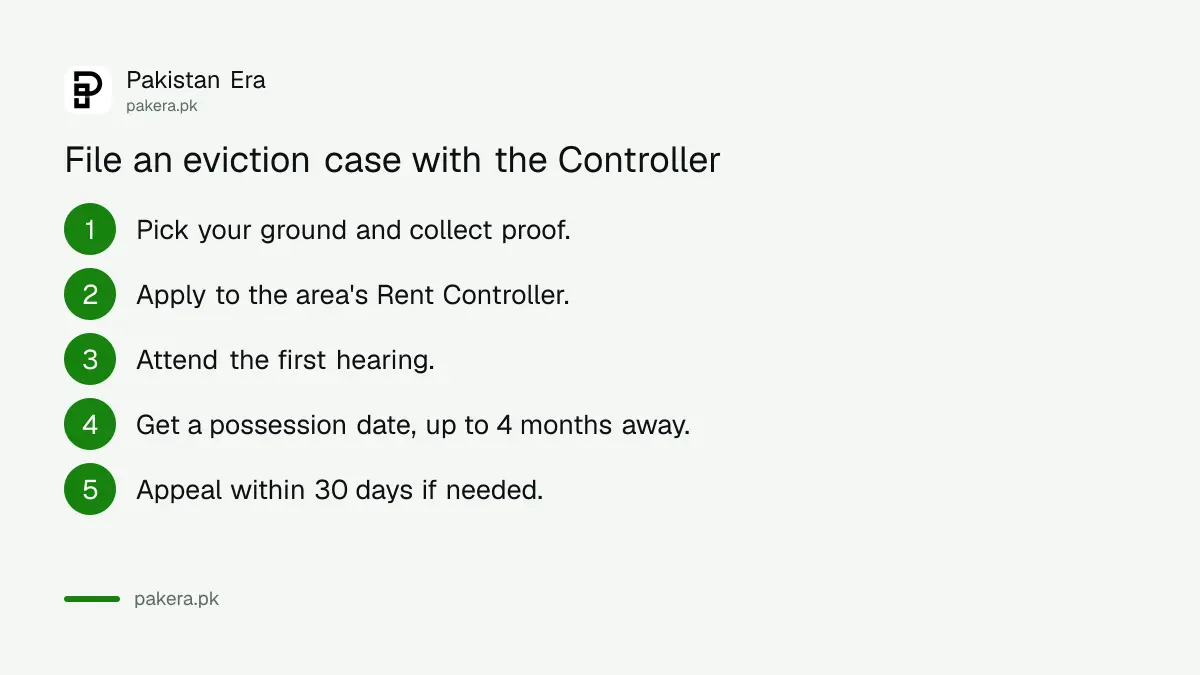
- Write down the ground you rely on and collect proof, such as missed rent dates, photos or a building sanction.
- File an application with the Rent Controller for the area where the building is.
- Attend the first hearing. Expect the Controller to order the tenant to deposit rent.
- If you win, the Controller fixes a date for possession, up to four months away.
- Either side may appeal to the High Court within 30 days of the final order.
Tenants can also apply. Under section 4, either side can ask the Controller to fix a fair rent, based on rents in the area over the last 12 months, building and repair costs, new taxes and the property tax register. Any increase is capped at 25 per cent of the current rent, and no further rise is allowed for three years. Once a fair rent is fixed, the landlord may take no more than one month's rent in advance.
When a building is sold, the new owner must tell the tenant by registered post. The tenant is not in default if the rent reaches the new owner within 30 days. Landlords must also register a tenant with police or Levies in Balochistan within 3 days. For comparison, see the rules to evict a tenant in Khyber Pakhtunkhwa.
Common questions
Who decides eviction cases in Balochistan?
The Rent Controller, a judicial officer appointed by the provincial government under the Balochistan Urban Rent Restriction Ordinance, 1959.
How late can rent be before eviction?
15 days after the date in the tenancy agreement, or 60 days from the period the rent covers if there is no agreement.
Can a landlord raise rent freely in Balochistan?
An agreed rent can be raised by agreement. If the Controller fixes a fair rent, the rise is capped at 25 per cent and frozen for three years.
How long does a tenant get to leave?
The Controller can allow reasonable time, up to four months in total. Under section 13-B, the notice gives two months.
Can I appeal a Rent Controller's order?
Yes, to the High Court within 30 days of the final order. There is no appeal against the interim order to deposit rent.
Does the Ordinance cover villages?
No. It covers urban areas under a municipal corporation, municipality, municipal, town or notified area committee.
How we verified this
What we checked, where we read it, and what we could not confirm.
Last checked 20 October 2026. We read the Balochistan Urban Rent Restriction Ordinance, 1959, with its amendments to 1985 and its 2014 extension note, on the Balochistan Code of the Law and Parliamentary Affairs Department on 20 October 2026. Sections cited are 2, 4, 5, 6, 13, 13-A, 13-B and 15. We did not find rules or a fee schedule for Rent Controller applications on an official site, and we did not check how long cases take in practice.
About the author

Senior Writer, Public Services and Technology
Shahid joined us in 2024 as an author. He is a senior contributor to Pakistan's leading technology websites. He writes detailed articles, mostly covering his expertise in the latest tech, mobiles, apps, gadgets, and step-by-step guides. His ideology is to help people understand the latest trends and explain complex methods through very easy-to-understand guides.