How to Pay Rent in Sindh When Your Landlord Refuses It: Money Order or Rent Controller Deposit
Landlord in Sindh refusing your rent? Section 10(3) allows a postal money order or a deposit with the Rent Controller, and the receipt is proof. See the steps.
Short answer: If your landlord in Sindh refuses or avoids taking your rent, section 10(3) of the Sindh Rented Premises Ordinance, 1979 lets you send it to him by postal money order or deposit it with the Rent Controller of your area. The Controller's receipt, or the money order receipt, is accepted as proof that you paid.
The landlord says he is away. Then he says the account is closed. Two months pass, and now a notice arrives saying you are in default. Tenants in Karachi, Hyderabad and Sukkur describe this pattern often. The law has a quiet answer for it, and most tenants never use it.
We read the Ordinance on the Sindh Laws site on 12 October 2026. Every section number below is from that official text. It is the copy amended up to 2001, so check a lawyer or the Controller's office for later changes.
Rent is due by the tenth of the next month unless you agreed otherwise
Section 10(1) says that, where no date was agreed, rent must be paid no later than the tenth of the month following the month it is due. Rent for October is due by 10 November. If your rent agreement on stamp paper sets another date, that date applies.
Section 10(2) adds that rent is to be paid to the landlord, and he must acknowledge receipt in writing. So the first step is always the plain one. Offer the rent, and ask for a signed note.
| Situation | What section 10 says |
|---|---|
| No agreed date | Pay by the tenth of the following month |
| Landlord accepts | He must acknowledge receipt in writing |
| Landlord refuses or avoids | Postal money order, or deposit with the Controller |
| Proof of payment | Written acknowledgement, money order receipt or Controller's receipt |
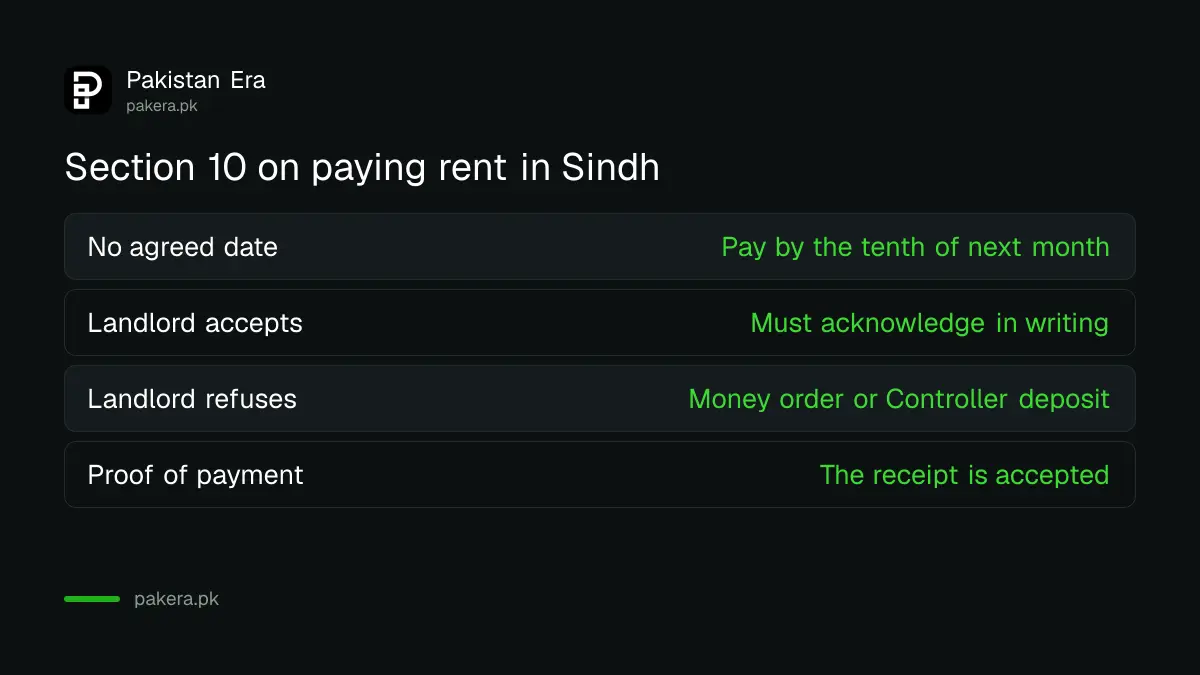
A refusal opens two routes: money order or Controller deposit
Section 10(3) says that where the landlord has refused or avoided the rent, it may be sent by postal money order or deposited with the Controller within whose jurisdiction the premises sit. "Controller" means the Rent Controller, the officer who hears rent cases for your area.
The Ordinance does not tell you to take the landlord's refusal in writing. It uses the words "refused or avoided". That second word matters, because many landlords never say no. They simply do not pick up.
The money order route is the simpler one. It needs the landlord's postal address and a post office. The Controller route needs a visit to the Rent Controller's office for the area where the property stands. We did not find an application form or a fee for the deposit in the Ordinance. Ask the office what it needs before you go.
Keep every receipt, because the receipt is your proof
Section 10(4) says the written acknowledgement, the money order receipt or the Controller's receipt "shall be produced and accepted in proof of the payment of the rent". That sentence is the whole reason to use this route.
Put the receipts in one envelope, with the rent month written on each. If a default case is ever filed, the Controller will look at what you can produce. A Supreme Court ruling on a Karachi eviction, reported on 11 October 2026, turned on rent schedules and receipts.
Late or missed rent is a ground for eviction
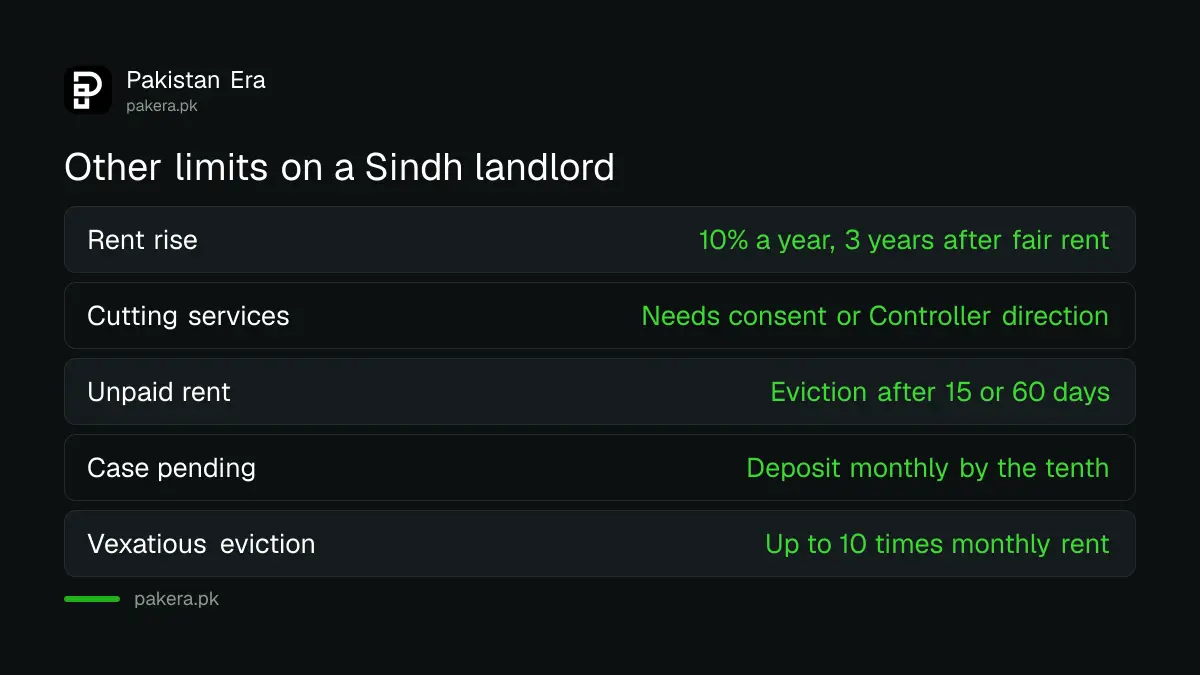
Section 15(2)(ii) lets the Controller order eviction if the tenant failed to pay within fifteen days after the agreed period, or, with no agreement, within sixty days after the rent became due. That is why a refused payment should not be left to pile up.
There is a softer rule for a first-time slip. Where the landlord's application rests only on non-payment and the tenant admits the rent on the first day of hearing, the Controller can, if the default is not above six months and is the first, direct payment of the rent claimed and reject the application. It is a rescue clause, not a plan.
When a case is already filed, section 16 applies. The Controller may fix the arrears, order you to deposit them within a set time, and direct monthly deposit on or before the tenth of every month until the case ends. If you fail, section 16(2) says your defence is struck off and the landlord is put in possession.
Other limits the Ordinance puts on a landlord
Section 9 bars a further rent rise for three years after a fair rent has been fixed, and caps any rent rise at ten per cent a year on the existing rent. Section 11 bars a landlord from cutting electricity, gas or water without your consent, a requisition from the authority, or the Controller's direction. A breach can mean up to six months in prison, a fine, or both.
Section 17 lets the Controller order a landlord to pay up to ten times the monthly rent if an eviction application is frivolous or vexatious. Our guide on who pays a tenant's unpaid electricity bill covers the other money dispute tenants face.
Follow these steps when the landlord will not take your rent
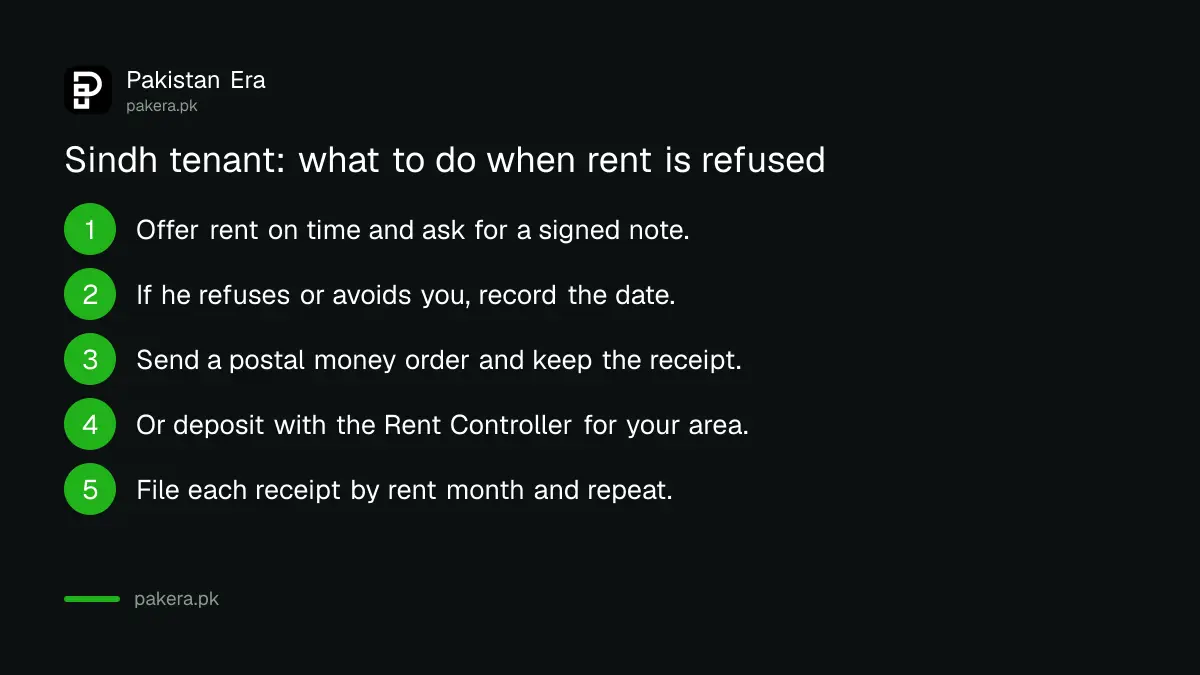
- Offer the rent on or before the due date and ask for a signed acknowledgement.
- If he refuses or avoids you, note the date and keep any message or call record.
- Send the rent by postal money order to his address, and keep the receipt.
- Or deposit it with the Rent Controller for your area, and keep the Controller's receipt.
- File each receipt by rent month, and repeat every month until he accepts.
Common questions
Can I deposit rent with the Rent Controller in Sindh?
Yes, if the landlord has refused or avoided it. Section 10(3) allows a deposit with the Controller of the area where the premises stand.
Is a postal money order accepted as proof of rent?
Yes. Section 10(4) says the money order receipt shall be produced and accepted in proof of payment of the rent.
When is rent due if my agreement has no date?
By the tenth of the month following the month it is due, under section 10(1).
How soon can a landlord seek eviction for unpaid rent?
Section 15(2)(ii) allows it after fifteen days past the agreed period, or sixty days after the rent fell due where nothing was agreed.
Does this apply in Punjab or Islamabad?
No. This is the Sindh ordinance. Other provinces and Islamabad have their own rent laws, and we have not covered their deposit rules here.
Is there a fee for depositing rent with the Controller?
The Ordinance names no fee, and we did not find one on the sources we read. Ask the Controller's office before you go.
How we verified this
What we checked, where we read it, and what we could not confirm.
We read the Sindh Rented Premises Ordinance, 1979 on the Sindh Laws site on 12 October 2026. This is the copy amended up to 2001. Laws change by amendment and notification, so confirm with the Rent Controller's office before you rely on it in a dispute. This article is information, not legal advice.
About the author

Senior Writer, Public Services and Technology
Shahid joined us in 2024 as an author. He is a senior contributor to Pakistan's leading technology websites. He writes detailed articles, mostly covering his expertise in the latest tech, mobiles, apps, gadgets, and step-by-step guides. His ideology is to help people understand the latest trends and explain complex methods through very easy-to-understand guides.