Who Pays a Tenant's Unpaid Electricity Bill in Pakistan: The Landlord's Rs 50 Affidavit
A landlord signs to pay a tenant electricity default and can ask for a cut after three months. See what NEPRA rules say about tenant, old and new owner dues.
In Pakistan, a landlord who puts a tenant's electricity connection on a Rs 50 stamp paper affidavit promises to pay the tenant's unpaid bills. NEPRA's Consumer Service Manual also lets the company cut the supply on the landlord's request after three months of default. That promise is the part most landlords never read.
If you rent out a house, rent one, or plan to buy one, the electricity file stays with the premises. This guide lists what the manual says about tenant dues, old dues and several connections, and what to check before you sign anything.
A landlord signs to pay a tenant's default
When a tenant applies for a connection, the manual's clause 2.3.3 asks for a no objection certificate from the owner. The owner must also affirm, on non-judicial stamp paper worth Rs 50, that he or she will be responsible for the tenant's default amount, if any.
The sentence is short and heavy. It means the company can look to the owner when a tenant stops paying. A tenant's bill is therefore a landlord's risk from day one, not only the tenant's.
The same clause adds a protection for owners. The connection can be disconnected on the owner's request if the tenant is a defaulter for three consecutive months. Write to the sub division office with your CNIC and the connection reference number, and keep a stamped copy.
Old dues at a house can follow the new connection
Clause 2.3.2 says an applicant must give an affidavit that no connection existed at the premises before, and that the applicant will pay any outstanding dues of a previous connection there, if noticed later. It also says the applicant is not a defaulter on another connection.
If the company later finds that the applicant is a defaulter elsewhere, it may disconnect the new connection after a prior seven days' notice. So a new tenant or owner can be asked to clear dues that are not theirs, depending on what the file shows.
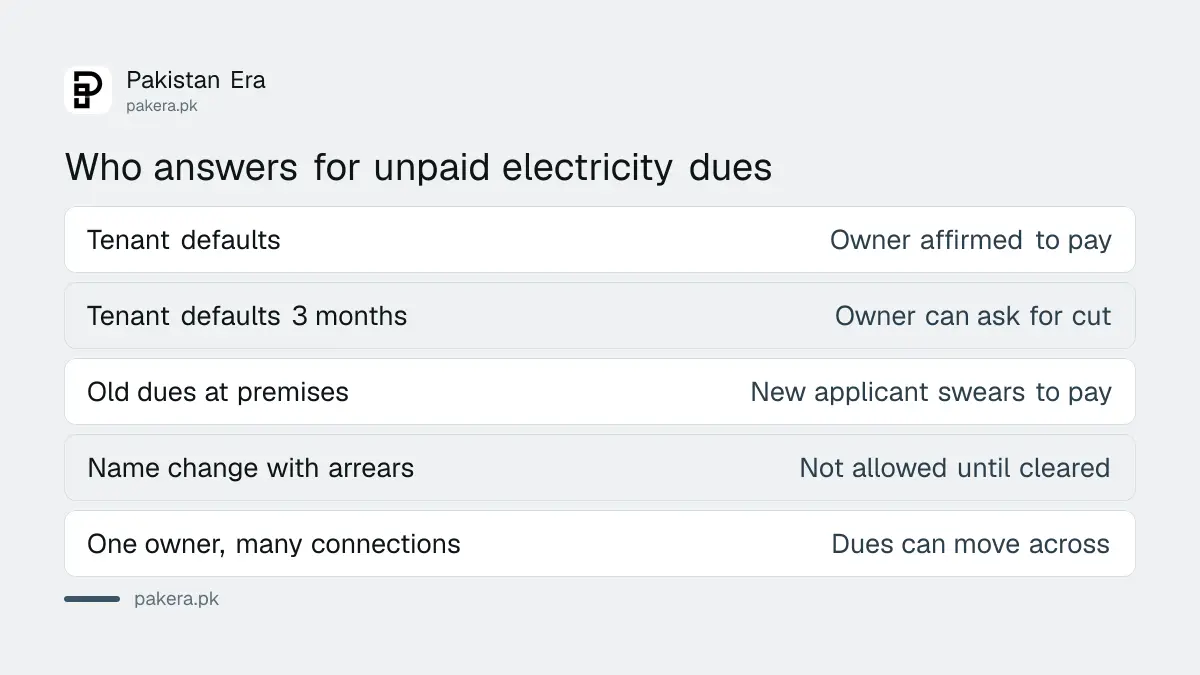
| Situation | What the manual says |
|---|---|
| Tenant defaults | Owner affirmed on Rs 50 stamp paper to pay the default (clause 2.3.3) |
| Tenant defaults three months in a row | Owner can ask for disconnection (clause 2.3.3) |
| Old connection at the premises | New applicant swears to pay dues if found later (clause 2.3.2) |
| One of several connections defaults | Others in the same premises are not cut (clause 8.2.7) |
| Owner has many connections | Dues can move to his other running connections (clause 8.2.8) |
Several connections in one building follow separate rules
Clause 8.2.7 says that where a premises has several connections in different names, a default on one does not lead to disconnection of the others. The company must watch that the defaulting portion does not take supply from another connection.
But clause 8.2.8 works the other way for one owner. If several connections are in the name of one owner and one defaults and is permanently disconnected, the company may transfer the outstanding dues to the owner's other running connections for recovery. A landlord with several flats should keep each bill paid.
A buyer cannot change the name while dues are pending
Clause 2.13.2 lists a copy of the last paid bill with the condition that no arrears, deferred amounts or instalments are pending. So if you buy a house with unpaid dues, the name change can stall until someone clears them.
Check the dues before the sale, not after. Our guide to checking your electricity bill online shows how to look up a bill with the reference number, which the seller can give you from any recent bill. Then follow the steps in the guide to changing the name on an electricity bill.
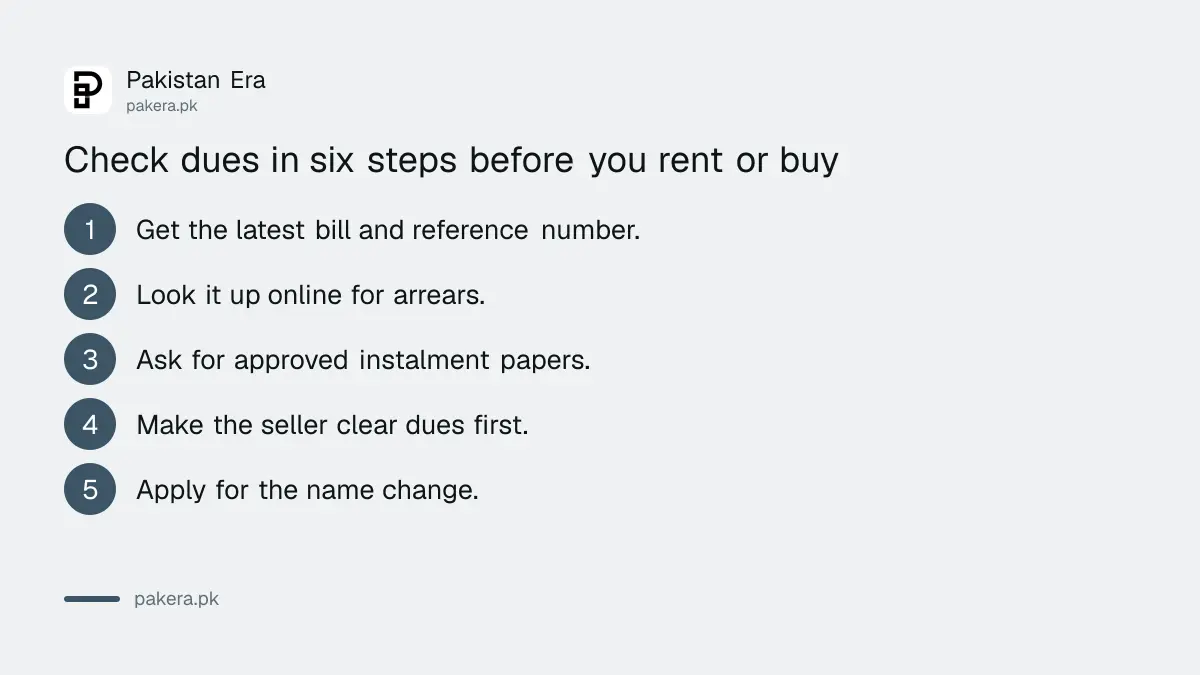
- Ask the seller or landlord for the latest bill and its reference number.
- Look up the bill online and check for arrears or instalments.
- Ask for a stamped copy of any instalment approval.
- Make the seller clear dues before the sale, and keep the paid receipt.
- Apply for the name change with the sale deed and the last paid bill.
- As a landlord, keep the stamp paper and the tenant's CNIC copy on file.
Write the electricity terms into the rent agreement
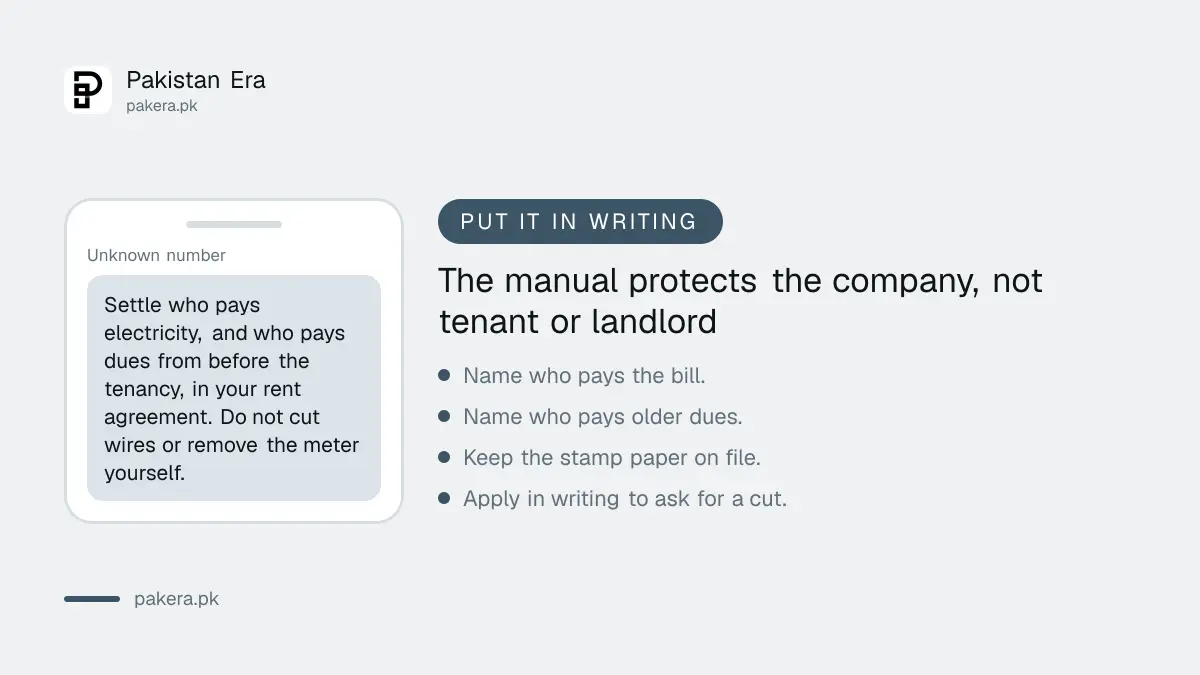
The manual protects the company, not the tenant and landlord from each other. Settle that in your rent agreement. State who pays the bill, who pays any dues from before the tenancy, and what happens if the supply is cut.
Our guide to rent agreements and stamp paper in Pakistan explains the paper side. If a landlord cuts your utilities as pressure, see what to do in Punjab if a landlord cuts your utilities. If a disconnection has happened, the steps to reconnect your electricity apply.
Common questions about tenants, landlords and electricity dues
Can the company bill the landlord for a tenant's unpaid electricity?
The manual says the owner affirms on stamp paper that he or she is responsible for the tenant's default amount. So the company can look to the owner. How a particular office recovers it can vary, so ask your sub division.
Can a landlord ask to cut the tenant's electricity?
Yes, but only after the tenant defaults on bills for three consecutive months, according to clause 2.3.3. Apply in writing. Do not remove wires or the meter yourself, which can create legal trouble of its own.
Does a new owner pay the previous owner's electricity debt?
A change of name needs no pending arrears, and an applicant swears to pay old dues at the premises if found later. So settle it in the sale contract, and have the seller clear dues before handover.
What if my tenant's bill is in my name?
Then you are the consumer and the bill is yours to pay, whoever uses the power. Collect the amount from the tenant under the rent agreement, and keep every receipt.
Can one flat's default cut power to the whole building?
Clause 8.2.7 says other connections in different names are not disconnected for one portion's default. Complain through the route in our guide to wrong-bill complaints if your power is cut for a neighbour's debt.
How we verified this
What we checked, where we read it, and what we could not confirm.
Last checked 8 October 2026. We read the NEPRA Consumer Service Manual (with amendments and clarifications, as on 26 November 2025) on nepra.org.pk, clauses 2.3.2, 2.3.3, 2.13.2, 8.2.7 and 8.2.8. NEPRA proposed six further changes to the manual on 25 September 2026, none about these clauses, and none is in force. We did not test how each company applies these clauses in practice. This is general information, not legal advice.
About the author

Tax, Bills and Technology Writer
Ali Akhtar is a young and curious voice here at Pakistan Era. He is currently pursuing his A-Levels and has a growing interest in Pakistan’s changing industrial landscape and educational trends. Ali likes to write in a way that helps him explain and explore the world around him. His writing reflects the perspective of the new generation navigating the evolving trends of Pakistan where technology, youth innovation, and shifting opportunities are reshaping the country’s future.