Will Petrol Get Cheaper in Pakistan? What Official Oil Forecasts Say for 2027
Petrol is Rs 398.96 a litre. Official forecasts see Brent at $105 this quarter and $84 in 2027. What each $1 of oil does to your litre, and when it could fall.
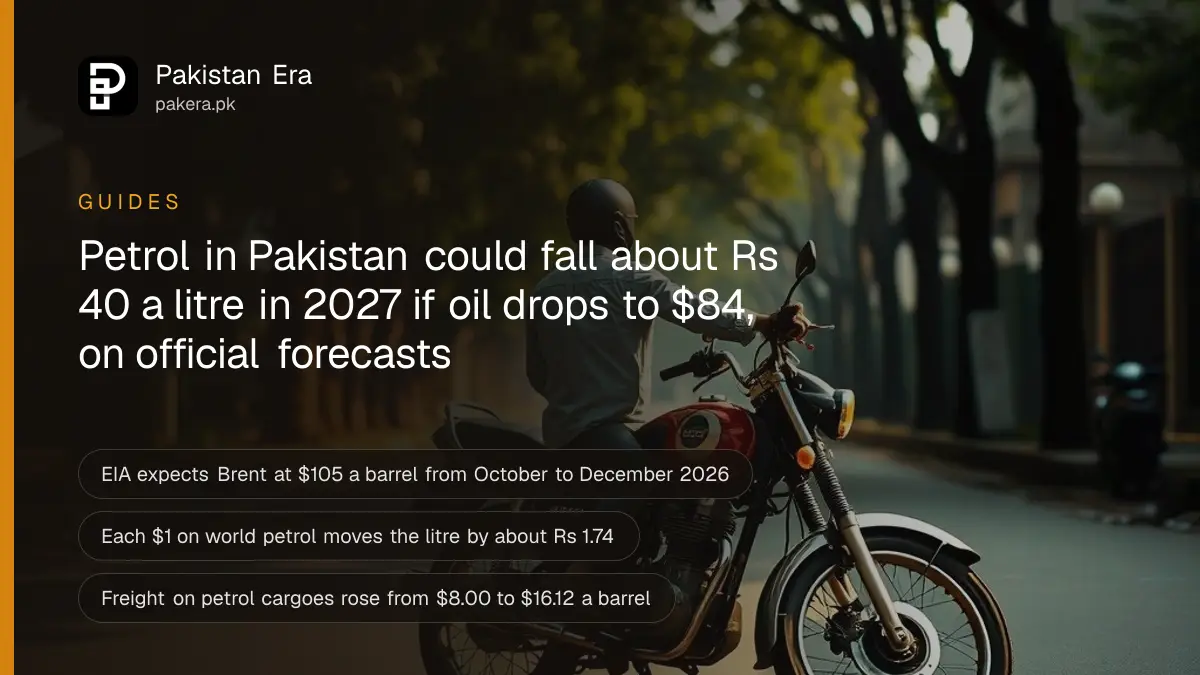
Petrol in Pakistan is unlikely to get much cheaper before 2027. OGRA set it at Rs 398.96 a litre on 9 October 2026. The US government's energy forecaster expects Brent crude to average $105 a barrel in the last three months of 2026, then $84 in 2027. On our arithmetic, a fall of that size could take about Rs 35 to Rs 40 off a litre next year, if the rupee and the levy stay where they are.
"Petrol kab sasta hoga" is the question behind most fuel searches right now. Nobody can give a date. What we can do is put the official forecasts next to OGRA's own formula and show what each dollar of oil does to your litre. That turns a guess into a range you can plan around.
Official forecasts say oil stays high this year and eases in 2027
The US Energy Information Administration (EIA), a US government agency, raised its oil forecast on 6 October 2026. It now expects Brent to average $105 a barrel in October to December, $14 higher than a month earlier, and $84 in 2027. The IMF chief said on 7 October that Brent futures point to high prices through 2027.
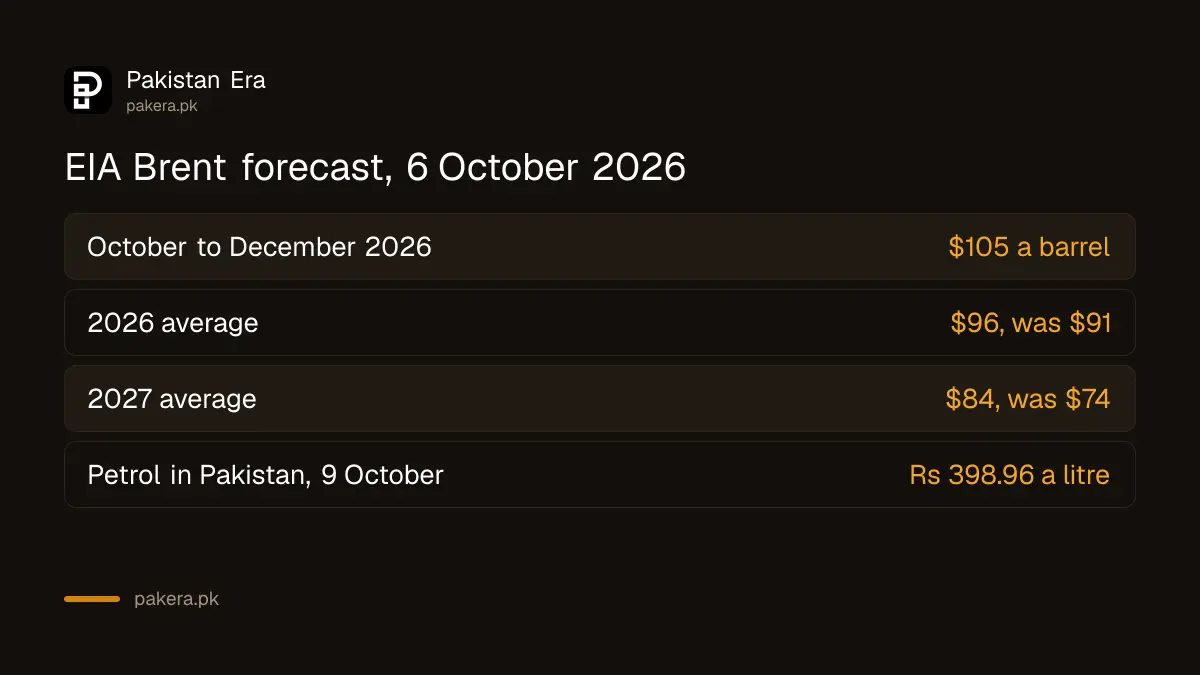
Brent is the world's main oil price benchmark. Pakistan does not buy Brent directly, but the Gulf prices that OGRA uses tend to move with it.
| Official figure | Value | Source and date |
|---|---|---|
| Brent forecast, October to December 2026 | $105 a barrel | EIA, 6 October 2026 |
| Brent forecast, 2026 average | $96 (was $91) | EIA, 6 October 2026 |
| Brent forecast, 2027 average | $84 (was $74) | EIA, 6 October 2026 |
| Oil price now | "Around $100 per barrel" | IMF Managing Director, 7 October 2026 |
| Petrol in Pakistan | Rs 398.96 a litre | OGRA, 9 October 2026 |
Notice the direction. Both EIA numbers went up from the month before, by $5 for this year and $10 for next. Forecasters are getting more worried, not less. The EIA said attacks on Saudi Arabia's East-West pipeline show how volatile oil flows remain, and that oil stocks are being drawn down around the world.
The two forecasts also differ on 2027. The EIA expects a clear fall to $84. The IMF's reading of futures markets says prices stay high. So treat a fall next year as possible, not certain.
Each $1 on world petrol moves your litre by about Rs 1.74
OGRA's sheet converts the world petrol price into rupees with a fixed formula. One barrel holds 158.98 litres, and the sheet used an exchange rate of Rs 277.21 a dollar on 9 October. So each $1 change in the world price changes the import cost by about Rs 1.74 a litre, before customs duty.
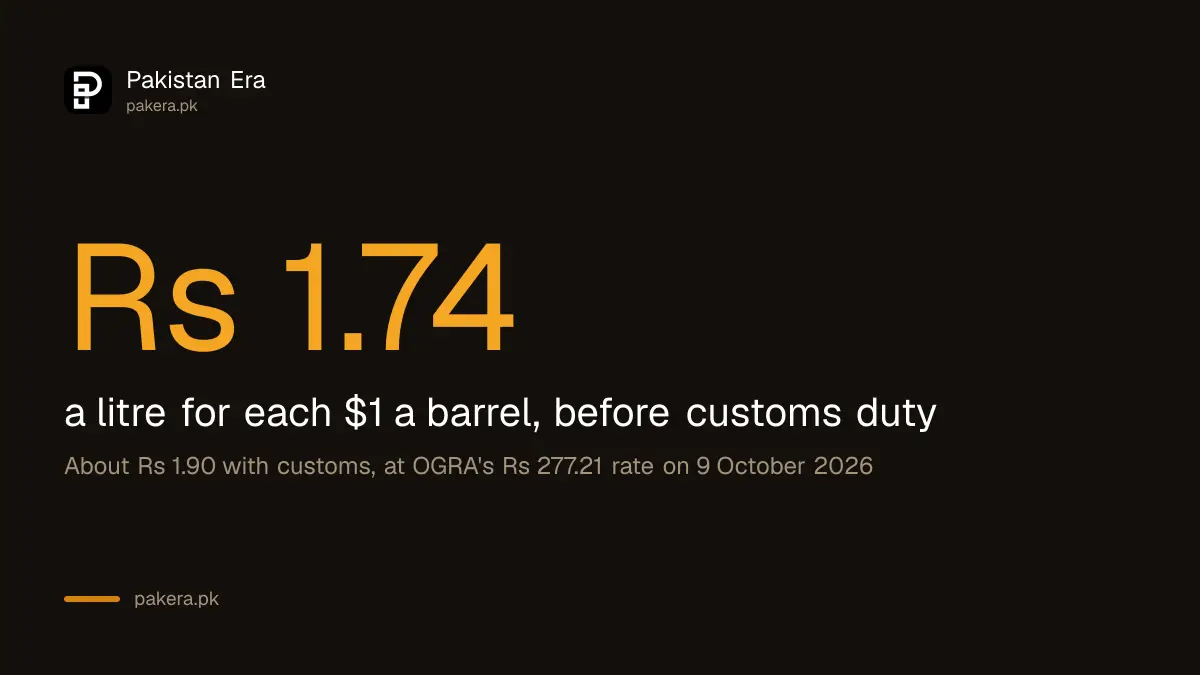
Customs duty is charged on the import value, so it moves too. On the 9 October sheet it was Rs 24.94 on an import cost of Rs 260.91, about 9.6 per cent. Add that, and each $1 is closer to Rs 1.90 a litre at the pump.
Here is how to work out a rough future price yourself, using the same steps we used.
- Take the change you expect in the world price, in dollars a barrel. For example, a $21 fall, from $105 to $84.
- Multiply by 1.74 to get rupees a litre: 21 times 1.74 is about Rs 36.5.
- Add about a tenth for customs duty: that gives about Rs 40.
- Take it off today's price: Rs 398.96 minus Rs 40 is about Rs 359.
- Remember the limits: this assumes the levy, margins, freight and the rupee all stay the same.
That Rs 359 is an illustration, not a forecast. OGRA prices petrol from the Gulf petrol price, not Brent crude, and the gap between them changes. But it shows the scale. Even if the EIA is right, petrol would still cost more next year than the Rs 342.79 it cost on 1 September 2026.
Freight on petrol cargoes has doubled since August
OGRA's sheet has a line called "Premium including Freight", the cost of shipping and the supplier's margin on PSO's cargoes. It was $8.00 a barrel on the 4 August sheet. It was $16.12 on 9 October. That is about Rs 14 a litre of extra cost that has nothing to do with the oil itself.
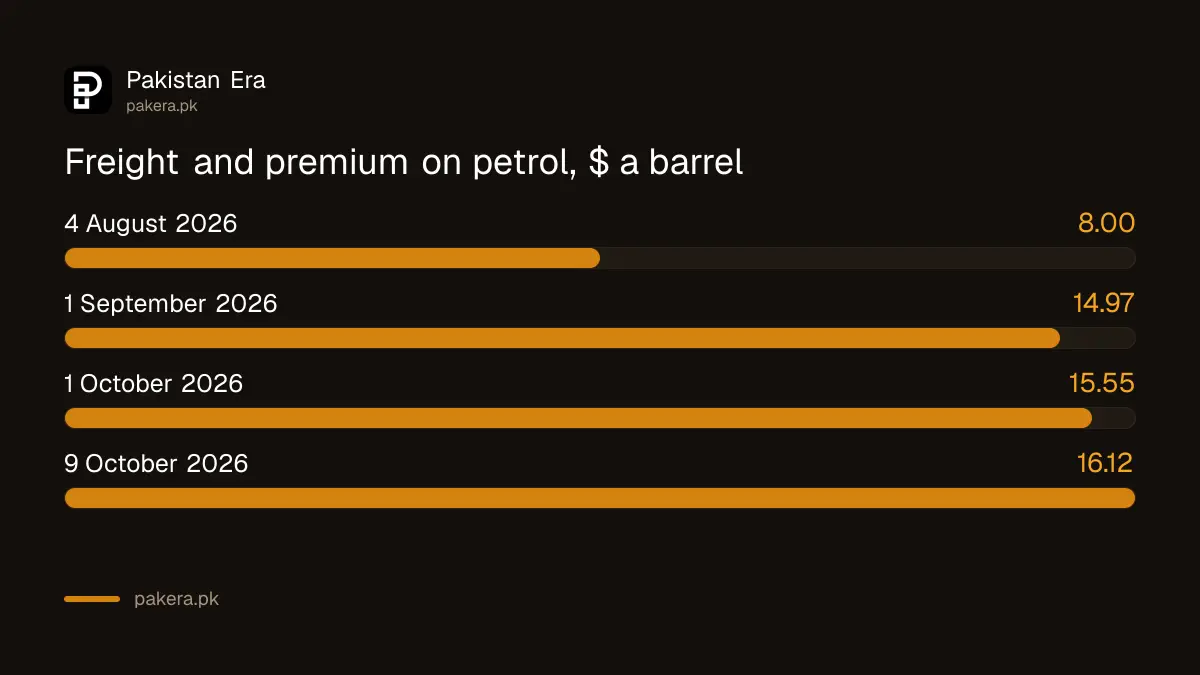
The rise tracks the trouble at sea. The IMF chief said shipping through the Strait of Hormuz "remains threatened". The EIA expects Gulf exports to keep moving through convoys and bypass routes. Both cost more than normal shipping.
This line could come down faster than oil itself if shipping calms. Going back to $8 would cut about Rs 15 a litre once customs is included, on our arithmetic. It is worth watching on the daily sheet.
Three things decide whether petrol falls faster
The world oil price is only one part. The government's levy, the rupee and freight decide the rest. On 9 October, Rs 85 of each litre was levies set by the federal government, and none of it moves with oil.
- The levy. The petroleum levy is Rs 80 a litre and the climate support levy Rs 5. A levy cut is the fastest way to lower the price, but the levy is a big earner for the budget. With Pakistan's IMF review agreed but not yet approved, a large cut looks unlikely.
- The rupee. Each Rs 1 rise in the dollar rate adds about 94 paisa a litre on the 9 October sheet. A steady rupee keeps this small.
- Freight. As above, about Rs 1.90 a litre for every $1 a barrel change in the freight premium.
The levy question is not new. Why the pump falls so little when oil falls is set out in detail in why petrol does not fall with oil. The short version: the bigger the fixed part of the price, the smaller the relief from cheaper oil.
How to see the next price coming
OGRA now publishes a price sheet every working day, and each one uses a seven working day rolling average of world prices. So you can see a rise or fall building before it fully lands. The sheet itself says the full impact of a change passes on in seven working days.
Open OGRA's price publications page, open the latest sheet, and compare the "Petrol Platts Arab Gulf Mean Average" line with the day before. It was $133.52 on 9 October, up from $132.18 on 8 October and $127.74 on 1 October. A rising average means more increases are still coming through. Day by day prices are logged in petrol price today in Pakistan.
If you qualify for the government's fuel relief, the steps are in petrol relief with code 9771. Check the current terms there before relying on it.
Common questions
Will petrol prices go down in Pakistan in 2026?
Probably not by much. The EIA expects Brent to average $105 a barrel from October to December 2026, higher than its September forecast, and the IMF says oil may stay high into 2027.
How much could petrol fall in 2027?
If world prices fall by about $21 a barrel, as the EIA's forecast suggests, our arithmetic gives about Rs 40 a litre off, to roughly Rs 359. That assumes no change to the levy, the rupee or freight.
How much does $1 of oil add to petrol in Pakistan?
About Rs 1.74 a litre before customs duty, and about Rs 1.90 with it, using OGRA's 9 October exchange rate of Rs 277.21.
Why does petrol change every day in Pakistan now?
OGRA publishes prices every working day, based on a seven working day average of Gulf petrol prices. Small daily moves replace the old fortnightly jumps.
What is the petrol price in Pakistan today?
OGRA set petrol at Rs 398.96 a litre from 9 October 2026. Check its latest sheet, since the price can change on each working day.
Who is the EIA?
The US Energy Information Administration is the US government's energy statistics agency. Its monthly Short-Term Energy Outlook is one of the most widely used official oil forecasts.
How we verified this
What we checked, where we read it, and what we could not confirm.
Last checked 9 October 2026, about 3:00 am PKT. We read the EIA's Short-Term Energy Outlook of 6 October 2026, the IMF Managing Director's 7 October speech, and OGRA price sheets for 4 August, 1 September, 1 October, 8 October and 9 October 2026. The per-dollar figures and the Rs 359 illustration are our own arithmetic from OGRA's formula, not an official forecast.
About the author

Global Affairs & Political Economy Writer
Muhammad Hatim is a book lover who started writing because he enjoys it. At Pakistan Era he writes about international relations, geopolitics and the global economy, with a particular interest in South Asia and the forces behind current events.