Google's September 2026 Spam Update Is Done: What Pakistani Site Owners Should Check
Google's September 2026 spam update finished on 8 October after 13 days. How Pakistani site owners can check Search Console, spot spam issues and fix them.
Google's September 2026 spam update finished rolling out on 8 October 2026, after it started on 24 September. It applied worldwide and in all languages, so it covers Pakistani sites in English and Urdu. If your traffic changed in those two weeks, compare Search Console data before and after, check the Manual actions report, and review Google's spam policies.
Google posted both the start and the end of the update on its Search Status Dashboard. We read the dashboard and its incident feed on 9 October 2026. The rollout took 13 days and 16 hours, much longer than the June and August 2026 spam updates, which each finished in under three days.
Google did not say which kind of spam this update targeted. So the honest answer to "what changed" is: Google improved its automated spam systems, and sites that break its spam policies may rank lower or drop out. Here is how a Pakistani site owner can tell whether that happened to them, and what to fix.
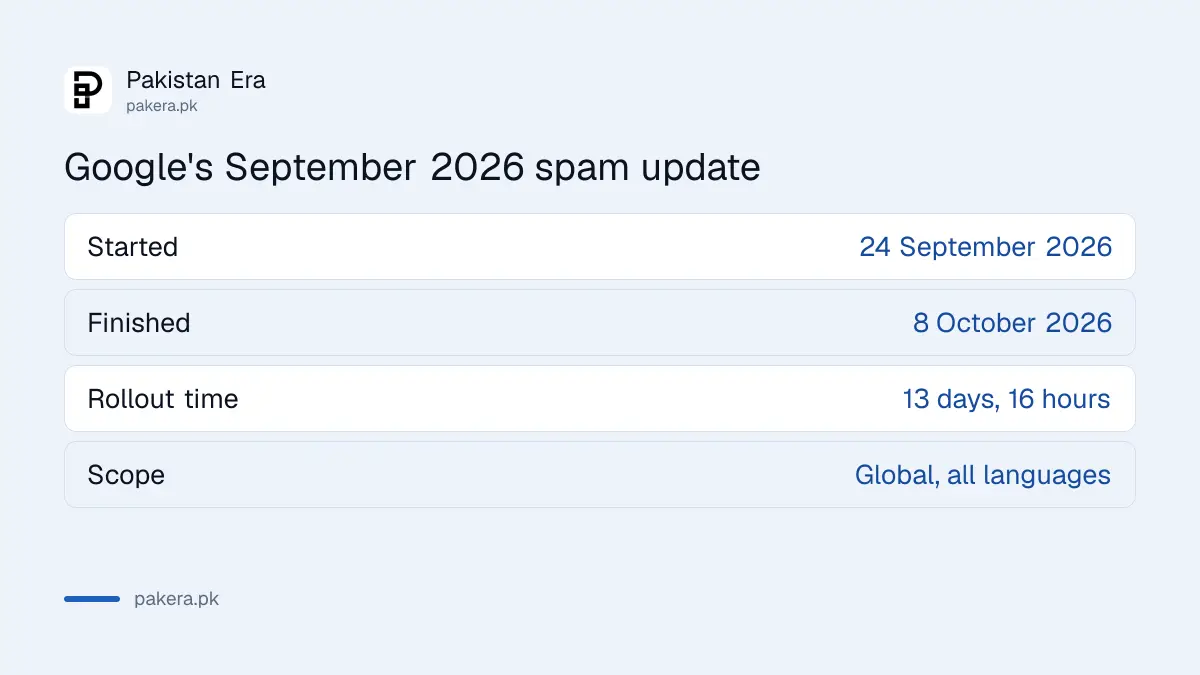
The September 2026 spam update ran from 24 September to 8 October
Google released the update on 24 September 2026 at about 9:15 pm Pakistan time and said it could take up to two weeks. The dashboard marked it complete on 8 October 2026, about 1:00 pm Pakistan time. Google said it applies globally and to all languages.
A spam update is a notable improvement to Google's automated systems that find search spam. Google says those systems run all the time. One of them is SpamBrain, which Google describes as its AI-based spam prevention system. When Google improves it in a big way, it announces a spam update.
| Google ranking update in 2026 | Started | Rollout time |
|---|---|---|
| February 2026 Discover update | 5 February | 21 days, 17 hours |
| March 2026 spam update | 24 March | 19 hours, 30 minutes |
| March 2026 core update | 27 March | 12 days, 4 hours |
| May 2026 core update | 21 May | 11 days, 21 hours |
| June 2026 spam update | 24 June | 2 days, 1 hour |
| August 2026 spam update | 18 August | 2 days, 16 hours |
| September 2026 spam update | 24 September | 13 days, 16 hours |
That makes four spam updates so far in 2026. Two of them landed within six weeks of each other, in August and September.
How to tell if the spam update hit your site
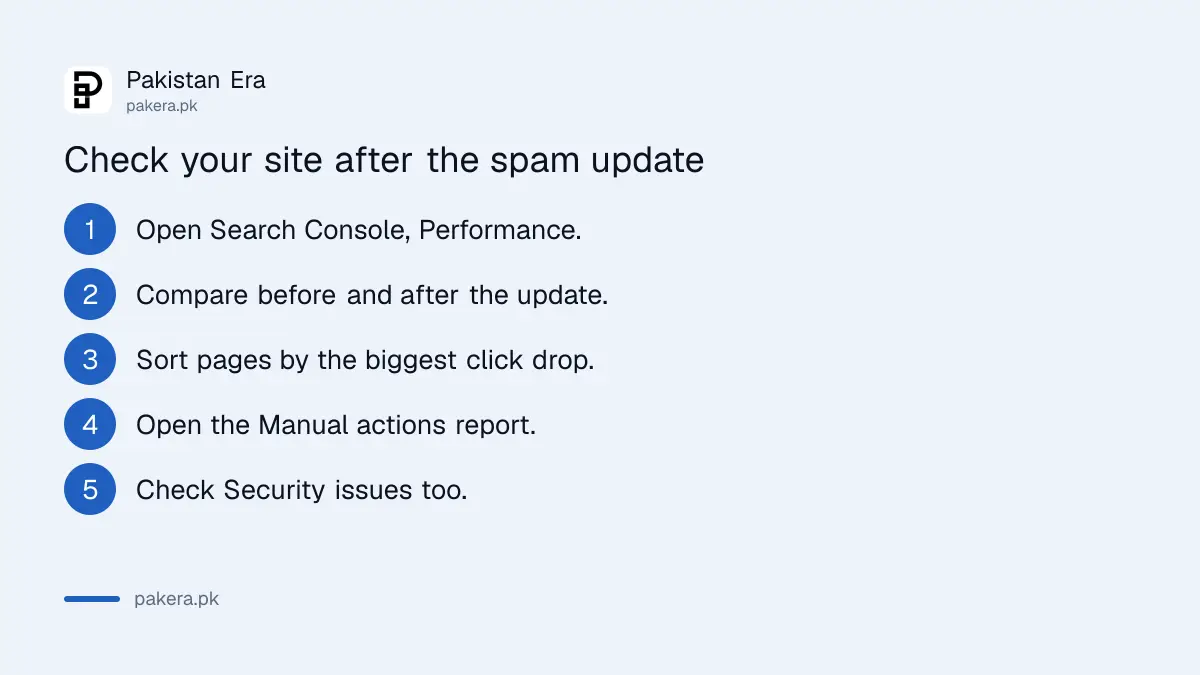
Open Search Console, go to the Performance report, and compare 24 September to 8 October with the same length of time before 24 September. Look for a sharp fall in clicks and average position across many pages, not one page. Then open the Manual actions report.
- Sign in to Search Console and pick your property.
- Open Performance, then Search results.
- Set the date to Compare, and choose two periods of the same length, one before 24 September and one after 8 October once you have enough days.
- Sort the Pages tab by the biggest drop in clicks. Note whether the fall hit the whole site or one section.
- Open Security and Manual Actions, then Manual actions. If it says "No issues detected", no human reviewer has penalised the site.
- Check Security issues on the same menu, because hacked pages can look like a spam drop.
A drop that starts on a date with no Google update is often something else: a site change, a server problem, a seasonal fall or a news story fading. If you have not set up tracking yet, Google Analytics 4 on a business website gives you a second view of visits next to Search Console.
Google's spam policies list what gets demoted
Google's spam policies name practices it demotes or removes, including scaled content abuse, link spam, scraping, expired domain abuse, site reputation abuse, thin affiliate pages, hacked content and user-generated spam. Google says sites that break them may rank lower or vanish from results.
Six of them are worth checking first on a small Pakistani site:
- Scaled content abuse. Many pages made mainly to rank, with little value, "no matter how it's created". Google names AI tools used to make many pages without adding value. Google's wider rules on AI-written content sit behind this.
- Link spam. Buying or selling links that pass ranking credit, link exchanges, paid guest posts with keyword links, and low-quality directory links. Google says paid links are fine if they carry rel="sponsored" or rel="nofollow".
- Scraping. Copying news or product text from other sites with only small changes, such as swapping in synonyms.
- Site reputation abuse. Hosting third-party pages, such as paid casino or coupon sections, mainly to use the host site's ranking strength.
- Expired domain abuse. Buying an old domain and filling it with low-value pages to use its past reputation.
- User-generated spam. Spam comments, forum posts or fake accounts on your site that you may not even know about.
Fixes can take months, and link spam gains do not come back
Google says changes may help a site recover if its automated systems learn, over a period of months, that the site follows the spam policies. For link spam updates, Google says any ranking benefit the bad links gave is lost for good and cannot be regained.
So do not expect a bounce next week. Fix the cause, then give it time:
- Remove or improve thin pages that exist only to catch search terms. Merge near-duplicates into one strong page.
- Stop any paid link deals. Mark sponsored links with rel="sponsored".
- Clean spam comments and lock down sign-ups if bots are posting.
- If a third party runs a section of your site, check whether it serves your readers or only rides on your name.
- If the site was hacked, follow the Security issues report and request a review.
A manual action is different. If the Manual actions report shows one, fix the issue it names, then send a reconsideration request from the same report. That is the only case where you ask Google directly to look again.
Our view: for a small business site, a content problem is more likely than a link problem. Fifty city pages with the same text and only the city name swapped look like scaled content to a machine. One good page often beats fifty thin ones, and the same thinking runs through how AI Overviews and AI search pick sources.
Report spam and watch the next update
You can report spam you see in results through Google's spam report form, linked from Search Central. To know when the next update starts, watch the Google Search Status Dashboard, which lists every confirmed ranking update with start and end times.
The dashboard also offers an RSS feed and a JSON history. A site owner who notes each update date next to their traffic chart will spot cause and effect much faster.
Common questions
When did the Google September 2026 spam update finish?
On 8 October 2026. Google's Search Status Dashboard says the rollout was complete as of that date. It started on 24 September 2026.
Did the update affect Urdu websites?
Yes, it could. Google said the update applies globally and to all languages, so it covers Urdu and English sites in Pakistan.
What kind of spam did the September 2026 update target?
Google did not say. Its announcement only linked to its general page on spam updates. Check your site against all of Google's spam policies.
Will my rankings come back if I fix the problem?
They may, but slowly. Google says its systems need months to learn that a site now follows the policies. Gains from bad links do not come back.
Do I need to file a reconsideration request after a spam update?
Only if Search Console shows a manual action. A spam update is automated, so there is nothing to file for it.
Is AI-written content spam under Google's rules?
Not by itself. Google's policy targets many pages made mainly to rank without adding value, however they are made.
How we verified this
What we checked, where we read it, and what we could not confirm.
Last checked 9 October 2026. We read the Google Search Status Dashboard and its incident history, Google's page on spam updates and your site, and its spam policies for Google web search. Pakistan times are converted from the UTC times in Google's feed. We did not test any site's ranking for this piece.
About the author

Founder and Editor
Umer Kureshi founded Pakistan Era in July 2024 and runs it as administrator, SEO lead and writer, overseeing website operations, search growth, content strategy and coverage of technology and current affairs.