Google's Rules on AI-Written Content for Pakistani Websites
Google updated its AI content guidance on 1 October 2026. See what scaled content abuse means, what to fact-check and when to label AI use on your site.
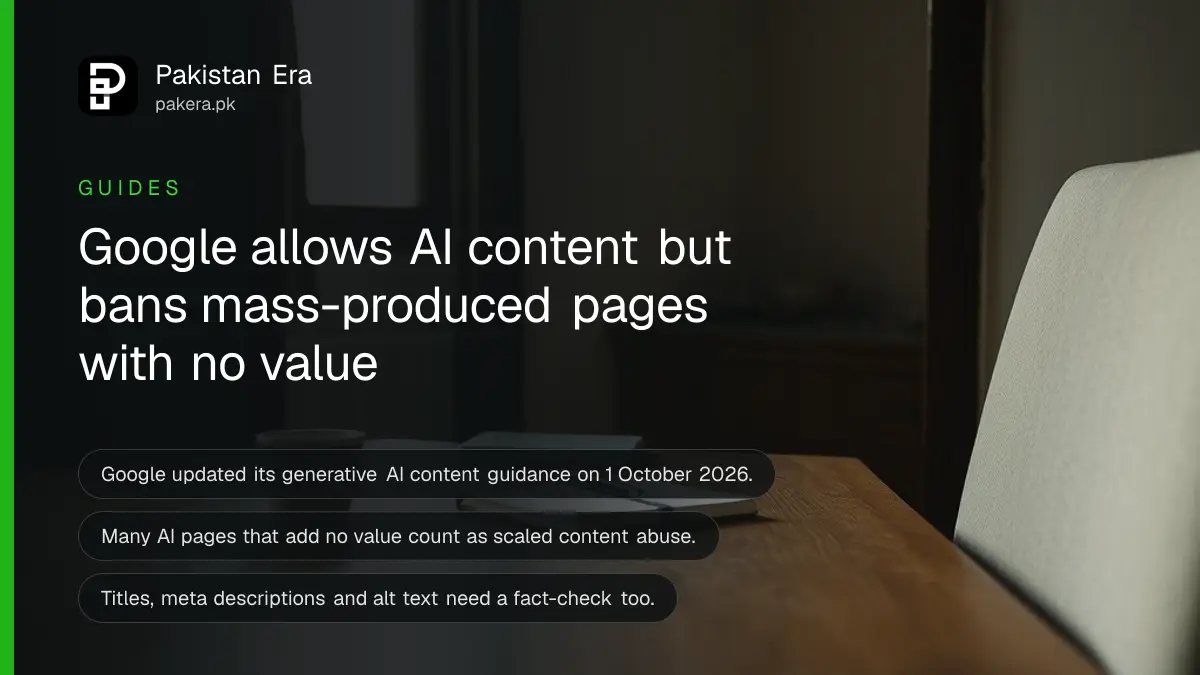
Google allows AI-written content on Pakistani websites. It does not allow using AI to mass-produce pages that add nothing for readers, which Google calls scaled content abuse. Fact-check every AI draft, including titles, meta descriptions and image text, before you publish.
A freelancer in Lahore pastes 300 keywords into an AI tool and has 300 "blog posts" by evening. Three months later the site is going nowhere. That is the exact habit Google's own guidance warns about, and Google updated that guidance on 1 October 2026.
We read Google's page on using generative AI content, its spam policies and its guide to AI features on 8 October 2026. Below is what they say in plain words, and what it means for a website owner, blogger or agency in Pakistan.
Google's rule is about value, not about who wrote the page
Google says generative AI can help when you research a topic and when you add structure to original content. The problem starts when AI tools generate many pages without adding value for users. Google says that may break its spam policy on scaled content abuse.
The spam policy defines scaled content abuse as many pages made mainly to manipulate rankings instead of helping users. It adds "no matter how it's created". So a team of ten people copying and rewording pages is caught by the same rule as one person with an AI tool.
Google's changelog lists the page as updated on 1 October 2026, and the page itself says "Last updated 2026-10-01 UTC". The changelog describes the change as matching the guidance to the Search Quality Raters guidelines.
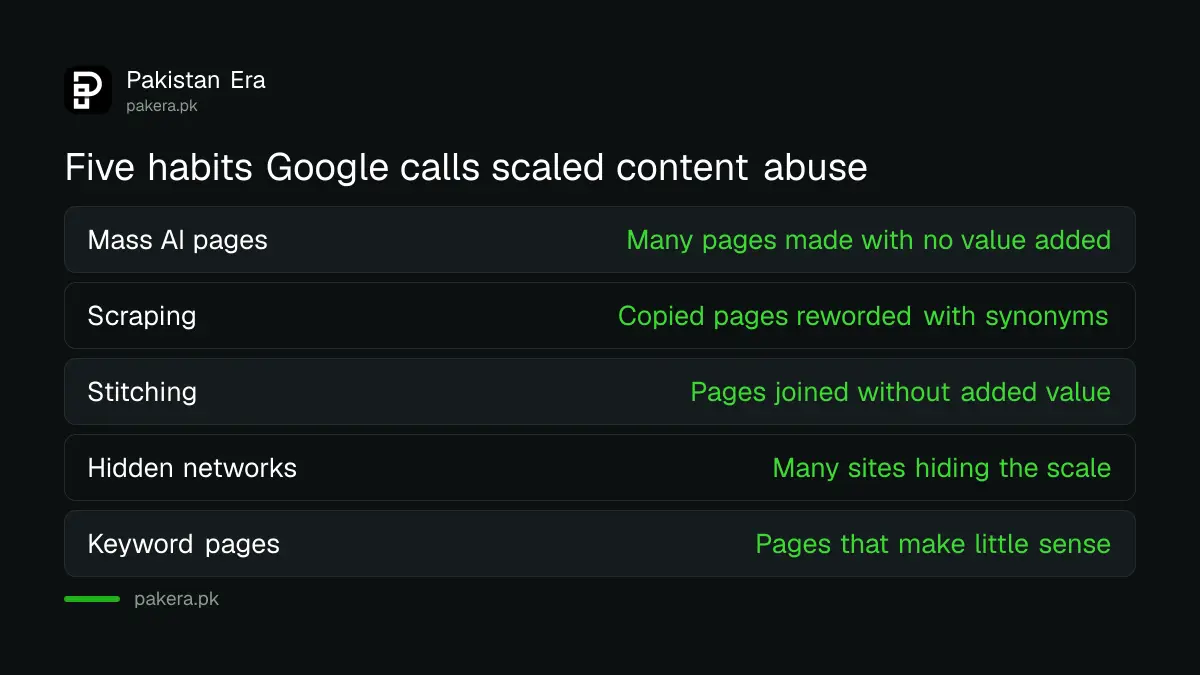
Scaled content abuse looks like these five habits
The spam policy gives a list of examples. It says the list is not complete. These are the ones a Pakistani site owner is most likely to meet.
| Habit | Google's wording | Common Pakistani example |
|---|---|---|
| Mass AI pages | Using generative AI tools to generate many pages without adding value for users | One page per city for "best plumber in" with the same text |
| Scraping and rewording | Content copied and changed with synonyms or translation, with little value added | Copying a news item and swapping words |
| Stitching | Combining content from different pages without adding value | Joining three fee pages into one without checking any |
| Hidden networks | Many sites made to hide the scale of the content | Ten blogs, one writer, one tool |
| Keyword pages | Pages that make little sense but carry search keywords | Lists of phrases with no answer |
Google's advice for hosting such pages is short. It says to exclude them from Search.
Every AI draft needs a human fact-check before it goes live
Google explains why. It says generative models "don't retrieve facts" and instead predict a likely sequence of words. That is why an AI tool can state a wrong fee or a wrong deadline with total confidence.
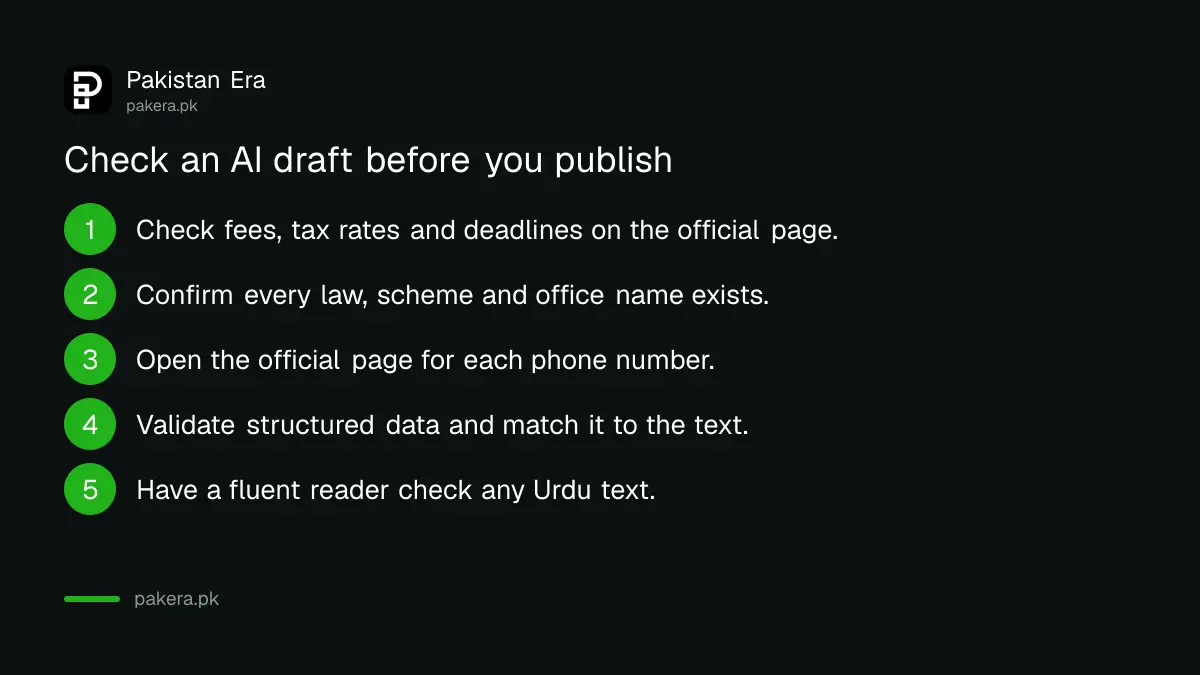
Google tells publishers to check all AI-generated content for accuracy and trust before publishing. The same review covers the parts people forget: the title element, the meta description, structured data and image alt text. These appear in search results, so a mistake there is public too.
For a Pakistani site, the risky items are easy to name.
- Fees, tax rates and deadlines. Check them on the office's own page.
- Names of laws, schemes and offices. AI tools often invent plausible ones.
- Phone numbers and helplines. Open the official page first.
- Structured data. Validate it, and make sure it matches the visible text.
- Urdu translations. Ask a fluent reader to check them, since tone and spelling drift.
Our own rule is the same. We state a fee as fact only when we read it on the responsible authority's page. If you use AI for drafts, the comparison of AI tools for Urdu shows which ones handle Urdu better, but none of them replaces the check.
Tell readers how the content was made when it helps them
Google says sharing how content was created can give readers context. If you generate content automatically, it suggests adding background on how automation was used, and adding image metadata. It does not demand a label on every page.
For online shops the rule is firmer. Google points to Merchant Center policies for AI-generated content. AI-generated images must carry the IPTC DigitalSourceType value TrainedAlgorithmicMedia in their metadata. AI-generated product titles and descriptions must be specified separately and labelled as AI-generated.
That matters for Pakistani sellers who list products on Google. If a tool made your product photo, tag the file. If a tool wrote your product description, label that field.
Google is not saying that AI pages rank or fail by default
The page also points to the Search Quality Raters guidelines, section 4.6.5 on scaled content abuse and section 4.6.6 on main content made with little effort, originality or added value. Google says those guidelines are not a guide to ranking first. Raters help evaluate Google's systems, and their ratings do not directly influence ranking.
So do not read the page as a ranking recipe. Read it as a boundary. Stay inside it, and the question becomes the old one: is the page useful, accurate and original?
Here is how a small Pakistani site can stay inside the line.
- Publish fewer pages and add something only you know, such as a price you checked or a form you filled.
- Use AI for outlines, summaries of your own notes and first drafts, then rewrite and verify.
- Do not clone one page across 50 cities. Write each only if you can add local facts.
- Remove or merge old thin pages. Google says to exclude abusive pages from Search.
The same logic applies to showing up in Google AI Overviews. Google's AI features page says there are no extra requirements and no special markup beyond normal SEO.
A five-minute check before you publish an AI-assisted page
Ask whether a reader would learn something they could not get from ten similar pages. Then check the facts, check the meta tags, and read the page aloud once. If you cannot name what is original, do not publish it yet.
Owners with a shop should also keep their listing fresh, because Google lists up-to-date Business Profile information among its basics. Our walkthrough for putting a shop on Google Maps covers the setup.
Common questions
Does Google penalise AI-written content in Pakistan?
No rule targets AI use as such. Google's spam policy targets many pages made without adding value, however they are created. The rules are the same in every country.
Do I have to label AI content on my blog?
Google does not require a label on blog posts. It says sharing how content was made can give readers context. Shops must follow Merchant Center labelling rules for AI images and product text.
Can I use ChatGPT or Gemini to write articles?
Yes, as a helper. Google says generative AI can help with research and structure. You must fact-check the result and add real value.
What is scaled content abuse?
It means generating many pages mainly to manipulate rankings instead of helping users. Google says this is spam whether people, scripts or AI tools create the pages.
What should I do with old thin AI pages?
Google says to exclude such content from Search. In practice that means improving the page, merging it into a better one, or removing it with a redirect or a noindex tag.
Does fact-checking include meta descriptions and alt text?
Yes. Google names title elements, meta descriptions, structured data and image alt text as parts that need review, because they can appear in Search results.
How we verified this
What we checked, where we read it, and what we could not confirm.
Last checked 8 October 2026 against Google's guidance on using generative AI content, Google's spam policies, AI features and your website and the Search Central documentation updates. We did not test any ranking effect, and Google makes no promise about rankings.
About the author

Founder and Editor
Umer Kureshi founded Pakistan Era in July 2024 and runs it as administrator, SEO lead and writer, overseeing website operations, search growth, content strategy and coverage of technology and current affairs.