Malaria Cases in Pakistan 2026: Weekly Count by Province and District (Latest: Week 41)
NIH counted 76,188 suspected malaria cases in Pakistan in week 41 of 2026, 66,145 in Sindh. See five weeks by province, top districts and lab results.
Short answer: Pakistan reported 76,188 suspected malaria cases in week 41 of 2026, and 66,145 of them were in Sindh. That is 87 per cent of the national count. The figures come from the National Institutes of Health (NIH) weekly disease bulletin, published on 28 October. Punjab did not report, so the national total leaves out Pakistan's largest province.
Weekly malaria reports in Pakistan have stayed between 76,000 and 81,000 for five weeks in a row. This page tracks those weeks by province, names the districts with the most cases, and shows how few suspected cases a laboratory actually confirms. We will update it as each new bulletin comes out.
Pakistan has logged 76,000 to 81,000 suspected cases a week since week 37
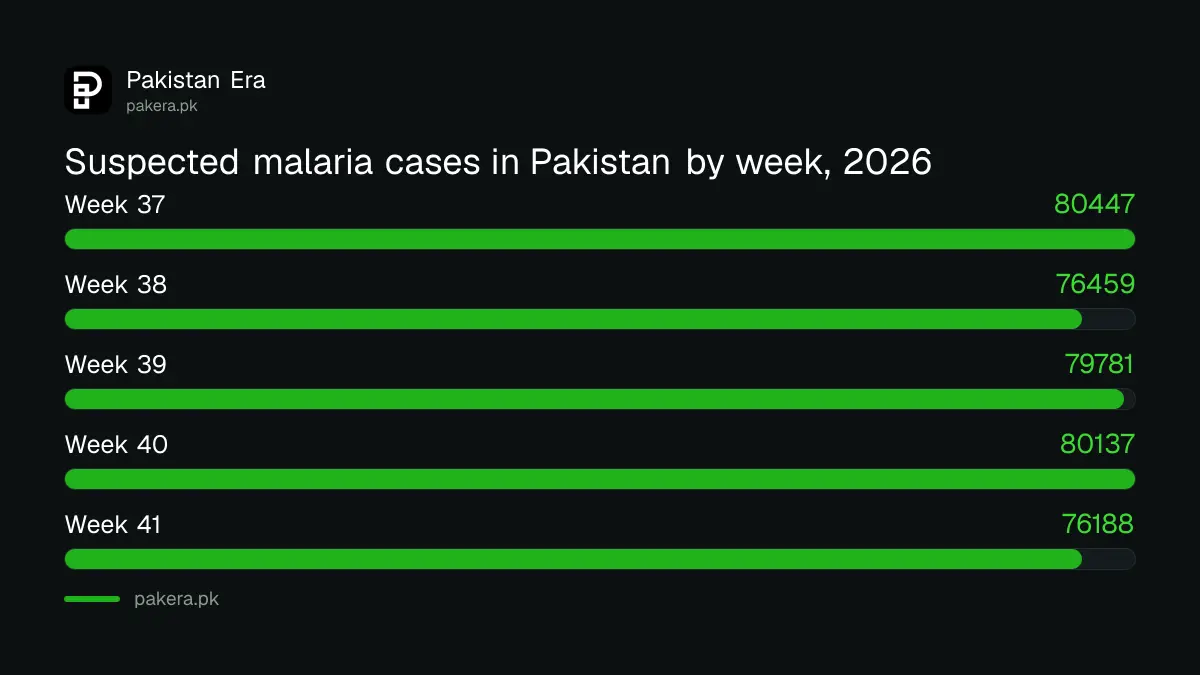
NIH's bulletins for weeks 37 to 41 of 2026 show 80,447, 76,459, 79,781, 80,137 and 76,188 suspected malaria cases. The count is steady, not falling fast. Week 41 was the lowest of the five, down 3,949 from week 40.
The bulletins come from the Integrated Disease Surveillance and Response system, or IDSR. Health facilities in 158 districts send a weekly count of patients who match a disease's definition. In week 41, 86 per cent of expected reports arrived. Every number here is a suspected case, not a confirmed one.
| Week (2026) | Pakistan | Sindh | Khyber Pakhtunkhwa | Balochistan | AJK, GB and ICT |
|---|---|---|---|---|---|
| Week 37 | 80,447 | 68,684 | 9,176 | 2,572 | 15 |
| Week 38 | 76,459 | 64,318 | 9,455 | 2,661 | 25 |
| Week 39 | 79,781 | 67,795 | 8,779 | 3,183 | 24 |
| Week 40 | 80,137 | 69,294 | 7,688 | 3,137 | 18 |
| Week 41 | 76,188 | 66,145 | 7,257 | 2,771 | 15 |
Punjab shows "NR", meaning not reported, in every one of these bulletins. So the national total is really a total for Sindh, Khyber Pakhtunkhwa, Balochistan, Azad Kashmir, Gilgit-Baltistan and Islamabad.
Sindh carries almost nine in ten cases
Sindh reported 66,145 suspected cases in week 41, 87 per cent of the total. Khyber Pakhtunkhwa reported 7,257 and Balochistan 2,771. Khyber Pakhtunkhwa has fallen for three weeks running, from 9,455 in week 38.
Inside Sindh, the cases are spread across the interior rather than Karachi. The table shows the districts with the most suspected cases in week 41 in each of the three provinces with large counts.
| Province | Top districts, week 41 (suspected cases) |
|---|---|
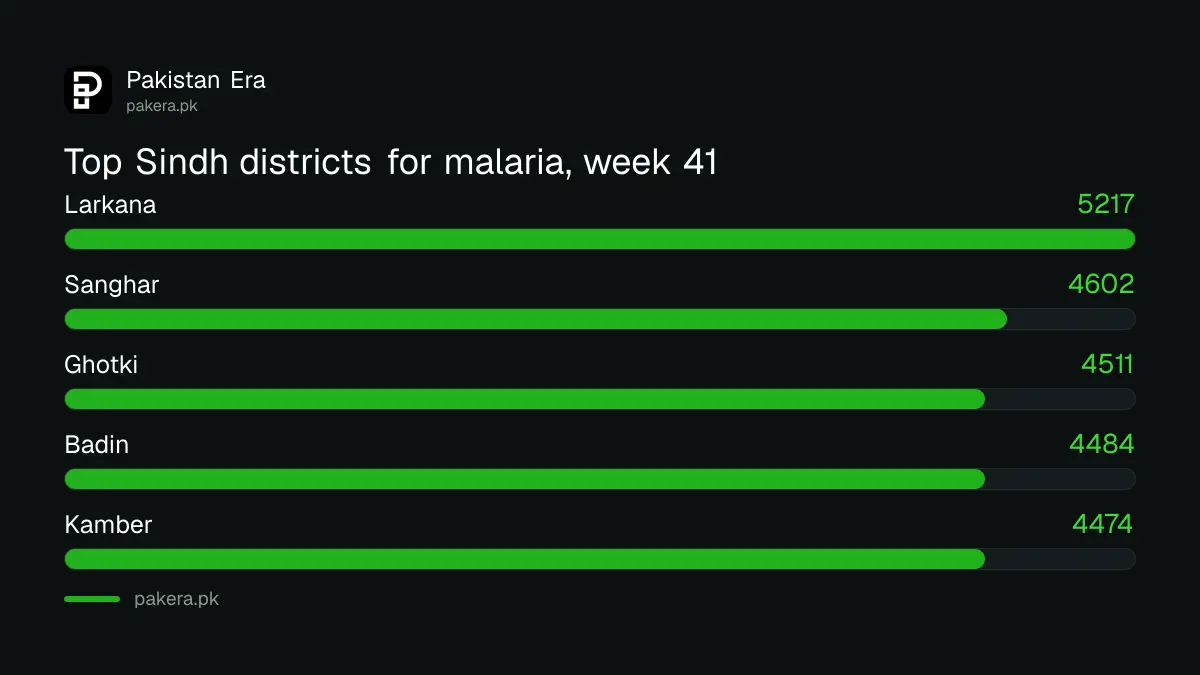
| Sindh | Larkana 5,217; Sanghar 4,602; Ghotki 4,511; Badin 4,484; Kamber 4,474; Khairpur 3,713 |
| Khyber Pakhtunkhwa | Bannu 967; Nowshera 877; Karak 591; D.I. Khan 567; Khyber 539; Mardan 479 |
| Balochistan | Kech (Turbat) 356; Lasbella 221; Washuk 206; Panjgur 198; Jaffarabad 146 |
Karachi's seven districts together reported 897 suspected cases in week 41, our own sum from the Sindh table. Karachi West had the most at 327. Larkana alone reported almost six times as many.
Labs confirmed about one in 22 tested samples in Sindh
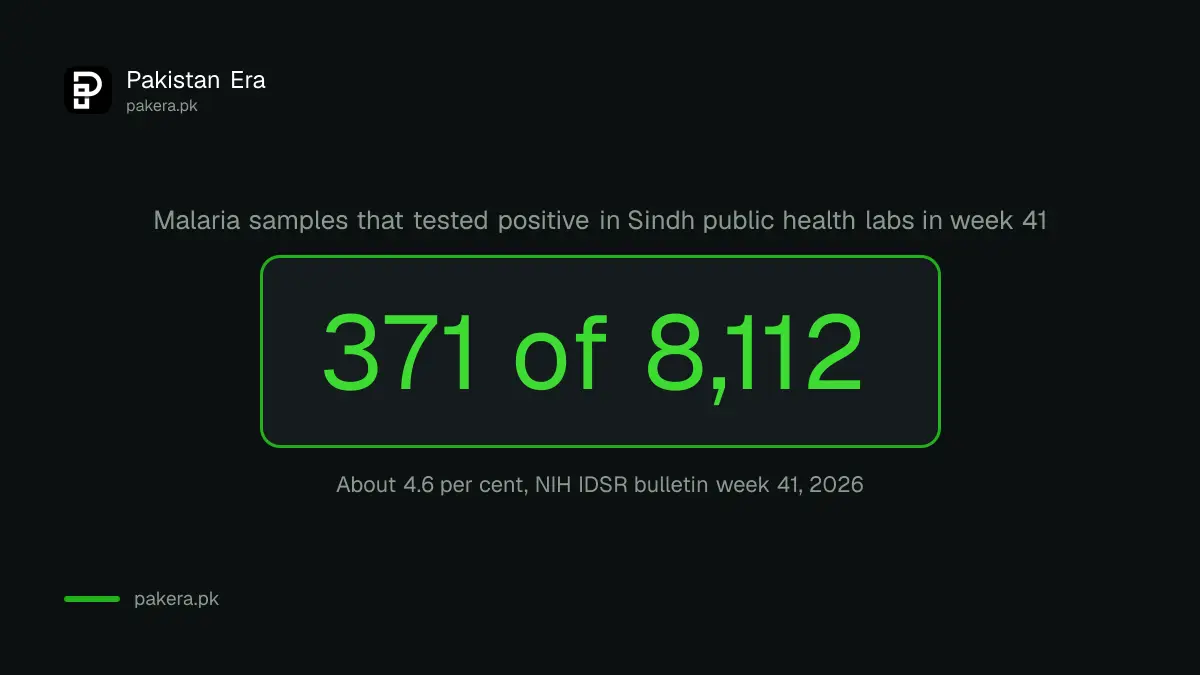
Public health labs in Sindh tested 8,112 malaria samples in week 41 and 371 were positive, about 4.6 per cent. In Balochistan, 78 of 1,725 tests were positive. Labs in Gilgit-Baltistan and Azad Kashmir found none.
Those lab figures cover only samples sent to public health laboratories, not every rapid test done at a clinic. But they are a reminder that many patients counted as suspected malaria have something else. Fever has many causes, including dengue, typhoid and flu. Our guide on testing a fever for malaria before treatment explains why a test should come before medicine.
Read the NIH bulletin for your own district
NIH posts the IDSR bulletin as a free PDF on its weekly bulletin page. Table 1 gives the province totals and Tables 2 to 4 give district figures for Sindh, Balochistan and Khyber Pakhtunkhwa. It usually appears more than two weeks after the week it covers.
- Open the NIH weekly bulletin page at nih.org.pk/phb/weekly-bulletin.
- Download the latest "IDSRS Week" bulletin for 2026.
- Find Table 1 for the national and province malaria count.
- Go to Table 2 (Sindh), Table 3 (Balochistan) or Table 4 (Khyber Pakhtunkhwa) for your district.
- Check Table 5 for how many samples public labs tested and how many were positive.
Remember that a district which sends no report shows "NR", not zero. A low number can mean few cases or missing reports.
What the numbers mean for your family
Malaria spreads through mosquito bites. The steady count in Sindh means the risk has not passed with the end of the monsoon. Cases usually fall as nights get colder, but the bulletins have not yet shown a sharp drop.
Use nets and repellent, clear standing water around the house, and get any fever tested at a health facility. The same steps help against dengue, which is also still being reported. For that count, see our weekly dengue tracker. For the week 40 detail, see our week 40 malaria report. We give no treatment advice. A doctor should decide on medicine after a test.
Common questions
How many malaria cases are there in Pakistan in 2026?
NIH's latest bulletin, for week 41, lists 76,188 suspected cases in one week. Weekly counts have been between 76,000 and 81,000 since week 37. Punjab is not included.
Which province has the most malaria cases?
Sindh, with 66,145 suspected cases in week 41, about 87 per cent of the national total. Khyber Pakhtunkhwa was second with 7,257.
Which district has the most malaria cases in Sindh?
Larkana, with 5,217 suspected cases in week 41. Sanghar (4,602), Ghotki (4,511), Badin (4,484) and Kamber (4,474) followed.
Are these confirmed malaria cases?
No. IDSR counts suspected cases. Public labs in Sindh confirmed 371 of 8,112 samples tested in week 41.
Why are Punjab's malaria cases missing?
Punjab is marked NR, not reported, in the NIH IDSR bulletins we read for weeks 37 to 41. The bulletin does not give a reason.
When does the next bulletin come out?
NIH posts each week's bulletin on its website, usually about two weeks or more after the week ends. The week 41 file was posted on 28 October 2026.
How we verified this
What we checked, where we read it, and what we could not confirm.
We read the NIH IDSR weekly bulletins for weeks 37, 38, 39, 40 and 41 of 2026, downloaded from the NIH weekly bulletin page on 4 November 2026. Province figures are from Table 1 of each bulletin, district figures from Tables 2 to 4 of week 41, and lab figures from Table 5. The Karachi sum and percentages are our own arithmetic. All cases are suspected unless labelled as lab results.
About the author

Tax, Bills and Technology Writer
Ali Akhtar is a young and curious voice here at Pakistan Era. He is currently pursuing his A-Levels and has a growing interest in Pakistan’s changing industrial landscape and educational trends. Ali likes to write in a way that helps him explain and explore the world around him. His writing reflects the perspective of the new generation navigating the evolving trends of Pakistan where technology, youth innovation, and shifting opportunities are reshaping the country’s future.