Dengue Cases in Pakistan 2026: Weekly Count by Province and KP District (Latest: Week 41)
Pakistan reported 1,728 suspected dengue cases in week 41 of 2026, KP 1,408 and Sindh 292. See every week since week 37 by province and the KP districts.
Pakistan reported 1,728 suspected dengue cases in week 41 of 2026, the latest National Institutes of Health (NIH) bulletin, up from 1,553 a week earlier. Khyber Pakhtunkhwa had 1,408 of them, Sindh 292, Azad Kashmir 23 and Balochistan 5, while Punjab did not report. The tables below track every week since week 37, province by province, plus the KP districts where the cases are concentrated.
The weekly count has nearly quadrupled in five weeks, from 461 in week 37. We read each NIH Integrated Disease Surveillance and Response (IDSR) bulletin at source, and we add the new week as soon as NIH posts it. The latest file, the week 41 bulletin, went up on NIH's weekly bulletin page on 28 October 2026.
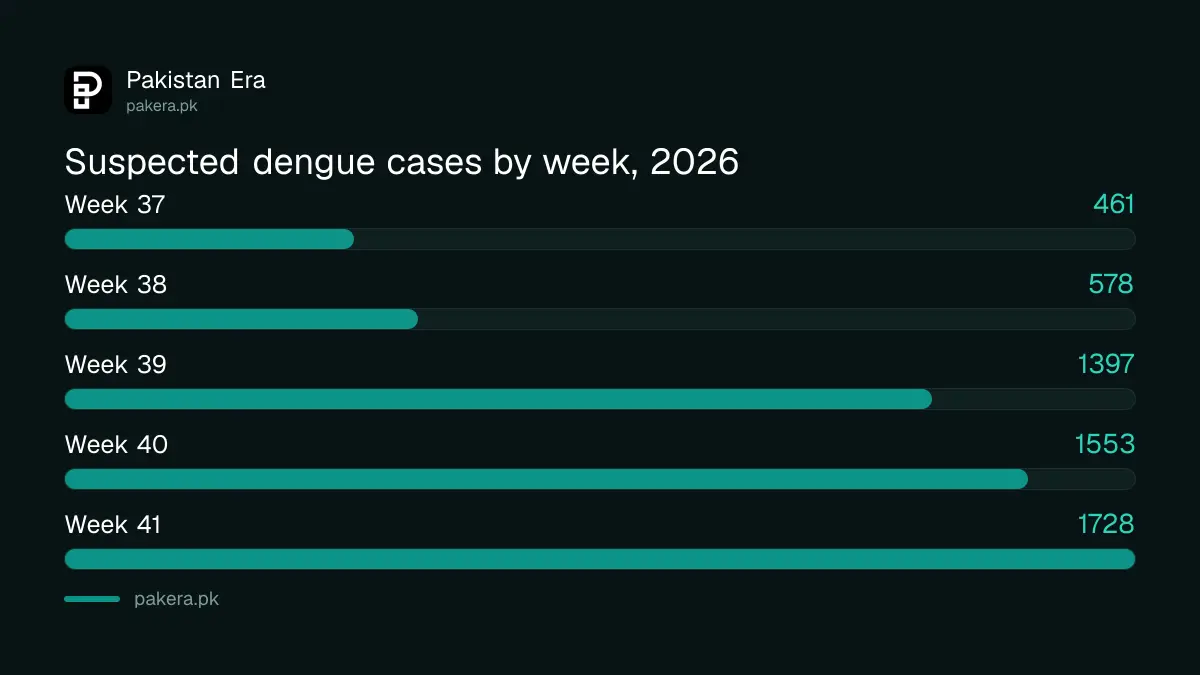
Dengue cases by week in Pakistan, 2026
Suspected dengue cases rose every week from week 37 to week 41 of 2026, from 461 to 1,728. The steepest jump came in week 39, when the count more than doubled. Across the five weeks, NIH counted 5,717 suspected cases by our sum.
| Epi week | KP | Sindh | AJK | Balochistan | ICT | GB | Pakistan |
|---|---|---|---|---|---|---|---|
| Week 37 | 322 | 139 | 0 | 0 | 0 | 0 | 461 |
| Week 38 | 340 | 235 | 1 | 0 | 2 | 0 | 578 |
| Week 39 | 1,150 | 241 | 1 | 3 | 2 | 0 | 1,397 |
| Week 40 | 1,334 | 206 | 8 | 4 | 1 | 0 | 1,553 |
| Week 41 | 1,408 | 292 | 23 | 5 | 0 | 0 | 1,728 |
Punjab shows NR, not reported, in every week, so the national figure leaves out Pakistan's largest province. For Punjab cities you need district figures; the latest we have is the Rawalpindi dengue count of 58 from the district health authority.
Khyber Pakhtunkhwa carries 81 per cent of reported cases
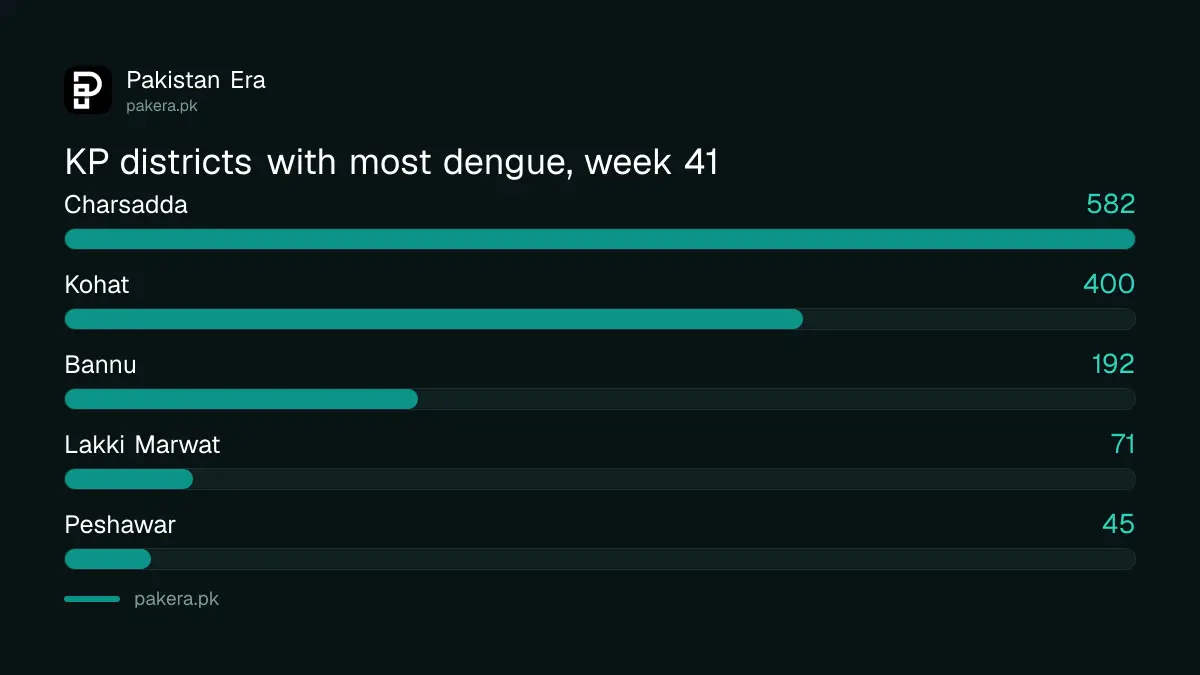
KP reported 1,408 of Pakistan's 1,728 suspected cases in week 41, about 81 per cent by our arithmetic. Its count rose by 74 from week 40. Three districts, Charsadda, Kohat and Bannu, reported 1,174 cases between them.
| KP district | Week 40 | Week 41 | Change |
|---|---|---|---|
| Charsadda | 506 | 582 | Up 76 |
| Kohat | 427 | 400 | Down 27 |
| Bannu | 184 | 192 | Up 8 |
| Lakki Marwat | 52 | 71 | Up 19 |
| Peshawar | 60 | 45 | Down 15 |
| Khyber | 51 | 23 | Down 28 |
| Haripur | 11 | 18 | Up 7 |
Smaller week 41 counts came from Karak and Nowshera (9 each), Swabi (8), Abbottabad, Hangu and Kohistan Lower (7 each), Bajaur (6), Mardan and Swat (5 each). Kohat was the fastest riser a week earlier, as our week 40 dengue report showed. In week 41 Charsadda took over.
Sindh lab tests found 177 positives in week 41
Public health labs in Sindh tested 2,384 dengue samples in week 41 and found 177 positive, about 7.4 per cent. That is up from 131 positives in 2,461 tests in week 40. Labs in AJK found 15 positives in 122 tests.
These lab numbers matter because the weekly totals above are suspected cases, a doctor's judgement before any test. Balochistan's labs tested 32 samples and found none positive. NIH's lab table has no dengue results for KP, Islamabad or Punjab this week, so KP's high count is not lab-confirmed in the bulletin. For Karachi's earlier picture, see Karachi dengue 2026.
Read the NIH bulletin yourself in four steps
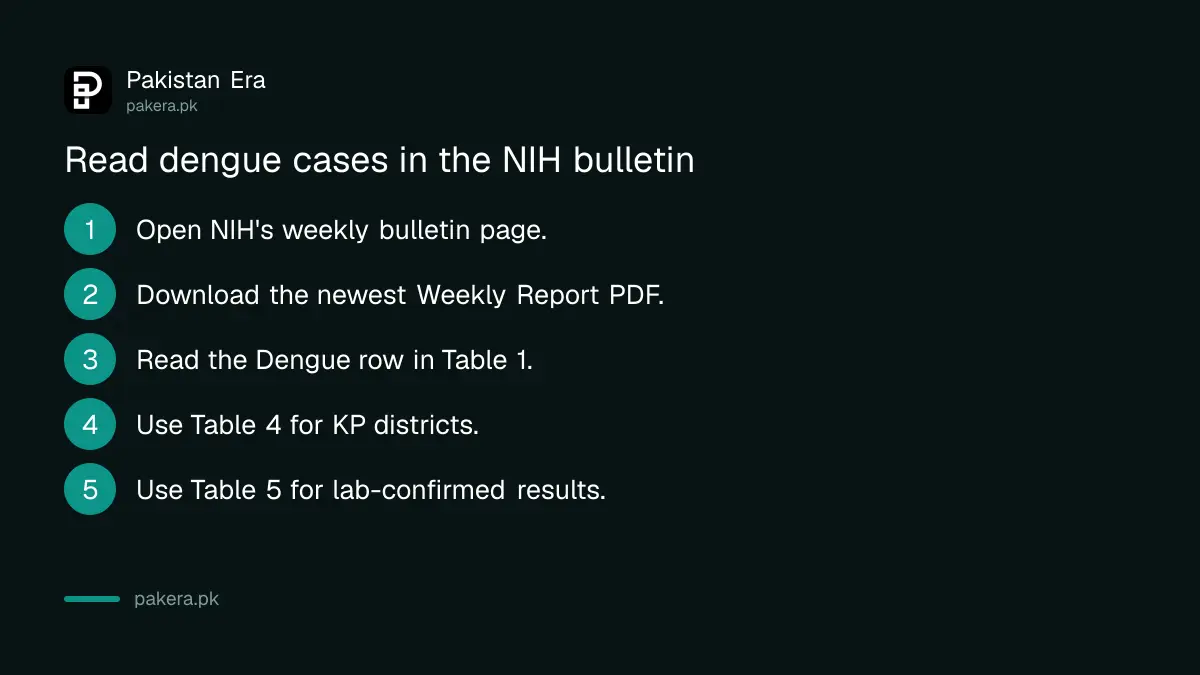
NIH posts one PDF a week on its weekly bulletin page. Table 1 gives every province, Table 4 the KP districts, and Table 5 the lab results. The file does not print the calendar dates of the epi week, so match by week number.
- Open the NIH weekly bulletin page and download the newest "Weekly Report" PDF.
- Go to Table 1 and read the Dengue row for each province.
- For KP districts, go to Table 4 and read the Dengue column.
- For confirmed results, go to Table 5 and read tests and positives by province.
The same method works for malaria, typhoid and flu, as set out in how to check disease cases in your district. One caution: reporting is not complete. In week 41, only 48 per cent of Islamabad's expected reports and 70 per cent of Balochistan's arrived, against 86 per cent nationally.
What a rising count means for your family
A rising count means more mosquitoes carrying the virus near people, so act on fever early. NIH's advice is paracetamol for fever, plenty of fluids, and no aspirin or ibuprofen. Go to a doctor early, and go at once for warning signs.
NIH's warning signs include severe belly pain, persistent vomiting, bleeding from the nose or gums, and confusion or irritability. The full NIH list is in why to avoid aspirin and ibuprofen in dengue. If a doctor asks for a test, the dengue test price for NS1 and IgM explains which test fits which day of fever.
At home, the weekly job is unglamorous: empty or scrub anything that holds water, from flower pots to water coolers. Cold nights later in November usually slow the mosquito, but that is a seasonal pattern, not a promise.
Common questions
How many dengue cases are there in Pakistan in 2026?
NIH's latest bulletin, week 41, counted 1,728 suspected cases in that one week. Weeks 37 to 41 add up to 5,717 suspected cases, without Punjab.
Which province has the most dengue cases?
Khyber Pakhtunkhwa, with 1,408 of 1,728 suspected cases in week 41. Charsadda, Kohat and Bannu lead within KP.
Why does Punjab show NR in the NIH bulletin?
NR means not reported. Punjab's figures were not in Table 1 for any of the weeks we read, so the national total leaves Punjab out.
Are these confirmed dengue cases?
No. NIH says all reported cases in the bulletin are suspected. Confirmed results appear only in its lab table, mostly from Sindh.
When is the next dengue update?
NIH posts a bulletin about once a week. The week 41 file went up on 28 October 2026, and we add each new week here when it appears.
How we verified this
What we checked, where we read it, and what we could not confirm.
We read the NIH IDSR week 41 bulletin PDF (posted 28 October 2026) on 31 October 2026, Tables 1, 4 and 5 and the compliance table, and cross-checked the KP district total against Table 1. Weeks 37 to 40 come from the NIH bulletins we read for our earlier weekly reports. The sums, percentages and changes are our arithmetic. We could not read Punjab's provincial dengue figures, which do not appear in the NIH tables, and NIH does not give calendar dates for each epi week.
About the author

Public Services and Education Journalist
Fajr Riaz is a journalist and content writer at Pakistan Era, based in Lahore. She covers the questions people meet in everyday life in Pakistan: how a public service works, what a change in the rules means, and where to find a reliable answer.