How to Check Disease Cases in Your District in Pakistan, Free From the NIH Weekly Bulletin
Check disease cases in your Pakistan district in 5 minutes with the free NIH weekly bulletin. Find the right table, read one row and see if the count is full.
Short answer: Open the National Institutes of Health (NIH) page at nih.org.pk/phb/weekly-bulletin, click the newest "IDSRS Week bulletin" for 2026, and read Tables 2, 3 and 4 for your district. Sindh, Balochistan and Khyber Pakhtunkhwa have district tables. Punjab is missing. It takes about five minutes and costs nothing.
Update, 11 October 2026: The week 38 bulletin also reported 395 suspected cutaneous leishmaniasis cases.
The bulletin is the only public, district-by-district disease count we found for Pakistan. We opened the week 38 and week 37 reports to write this. Every number you will find there is a suspected case reported by a clinic, not a confirmed one, and that changes how you should read it.
The newest bulletin is on the NIH weekly bulletin page
The NIH lists one bulletin for each week of the year on its weekly bulletin page, newest first. On 11 October 2026 the newest was "IDSRS Week 38 Bulletin (2026)", uploaded on 9 October. Each is a PDF of about 20 pages. You need no login to open it.
Expect a delay. Week 38 ended on 20 September, and the bulletin appeared 19 days later. The week 37 report went up on 5 October. So the bulletin tells you what was happening about three weeks ago, not this week. It is a trend tool, not a live alert.
The bulletin prints no calendar dates. It uses the standard week calendar, on which week 38 of 2026 runs from 14 to 20 September. An ISO week calendar turns any week number into dates.
Five tables answer most questions
Table 1 gives province totals. Tables 2, 3 and 4 give district counts for Sindh, Balochistan and Khyber Pakhtunkhwa. Table 5 gives laboratory results. Table 6 shows how many clinics in each district sent a report. Table 7 does the same for big hospitals. The overview on page 3 says which diseases rose or fell.
| Table | What it shows | Use it to |
|---|---|---|
| Table 1 | Cases by province, all diseases | Compare provinces |
| Tables 2 to 4 | Cases by district, Sindh, Balochistan, KP | Find your district |
| Table 5 | Lab tests and positives | See how many cases were confirmed |
| Table 6 | Clinics reporting, by district | Judge how complete a count is |
| Table 7 | Tertiary hospitals reporting | Check big-hospital coverage |
A worked example shows how to read one district row
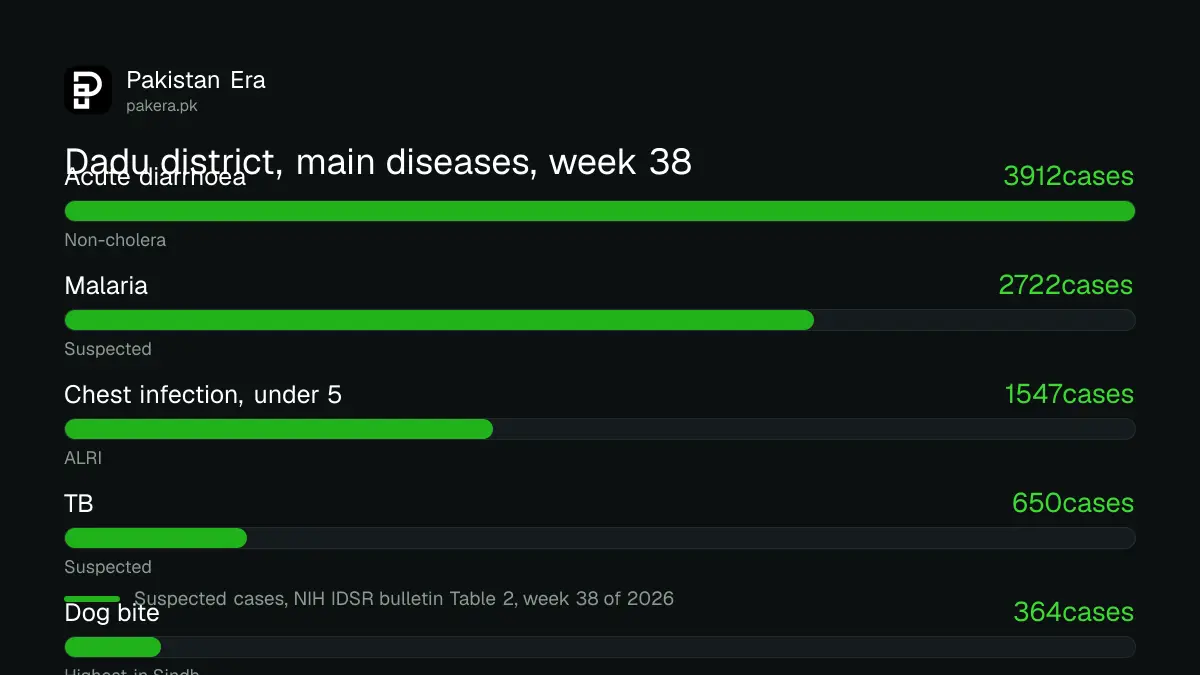
Take Dadu in Sindh, from Table 2 of the week 38 bulletin. It reported 3,912 cases of acute diarrhoea, 2,722 of malaria, 1,547 chest infections in children under five, 650 of TB, 364 dog bites, 285 of typhoid and 280 of viral hepatitis. Read across the row, then compare it with the district total below.
Now compare with last week. Download the previous bulletin and read the same row. A rise from one week to the next is a signal. A single number on its own is not, because districts differ in size and in how many clinics report.
Read the reporting rate before you trust a low number
A district with few cases may simply have few clinics reporting. Table 6 shows the share of clinics that sent a form. In Khyber Pakhtunkhwa in week 38, Bannu had only 127 of 228 sites reporting, a rate of 56 per cent, while Kohat had all 61. At national level the rate was 86 per cent.
The province rates tell the same story. Sindh reached 100 per cent, AJK 96, Gilgit-Baltistan 94 and Khyber Pakhtunkhwa 81. Balochistan managed 71 and Islamabad 70. A "0" in a table can mean no cases or no report. Check Table 6 before you decide which.
Punjab is marked "NR", not reported, in the case tables of these two bulletins, although Table 5 does carry some Punjab lab results. So you cannot use the bulletin for the case count in Lahore, Rawalpindi or any other Punjab district. For Punjab dengue, see how to report dengue larvae in Punjab.
Suspected cases are not confirmed cases
The NIH states on page 3 that all reported cases are suspected. Table 5 shows which were confirmed in labs. In week 38, public labs tested 424 typhoid samples and 16 were positive, and tested 595 measles samples with 167 positive. Divide positives by tested to get the share confirmed.
Many patients never reach a lab. So the lab share is not the true share of disease either. It is a floor for how many cases were real, and the clinic count is a ceiling for how many were suspected.
Use the numbers to act, not to panic
A rising count in your district is a reason to take simple precautions, not a reason to flee. Use it to check vaccines, water and mosquito control, and to ask your local health office what it is doing. The NIH also lists public health actions on page 4 for the diseases of the week.
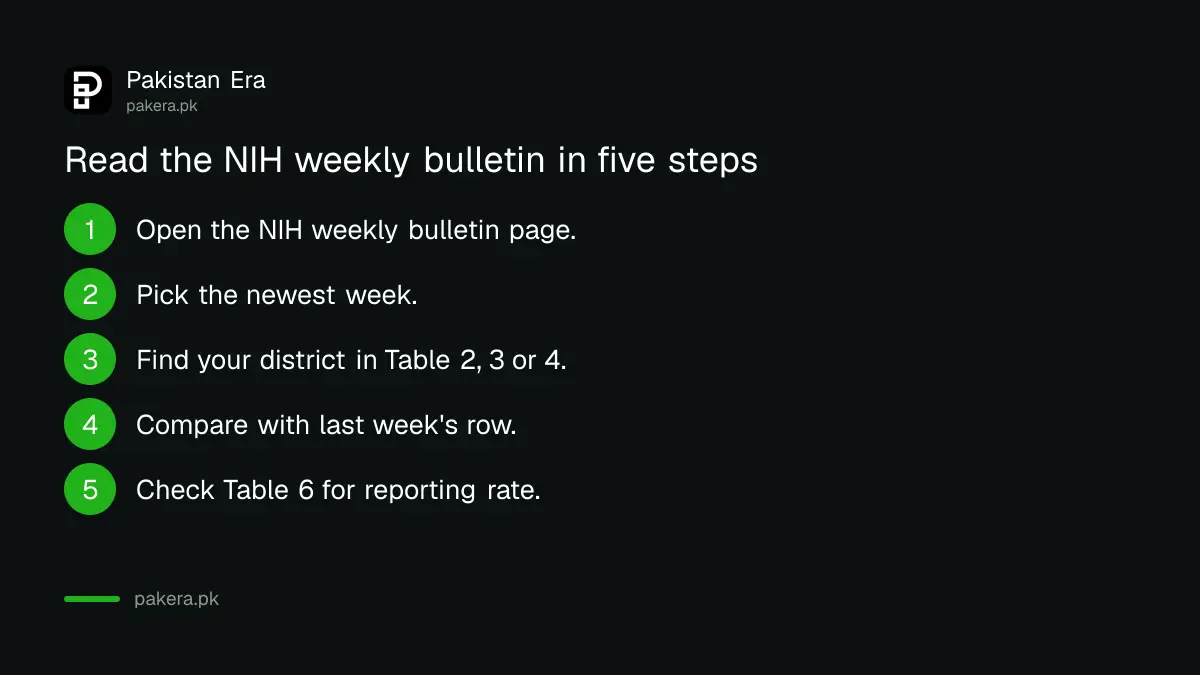
- Open the NIH weekly bulletin page and choose the newest week.
- Find your province in Table 1 and note the diseases at the top.
- Find your district in Table 2, 3 or 4 and read across the row.
- Open the previous week's bulletin and compare the same row.
- Check Table 6 for your district's reporting rate.
- Match the disease to a guide below and take the first step.
We read the week 38 bulletin disease by disease. See Sindh's malaria cases, dog bites, typhoid, cholera in Balochistan, hepatitis and measles and mumps. For a dengue case that needs hospital, read when a dengue patient must be admitted.
Common questions
Where is the NIH weekly disease bulletin?
On the NIH website at nih.org.pk/phb/weekly-bulletin. Each week has its own PDF, newest first.
How often is the bulletin updated?
Weekly. In practice week 37 appeared on 5 October 2026 and week 38 on 9 October, about three weeks after the weeks they cover.
Does it include Punjab?
No. Punjab is marked "NR", not reported, in the case counts of the week 37 and week 38 bulletins we read. Check later weeks, because that may change.
Can I find my own district?
If you live in Sindh, Balochistan or Khyber Pakhtunkhwa, yes, in Tables 2, 3 or 4. For AJK, Gilgit-Baltistan and Islamabad, the bulletin gives only province-level figures and a short note.
Are the numbers confirmed cases?
No. The NIH says all cases are suspected. Table 5 shows laboratory results for a smaller group of patients.
Why do some districts show zero?
It can mean no cases, or no report. Compare with Table 6, which lists how many sites in the district reported.
How we verified this
What we checked, where we read it, and what we could not confirm.
Last checked on 11 October 2026. We opened the NIH's IDSR weekly reports page and read the Public Health Bulletin, Pakistan, Week 38, 2026 and the Week 37 bulletin, including the case, laboratory and reporting tables and the public health actions on page 4. The week dates are our own calculation from the standard week calendar.
About the author

Tax, Bills and Technology Writer
Ali Akhtar is a young and curious voice here at Pakistan Era. He is currently pursuing his A-Levels and has a growing interest in Pakistan’s changing industrial landscape and educational trends. Ali likes to write in a way that helps him explain and explore the world around him. His writing reflects the perspective of the new generation navigating the evolving trends of Pakistan where technology, youth innovation, and shifting opportunities are reshaping the country’s future.