How to Report Dengue Larvae or Standing Water in Punjab
Report standing water or dengue larvae in Punjab on 1033, what anti-dengue teams do, the fines under the 2020 Act, and a weekly checklist to clear your home.
To report standing water, dengue larvae or a dengue hotspot in Punjab, call Healthline 1033, the Health and Population Department's free 24 hour line, and ask for your district's anti-dengue team. For a blocked drain or rubbish, use the WASA or Suthra Punjab complaint route. Larvae on your own premises can lead to a challan, sealing or a police case.
A water tank left open on the roof next door. A tyre shop with rain water in every tyre. An empty plot that floods after each shower. These are the places the dengue mosquito breeds, and in October they matter more than at any other time of year in Punjab.
We read the Punjab Infectious Diseases (Prevention and Control) Act 2020 on the Punjab Code, the 1033 helpline page, and the Health and Population Department's own dengue meeting notes. Here is how to report a dengue breeding site, what the teams do, and what the law says about fines.
Call 1033 to report a dengue breeding site in Punjab
Healthline 1033 is the Punjab Health and Population Department's toll free helpline. It runs 24 hours a day, every day of the year, and its page says it guides callers on dengue. Give the exact address, what you saw, and a landmark, then ask for the district anti-dengue team.
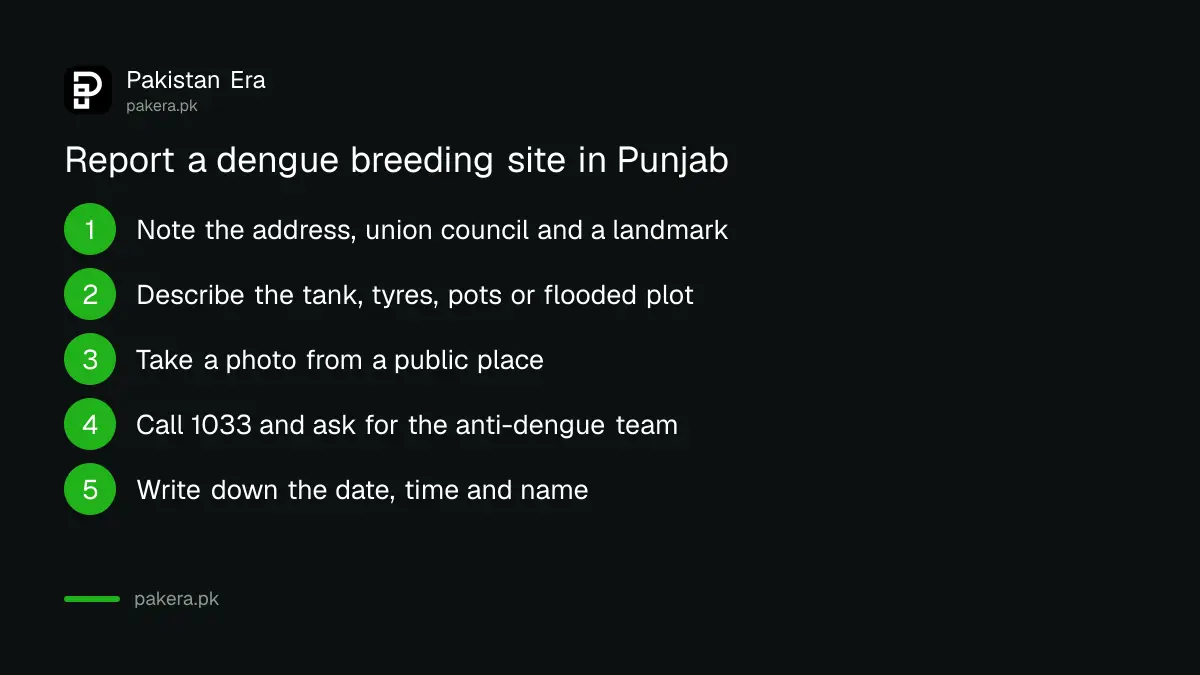
- Note the exact spot: house number, street, union council and a landmark.
- Describe what you saw: open tank, tyres, pots, a flooded plot or a water cooler.
- Take a photo from a public place, without entering anyone's property.
- Call 1033 and ask for the anti-dengue team or the district health office for your area.
- Write down the date, time and the name of the person you spoke to.
The 1033 page does not describe a formal larvae complaint system. So treat the call as the first step, not the last. If nothing happens within a few days, call again with your notes.
For a sickness rather than a breeding site, 1033 also helps. The department lists women medical officers among its staff.
Use the drain or rubbish route when the cause is a civic fault
Standing water often comes from a blocked drain, a leaking pipe or a heap of rubbish. Those are civic faults. Report them to the body that fixes them, and mention dengue in your complaint so it gets attention.
| What you see | Where to report |
|---|---|
| Larvae or open water in a home, shop or plot | 1033, or your district health office |
| Blocked sewer or overflowing drain | WASA in your city |
| Rubbish heap or dumped tyres and tins | Suthra Punjab or your local council |
| Water at a construction site | District health office or deputy commissioner's office |
| No action after several calls | Pakistan Citizen's Portal |
In Lahore, a blocked sewer or overflowing drain goes to WASA. Across Punjab, rubbish that holds rain water can be reported through Suthra Punjab garbage complaints. If no one acts, a complaint on the Pakistan Citizen's Portal is the next step up.
Anti-dengue teams check homes and outdoor spots
Punjab's anti-dengue teams run indoor surveillance in homes and outdoor surveillance at open sites. They look for larvae, destroy breeding spots, and record hotspots. Where larvae keep coming back, the district can issue challans, seal premises or register police cases.
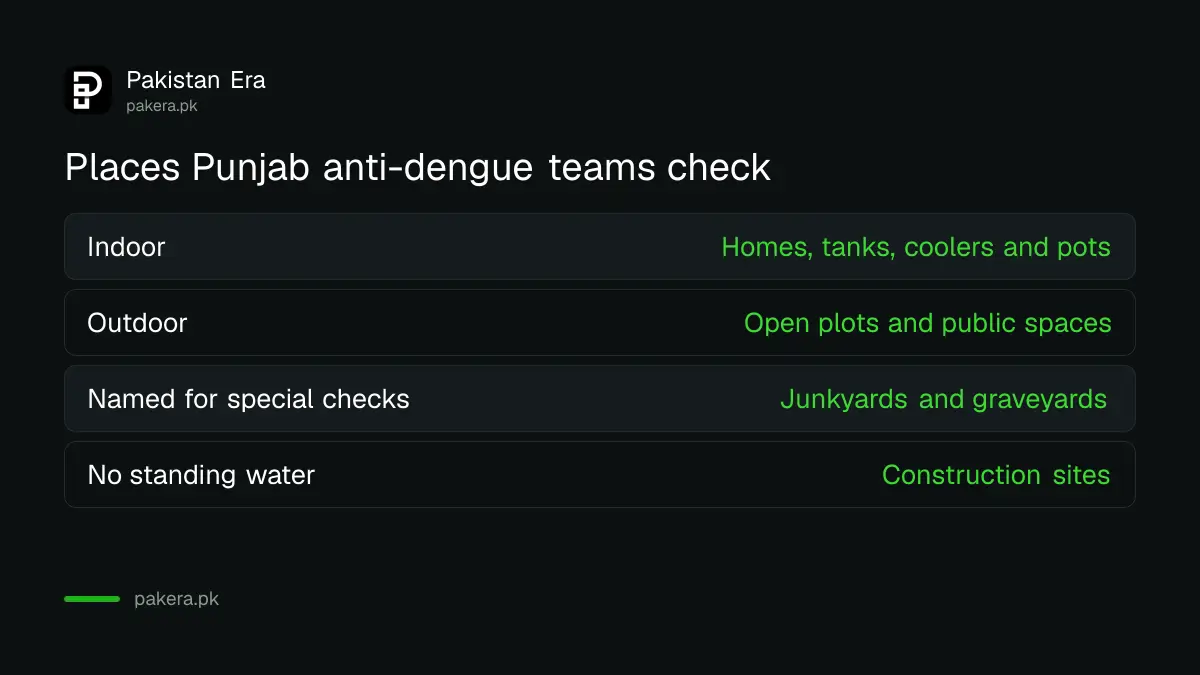
The department's own notes from its cabinet committee meetings set the priorities. On 12 March 2026, the ministers ordered indoor and outdoor surveillance and said construction sites must not hold standing water. Junkyards and graveyards were named for special checks. Housing societies were told to monitor dengue in their areas.
On 4 April 2026, the health minister told every government institution to appoint a dengue focal person. Strict action will be taken wherever larvae are found, "as the law applies equally to all", the department's note says. That covers offices and schools, not only homes.
The scale is large in a busy district. In Rawalpindi, 1,400 teams had checked more than 4.95 million houses by 22 September, the district health officer said, according to reports. The latest Rawalpindi dengue cases show how that district is doing.
Larvae on your premises can mean a challan, sealing or an FIR
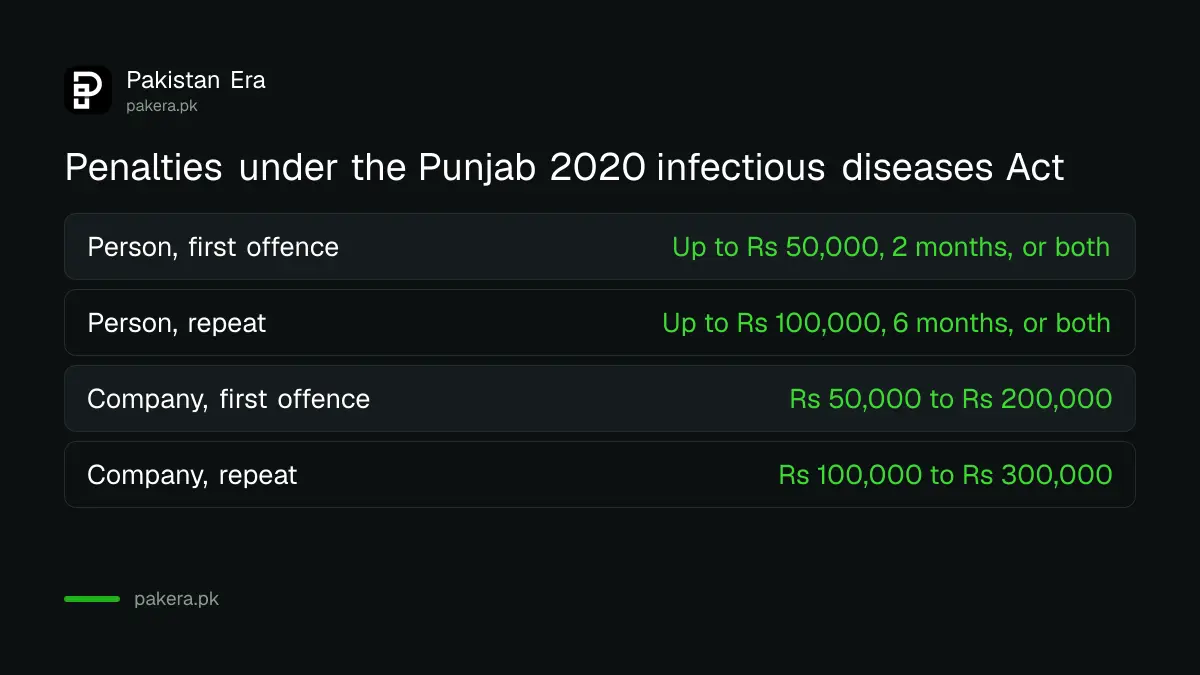
Rawalpindi registered 2,717 FIRs, sealed 678 premises and issued 2,239 challans over larvae and anti-dengue rules this year, with fines of Rs 2,832,000, according to district figures reported on 27 September. Punjab's 2020 infectious diseases law allows fines up to Rs 50,000 for a first breach of an order.
Section 17 of the Punjab Infectious Diseases (Prevention and Control) Act 2020 makes it an offence to ignore a direction, duty or requirement imposed under the Act without a reasonable excuse. Once the government declares a serious infection threat, section 5 lets it require premises to be kept in a sanitary condition.
| Who | First offence | Repeat offence |
|---|---|---|
| A person | Up to 2 months in jail, a fine up to Rs 50,000, or both | Up to 6 months in jail, a fine up to Rs 100,000, or both |
| A company or other body corporate | Fine of Rs 50,000 to Rs 200,000 | Fine of Rs 100,000 to Rs 300,000 |
Only a first class magistrate can try these offences, by summary trial. Deputy commissioners enforce the Act in their districts and may enter premises to do so. A person served with an order by a notified medical officer or a police officer can file a revision petition to a board made up of the divisional commissioner and a notified medical officer. The board must decide within 15 days.
One caution. The reports of challans and FIRs do not say which law each one was issued under. We could not find a dengue regulation under this Act published on the Punjab Code. So the fine on any one challan may differ from the Act's maximums. Ask the officer to name the law on the notice.
Clear breeding spots at home every week
The dengue mosquito breeds in clean water that stands for several days. So the most useful habit is a weekly round of your home and roof. Empty, scrub and cover every container.
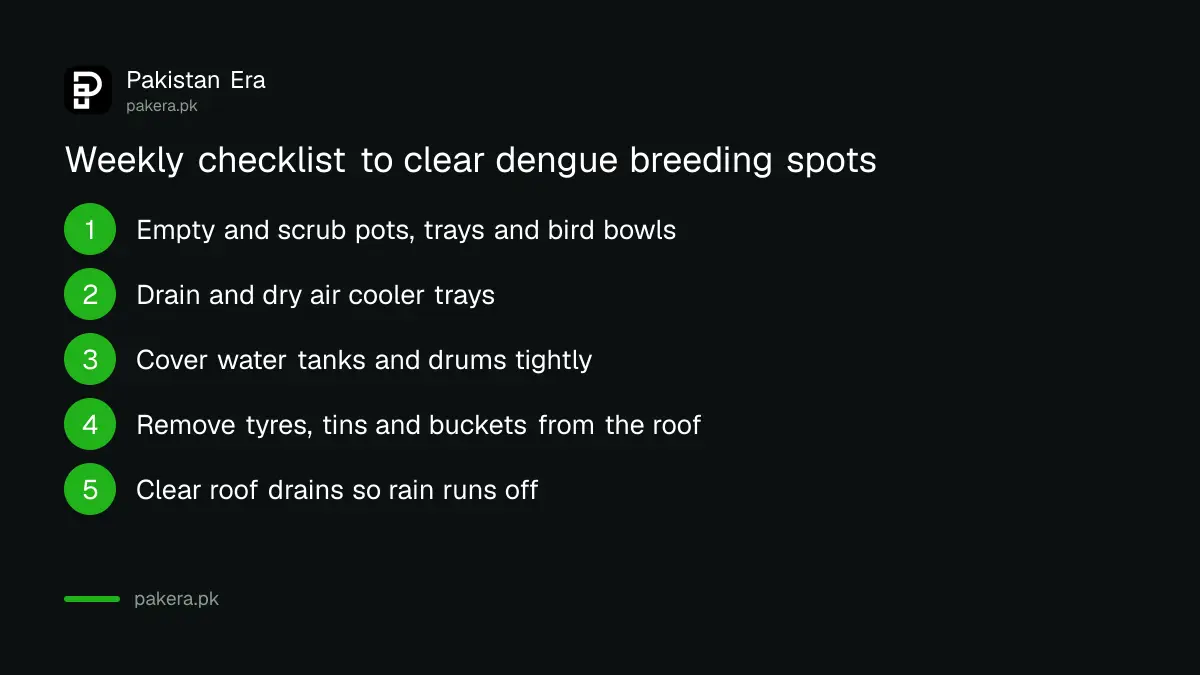
- Empty flower pots, pot trays and bird water bowls, and scrub the sides.
- Drain and dry air cooler trays.
- Cover water tanks and drums with tight lids.
- Turn over or throw away tyres, buckets, tins and broken pots on the roof.
- Clear roof drains and gutters so rain water runs off.
- Change water in vases and pet bowls every two or three days.
Larvae look like tiny wriggling threads near the water's surface. If you find them, pour the water on dry ground, scrub the container and dry it. Scrubbing matters because eggs stick to the sides.
The mosquito bites in daylight, mostly early morning and before dusk. Full sleeves and a repellent help. If someone at home gets a sudden high fever, learn the dengue warning signs, and know the rules on when a dengue patient must be admitted.
Common questions
What is the dengue helpline number in Punjab?
1033. It is the Punjab Health and Population Department's free helpline, open 24 hours a day, and it guides callers on dengue.
How do I report standing water in my street?
Call 1033 and ask for your district's anti-dengue team. If the water comes from a blocked drain, also complain to WASA.
What is the fine for dengue larvae in Punjab?
It depends on the law used. The 2020 infectious diseases Act allows up to Rs 50,000 for a first offence, but reported challans do not state the law or amount each time.
Can my house be sealed for dengue larvae?
Yes. Rawalpindi alone sealed 678 premises this year over larvae and anti-dengue rules, according to reported district figures.
Can I challenge a dengue fine or order?
Yes. An order by a notified medical officer or police officer under the 2020 Act can be challenged by revision petition. The board must decide within 15 days.
How often should I check my home for larvae?
Once a week. Empty, scrub and cover every container that can hold water, including cooler trays and roof tanks.
How we verified this
What we checked, where we read it, and what we could not confirm.
Last checked 3 October 2026. We read the Punjab Infectious Diseases (Prevention and Control) Act 2020 on the Punjab Code, including sections 5, 17, 20, 22, 25 and the 2021 amendment that added section 28-A. We read the Healthline 1033 page and the department's news notes from its dengue meetings of 12 March and 4 April 2026. The Rawalpindi team, FIR, sealing, challan and fine figures come from the district health authority as reported, because the authority does not publish its daily report on a public website we could find. We found no dengue regulation under the 2020 Act on the Punjab Code. The weekly home checklist follows standard public health advice on the dengue mosquito.
About the author

Public Services and Education Journalist
Fajr Riaz is a journalist and content writer at Pakistan Era, based in Lahore. She covers the questions people meet in everyday life in Pakistan: how a public service works, what a change in the rules means, and where to find a reliable answer.