When a Dengue Patient Must Be Admitted in Punjab
Any warning sign, or platelets below 70,000, means admission under the April 2026 criteria. Discharge needs all seven checks met.

Punjab has written down exactly when a dengue patient must be admitted to hospital, and exactly when a hospital may send them home. Any warning sign, or a platelet count below 70,000, means admission.
Those are not our rules. They are the Dengue Expert Advisory Group criteria, revised in April 2026 for epidemic conditions, and they are what doctors in Punjab are meant to be applying.
We downloaded and read the revised admission criteria and the revised discharge criteria from deag.punjab.gov.pk on 8 September 2026.
The admission rule in one line
All suspected, probable and confirmed patients, with any warning sign or a platelet count less than 70,000 per cubic millimetre, must be admitted to hospital for careful monitoring and management.
That is the sentence. It does not say may be admitted. It does not leave the platelet figure to judgment.
| Term | What the criteria say |
|---|---|
| Probable case | WBC below 4,000 with platelets below 100,000, or platelets falling by more than 20,000 in 24 hours |
| Confirmed case | PCR positive, NS1 positive, IgM positive, or a fourfold rise in IgG in paired samples |
| Admission trigger | Any warning sign, or platelets below 70,000 |
| Co-morbidities | Patients with uncontrolled co-morbidities to be evaluated carefully for possible admission |
The warning signs, in plain words
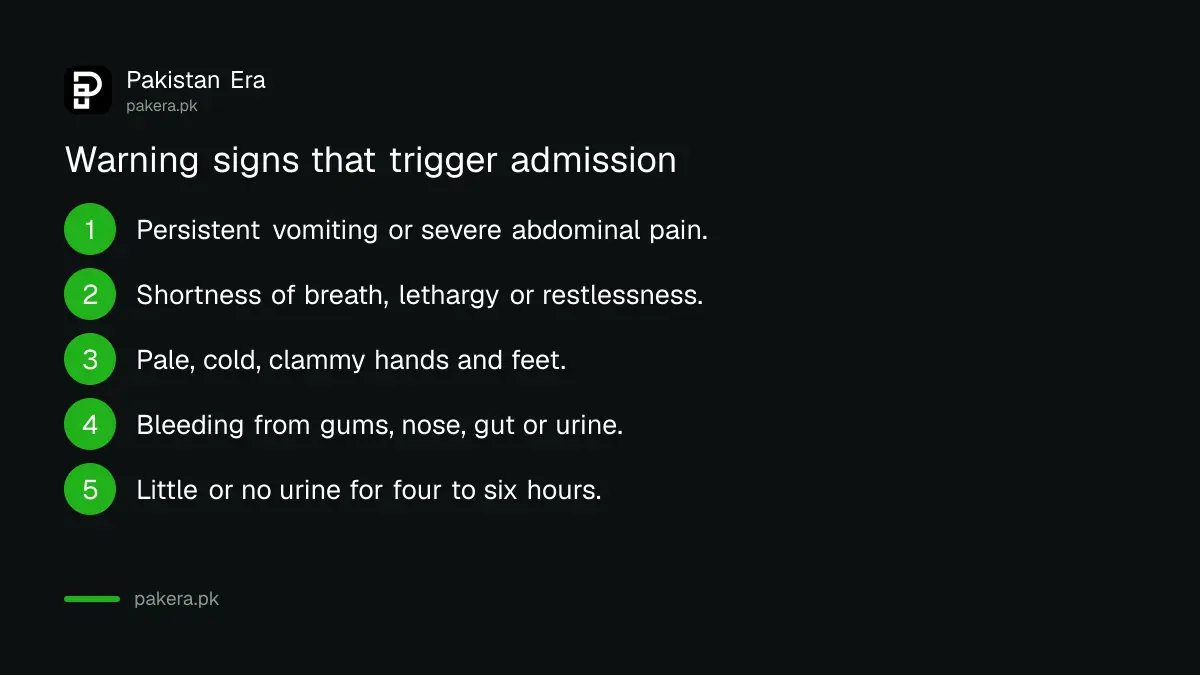
This is the list a family should know, because you will see these before a blood report does.
Haematocrit below 30 per cent or above 50 per cent. No clinical improvement, or parameters getting worse. Persistent vomiting. Severe abdominal pain. Shortness of breath. Lethargy or restlessness. Giddiness.
Pale, cold, clammy hands and feet. Bleeding of any kind, which the criteria list as nosebleed, bleeding gums, blood in stools, vomiting blood, coughing blood, unusually heavy periods, or blood in urine.
Pulse pressure below 25 mmHg. Capillary refill time longer than two seconds, meaning the colour takes more than two seconds to return after you press a fingernail. Little or no urine passed for four to six hours.
Any one of these, on its own, is an admission trigger under the criteria. Not a combination.
Why the platelet number gets misread
Families fix on the platelet count because it is the number they are given, and then relax when it stops falling.
The criteria treat it differently. A probable case is flagged at platelets below 100,000 together with a white cell count below 4,000, or by a falling trend of more than 20,000 in 24 hours. The admission line sits lower, at 70,000.
So the rate of fall matters as well as the level. A count dropping from 140,000 to 115,000 in a day is inside the probable case definition even though 115,000 sounds comfortable.
And the warning signs work independently of the number. A patient with normal platelets and severe abdominal pain still meets the admission rule.
When a hospital can discharge
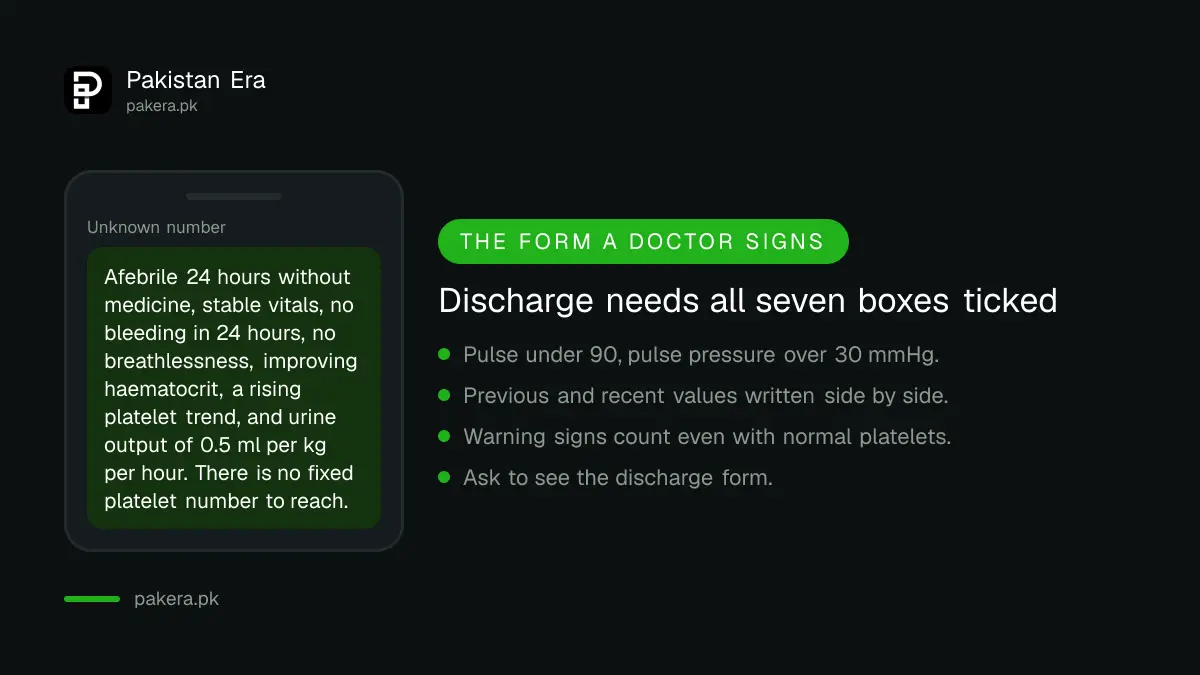
The revised discharge criteria are a form with seven checks, and the form says all of them must be fulfilled.
- Afebrile for 24 hours without fever medicine.
- Stable general condition and vital signs, with pulse below 90 a minute, age appropriate for children, and pulse pressure above 30 mmHg.
- No visible bleeding in the last 24 hours.
- No breathlessness or respiratory distress.
- Improving haematocrit for at least 24 hours.
- A rising trend in platelet count over 24 hours.
- Urine output of 0.5 millilitres per kilogram per hour.
The form records previous and recent haematocrit and platelet values side by side, so the trend is written down rather than remembered, and a doctor signs it.
Note what is not on the list. There is no platelet number a patient has to reach. The criterion is a rising trend over 24 hours, which is why a patient can go home on a count that sounds low if it is climbing and everything else is stable.
Serious and critical are defined too
The group has separately told hospitals how to label severity, and the wording is short.
All dengue haemorrhagic fever patients without evidence of shock are to be labelled serious. Patients with narrowing of pulse pressure, whether compensated or decompensated shock, are to be labelled critical, as are patients with bleeding or who are vitally unstable.
Those labels feed the provincial dashboard, so they are how a case is counted as well as how it is treated.
What to do with this
Take it as a checklist for the conversation, not as a diagnosis. You are not deciding anything, you are making sure the criteria are being applied.
If someone at home has dengue and shows any sign on that list, say so explicitly and ask whether the admission criteria are met. If a hospital is discharging and you are unsure, ask for the discharge form and check the seven boxes.
If care is refused or you believe the standard fell short, our guide to complaining against a hospital or doctor in Punjab sets out the sixty day deadline and the affidavit the Healthcare Commission requires. In an emergency, our guide to what Rescue 1122 does covers the ambulance route.
Our guide to free health programmes in Punjab beyond the Sehat Card covers treatment you do not have to pay for, and our guide to medical assistance from Bait-ul-Mal covers help with costs.
Common questions
At what platelet count is a dengue patient admitted in Punjab?
Below 70,000 per cubic millimetre, or at any platelet level if a warning sign is present.
What are the dengue warning signs?
Persistent vomiting, severe abdominal pain, shortness of breath, lethargy or restlessness, giddiness, cold clammy extremities, any bleeding, low pulse pressure, slow capillary refill, and little or no urine for four to six hours, among others.
Does a falling platelet count matter on its own?
A drop of more than 20,000 in 24 hours is part of the probable case definition, alongside a white cell count below 4,000.
When can a dengue patient be discharged?
Only when all seven discharge criteria are met, including 24 hours without fever and a rising platelet trend.
Is there a platelet number needed for discharge?
No. The criterion is a rising trend over 24 hours, not a fixed figure.
Who writes these criteria?
The Dengue Expert Advisory Group, based at SIMS on Jail Road in Lahore, which circulates them to health facilities in Punjab.
How we verified this
What we checked, where we read it, and what we could not confirm.
Last checked 8 September 2026. We downloaded the Revised DEAG Admission Criteria for Dengue (2026, Epidemic), marked revised April 2026, and the Revised Discharge Criteria, also marked revised April 2026, from the downloads section of deag.punjab.gov.pk, the site of the Dengue Expert Advisory Group, and read both. The admission rule that all suspected, probable and confirmed patients with any warning sign or a platelet count less than 70,000 per cubic millimetre must be admitted; the probable case definition of a white cell count below 4,000 with platelets below 100,000 or a falling trend of more than 20,000 in 24 hours; the confirmed case definition by PCR, NS1, IgM or a fourfold rise in IgG in paired samples; the list of warning signs including haematocrit below 30 or above 50 per cent, no clinical improvement or worsening parameters, persistent vomiting, severe abdominal pain, shortness of breath, lethargy or restlessness, giddiness, pale cold clammy extremities, bleeding including epistaxis, gum bleed, bloody stools, haematemesis, haemoptysis, menorrhagia and haematuria, pulse pressure below 25 mmHg, capillary refill time more than two seconds, and less or no urine output for four to six hours; and the note on patients with uncontrolled co-morbidities, are taken from the admission criteria document. The seven discharge criteria, afebrile for 24 hours without antipyretics, stable general condition and vital signs with pulse below 90 a minute and pulse pressure above 30 mmHg, no visible bleeding in the last 24 hours, no dyspnoea or respiratory distress, improving haematocrit for at least 24 hours, a rising trend in platelet count over 24 hours, and urine output of 0.5 millilitres per kilogram per hour, together with the statement that all of the above criteria should be fulfilled and the recording of previous and recent haematocrit and platelet values, are taken from the discharge form. The definitions of serious and critical are taken from the group's letter headed criteria to label a dengue patient of severe or critical disease. This article describes published clinical criteria so that families know what they are and can ask whether they are being applied. It is not medical advice, it is not a diagnosis, and no decision about a patient should be taken from it. Speak to the treating doctor.
About the author

Public Services and Education Journalist
Fajr Riaz is a journalist and content writer at Pakistan Era, based in Lahore. She covers the questions people meet in everyday life in Pakistan: how a public service works, what a change in the rules means, and where to find a reliable answer.