Election Offences in Pakistan: Penalties for Vote Buying, Fake Votes and Canvassing (Full List)
Election offences in Pakistan under the Elections Act 2017: vote buying, fake votes, the 400 metre canvassing rule, ballot photos and weapons, with penalties.
یہ صفحہ اردو میں پڑھیں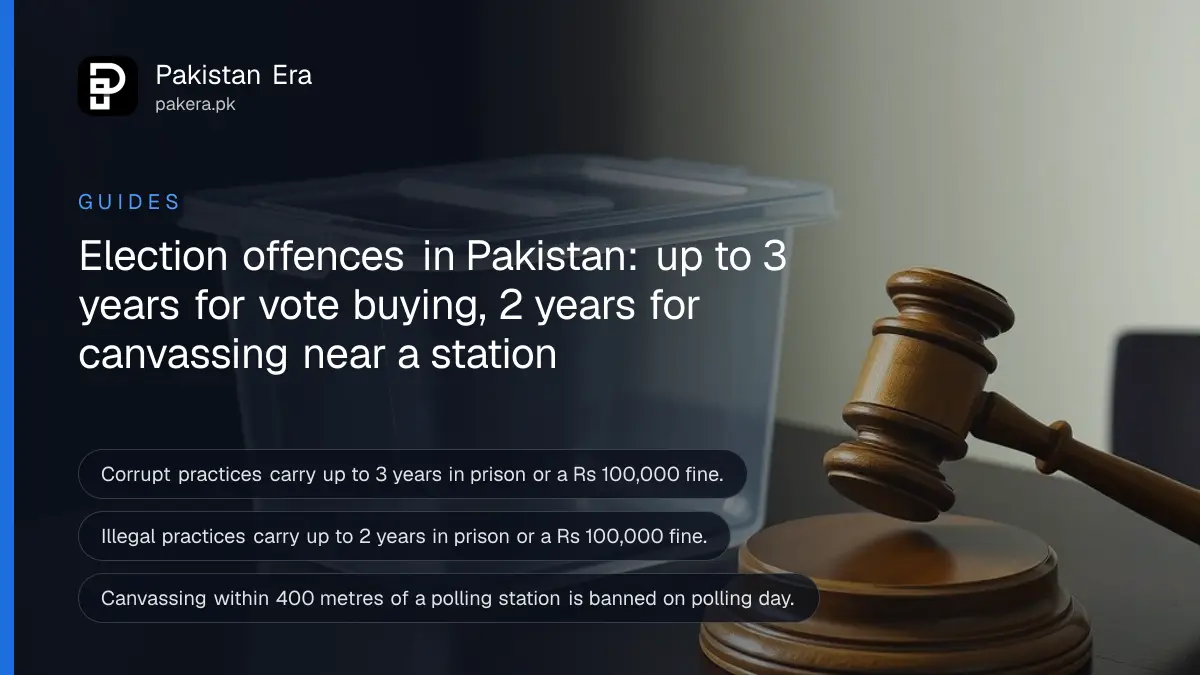
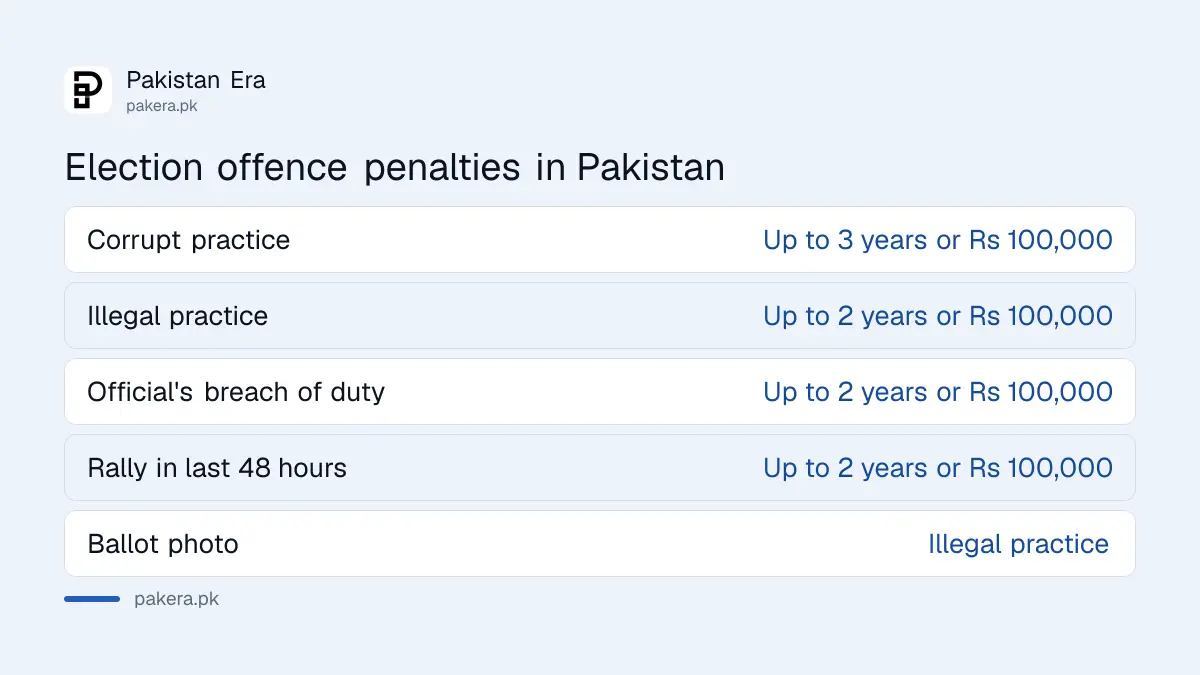
Election offences in Pakistan fall into two groups under the Elections Act, 2017. Corrupt practices, such as vote buying, fake voting and capturing a polling station, carry up to 3 years in prison, a fine of up to Rs 100,000, or both. Illegal practices, such as canvassing within 400 metres of a polling station, carry up to 2 years, Rs 100,000, or both.
Two by-elections take place on 8 November 2026, in NA-77 Gujranwala-I and PP-203 Sahiwal-VI. On days like this, voters ask the same things. Can a supporter stand at the gate with a flag? Can I take a photo of my ballot? Is a free lunch a bribe?
We read Chapter X of the Elections Act, 2017, sections 167 to 183, in the copy the Election Commission of Pakistan (ECP) publishes on its website, updated to 5 August 2023. This list puts every common offence in one table, with the section number so you can check it yourself.
Corrupt practices carry the heavier penalty of up to 3 years
A corrupt practice is the more serious kind of election offence. Section 174 sets the penalty at up to three years in prison, a fine of up to Rs 100,000, or both. Section 167 lists what counts.
| Corrupt practice | Section | What it means |
|---|---|---|
| Bribery | 168 | Giving or taking money, goods or any reward to vote or not to vote |
| Personation | 169 | Voting as someone else, living, dead or made up |
| Undue influence | 170 | Using force, threats or harm to make someone vote or stay away |
| Capturing a polling station | 171 | Seizing a station or booth, or making staff hand over ballots |
| Tampering with papers | 172 | Destroying or defacing ballot papers, or stuffing extra ones |
| False statement | 173 | Publishing a false claim about a candidate's character or withdrawal |
Personation is what many people call a "fake vote". It covers voting in the name of a person who has died. The law makes no exception for a relative's vote, even with their permission.
Illegal practices carry up to 2 years and cover polling day conduct
An illegal practice is the second group. Section 183 sets the penalty at up to two years in prison, a fine of up to Rs 100,000, or both. Section 175 lists them, and most are about what happens on and around polling day.
- Disorderly conduct near a polling station (Section 176).
- Canvassing in or near a polling station (Section 177).
- Interfering with the secrecy of the vote (Section 178).
- Voting when you know you are not qualified.
- Voting more than once, at the same station or at two stations.
- Taking a ballot paper out of the polling station.
- Holding or joining a public meeting in the 48 hours before the poll ends (Section 182).
- Carrying or showing a weapon at a meeting, during the campaign, on polling day and until 24 hours after the official result.
- Aerial firing or firecrackers at meetings or near a polling station.
- Violence against election staff.
The weapon rule is wide. The Act says a weapon includes a danda, lathi, knife or axe, not only a firearm.
The 400 metre rule stops canvassing near a polling station
On polling day, nobody may canvass for votes within 400 metres of a polling station. That covers asking for a vote, and persuading a voter to vote for or against someone, or not to vote at all.
Flags and signs have their own rule. A candidate's camp can show them only with the Returning Officer's permission, and only at a place set aside beyond 100 metres of the station. A Returning Officer is the official who runs the election in one constituency.
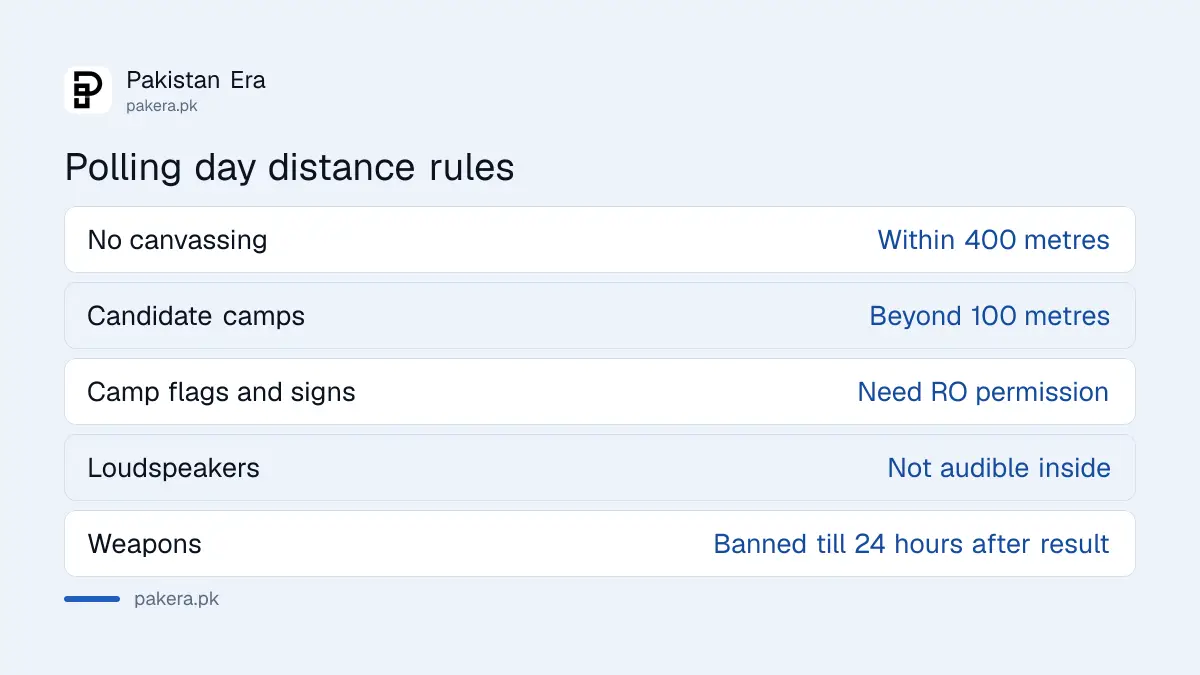
Loudspeakers are also covered. Using a megaphone or loudspeaker so that it can be heard inside the polling station is disorderly conduct under Section 176. So is shouting that can be heard inside.
Photographing your marked ballot is an offence
Section 178 protects the secrecy of the vote. Taking or trying to take a photo of a marked ballot paper with a phone camera or any other device is an offence. So is telling anyone how a voter in the station voted, if you learned it inside.
A selfie outside the station with your inked thumb is a different thing. The law targets the marked ballot paper and the secrecy of the vote. Keep the phone in your pocket inside the booth. Use it before you leave home instead, to check your polling station by 8300.
Check whether something is an offence in four steps
If you are not sure whether what you saw breaks the law, work through these steps. They follow the order of the Act.
- Ask whether money, goods or a favour was offered for a vote. If yes, it is bribery under Section 168.
- Ask whether force, a threat or a weapon was involved. If yes, look at Sections 170, 171 and 175.
- Ask where it happened. Within 400 metres of a polling station on polling day, canvassing is an offence under Section 177.
- Ask when it happened. A rally in the 48 hours before the poll ends breaks Section 182.
Then report it. For the 8 November polls the ECP has opened a control centre. Our page on the ECP helpline for the 8 November polls gives the number, email and fax.
Officials can be punished too
The Act does not only cover voters and candidates. Section 184 makes it an offence for an election official to break their duty on purpose or through negligence. Section 185 covers an official who breaks the secrecy of the vote. Section 186 bars officials, and members of a law enforcement agency on duty, from influencing voters. Section 188 sets the penalty for officials at up to two years in prison, a fine of up to Rs 100,000, or both.
This matters if a polling officer tells you who to vote for. Report it with the officer's name or the station number. Our guide to Forms 45, 47 and 49 shows how the count is recorded, so you know what a fair count looks like.
Common questions
What is the punishment for buying votes in Pakistan?
Bribery is a corrupt practice. Section 174 of the Elections Act, 2017 sets up to three years in prison, a fine of up to Rs 100,000, or both.
How far from a polling station can people canvass?
No canvassing within 400 metres of a polling station on polling day. Camps with flags need Returning Officer permission and must be beyond 100 metres.
Can I take a photo of my ballot paper?
No. Photographing a marked ballot paper is interference with the secrecy of voting under Section 178, an illegal practice.
Is voting for a dead relative an offence?
Yes. Section 169 defines personation as voting as another person, whether living, dead or fictitious.
Can a candidate's supporter carry a stick on polling day?
No. The Act's weapon rule includes a danda, lathi, knife or axe, on polling day and until 24 hours after the official result.
What is the penalty for a rally after the campaign ends?
Up to two years in prison, a fine of up to Rs 100,000, or both, under Sections 182 and 183.
How we verified this
What we checked, where we read it, and what we could not confirm.
Last checked 7 November 2026. We read Chapter X, sections 167 to 186, of the Elections Act, 2017 on the ECP election laws page, in the version updated to 5 August 2023. Later amendments, if any, may change a section; the ECP page is the place to check.
About the author

Global Affairs & Political Economy Writer
Muhammad Hatim is a book lover who started writing because he enjoys it. At Pakistan Era he writes about international relations, geopolitics and the global economy, with a particular interest in South Asia and the forces behind current events.