How to Get a PSQCA Licence for Your Product in Pakistan: Fees, Steps and Timeline
Get a PSQCA CM licence in Pakistan: Form I with Rs 1,000 per brand, Rs 5,000 yearly, 0.05% or 0.1% quarterly marking fee, factory inspection and 30-day grant.
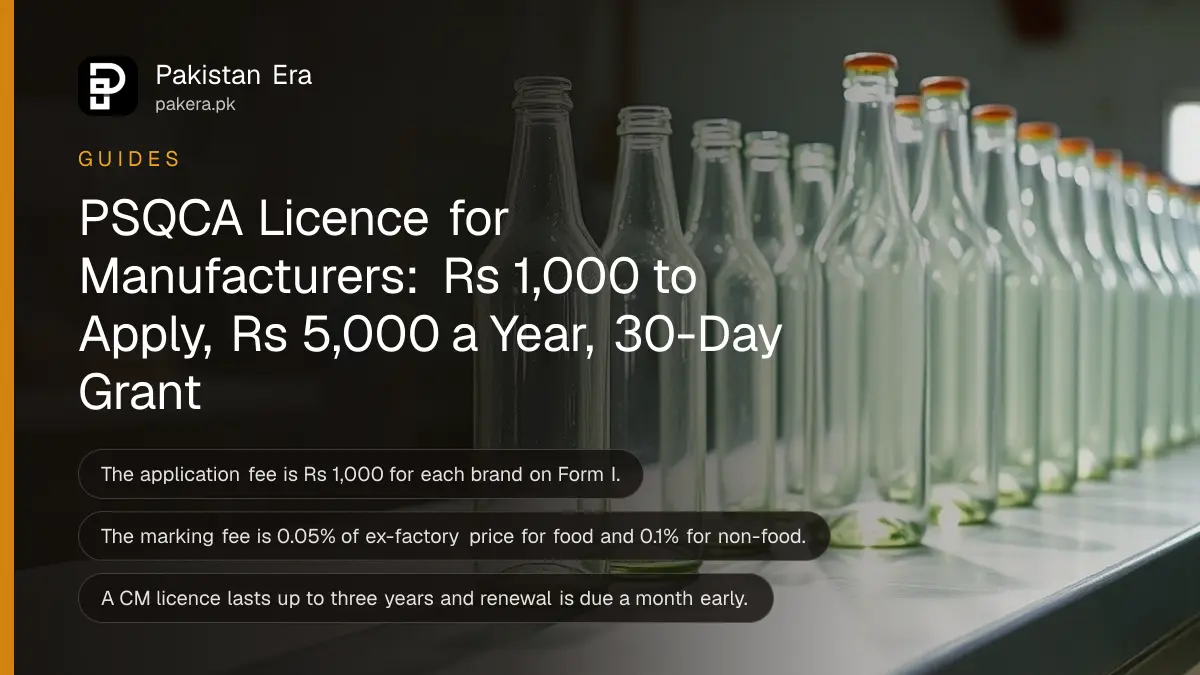
A manufacturer gets a PSQCA licence (the Certification Marks or CM licence) by applying on Form I with Rs 1,000 per brand, passing a factory inspection and sample tests, and then paying an annual licence fee of Rs 5,000. A marking fee of 0.05% of the ex-factory price for food, or 0.1% for non-food, is paid every quarter. PSQCA lists 30 days for the grant after testing.
If your product is on PSQCA's compulsory list, PSQCA requires it to carry the PS mark under a licence before sale. PSQCA's FAQ says that list has 166 items, across food, building materials and electrical goods. Products outside the list can still be certified under the voluntary scheme.
Check first whether your product is on the compulsory list
PSQCA keeps a list of products that must meet a Pakistan Standard before sale. If your product is on it, the CM licence is required. If not, you can apply for voluntary certification, which PSQCA has run since 2006, at a lower marking fee.
The list is on PSQCA's website under Conformity Assessment, "List of Compulsory Item to meet Pakistan Standards". Find the Pakistan Standard (PS) number for your product too. You will need it on the application, and it decides which tests your samples go through.
Each brand is a separate article. PSQCA's fee notification gives jam and jelly as its example: they share one standard, but each brand of jam and each brand of jelly is licensed and charged separately. All flavours of one brand count as one article.
Fees: Rs 1,000 to apply and Rs 5,000 a year, plus a marking fee
PSQCA's fee notification sets Rs 1,000 per brand to apply, Rs 5,000 a year as the licence fee, and a marking fee on every rupee of ex-factory sales. Inspection is Rs 5,000 per visit, plus travel and stay costs for the inspector.
| Fee | Amount | When |
|---|---|---|
| Application, per brand | Rs 1,000 | With Form I |
| Annual licence fee | Rs 5,000 | Every year |
| Marking fee, food articles | 0.05% of ex-factory price | Every quarter |
| Marking fee, non-food articles | 0.1% of ex-factory price | Every quarter |
| Marking fee, voluntary scheme | 0.05% of ex-factory price | Every quarter |
| Inspection | Rs 5,000 plus conveyance and stay | Per inspection |
| Laboratory testing | As per the QCC fee schedule | Per sample |
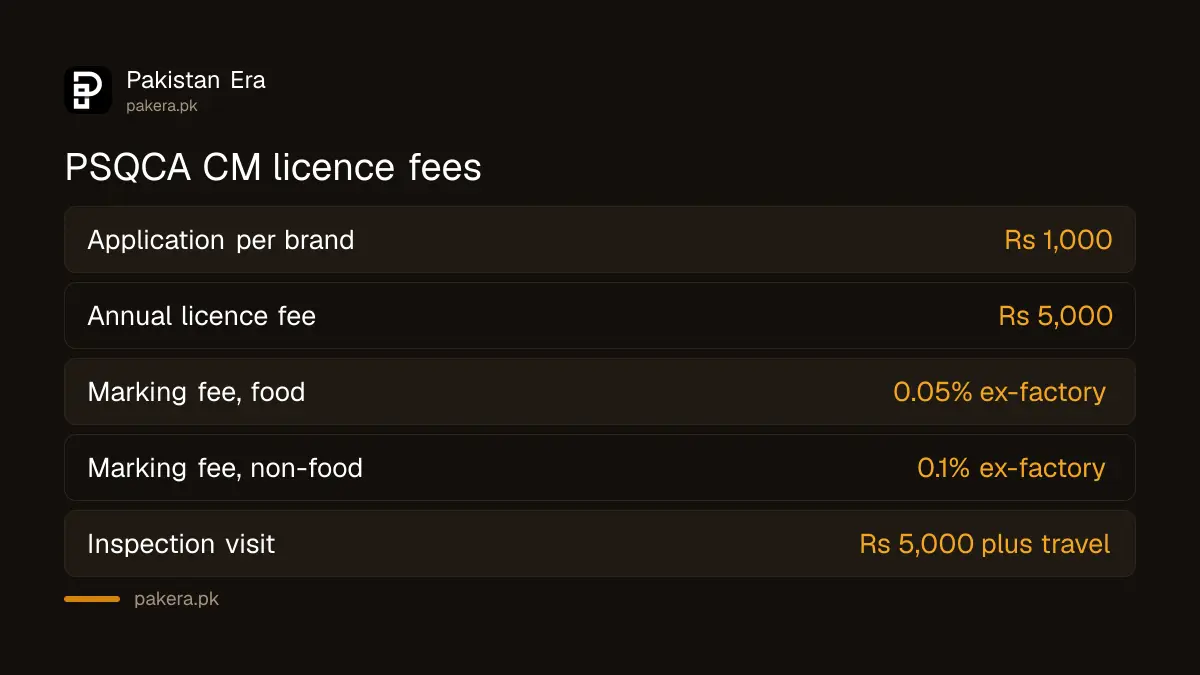
The ex-factory price is your invoice value without indirect taxes such as sales tax. So a non-food maker who sells Rs 10 million of a licensed brand in a quarter pays Rs 10,000 in marking fee for that quarter. A food maker with the same sales pays Rs 5,000.
The marking fee is due by the 15th of the month after each quarter, by bank draft or pay order, with a quarterly statement. That statement asks for your licence number, NTN, sales tax number, the quarter's electricity, gas and water bills, and your opening stock, production, sales and closing stock at ex-factory value.
Apply for the CM licence in six steps
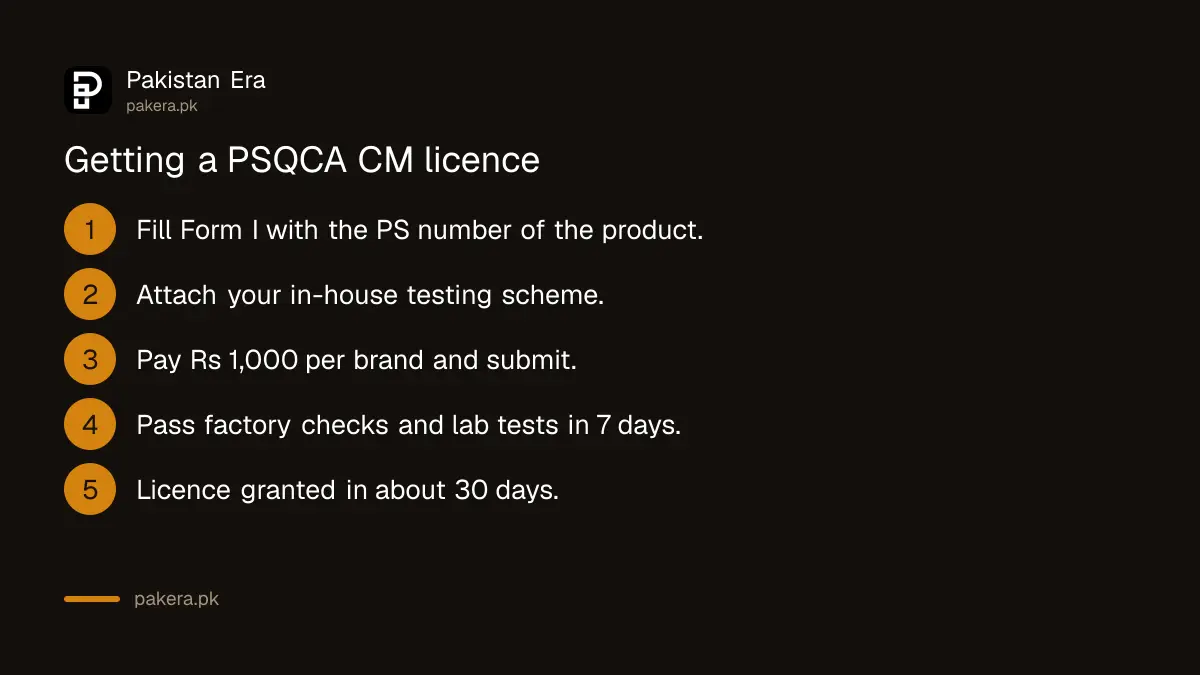
Submit Form I with the application fee and a written scheme of your in-house inspection and testing. PSQCA then inspects the factory, tests samples in the factory and its laboratory, and grants a licence on Form II if the product and your quality checks pass.
- Prepare Form I. Give your registered office, factory address, the person responsible for quality, the product description and the PS number. An individual signs it; for a firm, the authorised person signs.
- Attach your quality scheme. Rule 3(2) of the Pakistan Standards Conformity Assessment Rules, 2008 requires a statement of the inspection and tests you run during production.
- Submit and pay Rs 1,000 per brand. PSQCA's site links an online application, or file with the Conformity Assessment directorate for your area. PSQCA numbers and acknowledges each application, and lists 2 man days for scrutiny and registration.
- Factory inspection and samples. An inspector checks your premises and testing. PSQCA lists 1 to 2 days for in-factory testing and 7 days in the laboratory.
- Fix any gaps. If the inspector asks for changes to your process or tests, make them in the time given, after which the inquiry is repeated.
- Licence granted. PSQCA lists 30 days for the grant. The licence is valid for up to three years and cannot be transferred.
Conformity Assessment directorates are in Karachi (Gulistan-e-Jauhar), Lahore (Kot Lakhpat), Islamabad (H-9/1), Peshawar (Hayatabad), Quetta and Multan, with liaison offices in cities such as Gujranwala, Bahawalpur and Faisalabad. File with the one nearest your factory.
Keep the licence: quarterly checks and renewal a month early
After the grant, PSQCA visits the factory and tests factory and market samples every quarter. Apply to renew at least one month before the licence expires. Missed marking fees can get you an order to stop using the PS mark after 14 days' notice.
- Unpaid marking fee. Rule 14 allows PSQCA to order you to stop marking after a notice of at least 14 days. Marking resumes once the dues are paid.
- Failed surveillance sample. A non-conforming result can lead to suspension under rule 10, or cancellation under rule 11, after notice.
- Late renewal. Rule 7(2) says the renewal application must come at least one month before expiry, and follows the same steps as a new application.
- Licence deferred or suspended. Rule 13 says you must stop marking the product at once.
- Changed brand or factory. The licence is non-transferable. A new brand needs its own application and Rs 1,000 fee.
Buyers and shopkeepers can check a licence online on PSQCA's CM licence verification page, so keep your licence number on your invoices.
Common questions
How much is the PSQCA licence fee in Pakistan?
Rs 1,000 per brand to apply and Rs 5,000 a year as the licence fee. A marking fee of 0.05% (food) or 0.1% (non-food) of ex-factory sales is added every quarter.
How long does it take to get a PSQCA licence?
PSQCA lists 2 man days for scrutiny, 1 to 2 days of factory testing, 7 days of laboratory testing and 30 days for the grant.
How long is a CM licence valid?
Up to three years. Apply to renew at least one month before it expires.
Do I need a separate licence for each flavour?
No. PSQCA's fee notification treats all flavours of one brand as one article. Each separate brand needs its own licence.
My product is not on the compulsory list. Can I still get the PS mark?
Yes, through PSQCA's voluntary certification scheme. The marking fee for voluntary articles is 0.05% of ex-factory price.
When is the quarterly marking fee due?
By the 15th day of the month after each quarter, paid by bank draft or pay order with the quarterly statement.
How we verified this
What we checked and where we read it.
Last checked 24 November 2026. We read PSQCA's FAQ, its product certification process page, its procedure page and its conformity assessment contacts on psqca.com.pk, the Pakistan Standards Conformity Assessment Rules, 2008 (Gazette of 27 May 2008, rules 3 to 7 and 10 to 15, Forms I and II), and the marking fee notification on PSQCA's download page: SRO 29(KE)/2008 as amended up to 7 December 2010. That notification is the fee document PSQCA currently publishes.
To see how the mark looks to a buyer, compare checking a PSQCA licence on a heater or cable and PS marks on cooking oil, atta and milk. Small firms can claim part of certification costs through the SMEDA SMERP certification grant, and the quarterly statement needs your FBR sales tax registration.
Free on WhatsApp
Get last dates and rule changes on WhatsApp
We post new last dates, fee changes and fixes for common problems, a few short posts a day.
Follow Pakera on WhatsAppOther followers cannot see your number.
Pakera Solves It
Which online process wasted your time this week?
A portal that will not load, a form nobody explains, a complaint that went nowhere. Tell us. Every week we pick one, solve it step by step and publish the answer.
About the author

Tax, Bills and Technology Writer
Ali Akhtar is a young and curious voice here at Pakistan Era. He is currently pursuing his A-Levels and has a growing interest in Pakistan’s changing industrial landscape and educational trends. Ali likes to write in a way that helps him explain and explore the world around him. His writing reflects the perspective of the new generation navigating the evolving trends of Pakistan where technology, youth innovation, and shifting opportunities are reshaping the country’s future.