How to Get a Free Seat in an Islamabad Private School Under the 10% Rule
Every Islamabad private school must keep 10% of seats free for children in need, orphans and shuhada children first. How to ask, and how to complain to PEIRA.
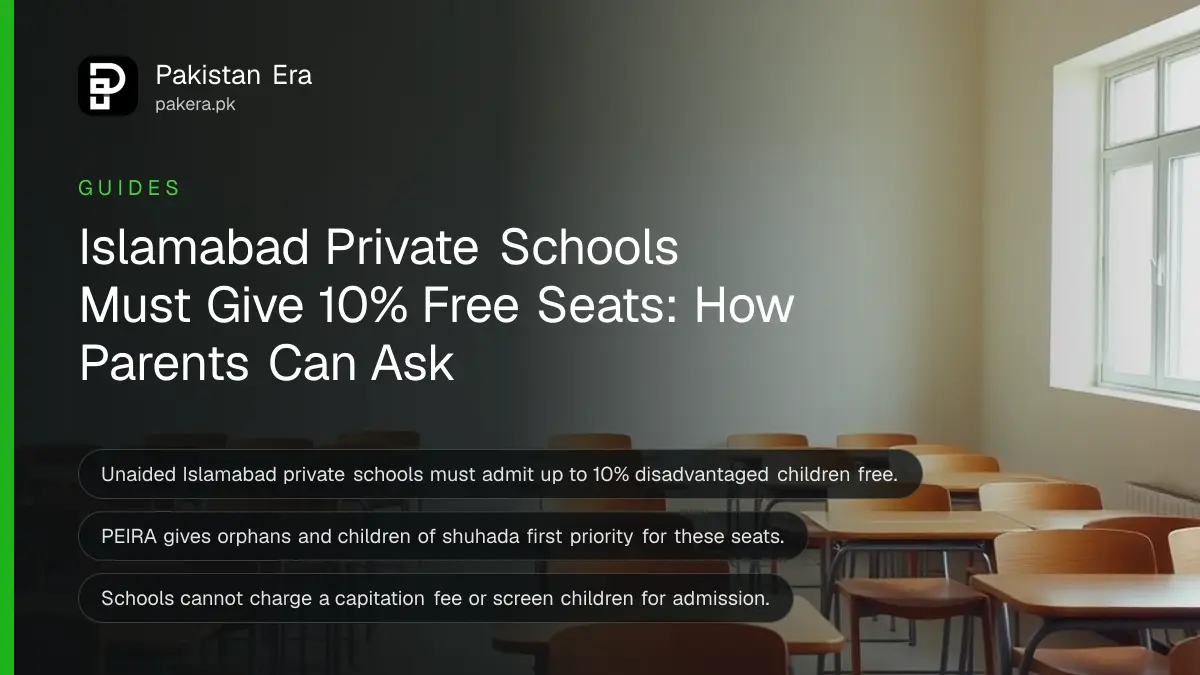
Every registered private school in Islamabad must keep at least 10% of its seats as need-based scholarships or free education, and orphans and children of shuhada get first priority. Ask the school in writing at admission time. If it refuses, complain to PEIRA at complaints.peira.gov.pk or complaints_cell@peira.gov.pk.
Many Islamabad parents never hear about this rule, because schools do not advertise it. Yet it is written in two places: the federal Right to Free and Compulsory Education Act, 2012, and the registration conditions set by the Private Educational Institutions Regulatory Authority (PEIRA). A family that knows the rule can ask for the seat with confidence.
| Rule | What it says | Source |
|---|---|---|
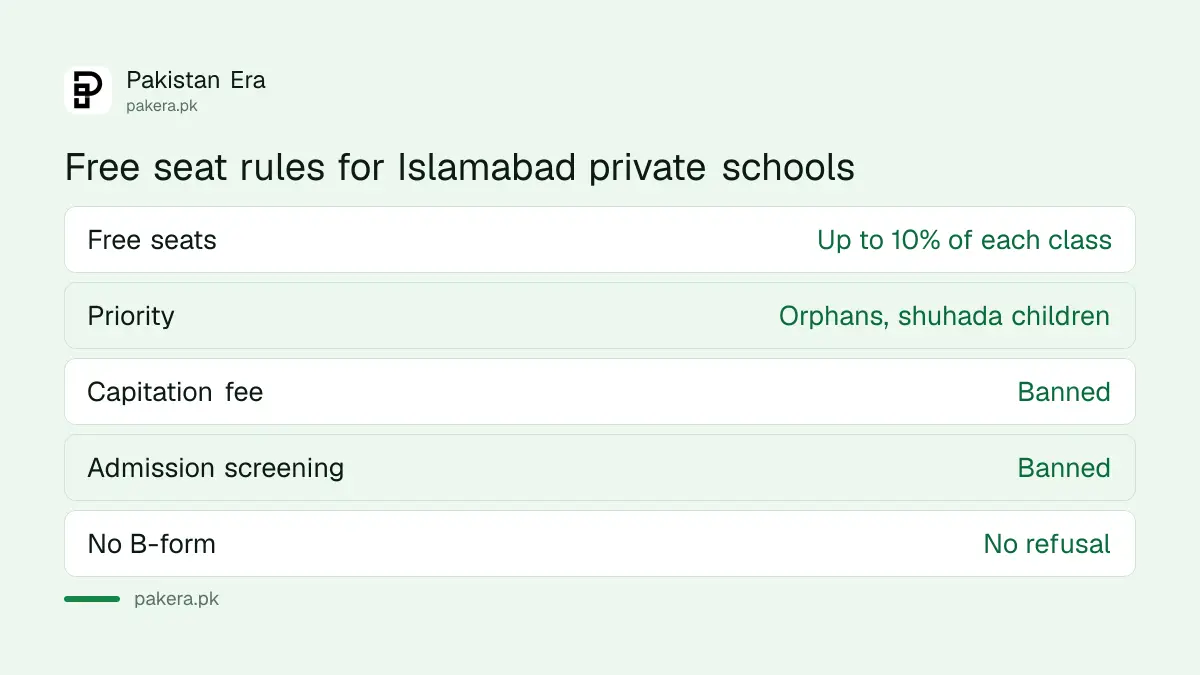
| 10% free seats | Unaided private schools admit disadvantaged children up to 10% of each class, free | Section 10(b), RTFCE Act 2012 |
| Need-based scholarships | At least 10% scholarships for students in need, a condition of registration | PEIRA policy |
| Who goes first | Orphan children and children of shuhada | PEIRA notification, 13 January 2026 |
| No screening | No capitation fee and no admission test for selection | Section 11, RTFCE Act 2012 |
| No proof of age | No child is refused admission for lack of an age document | Section 12, RTFCE Act 2012 |
The law reserves 10% of every class for disadvantaged children
Section 10(b) of the Right to Free and Compulsory Education Act, 2012 says a private school that gets no government aid must admit disadvantaged children from the neighbourhood in class I, and then in every class, up to 10% of the class strength, and educate them free to the school's final level.
The same section applies the rule to pre-school classes where a school runs them. The Act covers children aged 5 to 16 in the Islamabad Capital Territory. It defines "free education" as education free of education-related costs, including stationery, school bags and transport.
A "disadvantaged child" in the Act is one from a socially and economically disadvantaged class or group, or whose parents earn below an income limit the government notifies. Keep a salary slip, pension slip or other income proof ready when you ask.
PEIRA makes the 10% a condition of every school's registration
PEIRA requires every private school in Islamabad to give at least 10% scholarships to students in need, as part of the right to education. This is printed on every new and renewed registration certificate. It comes on top of any merit scholarships the school offers on its own.
So the school cannot say the rule does not apply to it. If it is registered with PEIRA, it has agreed to the condition. Ask to see the registration certificate at the front office; the 10% condition should be on it.
On 13 January 2026, PEIRA directed all private schools to implement the 10% need-based scholarship and free education policy strictly. It ordered that orphan children and children of shuhada be given priority when students are enrolled under the policy, and warned of action under the PEIRA Act, 2013 for non-compliance.
Ask for the seat in writing in five steps
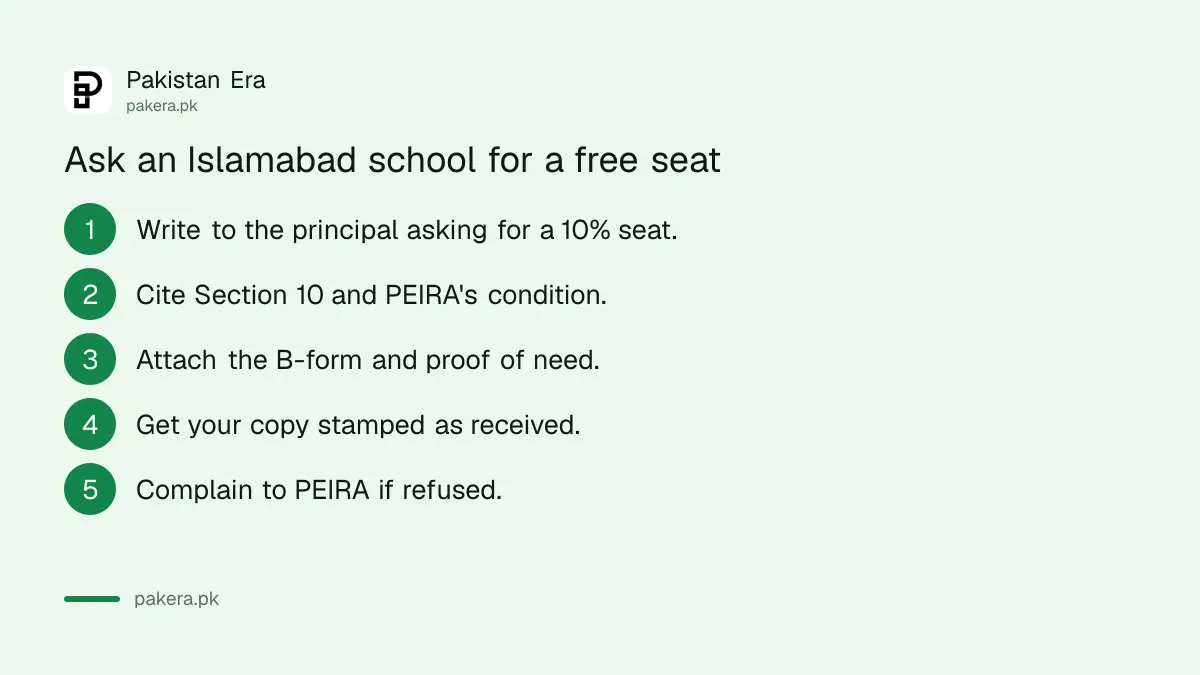
Apply to the school in writing at admission time, name the 10% rule, attach proof of need, and keep a signed or stamped copy. A written request gives PEIRA something to act on if the school says no. PEIRA's rules start the academic year on 1 April, so ask early.
- Write a short application to the principal asking for a free or need-based seat under the 10% policy.
- Mention Section 10 of the RTFCE Act 2012 and PEIRA's 10% registration condition.
- Attach the child's B-form and your proof of need, such as income proof, a father's death certificate or a shaheed family certificate.
- Hand it in and ask for a receiving stamp on your copy, or send it by registered post.
- If there is no answer in two weeks, follow up in writing and keep every reply.
The B-form helps, but the Act says no child may be refused admission for lack of proof of age. If the B-form is still being made, the steps for a NADRA B-form for a child explain how to get one.
A school cannot charge a capitation fee or test your child to pick
Section 11 of the Act bans any capitation fee, meaning any donation or payment beyond the notified fee, and any screening procedure, meaning a selection method other than random. Fines run up to 20 times the capitation fee and up to Rs 50,000 for a first screening breach.
| Breach | First time | Each later time |
|---|---|---|
| Taking a capitation fee | Fine up to 20 times the fee charged | Fine up to Rs 50,000 |
| Screening a child or parent | Fine up to Rs 50,000 | Fine up to Rs 100,000 |
If a school asks for a "donation" or a "building fund" before giving a free seat, write down the amount and who asked. PEIRA's rules also limit what fees a school can charge at all; the details are in the guide to complain about a private school fee in Islamabad.
Complain to PEIRA if the school refuses
Register as a parent on PEIRA's Complaint Redressal System, name the school, attach your written request and its reply, and say which rule was broken. You can also email complaints_cell@peira.gov.pk or call the complaints cell on 051 9107746.
| PEIRA contact | Detail |
|---|---|
| Complaint portal | complaints.peira.gov.pk, "Parent / General Public" |
| Complaints email | complaints_cell@peira.gov.pk |
| Complaints cell phone | 051 9107746 |
| Member Registration | 051 9107711 |
| Secretary PEIRA | 051 9107745 |
The portal says complaints are kept confidential. Under PEIRA's 2024 rules, the Authority can fine a school for any breach of the rules, at 10% of the matching tuition fee for each day the breach continues after notice. Families outside Islamabad have a different law: in Punjab, see how to get a free seat in a Punjab private school.
Common questions
Do all private schools in Islamabad have to give free seats?
Yes, every school registered with PEIRA. The 10% need-based scholarship condition is printed on new and renewed registration certificates.
Who gets priority for the 10% seats?
PEIRA's notification of 13 January 2026 gives priority to orphan children and children of shuhada.
Does free education cover books and transport?
The RTFCE Act 2012 defines free education as free of education-related costs, including stationery, school bags and transport.
Can the school test my child before giving a free seat?
Section 11 bans screening procedures, meaning any selection method other than random. A school that screens can be fined up to Rs 50,000 for a first breach.
My child has no B-form. Can the school refuse?
No. Section 12 says no child shall be denied admission for lack of proof of age.
Does this rule apply in Rawalpindi?
No. PEIRA and the 2012 Act cover the Islamabad Capital Territory. Rawalpindi schools follow Punjab law.
How we verified this
What we checked and where we read it.
We checked the Right to Free and Compulsory Education Act, 2012 on the Pakistan Code website, PEIRA's "Need-based Scholarship Provisions" page, its notification of 13 January 2026 on orphans and shuhada children, its Complaint Redressal System home page, its contact page and the 2024 PEIRA rules (S.R.O. 179(I)/2025) on 24 November 2026. The Act leaves the income limit for a "disadvantaged child" to a government notification, which is not posted on the PEIRA site. Sources: RTFCE Act 2012 and PEIRA.
Free on WhatsApp
Get last dates and rule changes on WhatsApp
We post new last dates, fee changes and fixes for common problems, a few short posts a day.
Follow Pakera on WhatsAppOther followers cannot see your number.
Pakera Solves It
Which online process wasted your time this week?
A portal that will not load, a form nobody explains, a complaint that went nowhere. Tell us. Every week we pick one, solve it step by step and publish the answer.
About the author
Public Services and Education Journalist
Fajr Riaz is a journalist and content writer at Pakistan Era, based in Lahore. She covers the questions people meet in everyday life in Pakistan: how a public service works, what a change in the rules means, and where to find a reliable answer.