Get a Free Seat in a Private School in Punjab Under the 10 Percent Quota
Punjab law makes unaided private schools keep 10% of seats in every class free for disadvantaged children. Who qualifies, how to apply and where to complain.
Every private school in Punjab that takes no government aid must keep 10 percent of the seats in each class, from class one up, for children who study free. That is section 13 of the Punjab Free and Compulsory Education Act 2014. The school cannot charge these children admission fee, tuition fee, security or any donation.
The detail is in the Punjab Free and Compulsory Education Rules 2024, which we read in the Punjab Gazette copy on the School Education Department website. They say who counts as a disadvantaged child, how a family applies, and what happens when a school refuses. One warning first: we could not find a published seat list or application form for any district, so this is a right you may have to push for.
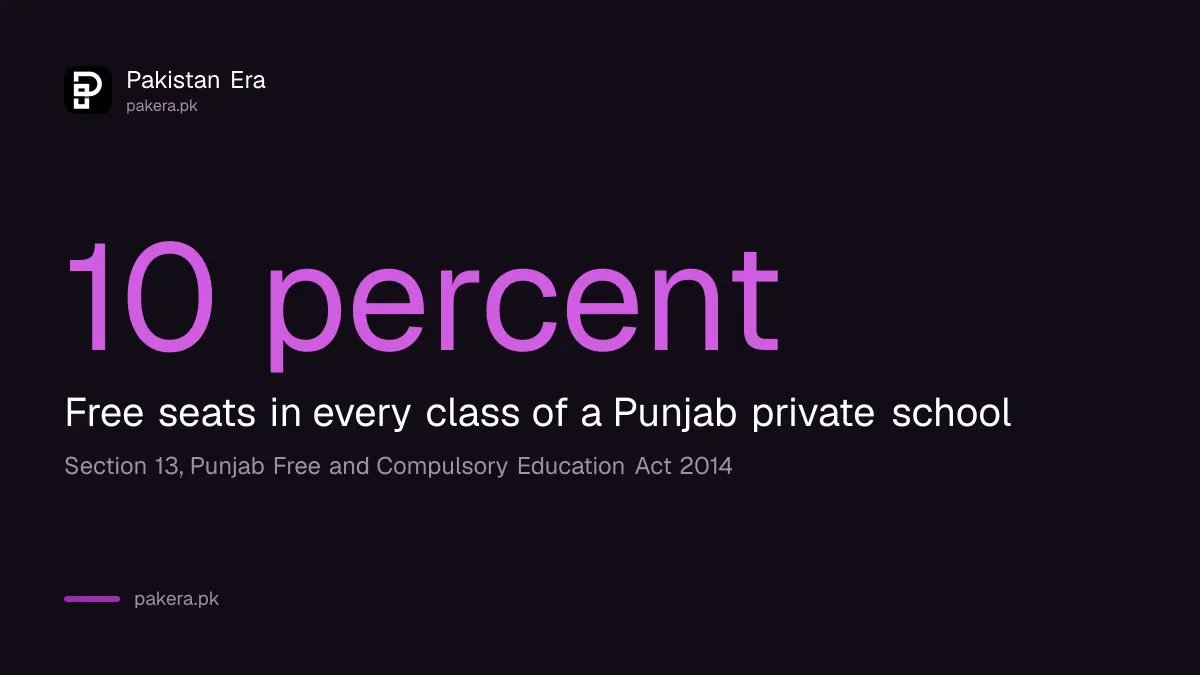
Private schools in Punjab must give 10 percent of seats free
Section 13 of the Act tells every unaided private school to admit, in class one and then in every class, 10 percent of that class's strength free. Rule 14 bans charging these children admission fee, tuition fee, security charges or capitation fee "whatsoever".
The Act gives the government a second option. Instead of free seats, a school can be made to provide "prescribed vouchers" for the education of disadvantaged children in another school. Rule 14 says that if a school fails to admit enough children, it must give the district vouchers equal to its admission fee, tuition fee and security charges for the missing seats.
Aided private schools, meaning those that get government grants, have a different duty. They must give free education to a share of children that matches the share of their running costs paid by the grant.
Who counts as a disadvantaged child under the 2024 Rules
Rule 13 lists three groups: children facing social exclusion, children facing economic exclusion, and children with a mild disability. The District Education Authority decides who qualifies, working with the Social Welfare and Bait-ul-Maal Department.
| Group | Examples named in Rule 13 |
|---|---|
| Social exclusion | Orphan or single parent; gender; parents who cannot read; living in a slum or kachi abadi; religious, caste or tribal minority in the area; remote area |
| Economic exclusion | Unemployed parents; parents earning less than the government's notified minimum wage; nomadic families; families on a poverty support programme or zakat |
| Mild infirmity | Intellectual weakness, mild physical disability or slow learning |
Rule 14 adds an income test. A disadvantaged child applies for the 10 percent quota "if the income of his family is less than the minimum income notified by the Government". We did not find that income notification on the department's website.
A family on BISP support or on Bait-ul-Mal help for orphans already fits one of the named categories, which makes papers from those programmes useful evidence.
Girls, orphans and children of kiln workers get preference
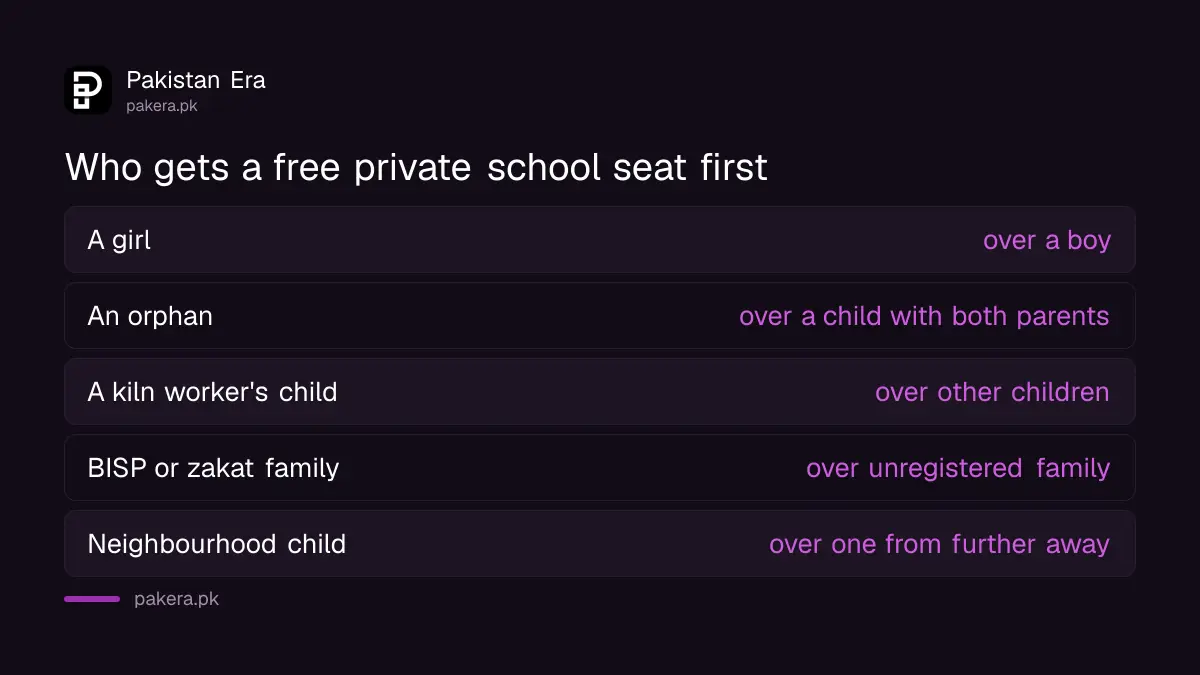
When more children apply than there are free seats, the District Education Authority allocates them using preferences in the Appendix to the 2024 Rules. A child who meets two or more conditions ranks higher. Girls, orphans, minority children and kiln workers' children are named.
Among the preferences the Appendix lists:
- A girl over a boy.
- An orphan over a child with both parents alive, and a single parent family over a two parent family.
- A child living in the neighbourhood over one from further away.
- A child of a kiln worker or workshop worker over other children.
- A child whose parents get a poverty targeted income support or zakat over one whose parents are not registered.
- A child from a minority community, a nomadic family or a slum.
How to apply for a free private school seat in Punjab
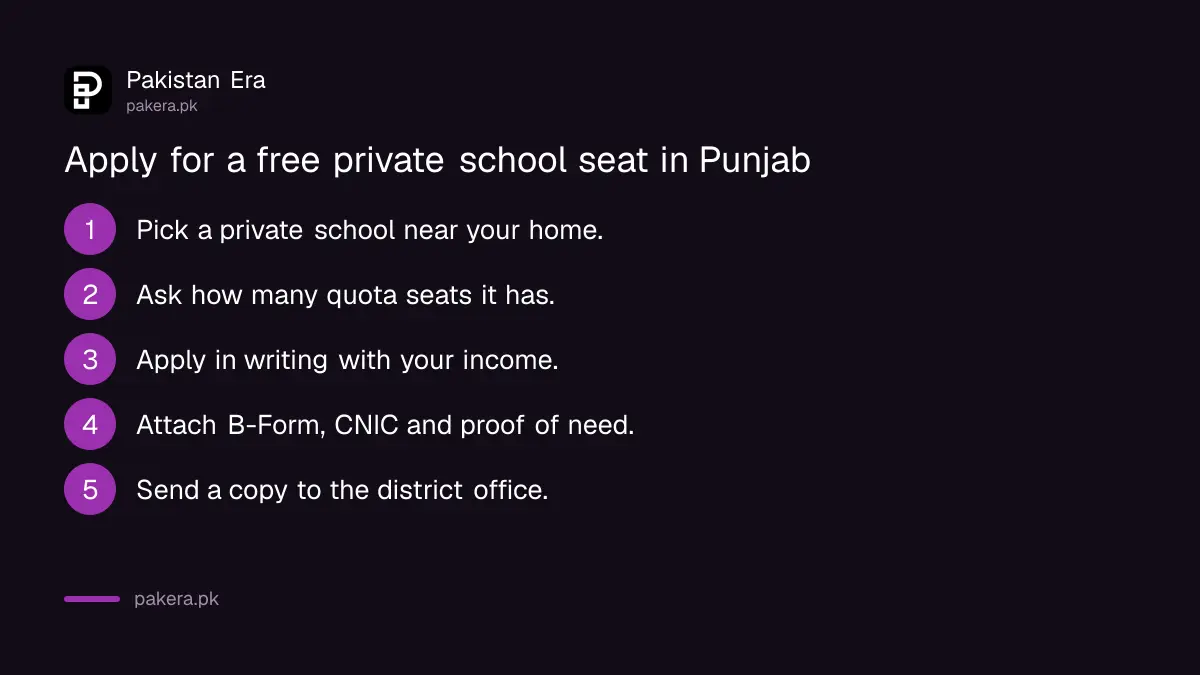
Apply in writing to the private school near your home and send a copy to the District Education Authority. Show why your child is disadvantaged and that your income is low. Keep receipts of both letters. If the school refuses, the district must deal with it.
- Pick a private school in your neighbourhood. The Rules prefer neighbourhood children, and Rule 8 sets primary schools within 1.5 km of home.
- Ask the school how many seats it has reserved. Rule 14 says each school must announce this publicly in print and electronic media and tell the district.
- Write an application for admission against the 10 percent quota. Give the child's name, age and class, your address and your monthly income.
- Attach evidence. The child's B-Form, your CNIC, and proof of the category: a death certificate for an orphan, a BISP or zakat record, or a signed letter. Rule 5 refers to evidence signed by a government officer, a magistrate or a local government member.
- Send a copy to the Chief Executive Officer of the District Education Authority and keep the received copy.
- Follow up during the admission period, 1 April to 31 October, and check the list the district must display at its office and on its website.
What the school cannot do once your child is in
A school that admits a child on a free seat cannot charge any fee, cannot seat the child in a separate room or at different timings, and cannot treat the child differently in any way. Rule 14 says so in plain terms.
The district must also pay for the child's uniform, learning material and transport in advance, through a voucher to the parents, when a disadvantaged child is placed in a public or aided private school. Ask the district office how it pays this.
The school must send the district monthly data on every child admitted under the quota, and an officer can inspect its records. So once a seat is given, it is on record.
Complain to the District Education Authority if a school refuses
Rule 16 lets any person file a written complaint about a child's right to education with the District Education Authority, which must decide within 30 days after hearing both sides. Rule 14 says if a school fails to admit under the quota, the authority "shall proceed" under the Act.
Write to the Chief Executive Officer of your District Education Authority. Attach your application, its receipt and your evidence. The School Education Department lists a hotline, 042-111-11-20-20, on its initiatives page.
A free private seat is not the only route. A government school in Punjab must admit your child free, and Punjab Education Foundation partner schools teach voucher children free as well.
Common questions
Do private schools in Punjab have to give free seats?
Yes. Section 13 of the Punjab Free and Compulsory Education Act 2014 makes every unaided private school admit 10 percent of each class free, from class one up, or provide vouchers instead if the government decides so.
Who can apply for the 10 percent quota?
A disadvantaged child under Rule 13, such as an orphan, a child of unemployed or low paid parents, a minority child or a child with a mild disability, whose family income is below the government's notified limit.
Can the school charge anything for a free seat?
No. Rule 14 bans admission fee, tuition fee, security charges and capitation fee for these children.
Where is the list of free seats?
Each school must announce its reserved seats in print and electronic media, and the District Education Authority must display the list at its office and on its website. We could not find a published list on 2 October 2026.
What if the school says it has no quota?
Complain in writing to the District Education Authority. Rule 16 gives it 30 days to decide, and Rule 14 tells it to act under the Act when a school fails to admit.
How we verified this
What we checked, where we read it, and what we could not confirm.
Last checked on 2 October 2026. We read section 13 of the Punjab Free and Compulsory Education Act 2014 on the Punjab Code website, and rules 5, 8, 13, 14 and 16 and the Appendix of the Punjab Free and Compulsory Education Rules 2024, published in the Punjab Gazette on 10 February 2025. We did not find the government's minimum income notification for the quota, a district seat list, or an official application form. How far districts enforce the quota is not something we could check.
About the author
Public Services and Education Journalist
Fajr Riaz is a journalist and content writer at Pakistan Era, based in Lahore. She covers the questions people meet in everyday life in Pakistan: how a public service works, what a change in the rules means, and where to find a reliable answer.