Pakistan Reports 395 Suspected Cutaneous Leishmaniasis Cases in a Week, 356 in KP
NIH's week 38 bulletin counts 395 suspected cutaneous leishmaniasis cases in Pakistan, 356 in Khyber Pakhtunkhwa. See the districts and what a skin sore needs.
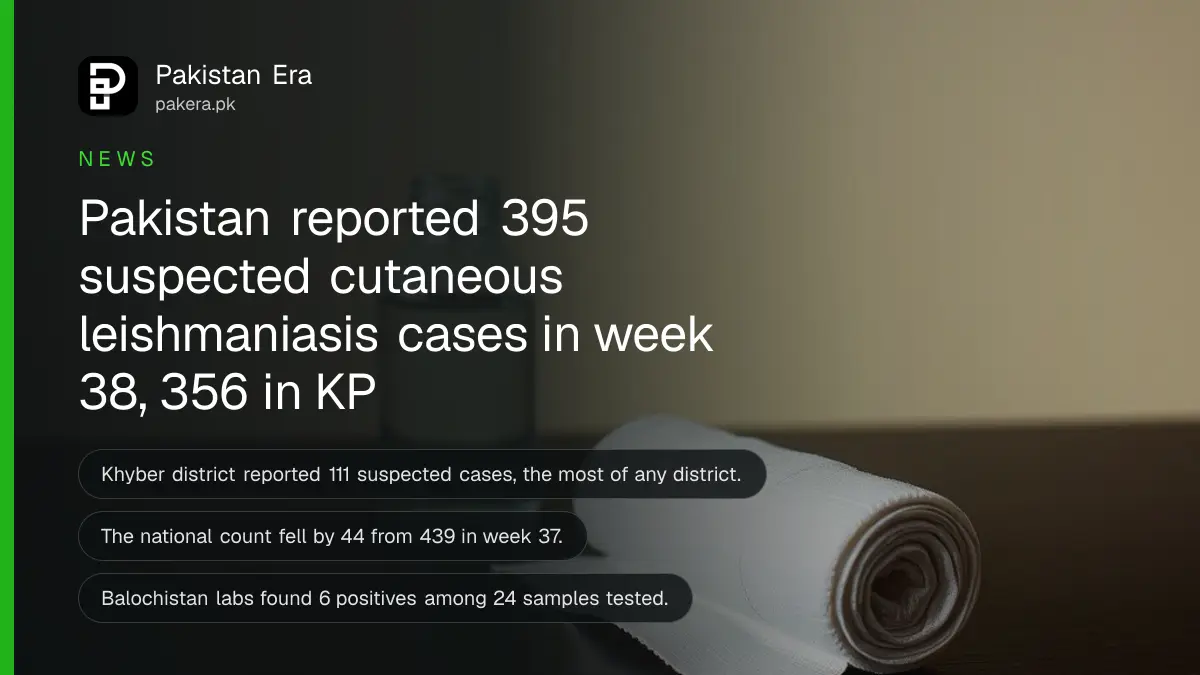
Short answer: Pakistan reported 395 suspected cases of cutaneous leishmaniasis in week 38 of 2026, down from 439, the National Institutes of Health (NIH) says. Khyber Pakhtunkhwa sent 356 of them, and Khyber district alone had 111. The disease spreads by sandfly bites and shows as a skin sore. See a doctor for a sore that will not heal.
The NIH put the week 38 bulletin online on Friday 9 October 2026. We read its tables and set them beside week 37. The figures are suspected cases sent in by clinics, not lab-confirmed ones. Punjab did not report.
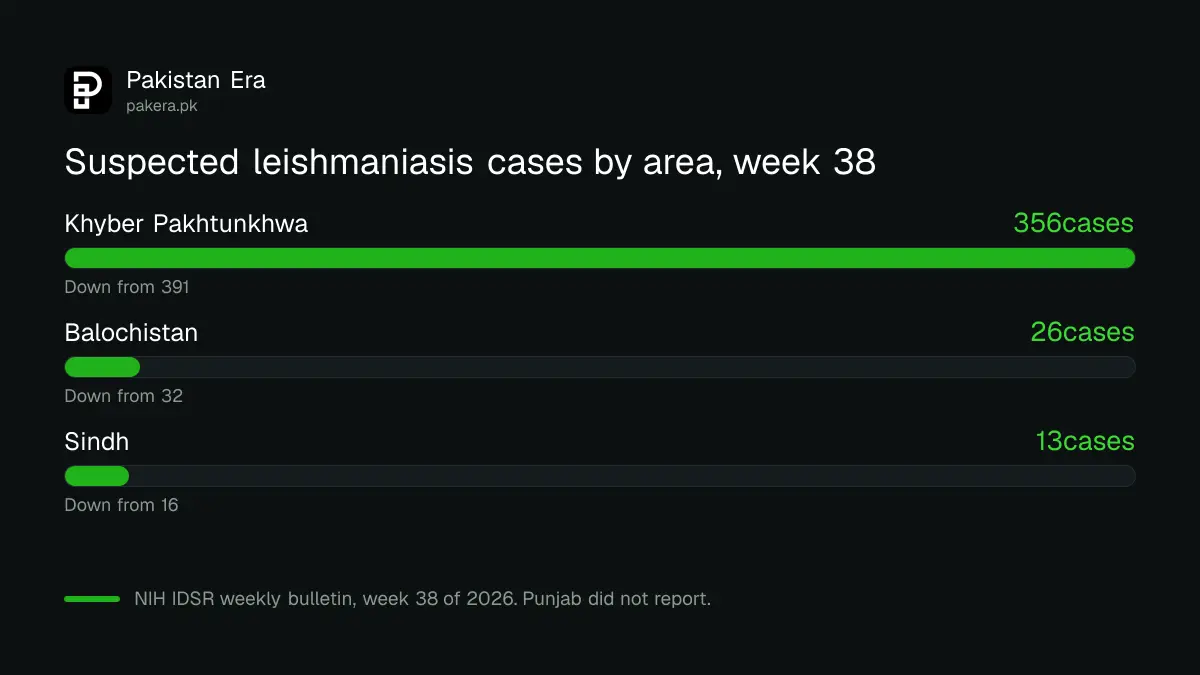
Khyber Pakhtunkhwa reported 356 of the 395 cases
The NIH bulletin lists cutaneous leishmaniasis, shortened to CL, among the diseases it tracks every week. Khyber Pakhtunkhwa reported 356 cases in week 38, Balochistan 26 and Sindh 13. The national count fell by 44 cases from week 37.
Cutaneous leishmaniasis ranked just after dengue in the national table. AJK, Gilgit-Baltistan and Islamabad reported none, and Punjab is marked NR, for not reported, so the national count leaves out the largest province.
| Area | Week 37 | Week 38 |
|---|---|---|
| Khyber Pakhtunkhwa | 391 | 356 |
| Balochistan | 32 | 26 |
| Sindh | 16 | 13 |
| AJK, Gilgit-Baltistan, Islamabad | 0 | 0 |
| Punjab | NR | NR |
| Pakistan | 439 | 395 |
Khyber, Karak and Mohmand led the district list
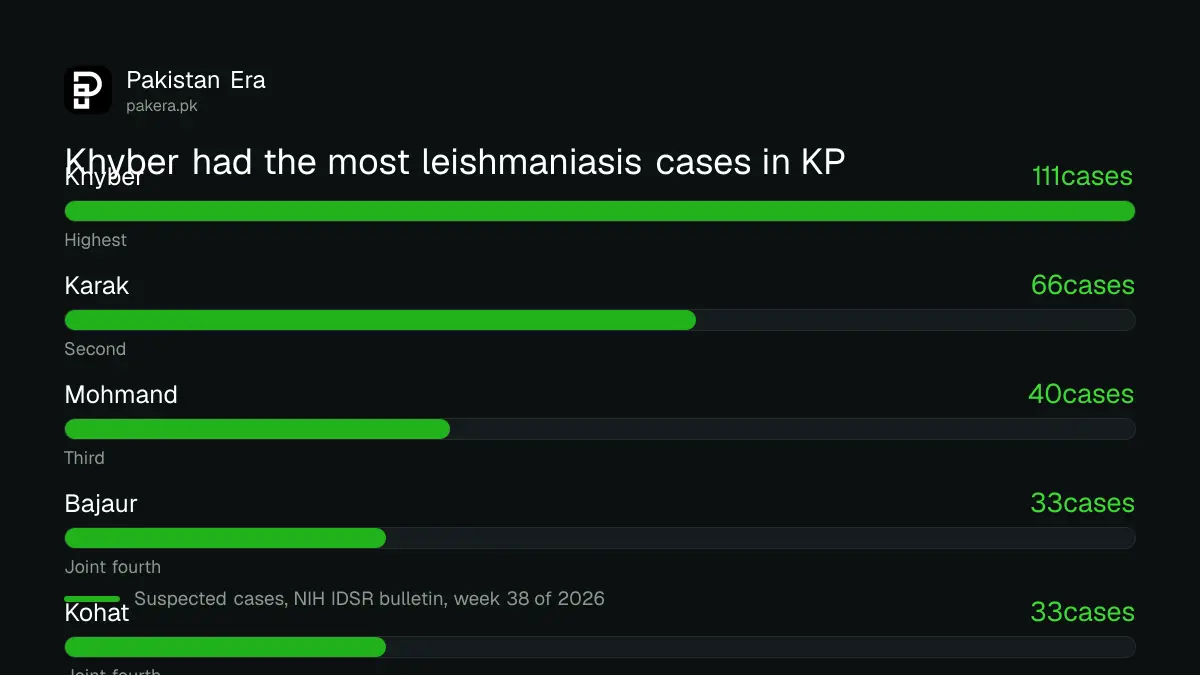
Khyber district reported 111 suspected cases in week 38, Karak 66 and Mohmand 40. Bajaur and Kohat each had 33, and Nowshera 31. The three leading districts account for 217 cases, about three in every five in the province.
The NIH does not say why these districts lead. District counts depend on how many clinics report and on the population, so they show where cases were recorded. Our guide to checking disease cases in your district shows how to find any district's row in the bulletin.
Balochistan's labs found 6 positives in 24 tests
The NIH's public health laboratory table shows 24 samples tested for cutaneous leishmaniasis in Balochistan in week 38, of which 6 were positive. Sindh's laboratories tested 2 samples and found 1 positive. Gilgit-Baltistan tested 2 and found none.
These are small numbers and say little about the scale. Most of the 395 suspected cases were not lab tested, going by the bulletin's table. Khyber Pakhtunkhwa, which had the most suspected cases, has no entry in the laboratory table for this disease.
| Area | Samples tested | Positive |
|---|---|---|
| Balochistan | 24 | 6 |
| Sindh | 2 | 1 |
| Gilgit-Baltistan | 2 | 0 |
The disease spreads by sandfly bites and leaves a skin sore
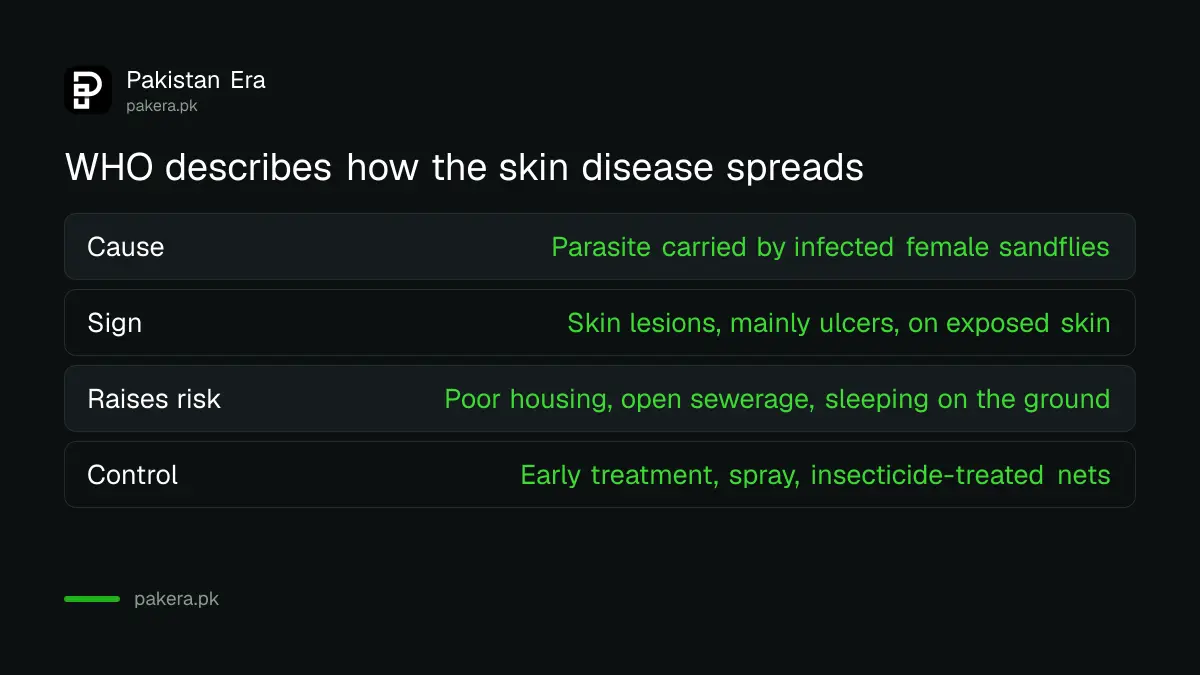
The World Health Organization says cutaneous leishmaniasis is the most common form of leishmaniasis. It is caused by parasites carried by infected female sandflies, and it causes skin lesions, mainly ulcers, on exposed parts of the body. These can leave life-long scars.
WHO says poor housing, open sewerage and waste raise the risk because they help sandflies breed and rest. Sleeping outside or on the ground can raise it too. The disease is treatable and curable, and WHO says early diagnosis and prompt treatment reduce disability and spread.
WHO's Eastern Mediterranean Region, which includes Pakistan, accounts for 80 per cent of the cutaneous cases reported worldwide. That is a regional figure and not a Pakistan count.
What to do about a skin sore that does not heal
See a doctor at a government hospital or a licensed clinic for a skin sore that does not heal. Only a test can tell leishmaniasis from other skin problems. Do not treat it at home or with leftover medicine.
Our guide to checking that a clinic or lab is licensed in Khyber Pakhtunkhwa helps you pick a legitimate place for testing. For other insect-borne diseases in the same bulletin, see our reports on dengue in Islamabad and Khyber Pakhtunkhwa and malaria in Sindh.
- Note the date the sore first appeared and where you were bitten or sleeping.
- Do not scratch or pick at it, and keep it covered with a clean dressing.
- Go to a government hospital or licensed clinic and say you suspect leishmaniasis.
- Ask for a lab test before any treatment starts.
- Finish the full treatment the doctor gives you.
The steps above are general advice, not from the NIH bulletin. WHO says control depends on early diagnosis, treatment, insecticide spray, insecticide-treated nets and cleaning up the environment.
Common questions
How many cutaneous leishmaniasis cases did Pakistan report in week 38?
Pakistan reported 395 suspected cases in week 38 of 2026, according to the NIH, down from 439 in week 37. Khyber Pakhtunkhwa sent 356. Punjab did not report.
What is cutaneous leishmaniasis?
It is a skin disease caused by a parasite and spread by the bite of an infected sandfly. WHO says it causes skin ulcers on exposed parts of the body, which can leave scars.
Is it spread from person to person?
WHO describes the infection as transmitted through the bites of infected sandflies. Its fact sheet does not describe spread by touch. Ask your doctor about your own situation.
Which district had the most cases?
Khyber district in Khyber Pakhtunkhwa, with 111 suspected cases in week 38. Karak was second with 66. District counts depend on reporting and on population.
Is it curable?
WHO says leishmaniasis is a treatable and curable disease. Treatment depends on the type of disease and where the person lives, so a doctor must decide.
Where can I read the bulletin?
The NIH publishes the bulletin each week on its Public Health Bulletin page, which we link in the sources below.
How we verified this
What we checked, where we read it, and what we could not confirm.
Last checked on Sunday 11 October 2026. We read the NIH Integrated Disease Surveillance and Response bulletins for weeks 37 and 38 of 2026 from the National Institutes of Health weekly bulletin page, and the World Health Organization's leishmaniasis fact sheet. All counts are suspected cases as the NIH prints them.
About the author

Tax, Bills and Technology Writer
Ali Akhtar is a young and curious voice here at Pakistan Era. He is currently pursuing his A-Levels and has a growing interest in Pakistan’s changing industrial landscape and educational trends. Ali likes to write in a way that helps him explain and explore the world around him. His writing reflects the perspective of the new generation navigating the evolving trends of Pakistan where technology, youth innovation, and shifting opportunities are reshaping the country’s future.