FBR SRO 2134: Sales Tax Appeals Go Faceless, Hidden Commissioner, Stay Decided in 7 Working Days
FBR SRO 2134 of 18 November 2026 makes sales tax appeals online only, with an anonymous Commissioner and a stay decided in 7 working days. Start date pending.
Short answer: FBR's S.R.O. 2134(I)/2026, dated 18 November 2026, adds a "Faceless Appeals" chapter to the Sales Tax Rules. Sales tax and federal excise appeals will be filed and heard online only, the Commissioner (Appeals) will stay anonymous with face hidden and voice modulated on video, and a stay of recovery must be decided within 7 working days. The chapter is not in force yet: FBR will notify the start date separately.
That start date is the point most readers will miss. The rules are final, but they apply only from a date FBR has still to publish, and the date can differ for different classes of appeals. Until then, appeals go on as before.
FBR published a matching draft for income tax appeals the same day, S.R.O. 2136(I)/2026, with only three days for objections after it appears in the Gazette.
SRO 2134 moves sales tax appeals to the National Faceless Centre
SRO 2134 covers appeals under section 45B of the Sales Tax Act and section 33 of the Federal Excise Act that run through the National Faceless Centre. That means appeals against orders made by officers in the Centre, plus any other orders FBR later names by notification.
The Centre gets an Appeals Wing made up of Appellate Units. Each unit is run by a Commissioner Inland Revenue (Appeals). The wing reports to Member (Legal) Inland Revenue at FBR, and the rules say the Centre's Director General and Chief Commissioner cannot direct a Commissioner (Appeals) on how to hear or decide a case.
If your sales tax assessment came from the faceless unit set up under SRO 2085 for faceless sales tax assessment, this is where your appeal will go once the chapter starts.
You will never know who decides your appeal
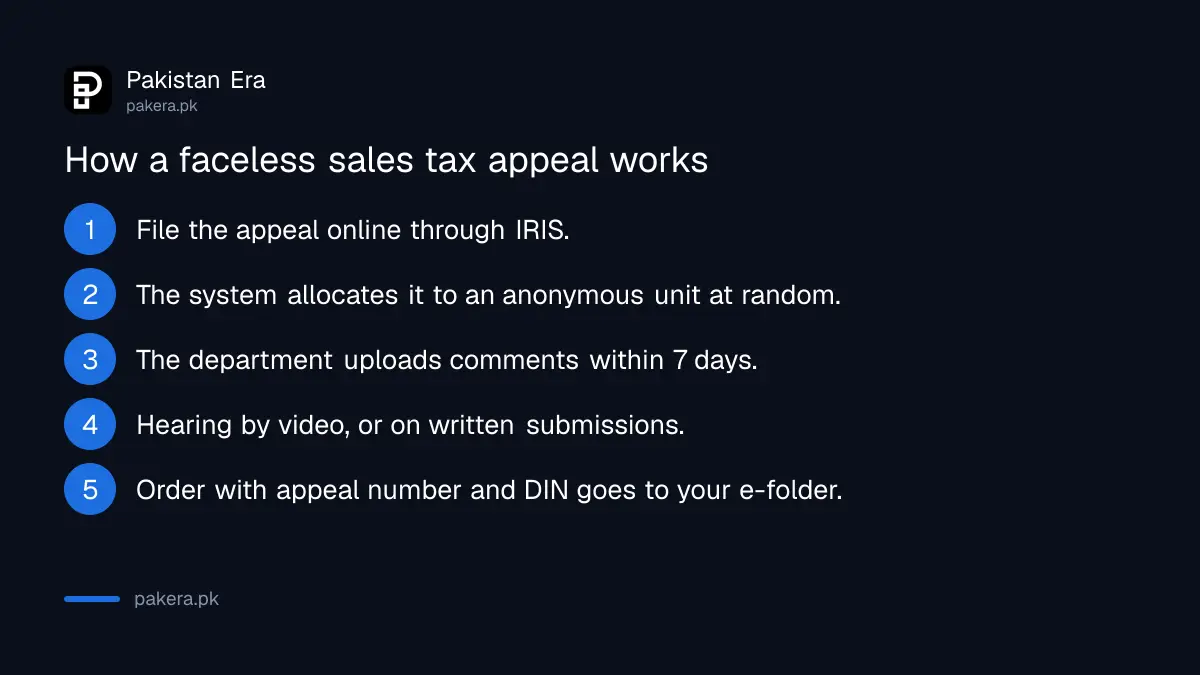
Every appeal gets an automatic number and is sent to an Appellate Unit at random by an FBR algorithm. The name of the unit and the Commissioner stays hidden from you, your lawyer and the tax department, even in the final order. On video, the Commissioner's face is not shown and the voice is modulated.
The order itself carries an appeal number and a Digital Identification Number (DIN) instead of a name or signature. If you go on to the Appellate Tribunal, you quote that appeal number and DIN in place of the Commissioner's name.
Some safeguards come with the anonymity. An officer who did the audit, the assessment or the quality control on your case cannot hear its appeal. A Commissioner with a personal or financial link to you must record it and step aside. And once a hearing has started, the appeal can be moved only for written reasons, in which case you can ask to be heard again from the start.
| Step | What SRO 2134 says |
|---|---|
| Filing | Online only, through IRIS or another FBR system |
| Allocation | Random and automatic, every allocation logged |
| Who hears it | Anonymous Commissioner (Appeals) |
| Hearing | Video only, face hidden and voice modulated |
| In-person appearance | Not allowed for either side |
| Department's comments | Within 7 days of being asked, unless more time is given |
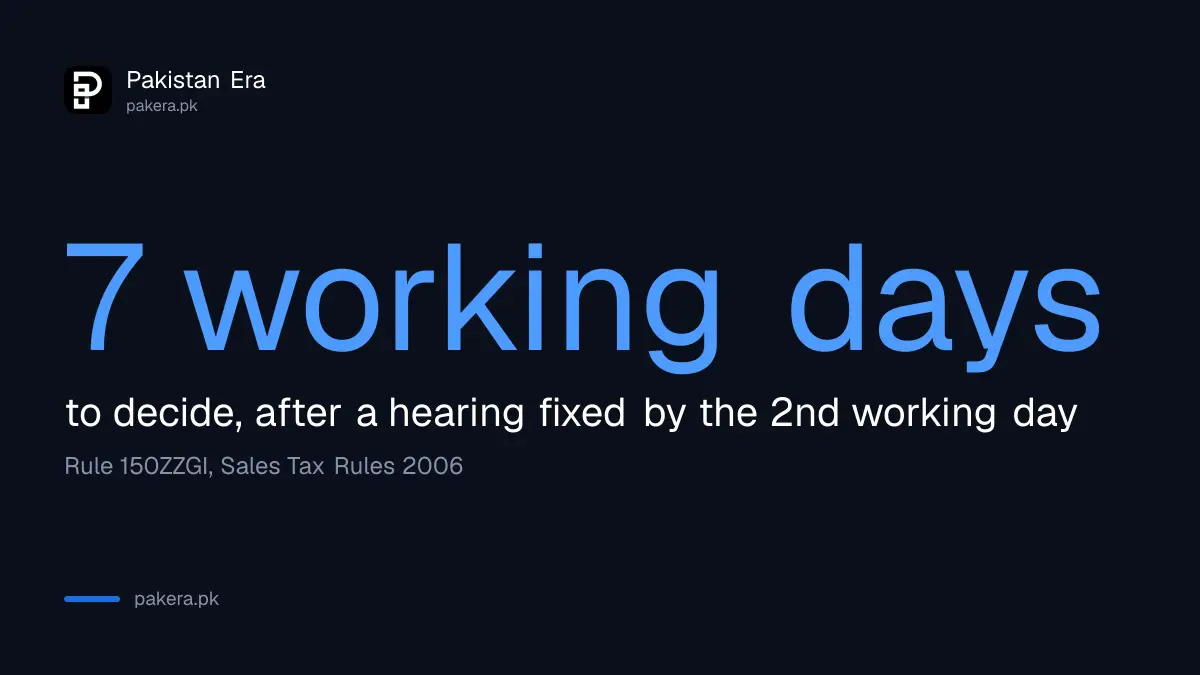
| Stay of recovery | Fixed for hearing by the 2nd working day, decided within 7 working days |
| Written option | You can choose a decision on written submissions only |
| Order | Carries an appeal number and DIN, no name or signature |
| Service | Sent to your e-folder in the system, which counts as served |
A stay of recovery must be decided within 7 working days
For a business facing recovery of a disputed tax demand, the stay rule is the most useful part. Once you file a stay application online, the system must fix it for an e-hearing no later than the second working day. The Commissioner must decide it within seven working days of that date.
The Commissioner must hear the department before deciding. The decision goes out through the system to you, the department and the Field Operations Wing on the same day it is made. That last step matters, because the field office is the one that carries out recovery.
The hearing itself is by video through FBR's own system, and every hearing is recorded and kept in the appeal file. If you prefer, you can ask through the portal for a decision on written submissions alone. The department then files written comments and you get a right of reply.
Four clauses that protect the taxpayer
Beyond the stay deadline, four clauses in the rules help the person appealing. Each one is easy to overlook in a long notification.
- Portal failure counts as a good reason. If you miss the deadline because the e-portal was down, and FBR confirms the technical failure, that is treated as sufficient cause for a late appeal.
- No internet is not a bar. You can ask to join the video hearing from the e-hearing room at the nearest Field Operations Wing unit, and that office must arrange it.
- The Tribunal route stays open. The option to appeal straight to the Appellate Tribunal, under the second proviso to section 45B, is untouched.
- Pending appeals stay put. An appeal already before a Commissioner (Appeals) on the start date continues there, unless FBR orders it moved. If it is moved, it continues from the stage it had reached.
The direct route matters for larger disputes. The fee and the 30 day limit for an appeal to the Appellate Tribunal Inland Revenue are unchanged by SRO 2134. And the portal-failure clause is worth knowing on any deadline day, because IRIS going down near a deadline is not new.
One more clause cuts the other way for some appellants. Where the Commissioner orders a further enquiry, the rules say this does not allow the case to be sent back for a fresh decision from scratch. The Commissioner has to decide it on the record and the enquiry report.
Income tax appeals are next, with 3 days to object
The income tax version is still a draft. S.R.O. 2136(I)/2026 proposes a new Chapter XIXA, "Faceless Appeals", in the Income Tax Rules, 2002, for appeals under section 127 of the Income Tax Ordinance that go through the faceless centre. It adds an Appeals Wing and follows the same pattern as the sales tax rules.
Objections and suggestions must reach FBR within three days of the draft's publication in the official Gazette. That is a very short window. Tax advisers and business groups who want to comment should do it at once.
| Notification | Tax | Status |
|---|---|---|
| S.R.O. 2134(I)/2026 | Sales tax and federal excise | Final, start date to be notified |
| S.R.O. 2136(I)/2026 | Income tax | Draft, objections within 3 days of Gazette publication |
Both follow the faceless assessment rules FBR has rolled out since October, so the full chain, from audit to assessment to first appeal, is moving online. The background on the National Faceless Centre explains how cases reach it in the first place.
Common questions about FBR faceless appeals
Is SRO 2134 in force now?
No. The chapter starts on a date FBR will notify in the Gazette, and different dates can apply to different classes of appeals. Until then, sales tax appeals follow the existing process.
Can I meet the Commissioner (Appeals) in person?
No. Neither you nor the department can appear in person. Hearings are by video only, or you can ask for a decision on written submissions.
How will I know who decided my appeal?
You will not. The order carries an appeal number and a Digital Identification Number instead of the Commissioner's name, designation or signature.
How fast is a stay of recovery decided?
The system must fix the stay application for an e-hearing by the second working day after you file it. The Commissioner must decide it within seven working days of that date.
What if IRIS is down on my last day to appeal?
If FBR confirms a technical failure of the e-portal, the rules treat it as sufficient cause for a late appeal. Keep screenshots of the error with the date and time.
Does this cover income tax appeals?
Not yet. SRO 2134 covers sales tax and federal excise. The income tax version, SRO 2136, is a draft open for objections for three days after Gazette publication.
How we verified this
What we checked and where we read it.
We read S.R.O. 2134(I)/2026 (Sales Tax Rules, Chapter XIV-CA, rules 150ZZGB to 150ZZGN) and the draft S.R.O. 2136(I)/2026 (Income Tax Rules, Chapter XIXA) in full, both dated 18 November 2026, from the SRO list on the Federal Board of Revenue website, on 20 November 2026. Every rule above is from the notification text. The scanned PDFs carry the SRO number by hand, and the draft's number is taken from FBR's own listing.
About the author

Tax, Bills and Technology Writer
Ali Akhtar is a young and curious voice here at Pakistan Era. He is currently pursuing his A-Levels and has a growing interest in Pakistan’s changing industrial landscape and educational trends. Ali likes to write in a way that helps him explain and explore the world around him. His writing reflects the perspective of the new generation navigating the evolving trends of Pakistan where technology, youth innovation, and shifting opportunities are reshaping the country’s future.