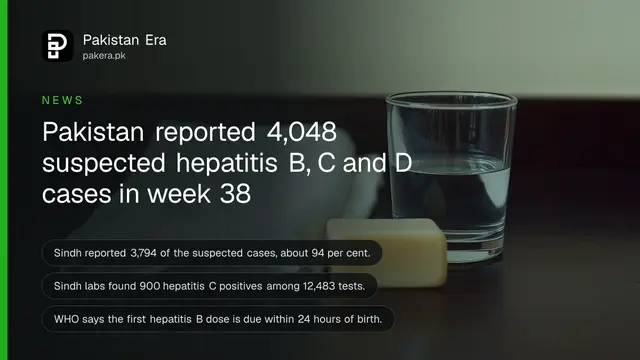
Pakistan Reports 317 Suspected Measles Cases in a Week, While Mumps and Diphtheria Rise
NIH's week 38 bulletin counts 317 suspected measles cases in Pakistan, 253 in KP, while mumps, whooping cough and diphtheria rose. Check your child's card.
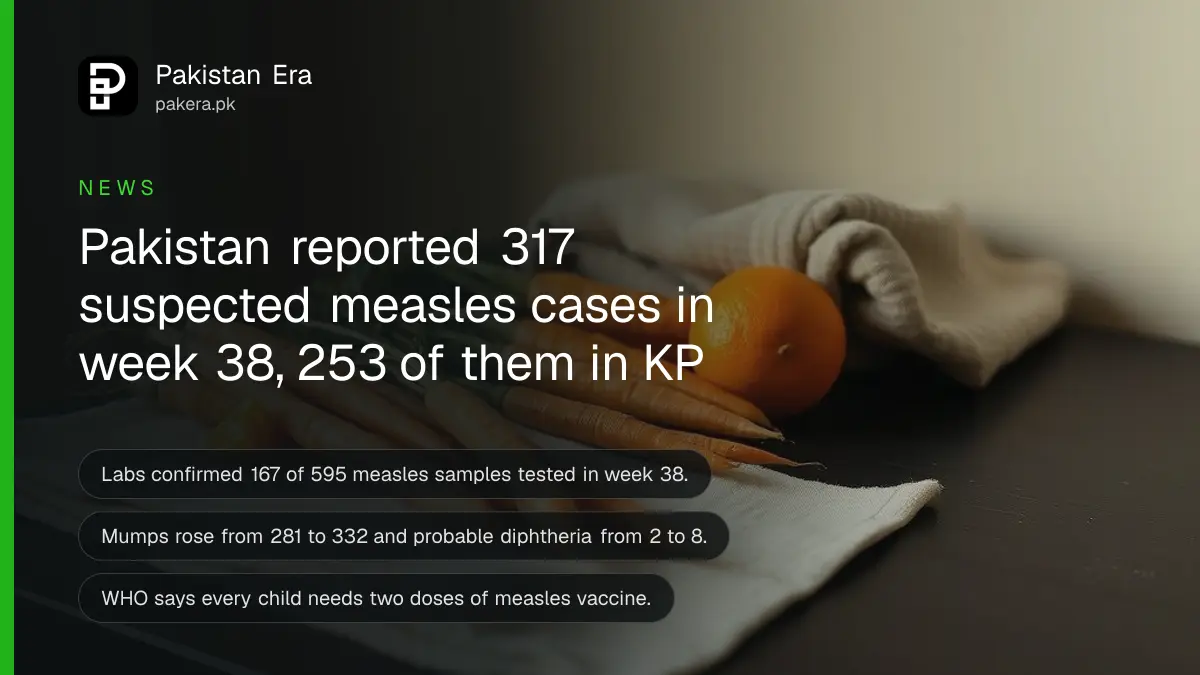
Short answer: Pakistan reported 317 suspected measles cases in week 38 of 2026, down from 342, and 253 of them were in Khyber Pakhtunkhwa. But mumps rose to 332, whooping cough to 58 and probable diphtheria to 8, the National Institutes of Health (NIH) says. Check your child's vaccine card now.
The NIH uploaded the bulletin on Friday 9 October 2026. We read the week 38 and week 37 tables ourselves. All figures are suspected cases reported by clinics, and Punjab did not send its weekly report, so the national totals are undercounts.
Measles fell to 317 cases, with 253 in Khyber Pakhtunkhwa
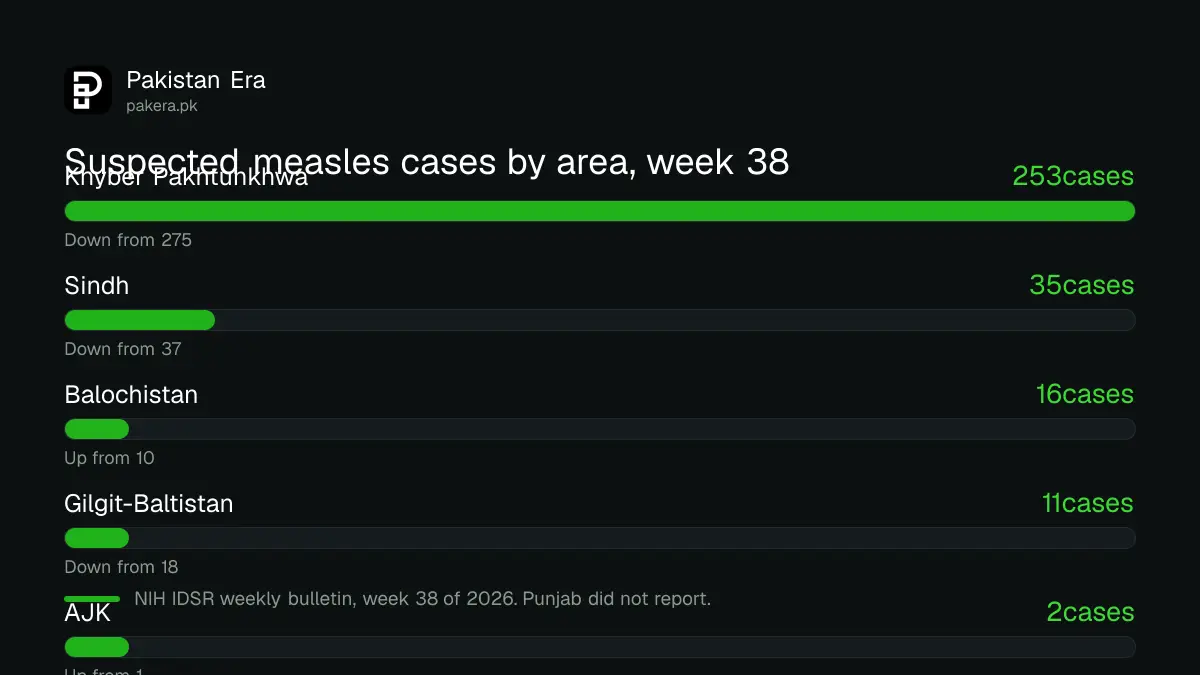
Pakistan reported 317 suspected measles cases in week 38, down 25 from week 37. Khyber Pakhtunkhwa had 253, or 80 per cent. Sindh reported 35, Balochistan 16, Gilgit-Baltistan 11 and AJK 2. Balochistan rose from 10 to 16, and AJK from 1 to 2.
The NIH counts these cases through its Integrated Disease Surveillance and Response system, called IDSR. Clinics in 158 districts send weekly forms. Punjab is marked "NR", meaning not reported, for every disease. The Punjab lab results, in contrast, do appear in the laboratory table, so Punjab has measles cases being tested even though its clinic count is missing.
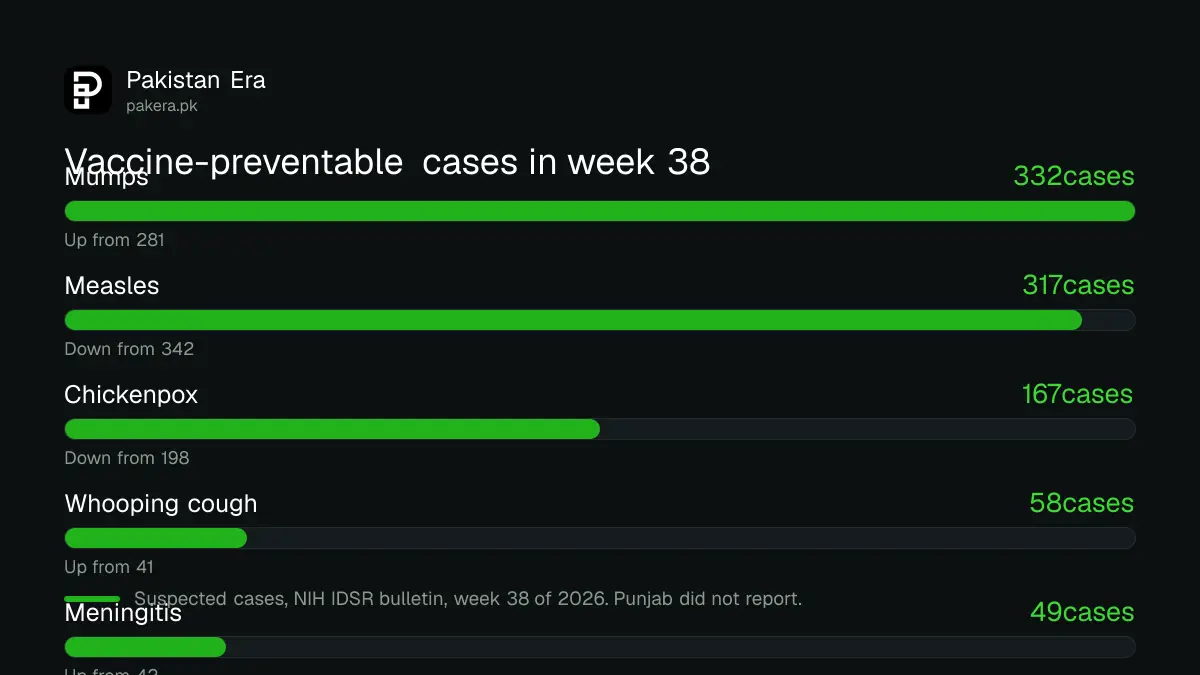
| Disease | Week 37 | Week 38 | Change |
|---|---|---|---|
| Measles | 342 | 317 | Down |
| Mumps | 281 | 332 | Up |
| Whooping cough (pertussis) | 41 | 58 | Up |
| Meningitis | 42 | 49 | Up |
| Diphtheria (probable) | 2 | 8 | Up |
| Chickenpox | 198 | 167 | Down |
Labs confirmed 167 of 595 measles samples in week 38
Public health laboratories tested 595 measles samples in week 38 and 167 were positive, about 28 per cent. In Khyber Pakhtunkhwa, 84 of 224 tested positive. Punjab tested 239 and found 41. Sindh found 24 of 89 and Balochistan 9 of 26. The week before, 193 of 602 were positive.
A positive rate of more than one in four is high for a disease that two vaccine doses prevent. It means many children who were tested did have measles. Labs test only a share of suspected cases, so the real count of true measles is higher than 167.
Khyber Pakhtunkhwa is the province to watch. It supplied 253 of the 317 clinic cases and the largest share of confirmed ones. The NIH notes that measles fell there this week, and also notes that mumps, meningitis and diphtheria rose.
Mumps, whooping cough and diphtheria all went up
The NIH lists mumps, pertussis, meningitis and diphtheria among the vaccine-preventable diseases that increased in week 38. Mumps rose from 281 to 332, led by Khyber Pakhtunkhwa at 164. Whooping cough rose from 41 to 58, and AJK alone reported 42 of them. Probable diphtheria rose from 2 to 8.
The eight probable diphtheria cases were in Khyber Pakhtunkhwa (4), Sindh (3) and Balochistan (1). "Probable" means a doctor suspected diphtheria, but it has not been confirmed. Diphtheria is a serious throat infection that a childhood vaccine prevents. Even a small count matters, because it can spread among unvaccinated children.
Gilgit-Baltistan reported 62 mumps cases, up from 45, and Sindh 51. Meningitis was highest in Sindh at 26, then Khyber Pakhtunkhwa at 12. Flu-like illness and chest infections in children under five also rose nationwide, which is why the warning signs of pneumonia in a child are worth knowing now.
Two measles doses protect a child, and vitamin A helps a sick one
The World Health Organization says every child needs two doses of measles vaccine. The first is usually given at 9 to 15 months and the second at 15 to 18 months, depending on local measles levels. Measles starts with fever, runny nose, cough and red watery eyes, and a rash follows 3 to 5 days later.
Measles can cause pneumonia, brain swelling, blindness and severe diarrhoea, the WHO warns, and children under five face the highest risk. For a child under five with suspected measles, WHO recommends two doses of vitamin A on consecutive days, given by a health worker. Do not give high-dose vitamin A at home without advice.
- Find your child's vaccine card and check for two measles doses.
- If a dose is missing, take the card to a nearby government vaccination centre.
- Keep a child with fever and a rash at home and away from other children and pregnant women.
- Take the child to a doctor the same day if breathing is fast, the child is very drowsy or cannot drink.
- Ask the doctor about vitamin A for children under five.
- Tell the school or nursery so other parents can check their children's cards.
The card check is explained step by step in how to check your child has both measles doses, and the full list of routine shots is in the EPI baby vaccination schedule. The NIH bulletin itself does not announce a new measles campaign, and we did not find one for this week.
Common questions
How many measles cases did Pakistan report in week 38?
The NIH counted 317 suspected measles cases in week 38 of 2026, down from 342. Khyber Pakhtunkhwa reported 253. Punjab's clinic count is missing.
Is mumps rising in Pakistan?
Yes, in this bulletin. Suspected mumps cases rose from 281 to 332 in week 38, with 164 in Khyber Pakhtunkhwa.
Has diphtheria returned in Pakistan?
The NIH reported 8 probable diphtheria cases in week 38, up from 2. They are not confirmed, and the bulletin calls for field checks.
How many doses of measles vaccine does a child need?
Two, says the WHO. The first dose is usually given at 9 to 15 months and the second at 15 to 18 months.
Should my child get vitamin A for measles?
The WHO recommends vitamin A for children under five with suspected measles, two doses on consecutive days. A health worker should give it.
What week does week 38 cover?
The bulletin prints no dates. On the standard week calendar, week 38 of 2026 runs from 14 to 20 September.
How we verified this
What we checked, where we read it, and what we could not confirm.
Last checked on 11 October 2026. We read the NIH's Public Health Bulletin, Pakistan, Week 38, 2026 and the Week 37 bulletin, both listed on the NIH's IDSR weekly reports page. Province figures are from Table 1, and laboratory results from Table 5. Measles facts are from the WHO measles fact sheet. The week dates are our own calculation.
About the author

Tax, Bills and Technology Writer
Ali Akhtar is a young and curious voice here at Pakistan Era. He is currently pursuing his A-Levels and has a growing interest in Pakistan’s changing industrial landscape and educational trends. Ali likes to write in a way that helps him explain and explore the world around him. His writing reflects the perspective of the new generation navigating the evolving trends of Pakistan where technology, youth innovation, and shifting opportunities are reshaping the country’s future.