Pakistan Reports 2,458 Suspected Typhoid Cases in One Week, Up From 2,364
NIH's week 38 bulletin counts 2,458 suspected typhoid cases in Pakistan, up from 2,364. See which provinces and districts lead and what to do if you have fever.
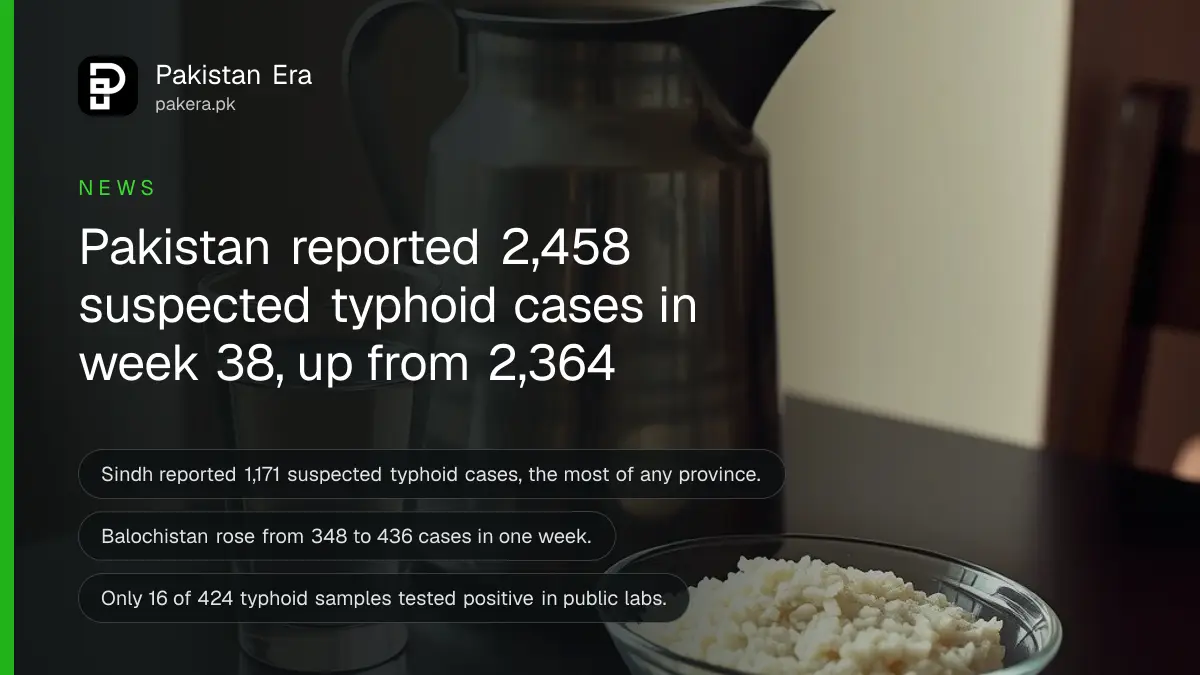
Short answer: Pakistan reported 2,458 suspected typhoid cases in one week, week 38 of 2026, in the National Institutes of Health (NIH) disease bulletin uploaded on 9 October 2026. That is up from 2,364 the week before. Sindh had 1,171 and Khyber Pakhtunkhwa 679. Punjab sent no figures, so the true count is higher.
We downloaded the week 38 and week 37 bulletins and read the province and district tables. The numbers are suspected cases, not lab-confirmed ones. Only a small share of the samples tested in public labs came back positive, and that gap matters for how you read the headline.
Pakistan reported 2,458 suspected typhoid cases in week 38
The NIH counted 2,458 suspected typhoid cases across Pakistan in week 38 of 2026, a rise of 94 from week 37. Typhoid ranked ninth among the diseases reported most often that week, behind diarrhoea, malaria, flu-like illness, chest infections, TB, bloody diarrhoea, dog bites and viral hepatitis.
The NIH collects these counts through its Integrated Disease Surveillance and Response system, called IDSR. Clinics and hospitals in 158 districts send weekly forms. Each case is a patient a doctor suspected of typhoid. Punjab is marked "NR", meaning not reported, for every disease, so the national total leaves out the largest province.
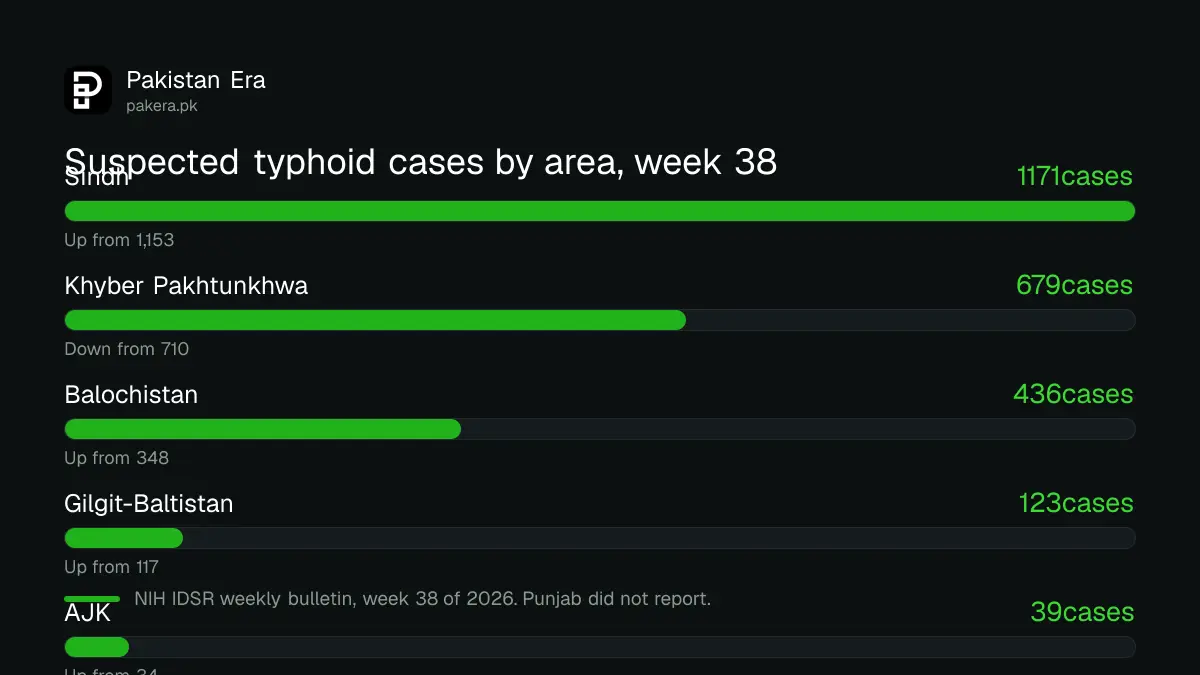
| Area | Week 37 | Week 38 |
|---|---|---|
| Sindh | 1,153 | 1,171 |
| Khyber Pakhtunkhwa | 710 | 679 |
| Balochistan | 348 | 436 |
| Gilgit-Baltistan | 117 | 123 |
| AJK | 34 | 39 |
| Islamabad | 2 | 10 |
| Punjab | NR | NR |
| Pakistan | 2,364 | 2,458 |
Balochistan shows the sharpest rise, up 88 cases
Balochistan reported 436 suspected typhoid cases in week 38, up from 348, a rise of about one quarter. It was the largest jump of any province. The NIH's Balochistan note lists typhoid among the diseases that increased. Gilgit-Baltistan also saw an increase.
Inside Balochistan, Khuzdar reported the most with 80 cases. Naseerabad had 72, Chaman 52 and Barkhan 44. We added the district figures we could read cleanly and they come to 421 of the 436 total. A few rows in the table wrap over two lines, so we do not quote a district sum as exact.
Balochistan also has the weakest reporting among the provinces that file. Its IDSR compliance was 71 per cent, so some facilities did not send a form at all.
Dadu leads Sindh, and Swat leads Khyber Pakhtunkhwa
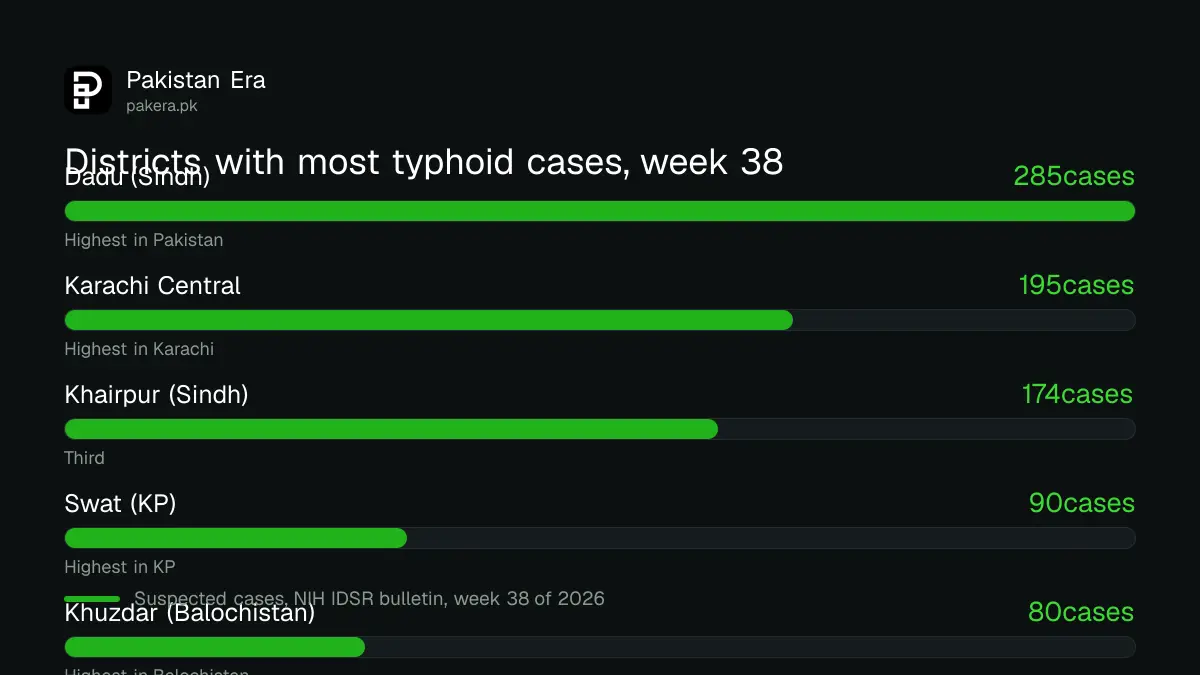
In Sindh, Dadu reported the most suspected typhoid cases in week 38 with 285. Karachi Central followed with 195 and Khairpur with 174. In Khyber Pakhtunkhwa, Swat had 90, Bannu 80 and Charsadda 70. Khyber Pakhtunkhwa's total fell from 710 to 679.
The Sindh district table adds up to the 1,171 provincial total. For Karachi, the Central district alone had 195, far more than any other Karachi district. East had 3, Korangi 2 and South none, which looks more like a reporting gap than a typhoid-free week.
Only 16 of 424 lab samples tested positive
Public health laboratories tested 424 typhoid samples in week 38 and found 16 positive. Sindh tested 207 with 10 positive, Balochistan 78 with 5, and Gilgit-Baltistan 139 with 1. The week before, 465 samples gave 26 positives. Suspected cases are far more than confirmed ones.
That does not mean 2,458 people were wrongly told they had typhoid. Most patients are never tested in these labs. Many get a clinic diagnosis and a course of antibiotics. But the small lab sample shows why a suspected count should be read as a signal of fever illness, not an exact tally of typhoid.
The World Health Organization says typhoid is confirmed through blood testing. If a doctor suspects typhoid, ask which test was used and keep the report.
What typhoid looks like and what to do first
Typhoid causes a prolonged fever, tiredness, headache, nausea, belly pain, and constipation or diarrhoea, according to the WHO. It spreads through contaminated food or water. See a doctor early, get a blood test, and finish every antibiotic your doctor prescribes.
Antibiotic resistance makes typhoid harder to treat, the WHO notes. That is the reason to avoid buying antibiotics over the counter and stopping when you feel better. A half-finished course can leave the bacteria stronger.
- Go to a doctor if fever lasts more than a few days, especially with belly pain or vomiting.
- Ask for a blood test and keep the report.
- Take the antibiotic exactly as prescribed and finish the course.
- Drink boiled or properly filtered water and eat freshly cooked food.
- Wash hands with soap after the toilet and before eating.
- Keep the patient's cup and plate separate until the doctor says the risk has passed.
Prevention also means a vaccine. The WHO recommends the typhoid conjugate vaccine for children from 6 months of age and for adults up to 45 or 65 years, depending on the vaccine. We cover who can get it and where in typhoid and hepatitis B vaccines for adults in Pakistan. Fever with watery stools needs fluids first, as set out in how to treat a child's diarrhoea at home.
The same bulletin tracks other diseases this season
Week 38 also showed rises in mumps, whooping cough, meningitis and probable diphtheria, and in flu-like illness and chest infections in children under five. Malaria and dog bite figures from the same bulletin are covered in Sindh's week 38 malaria cases and the week 38 dog bite count.
Typhoid, cholera and hepatitis A and E all travel through dirty water. Acute watery diarrhoea fell to 112,030 cases from 119,045, but remained the most reported illness by far.
Common questions
How many typhoid cases did Pakistan report in week 38?
The NIH counted 2,458 suspected typhoid cases in week 38 of 2026, up from 2,364 in week 37. Punjab did not report, so the national figure is an undercount.
Are these confirmed typhoid cases?
No. The NIH says all cases in the bulletin are suspected. In public labs, 16 of 424 typhoid samples tested positive in week 38.
Which province has the most typhoid?
Sindh reported the most with 1,171, then Khyber Pakhtunkhwa with 679 and Balochistan with 436. Balochistan rose the fastest.
How is typhoid confirmed?
The WHO says typhoid is confirmed through blood testing. Ask your doctor which test was done and keep the result.
Is there a typhoid vaccine for adults in Pakistan?
The WHO recommends the typhoid conjugate vaccine for ages 6 months up to 45 or 65 years. We did not verify local stock or price, so ask your doctor or a vaccination centre.
What week does week 38 cover?
The bulletin prints no dates. On the standard week calendar, week 38 of 2026 runs from 14 to 20 September.
How we verified this
What we checked, where we read it, and what we could not confirm.
Last checked on 11 October 2026. We read the NIH's Public Health Bulletin, Pakistan, Week 38, 2026 and the Week 37 bulletin, both listed on the NIH's IDSR weekly reports page. Province figures are from Table 1, district figures from Tables 2 to 4 and laboratory results from Table 5. Disease facts are from the WHO typhoid fact sheet. The week dates are our own calculation.
About the author

Tax, Bills and Technology Writer
Ali Akhtar is a young and curious voice here at Pakistan Era. He is currently pursuing his A-Levels and has a growing interest in Pakistan’s changing industrial landscape and educational trends. Ali likes to write in a way that helps him explain and explore the world around him. His writing reflects the perspective of the new generation navigating the evolving trends of Pakistan where technology, youth innovation, and shifting opportunities are reshaping the country’s future.