Avoid Aspirin and Ibuprofen in Dengue in Pakistan: NIH Says Use Paracetamol, Fluids and Go Early
NIH says dengue fever is treated with paracetamol, fluids and rest, and that aspirin and similar painkillers should generally be avoided. Know the danger signs.
Short answer: The NIH dengue advisory says there is no specific antiviral drug. Treat fever and body pain with acetaminophen, which is paracetamol, drink plenty of fluids, and generally avoid aspirin and other NSAID painkillers because of bleeding risk. Steroids have no proven benefit. Go to hospital early if you see any danger sign.
It is the third day of fever. The body aches. Someone at home hands over whatever painkiller is in the drawer. In dengue, that choice can matter.
We read the National Institutes of Health (NIH) Islamabad advisory for the prevention and control of dengue fever on 14 October 2026. It is dated 3 March 2025 and written for doctors, but its treatment section is clear enough to share. It is not personal medical advice, so ask a doctor about your own case. We cover the signs of dengue in dengue warning signs, and how it differs from chikungunya in chikungunya versus dengue.
Dengue has no antiviral drug, so care is supportive
NIH says there is no specific antiviral treatment for dengue. Treatment relies on managing symptoms and watching for complications. NIH says good early care at a clinic reduces hospital admissions and can keep the death rate under 1 percent.
NIH says the incubation period is 3 to 14 days, commonly 4 to 7. Many infections show no symptoms at all, from 50 to 90 percent of them by NIH's figures. When symptoms come, they are sudden high fever, headache, pain behind the eyes, severe muscle and bone pain, weakness, vomiting and a sore throat. The pain is why dengue is called break-bone fever.
For tests and their timing, see dengue test prices and when to get each test.
Paracetamol is the painkiller NIH names for dengue
NIH says fever and muscle pain in dengue should be managed with acetaminophen, known in Pakistan as paracetamol. It advises that aspirin and non-steroidal anti-inflammatory agents should generally be avoided because of the risk of bleeding complications, and the risk of Reye's syndrome in children.
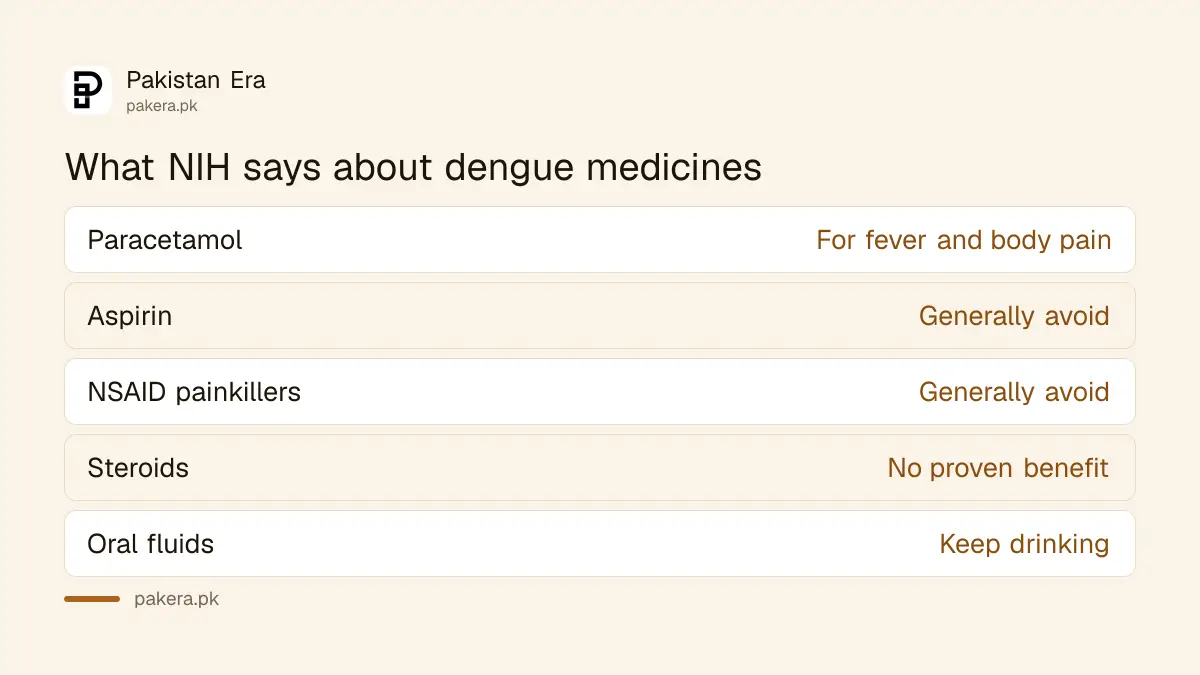
| Option | NIH advisory says |
|---|---|
| Paracetamol (acetaminophen) | Use for fever and muscle pain |
| Aspirin | Generally avoid: bleeding risk, and Reye syndrome in children |
| NSAID painkillers | Generally avoid: bleeding risk |
| Corticosteroids | No demonstrated benefit, potentially harmful |
| Oral fluids | Keep drinking to avoid dehydration |
Non-steroidal anti-inflammatory drugs, or NSAIDs, are a group of painkillers. Common ones sold in Pakistan include ibuprofen and diclofenac. The advisory names the group, not each brand. Check the label or ask the pharmacist whether your painkiller is an NSAID.
Ask a doctor for the dose. Do not give a child any painkiller without advice. Combination cold and flu tablets may contain more than one drug, so check what is in them.
Fluids, rest and no steroids
NIH says dengue patients should keep up their oral fluids to avoid dehydration. It says corticosteroids have no demonstrated benefit and are potentially harmful. A doctor may use intravenous fluids in a hospital when a patient cannot drink enough or shows warning signs.
Water, oral rehydration solution, soup and fresh juice all count. Small sips often work better than large drinks when you feel sick. Rest at home is fine for mild illness, in a room with a net or screen so mosquitoes cannot bite you and pass the virus on.
Do not ask a clinic for a steroid injection "to speed things up". The advisory says steroids do not help in dengue and may harm.
Danger signs mean go to hospital the same day
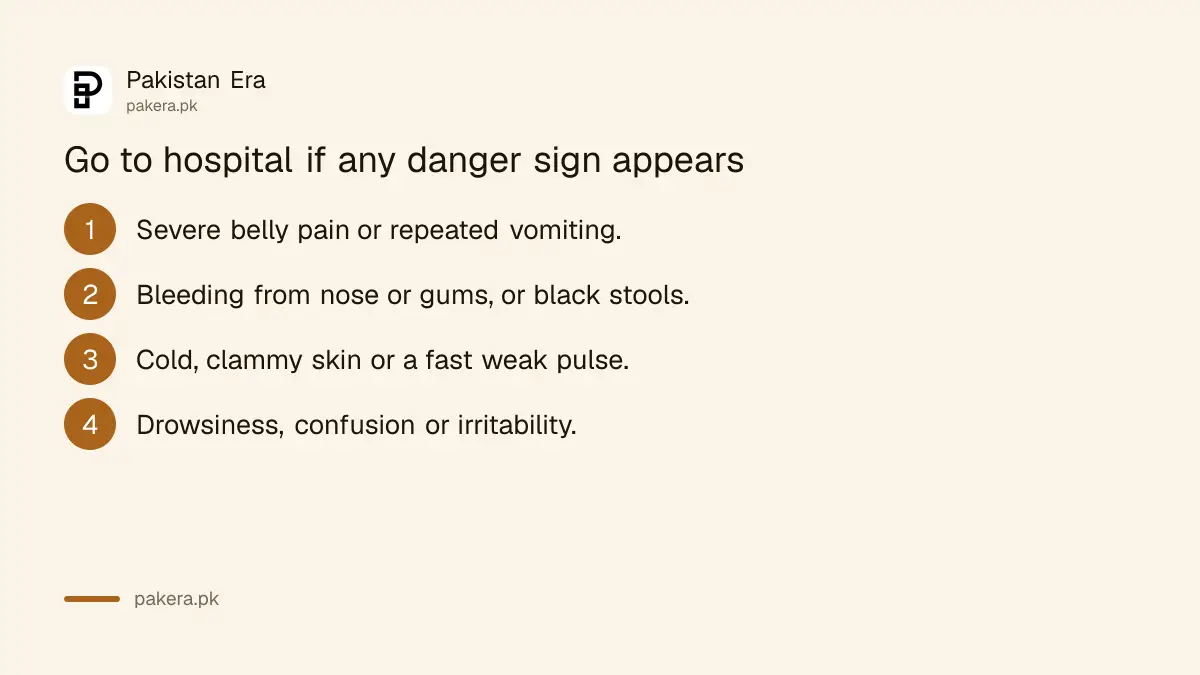
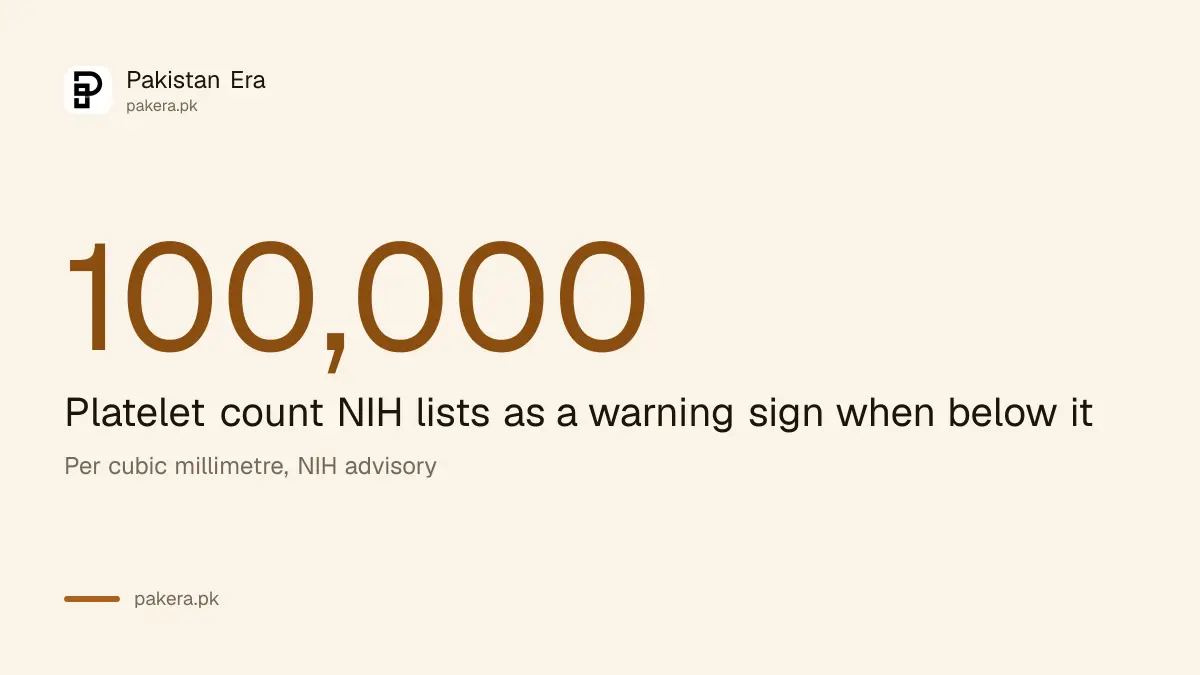
NIH lists severe belly pain, persistent vomiting, bleeding, confusion or irritability, and a platelet count under 100,000 per cubic millimetre as warning signs. Early signs of shock are restlessness, cold clammy skin and a fast weak pulse. These patients must go to hospital.
- Give paracetamol only, in the dose a doctor advises.
- Offer fluids often, in small sips.
- Keep the patient under a net or screen.
- Watch for any danger sign every few hours.
- Go to hospital the same day if one appears.
Do not wait for the fever to end. NIH notes that bleeding signs include red spots on the skin, bleeding from the nose or gums, vomiting blood and black tarry stools. Breathing difficulty and pale, cold skin are also on its list.
For hospital admission rules in Punjab, see when a dengue patient must be admitted.
Platelet transfusion is for severe cases only
NIH says platelet transfusion may be warranted in severe thrombocytopenia, below 10,000 per cubic millimetre, together with active bleeding. A low count alone is not the whole picture. Doctors read blood counts together with vital signs and the state of the patient's circulation.
That is a rule for doctors, not families. Do not demand platelets for a count that has dipped below normal. NIH says hematocrit, another blood measure, must be read with vital signs and fluid status.
If you worry that a dengue patient is being treated wrongly, ask the doctor why. In Punjab, see how to complain against a hospital or doctor.
Common questions
Which painkiller is safe for dengue?
NIH names acetaminophen, which is paracetamol, for fever and muscle pain. Ask a doctor for the right dose, especially for children.
Can I take ibuprofen or diclofenac for dengue?
NIH says aspirin and NSAIDs should generally be avoided because of bleeding risk. Ibuprofen and diclofenac belong to the NSAID group, so ask a doctor first.
Should I take a steroid for dengue?
No. NIH says steroids have no demonstrated benefit in dengue and are potentially harmful.
When do dengue patients need a platelet transfusion?
NIH says it may be warranted in severe thrombocytopenia under 10,000 per cubic millimetre with active bleeding. A doctor must decide.
How long does it take for dengue symptoms to appear?
NIH says 3 to 14 days after the bite, commonly 4 to 7 days.
How we verified this
What we checked, where we read it, and what we could not confirm.
Last checked on 14 October 2026, Pakistan time. We read the NIH advisories page and the NIH Advisory for the Prevention and Control of Dengue Fever (No. F.1-22/Adv/CDC/2025, 3 March 2025), a scanned PDF we read page by page as images. We did not check doses, which the advisory does not give, and we did not find a newer NIH dengue treatment advisory. This page is not medical advice.
About the author

Tax, Bills and Technology Writer
Ali Akhtar is a young and curious voice here at Pakistan Era. He is currently pursuing his A-Levels and has a growing interest in Pakistan’s changing industrial landscape and educational trends. Ali likes to write in a way that helps him explain and explore the world around him. His writing reflects the perspective of the new generation navigating the evolving trends of Pakistan where technology, youth innovation, and shifting opportunities are reshaping the country’s future.