Tell Chikungunya From Dengue in Pakistan: Symptoms, Tests and the Safe Painkiller
Chikungunya and dengue start with the same fever. Learn the joint pain clue, which blood test to ask for, why WHO says paracetamol only, and how to avoid bites.
Short answer: Chikungunya and dengue both start with a sudden high fever, and the same mosquito spreads both. The clue is the joints: chikungunya brings severe, often crippling joint pain and swelling. Only a blood test can tell them apart for sure. Until dengue is ruled out, the World Health Organization (WHO) says to use paracetamol only, not painkillers like ibuprofen, because they can raise the risk of bleeding.
Chikungunya is not a distant problem. Pakistan's National Institute of Health (NIH) recorded 88 suspected chikungunya cases in week 38 of 2026, in mid September, and 110 the week before. Most came from Khyber Pakhtunkhwa and Sindh. Here is how to spot it, which test to ask for, and what to avoid.
Chikungunya is a virus spread by the same mosquito as dengue
Chikungunya is a viral illness passed on by the bite of an infected Aedes mosquito, the same day-biting mosquito that carries dengue. It causes fever and severe joint pain. Most people recover fully, and WHO says one infection likely protects you from catching it again.
The name comes from a word in the Kimakonde language of Tanzania that means "that which bends up". It describes how people stoop with the joint pain. The virus is now found in more than 110 countries, according to WHO.
Because the Aedes mosquito breeds in clean standing water, chikungunya follows the same season as dengue in Pakistan. Water coolers, tyres, flower pots and rooftop tanks are where both start.
Pakistan recorded 88 suspected chikungunya cases in one week of September
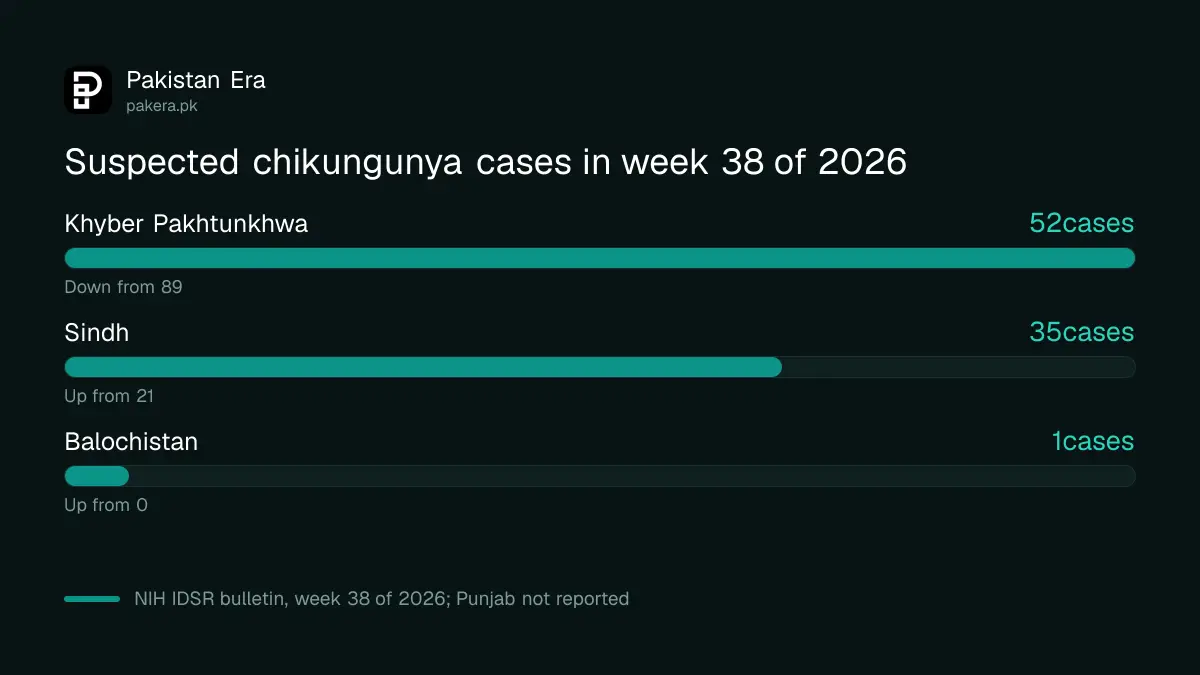
The NIH's weekly disease bulletin for week 38 of 2026 lists 88 suspected chikungunya cases: 52 in Khyber Pakhtunkhwa, 35 in Sindh and 1 in Balochistan. In week 37 there were 110. Punjab sent no report, so the real national figure is higher.
| Area | Week 37 | Week 38 |
|---|---|---|
| Khyber Pakhtunkhwa | 89 | 52 |
| Sindh | 21 | 35 |
| Balochistan | 0 | 1 |
| Islamabad, AJK and Gilgit-Baltistan | 0 | 0 |
| Punjab | Not reported | Not reported |
| Total | 110 | 88 |
For comparison, the same bulletin lists 578 suspected dengue cases in week 38. Dengue is still the bigger worry, and Khyber Pakhtunkhwa has its own surge, as the counts for dengue in Islamabad and Khyber Pakhtunkhwa show. But chikungunya is circulating at the same time, and the two are easy to confuse.
Severe joint pain is the sign that points to chikungunya
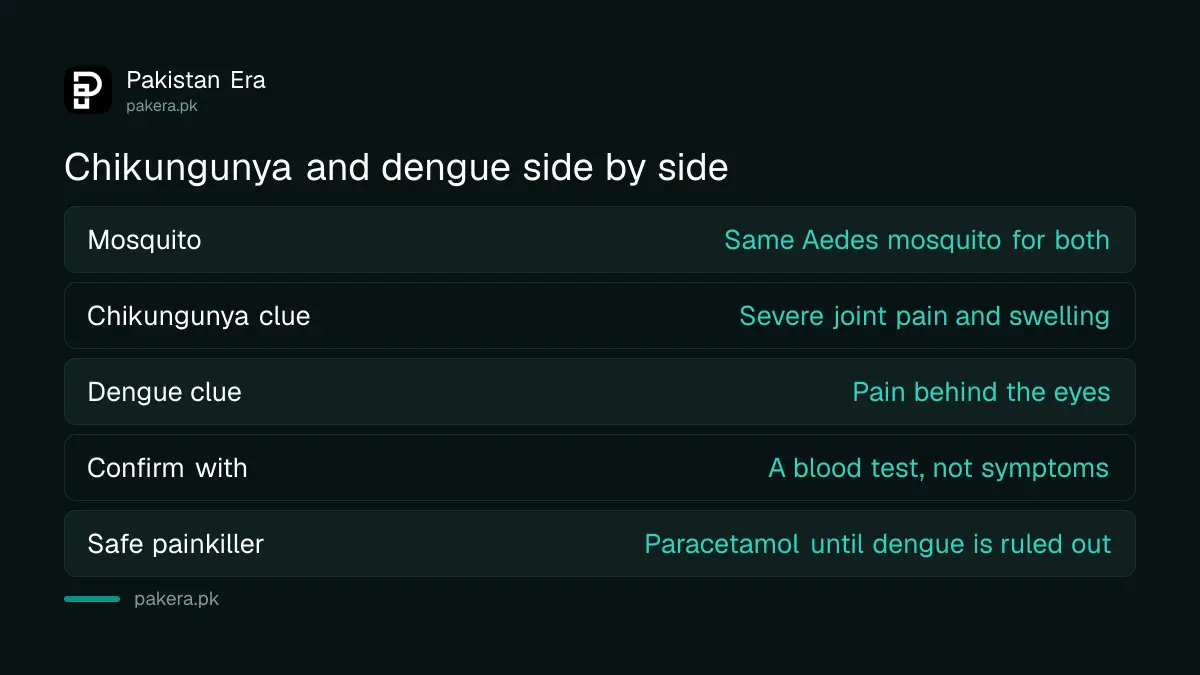
Both illnesses start with a sudden fever, headache, body ache and sometimes a rash. Chikungunya stands out for severe joint pain, often with swelling. Dengue is better known for pain behind the eyes, and severe dengue can cause bleeding. Neither can be confirmed without a test.
| Feature | Chikungunya | Dengue |
|---|---|---|
| Spread by | Aedes mosquito, bites by day | Aedes mosquito, bites by day |
| Start | Sudden fever, 4 to 8 days after the bite | Fever, 4 to 10 days after infection |
| Main clue | Severe joint pain and swelling | Pain behind the eyes, body ache |
| Main danger | Long lasting joint pain; rare complications | Severe dengue, with bleeding gums or nose |
| How long | Joint pain usually days, sometimes weeks or months | Symptoms last 2 to 7 days; severe signs can follow after the fever goes |
| Safe painkiller until tested | Paracetamol | Paracetamol |
WHO says chikungunya symptoms usually begin 4 to 8 days after the bite, but can take anywhere from 2 to 12 days. The joint pain usually lasts a few days. In some people it lasts weeks, months or even years. The danger signs for dengue are different and more urgent, and are listed in the dengue signs that mean go to hospital.
A blood test in the first week is the only way to be sure
Chikungunya is confirmed by a blood test. In the first week of illness, WHO says a PCR test finds the virus itself. After the first week, an antibody test finds the body's response, which stays detectable for about two months. Ask your doctor to rule out dengue at the same time.
PCR means polymerase chain reaction, a lab test that looks for the virus's genetic material. An antibody test looks for the proteins your immune system makes to fight it. Dengue has its own tests, the NS1 test in the first days and IgM later. Their costs and timing are set out in the dengue NS1, IgM and CBC tests.
Ask the lab before giving a sample whether it runs a chikungunya test. We did not survey which labs in Pakistan offer it.
What to do if you think you have chikungunya
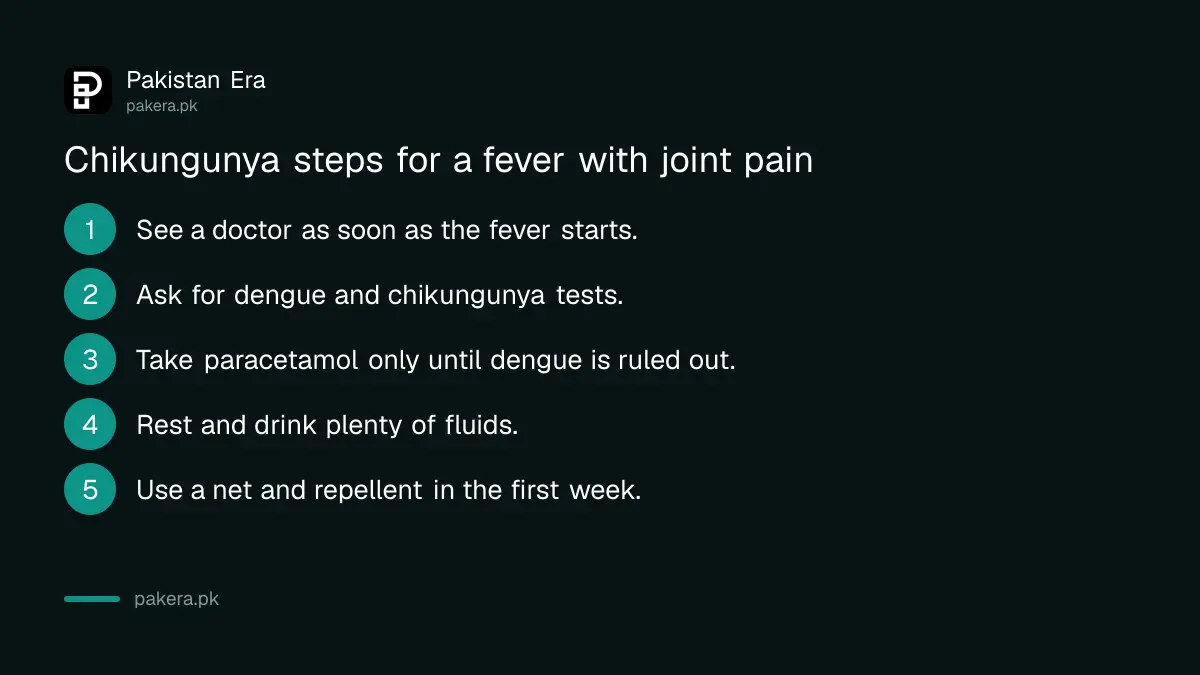
See a doctor, get tested for dengue and chikungunya, rest and drink plenty of fluids. Take only paracetamol for fever and pain until dengue is ruled out. There is no specific medicine that kills the chikungunya virus, so treatment is about easing the fever and pain.
- See a doctor at a government hospital or clinic as soon as the fever starts.
- Ask for a dengue test, and a chikungunya test if you have severe joint pain.
- Use paracetamol only for fever and pain until dengue is ruled out. Do not take ibuprofen, aspirin or similar painkillers on your own.
- Rest and drink plenty of water, juice or other fluids.
- Sleep under a mosquito net and use repellent during the first week, so mosquitoes do not pick up the virus from you and spread it at home.
- Go back to the doctor if joint pain lasts for weeks, or if a baby or an older family member falls ill.
WHO says severe illness and deaths are rare, and usually occur in newborns or older people who already have other health problems. Those two groups need a doctor early. Do not change any regular medicine without your doctor.
Stopping mosquito breeding protects you from both illnesses
The best protection is to avoid mosquito bites and remove standing water. WHO advises emptying and cleaning water containers every week, using window and door screens, and wearing clothes that cover the skin in the daytime. Repellents should contain DEET, IR3535 or icaridin.
The Aedes mosquito bites mainly by day, so a bed net at night is not enough on its own. Children who nap in the afternoon, sick patients and older people resting in the day should use a net then too, WHO says.
WHO says two chikungunya vaccines are approved in some countries but are not yet widely available. So prevention at home still does most of the work. In Punjab, you can also report a breeding site you cannot clear yourself, as explained in reporting dengue larvae or standing water in Punjab.
Common questions
Is chikungunya the same as dengue?
No. They are different viruses, but the same Aedes mosquito spreads both. Chikungunya is known for severe joint pain. Severe dengue can cause bleeding.
How long does chikungunya joint pain last?
Usually a few days, WHO says. In some people it lasts weeks or months, and rarely years. See a doctor if it does not settle.
Which painkiller is safe for chikungunya?
WHO recommends paracetamol until dengue is ruled out. Painkillers such as ibuprofen can raise the risk of bleeding if the illness turns out to be dengue.
Can you get chikungunya twice?
Unlikely. WHO says evidence suggests that people who recover are likely to be immune to future chikungunya infections.
Is there a chikungunya vaccine in Pakistan?
WHO says two vaccines are approved in some countries but are not widely available or in wide use. We could not confirm that either is registered or sold in Pakistan.
How we verified this
What we checked, where we read it, and what we could not confirm.
Last checked on Saturday 10 October 2026. Symptoms, timing, testing, treatment and prevention advice are from the WHO chikungunya fact sheet. Pakistan's case counts are from Table 1 of the NIH's weekly bulletins for week 37 and week 38 of 2026, on the NIH IDSR weekly reports page. All bulletin figures are suspected cases. This page is general information, not a diagnosis, so see a doctor for any fever.
About the author

Public Services and Education Journalist
Fajr Riaz is a journalist and content writer at Pakistan Era, based in Lahore. She covers the questions people meet in everyday life in Pakistan: how a public service works, what a change in the rules means, and where to find a reliable answer.