Become a PPIB Certified Solar Installer in Pakistan: 2026 Fees From Rs 408,410, 14 Documents and the PEC Rule
PPIB solar installer certification in Pakistan for 2026: Rs 20,420 processing fee, Rs 408,410 to Rs 816,820 by category, a Rs 500,000 guarantee and 14 papers.
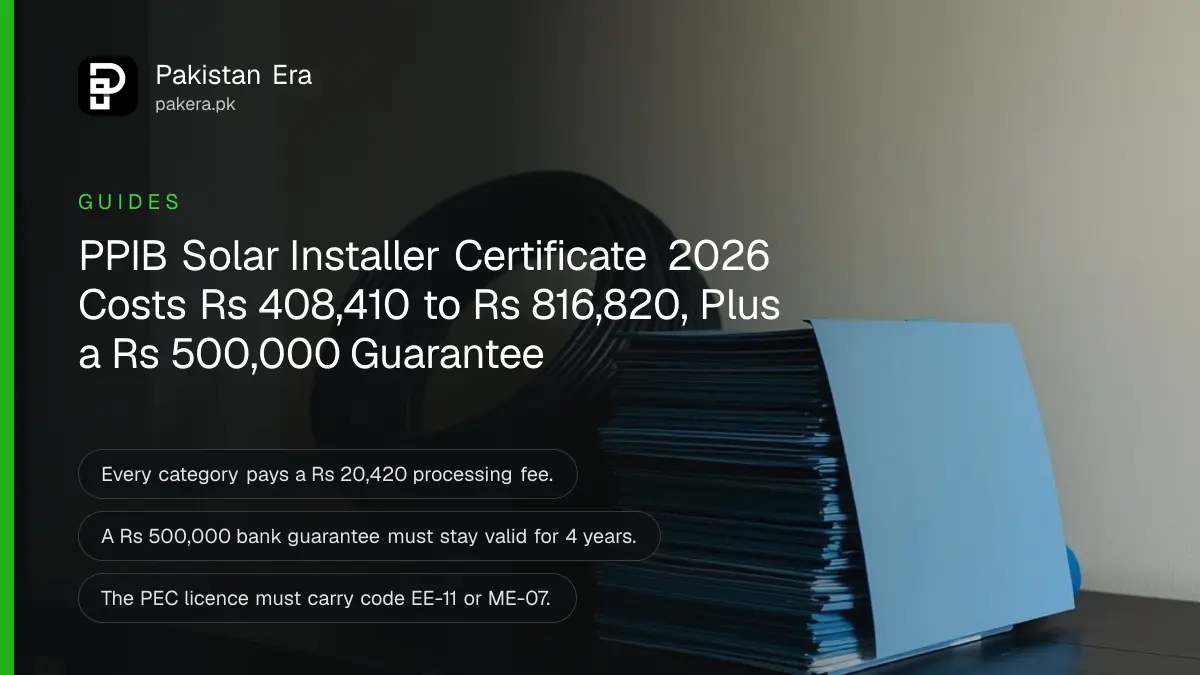
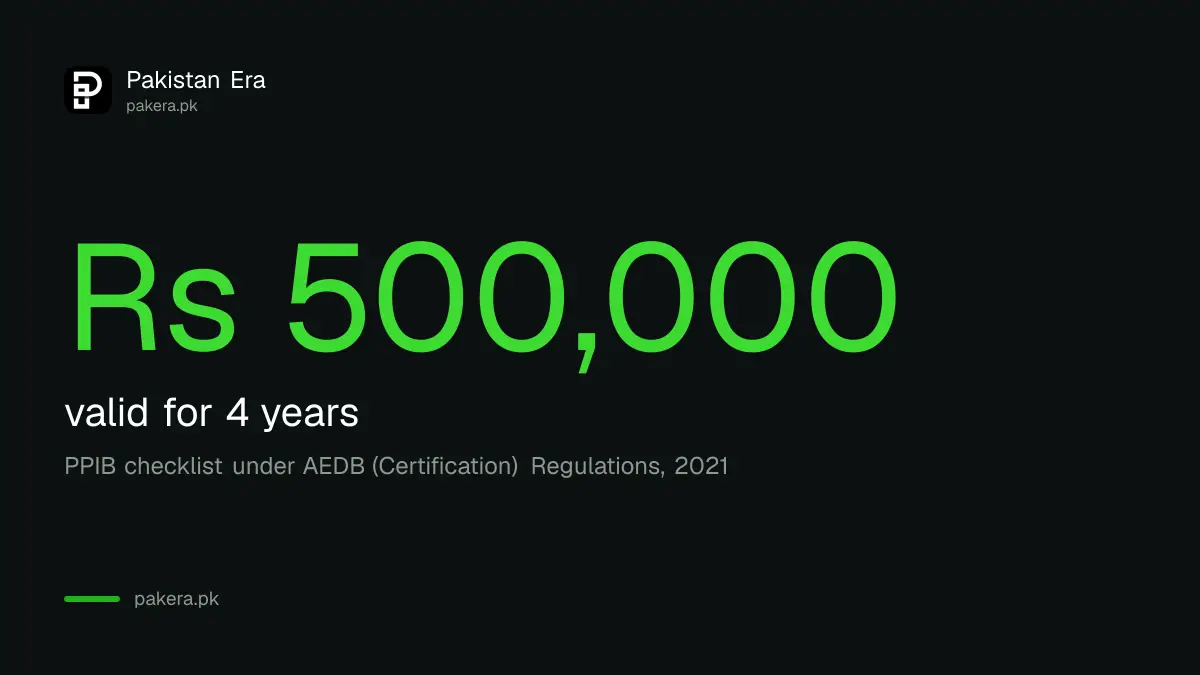
To become a certified solar installer in Pakistan in 2026, a company applies to PPIB under the AEDB (Certification) Regulations, 2021, with a Rs 20,420 processing fee, a Rs 500,000 bank guarantee valid for 4 years, and a certification fee of Rs 408,410 (C-3), Rs 612,615 (C-2) or Rs 816,820 (C-1). PPIB's checklist has 14 items, and a valid Pakistan Engineering Council (PEC) licence is the one most applicants get stuck on.
Certification is what lets a company sign net metering files. Every electricity company wants an inspection certificate from an engineer of a certified company, and PITC's net billing portal asks for the installer by name. Without a certificate, a solar business can sell panels but cannot complete a grid-connected job on its own.
The Private Power and Infrastructure Board (PPIB) now handles the certification once done by the Alternative Energy Development Board (AEDB). The rules still carry AEDB's name.
PPIB's 2026 fees for C-1, C-2 and C-3 installers
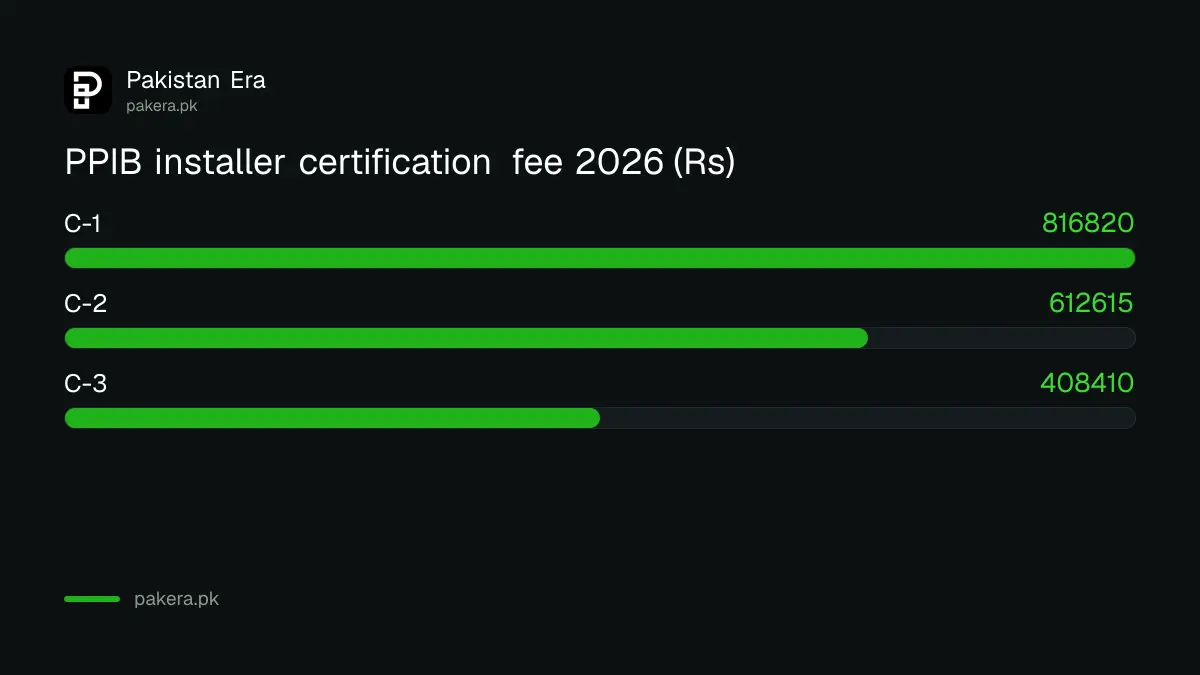
PPIB's fee notice for calendar year 2026 sets one processing fee for every category and a certification fee that rises with the category. Both fees go up by 5% each calendar year, so check the notice again before you apply in 2027.
| Category | Largest system | Processing fee (non-refundable) | Certification fee | Total, before guarantee |
|---|---|---|---|---|
| C-3 | Up to 250 kW | Rs 20,420 | Rs 408,410 | Rs 428,830 |
| C-2 | Up to 500 kW | Rs 20,420 | Rs 612,615 | Rs 633,035 |
| C-1 | Up to and above 500 kW | Rs 20,420 | Rs 816,820 | Rs 837,240 |
Both fees are paid in the name of the Alternative Energy Fund. The totals are our own sums. On top of them sits a Rs 500,000 bank guarantee, which is not a fee: it is security that PPIB holds for 4 years.
The 14 documents on PPIB's installer checklist
The checklist has 14 items. Most are company and tax papers. The two that take time are the PEC licence in the right category and the bank guarantee in PPIB's own format, so start those first.
- The application form from PPIB's website (fresh or renewal).
- An authority letter or board resolution, with a copy of the applicant's CNIC or passport.
- The applicant's company profile.
- A certificate of incorporation, or a registered partnership deed.
- A valid PEC licence in the right category and specialisation (see below).
- Income tax registration and an active taxpayer status report.
- Sales tax registration and the last three months' sales tax returns, where they apply.
- Registration under the provincial sales tax on services law of each province you will work in, with active status.
- Particulars of installed projects, on PPIB's proforma.
- A pay order or challan for the processing fee, in the name of the Alternative Energy Fund.
- A bank guarantee of Rs 500,000, valid for 4 years, in PPIB's format.
- An affidavit on stamp paper, as set out in Schedule 2, Part I, serial xi of the regulations.
- Every document signed and stamped by the applicant.
- The certification fee, in the name of the Alternative Energy Fund.
Item 8 decides where you can work. The certified installer lists show an "area" column, such as "ICT and Punjab". A company registered only with the Punjab Revenue Authority should not expect Sindh or Balochistan on its certificate.
The PEC licence you need for each category
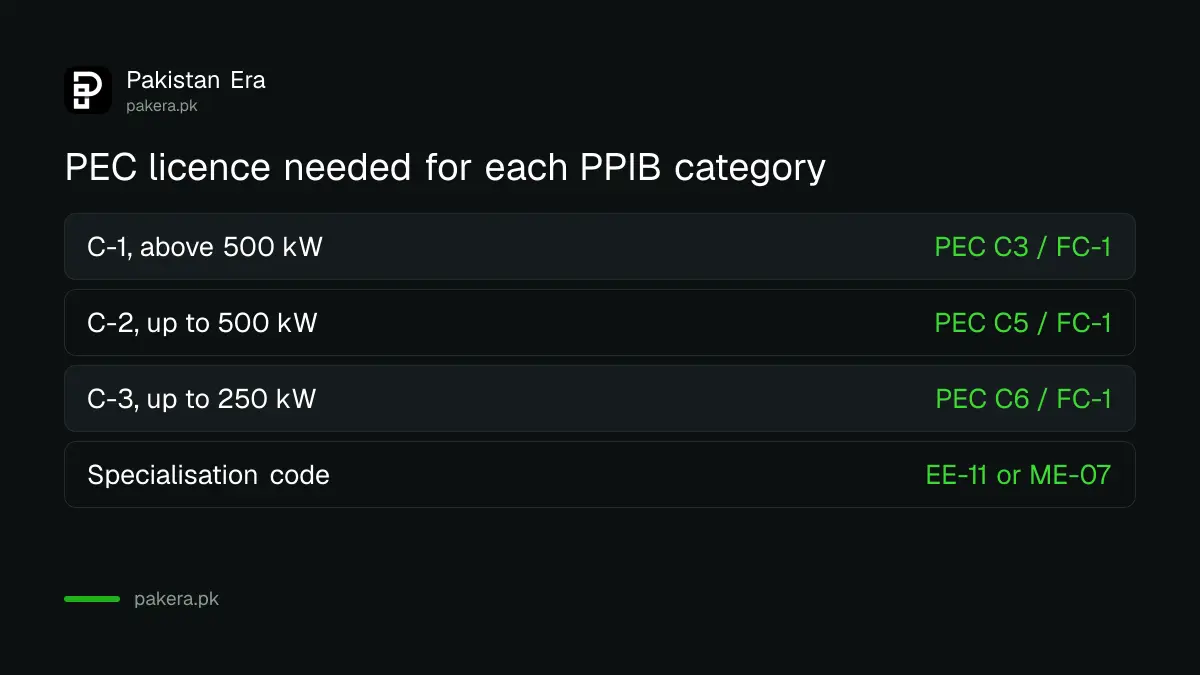
PPIB asks for a minimum PEC contractor category for each installer category: C3 for C-1, C5 for C-2 and C6 for C-3, each with FC-1. The licence must carry a solar specialisation code, EE-11 or ME-07.
| PPIB category | Minimum PEC category | Accepted PEC codes |
|---|---|---|
| C-1 (up to and above 500 kW) | C3 / FC-1 | EE-11 or ME-07 |
| C-2 (up to 500 kW) | C5 / FC-1 | EE-11 or ME-07 |
| C-3 (up to 250 kW) | C6 / FC-1 | EE-11 or ME-07 |
EE-11 is general electrical works and solar systems. ME-07 is general mechanical works and solar systems. A PEC licence without one of these codes does not meet the checklist, even in a high category.
How to apply to PPIB as a solar installer, step by step
The application is a paper file with pay orders and a bank guarantee. Prepare the PEC and tax papers first, then the guarantee, then the fees. After certification, you register on PITC's net billing portal so customers can name you in their applications.
- Choose the category that matches the largest jobs you plan to take.
- Get or upgrade the PEC licence with code EE-11 or ME-07.
- Collect tax registrations and returns, federal and provincial.
- Fill in the proforma of installed projects.
- Get the bank guarantee drafted in PPIB's format.
- Make the pay orders for the processing fee and the certification fee.
- Sign and stamp every page, add the affidavit, and submit to PPIB in Islamabad.
- Once certified, contact PPIB on 051-9222360-61, extension 212, for vendor registration on the net billing portal.
Certificates end on 30 June and need renewal
PPIB certificates are valid to 30 June of a stated year. The lists dated 13 November 2026 show end dates from 30 June 2024 to 30 June 2028, so many listed companies need to renew. Renewal uses the same application form.
PPIB has extended validity by notification before. In July 2024 it extended certificates that ended on 30 June 2024 to 31 August 2024, after a PEC notice. Do not rely on an extension: renew in good time, because a lapsed certificate will not satisfy a DISCO.
Customers can and do check. The steps a homeowner follows are in the net metering rules for 2026, and an expired certificate is a common reason for delay. Delays that do happen can end up as a net metering complaint to NEPRA, so a clean installer file protects your business too.
Common questions
How much is the PPIB installer certification fee in 2026?
Rs 408,410 for C-3, Rs 612,615 for C-2 and Rs 816,820 for C-1, plus a Rs 20,420 processing fee for every category.
Is the processing fee refundable?
No. PPIB's notice says the application processing fee is non-refundable.
How long must the bank guarantee be valid?
Four years, for Rs 500,000, in the format on PPIB's website.
Which PEC code do I need for solar?
EE-11 (general electrical works and solar system) or ME-07 (general mechanical works and solar system).
Do the fees change every year?
Yes. Both fees rise by 5% for each calendar year, according to PPIB's 2026 fee notice.
Can a sole trader apply?
The checklist asks for a certificate of incorporation or a registered partnership deed, so a registered company or partnership is the expected applicant.
How we verified this
What we checked and where we read it.
Checked on 15 November 2026 on the PPIB website, Net-metering menu: "Revised Application Processing Fee and Certification Fee for the calendar year 2026", "Check List for Enlistment of Installer with PPIB under AEDB (Certification) Regulations, 2021", the July 2024 validity extension notification, and the three certified installer lists dated 13 November 2026. The vendor registration number comes from the installer message on PITC's net billing portal. The fee notice prints the three certification fees in a single column beside C1, C2 and C3; we read them in that order, from highest to lowest.
About the author

Tax, Bills and Technology Writer
Ali Akhtar is a young and curious voice here at Pakistan Era. He is currently pursuing his A-Levels and has a growing interest in Pakistan’s changing industrial landscape and educational trends. Ali likes to write in a way that helps him explain and explore the world around him. His writing reflects the perspective of the new generation navigating the evolving trends of Pakistan where technology, youth innovation, and shifting opportunities are reshaping the country’s future.