How to Check a Fever for Malaria in Pakistan: Get a Parasite Test Before Treatment
NIH counted 76,459 suspected malaria cases in Pakistan in week 38 of 2026, 64,318 in Sindh. See WHO's advice on fever, parasite tests and warning signs.
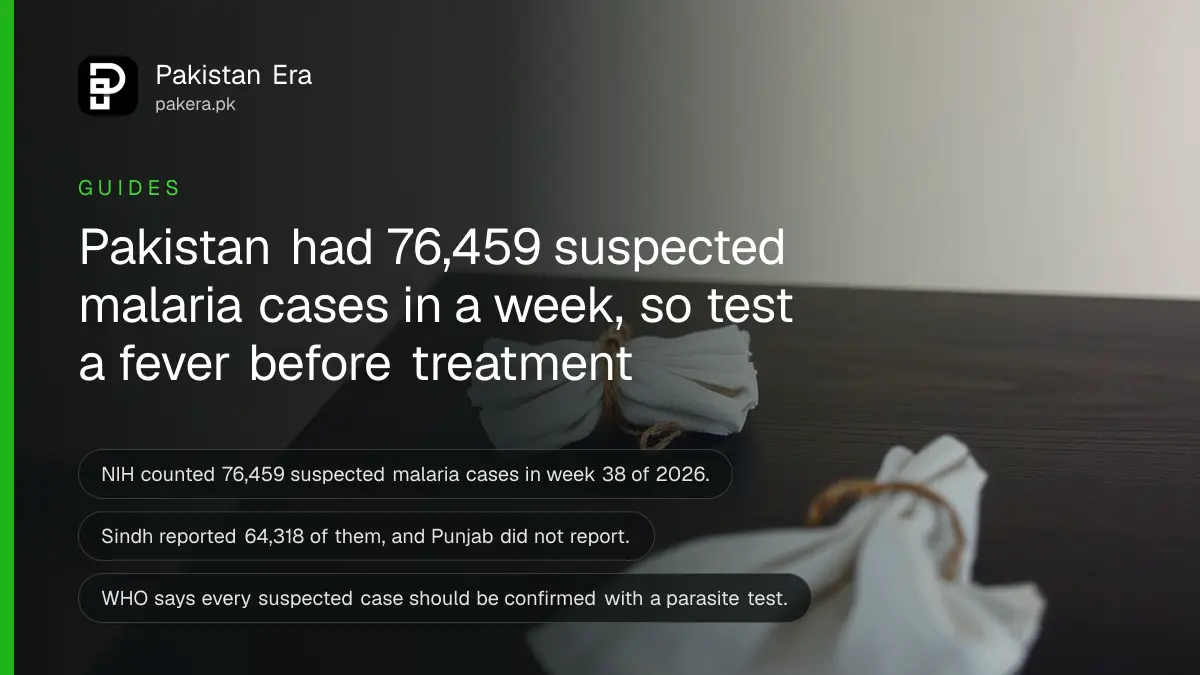
Short answer: WHO says every suspected malaria case should be confirmed with a parasite test, either a microscope slide or a rapid diagnostic test, before treatment. In Pakistan, NIH counted 76,459 suspected malaria cases in week 38 of 2026, 64,318 of them in Sindh. If you have fever and chills, get the test and do not guess.
A fever in Pakistan can be many things. Dengue, typhoid, flu and malaria all start the same way. Taking a leftover tablet and waiting is a poor plan, because each illness needs different care.
We read the World Health Organization (WHO) malaria fact sheet and the National Institute of Health (NIH) Integrated Disease Surveillance and Response (IDSR) bulletin for week 38 of 2026 on 14 October 2026. This page puts both in plain words. It is not medical advice. A doctor decides the treatment.
NIH counted 76,459 suspected malaria cases in one week
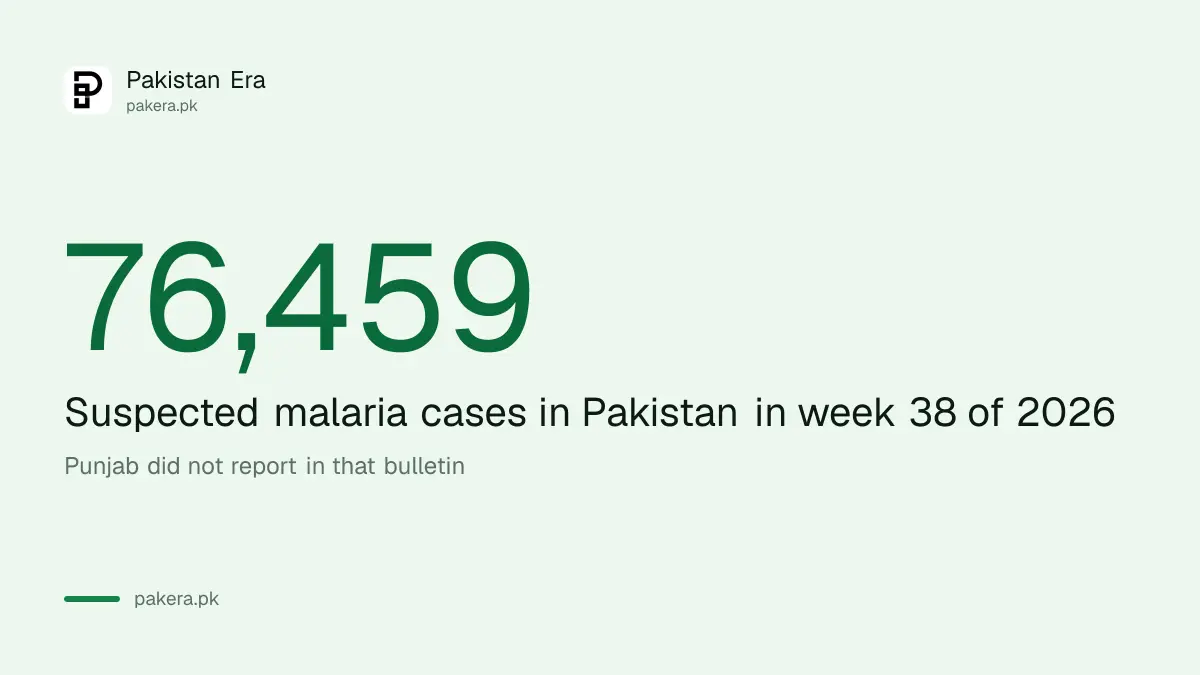
The NIH bulletin for week 38 of 2026 lists 76,459 suspected malaria cases across Pakistan. Sindh reported 64,318, Khyber Pakhtunkhwa 9,455, Balochistan 2,661, Islamabad 8 and Azad Kashmir 17. Punjab did not report. These are suspected cases, not confirmed ones.
| Area | Suspected malaria cases, week 38 of 2026 |
|---|---|
| Sindh | 64,318 |
| Khyber Pakhtunkhwa | 9,455 |
| Balochistan | 2,661 |
| Azad Jammu and Kashmir | 17 |
| Islamabad | 8 |
| Punjab | Did not report |
| Pakistan total | 76,459 |
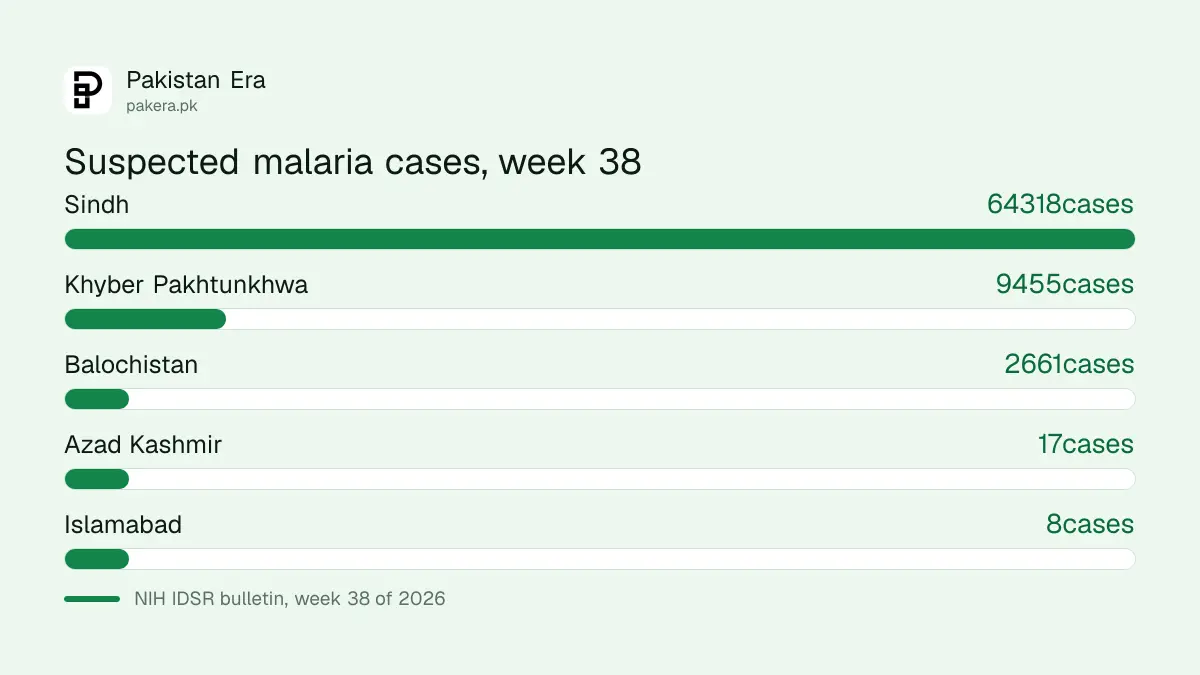
The bulletin says cases of malaria fell that week. Our report on the Sindh malaria count for week 38 gives the district detail. The bulletin also says all reported cases are suspected cases that need field verification.
Early malaria looks like many other fevers
WHO says the most common early symptoms are fever, headache and chills. They usually appear 10 to 15 days after a bite from an infected mosquito. Severe cases can bring extreme tiredness, confusion, seizures and difficulty breathing, and need emergency care at once.
Because the early signs match other illnesses, a test is the only way to know. In dengue season the same fever may be dengue instead. Our pages on dengue warning signs and on how to tell chikungunya from dengue help you ask the right question. They do not replace a test.
WHO says early treatment of mild malaria can prevent it from becoming severe. That is why waiting a week at home is a bad idea.
Get a parasite test before treatment
WHO recommends that all suspected malaria cases be confirmed with a parasite-based test: microscopy of a blood slide, or a rapid diagnostic test (RDT) that works like a finger-prick kit. Treatment is chosen after the result, based on the parasite type and your health.
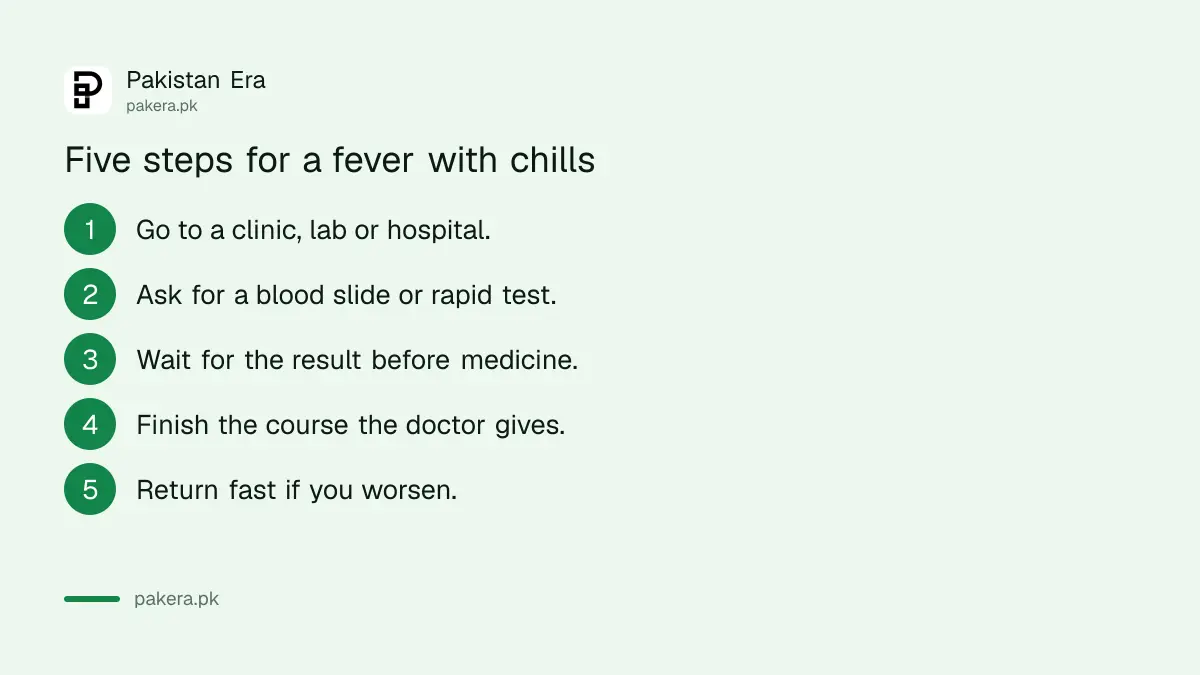
- Go to a clinic, lab or hospital and say you have fever and chills.
- Ask for a malaria test: a blood slide or a rapid test.
- Wait for the result before you start any malaria medicine.
- Take the prescribed course in full, as the doctor directs.
- Return at once if the fever gets worse or you become confused or breathless.
WHO says that the most effective treatment for the common P. falciparum type is artemisinin-based combination therapy, and that the choice depends on the parasite type, drug resistance, age, weight and pregnancy. Only a doctor can match these. We do not name doses.
We could not verify on an official Pakistani page whether the test is free at every government facility, so we do not state it. Ask the facility and ask for a receipt for any fee.
Prevent bites with nets, repellent and covered skin
WHO lists insecticide-treated nets for sleeping, mosquito repellent after dusk and protective clothing. Anyone travelling to a malaria area should ask a doctor about preventive medicine before the trip. These are the steps WHO names, and they work best together.
Standing water is where mosquitoes breed. After rain or floods, water stays in ditches, tyres and pots. The NIH has issued advisories on vector-borne disease after floods. In Punjab, you can report dengue larvae or standing water, which also helps against malaria mosquitoes.
Pregnant women and young children should not wait. WHO says treatment depends on pregnancy status and age, so tell the doctor if you are pregnant.
Go to hospital for severe signs
WHO says people with severe symptoms, such as extreme tiredness, confusion, seizures or difficulty breathing, should get emergency care right away. Do not wait for a test appointment. Call an ambulance or go to the nearest emergency room.
Ambulance numbers vary by province. In Sindh, call a free 1122 ambulance. Elsewhere, see the page on Edhi and Chhipa ambulance numbers.
Common questions
Can I treat malaria without a test?
WHO recommends confirming every suspected case with a parasite test. Treatment depends on the result, so test first when you can.
How long after a mosquito bite do symptoms start?
WHO says typically 10 to 15 days after a bite from an infected mosquito.
Which province has the most suspected cases?
In NIH's week 38 bulletin, Sindh had 64,318 of the 76,459 suspected cases.
Is a suspected case the same as a confirmed case?
No. NIH counts suspected cases. They need field verification before they count as confirmed malaria.
Is malaria spread from person to person?
WHO describes it as spread by the bite of an infected mosquito. We use only that statement.
Does a net really help?
WHO lists insecticide-treated nets for sleeping as a key prevention step in malaria areas.
How we verified this
What we checked, where we read it, and what we could not confirm.
Last checked on 14 October 2026, Pakistan time. We read the WHO malaria fact sheet and the NIH IDSR weekly public health bulletin for week 38 of 2026 on nih.org.pk (Table 1). Punjab did not report in that bulletin, so the national total is incomplete. We could not confirm on an official page where malaria tests are free, so we do not claim it. This page is not medical advice.
About the author

Tax, Bills and Technology Writer
Ali Akhtar is a young and curious voice here at Pakistan Era. He is currently pursuing his A-Levels and has a growing interest in Pakistan’s changing industrial landscape and educational trends. Ali likes to write in a way that helps him explain and explore the world around him. His writing reflects the perspective of the new generation navigating the evolving trends of Pakistan where technology, youth innovation, and shifting opportunities are reshaping the country’s future.