Overseas Pakistani Property Case in Khyber Pakhtunkhwa: Special Court, 120 Day Judgment and 15 Day Appeal
KP's 2026 law sends overseas Pakistanis' property cases to Special Courts: 10 day notice, leave to defend in 15 days, judgment in 120 days, appeal in 15 days.
Overseas Pakistanis with property disputes in Khyber Pakhtunkhwa now go to a Special Court under the KP Establishment of Special Courts (Overseas Pakistanis Property) Act, 2026. The court must decide within 120 days of granting leave to defend, appeals go to the Peshawar High Court within 15 days, and evidence can be given by video from an embassy.
The Act is KP Act No. XII of 2026. It came into force at once when it was published in the KP Gazette on 4 June 2026. It moves every property case in which an overseas Pakistani is a party out of the ordinary civil courts and into these courts.
Who counts as an overseas Pakistani under the KP law
The Act covers anyone with a Pakistani passport, CNIC, NICOP, Pakistan Origin Card or Overseas Pakistanis Foundation card who lives, works or studies abroad for more than one year. A relative or agent can file the case if the overseas Pakistani authorises them.
The property must be immovable property, as defined in the Registration Act, 1908: land, a house, a plot, a shop or a flat. The Act applies across the whole of Khyber Pakhtunkhwa. If your plot is in Punjab, Islamabad or Balochistan, a different law applies, set out in the guides for Punjab, Islamabad and Balochistan.
The old route and the new route compared
Before this Act, an overseas owner filed an ordinary civil suit and waited with no fixed deadline. Now the case goes to a Special Court with short notice periods, a leave to defend stage, a 120 day limit for judgment and a 15 day appeal window.
| Step | Ordinary civil suit | KP Special Court under the 2026 Act |
|---|---|---|
| Which court | Civil court with jurisdiction | Special Court for overseas Pakistanis' property |
| First appearance date | As fixed by the court | Not later than 10 days |
| Defendant's right to defend | Automatic written statement | Only with leave of the court, decided in 15 days |
| Security from defendant | Not required as a rule | At least 10% of the property's market value if the court imposes it |
| Judgment | No fixed time | Within 120 days of granting leave to defend |
| Adjournments | Under the Code of Civil Procedure | No more than 7 days at a time |
| Appeal | Normal appeal route | High Court within 15 days; High Court decides in 90 days |
How to file a case, step by step
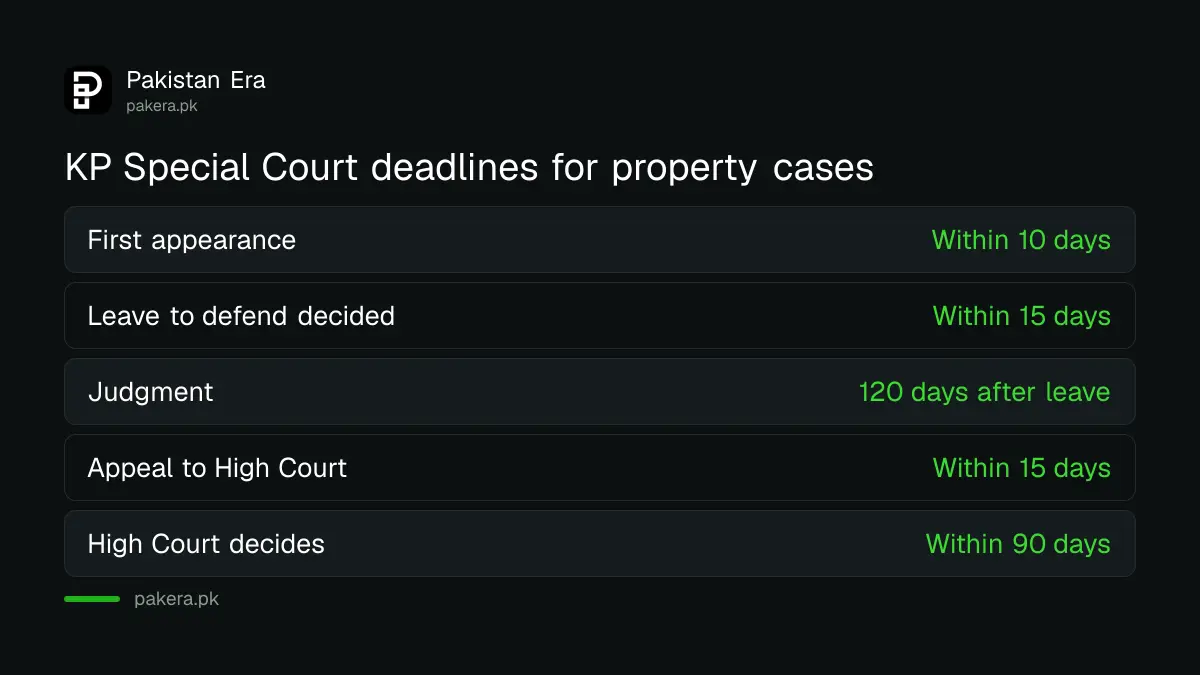
File a plaint in the Special Court for your district, stating who owns the property, who is in unlawful possession, its estimated market value and any rent the occupier collects. The court then serves the defendant, who must apply for leave to defend or lose the case.
- Collect proof of ownership: registry deed, mutation (intiqal), fard, or allotment letter.
- Collect proof of your status: passport, NICOP or POC, plus proof you live abroad.
- If you cannot travel, give a relative or lawyer a power of attorney attested at a Pakistani mission.
- File the plaint with the facts of ownership, unlawful possession, market value, any rent taken, and the relief you want.
- Ask the court for an order stopping the occupier from selling or mortgaging the property while the case runs.
- Ask to join hearings by video link, which the court must arrange on request.
Section 5 says the Peshawar High Court will make rules for e-filing, and section 21 gives the government 120 days from commencement to make rules under the Act. Ask the district court registrar which court has been notified for your district and how filing works there, because section 3 lets the government either set up new courts or designate existing district courts.
Deadlines the court and the other side must meet
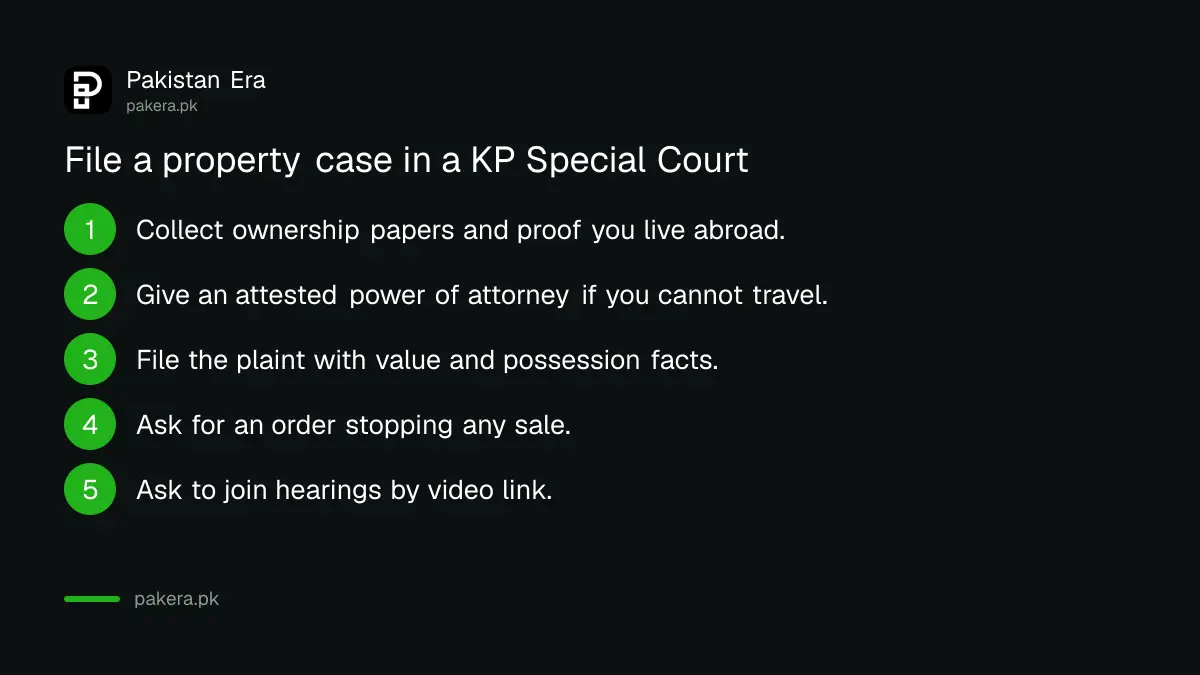
The Act sets tight times at each stage. Notice for appearance within 10 days, a second notice within 7 days, leave to defend decided in 15 days, judgment within 120 days, appeal within 15 days and the appeal decided within 90 days.
| Stage | Time limit | Section |
|---|---|---|
| Defendant's first appearance | Within 10 days | 6(1) |
| Second notice if absent | Within 7 days | 6(3) |
| Set aside an ex-parte order | Within 10 days of knowing | 6(5) |
| Decide leave to defend | 15 days from filing | 7(8) |
| Judgment | 120 days from grant of leave | 9(1) |
| Appeal to the High Court | 15 days | 11(1) |
| High Court decides appeal | 90 days | 11(3) |
If the case runs past 120 days, the court can order the defendant to give security, and pass judgment if they fail, unless the delay is not the defendant's fault. A stay granted in appeal lapses after two months.
Protections for your property while the case runs
Once notices go out, any sale or mortgage of the property by the defendant is void. The court can also attach the property, appoint a receiver, or order a buyer or benami holder not to deal with it, and it can call on police to enforce its decree.
- Transfers are void. Section 15 bars the defendant from selling, mortgaging or handing over the property after notices are published.
- Cases already pending move over. Section 14 transferred pending property cases filed by overseas Pakistanis to the Special Court, which continues from the same stage.
- Evidence from abroad. Section 8(6) lets you or a witness give evidence through the Pakistani embassy, high commission or consulate by video, under a notified official's supervision.
- False cases cost money. Section 10 lets the court order a plaintiff whose case is false and frivolous to pay the defendant's costs. Bring a genuine claim with documents.
If the dispute is about a share in a parent's property, start with the steps to claim inherited property as an overseas Pakistani, because the succession papers come first.
Common questions
Is the KP overseas property law in force?
Yes. Section 1(3) says it came into force at once. It was published in the KP Gazette (Extraordinary) on 4 June 2026 after the Governor's assent.
Can my brother in Peshawar file the case for me?
Yes. The Act defines the plaintiff as the overseas Pakistani or anyone he authorises. Give a clear, attested power of attorney naming the property.
Do I have to fly back for hearings?
No. Section 8(5) says the court shall arrange for you to join by video link on request, and section 8(6) allows evidence through the nearest Pakistani mission.
Can the occupier appeal against a refusal of leave to defend?
No. Section 11(4) bars appeals, reviews and revisions against an order on leave to defend or any interim order. Only the final judgment can be appealed.
Who hears the case if I am a defendant living abroad?
Section 4(3) sends every property case where one or more parties are overseas Pakistanis to the Special Court, so your case goes there too.
How we verified this
What we checked and where we read it.
We read the Khyber Pakhtunkhwa Establishment of Special Courts (Overseas Pakistanis Property) Act, 2026 (KP Act No. XII of 2026) in full on the KP Code page for the Act on 25 November 2026. The Act's front page records first publication in the KP Gazette (Extraordinary) on 4 June 2026. The KP Code page lists no rules or court notification under the Act on the same date.
Free on WhatsApp
Get last dates and rule changes on WhatsApp
We post new last dates, fee changes and fixes for common problems, a few short posts a day.
Follow Pakera on WhatsAppOther followers cannot see your number.
Pakera Solves It
Which online process wasted your time this week?
A portal that will not load, a form nobody explains, a complaint that went nowhere. Tell us. Every week we pick one, solve it step by step and publish the answer.
About the author

Global Affairs & Political Economy Writer
Muhammad Hatim is a book lover who started writing because he enjoys it. At Pakistan Era he writes about international relations, geopolitics and the global economy, with a particular interest in South Asia and the forces behind current events.