Overseas Pakistani Property Case in Punjab: Special Court, 90 Day Judgment and Video Link Hearings
Overseas Pakistanis can take a Punjab property dispute to a special court: who qualifies, what to file, the 10, 15 and 90 day deadlines and video link hearings.
An overseas Pakistani with a property dispute in Punjab files a petition in a special court set up under the Punjab Establishment of Special Courts (Overseas Pakistanis Property) Act 2025, which must give judgment within 90 days of deciding the other side's request to defend. You can file through an attorney, join hearings by video link, and give evidence at a Pakistani embassy or consulate.
That matters because the usual problem is distance. A brother or tenant sits in the house, the case drags for years, and every hearing needs a flight home. We read the Act on the Punjab Government's Punjab Code page for the Act on 28 October 2026. Below are the deadlines it sets and the steps that follow from them.
You count as an overseas Pakistani after 182 days abroad in a tax year
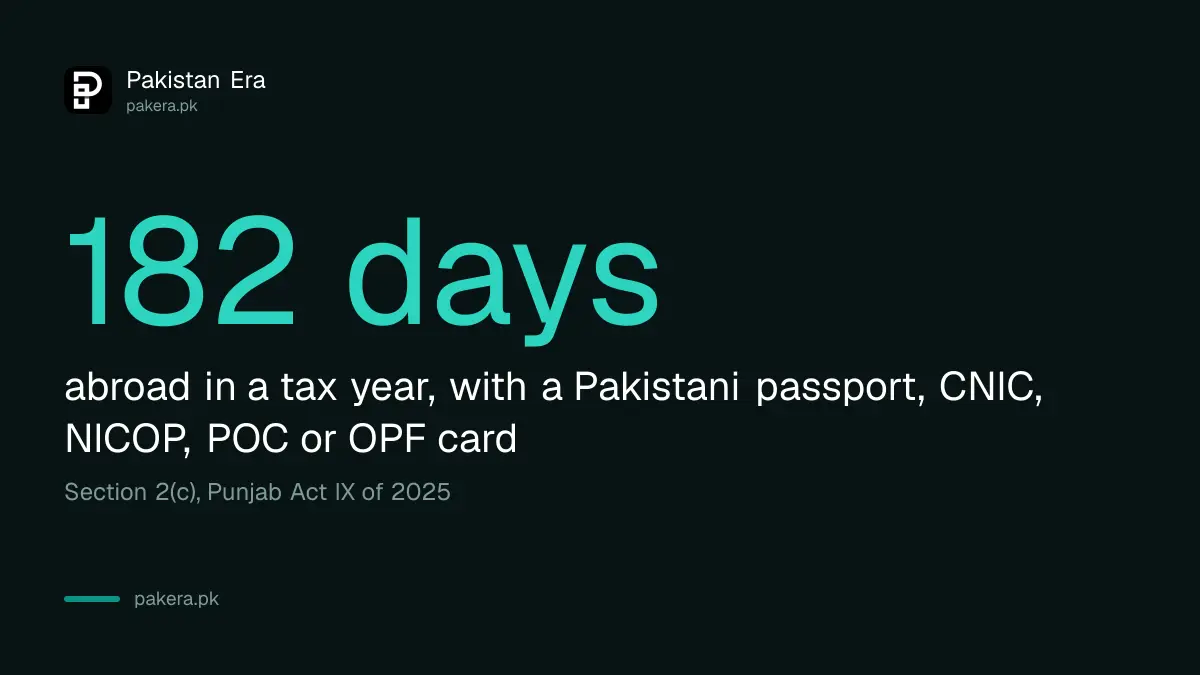
Section 2(c) covers anyone holding a Pakistani passport, CNIC, NICOP, Pakistan Origin Card or Overseas Pakistanis Foundation card who lives, works or studies abroad for more than 182 days in a tax year. Living abroad permanently or for a temporary job both count.
The petitioner can be the overseas Pakistani or anyone they authorise. In practice that means a registered power of attorney. If you are setting one up, the steps to make a power of attorney from abroad come first.
The court's reach is wide. Under section 4(3), every suit, petition or proceeding in Punjab in which one or more parties is an overseas Pakistani goes to the special court. Section 13 also moved cases already pending in other courts to the special courts when the Act started.
The Punjab special court works to fixed deadlines
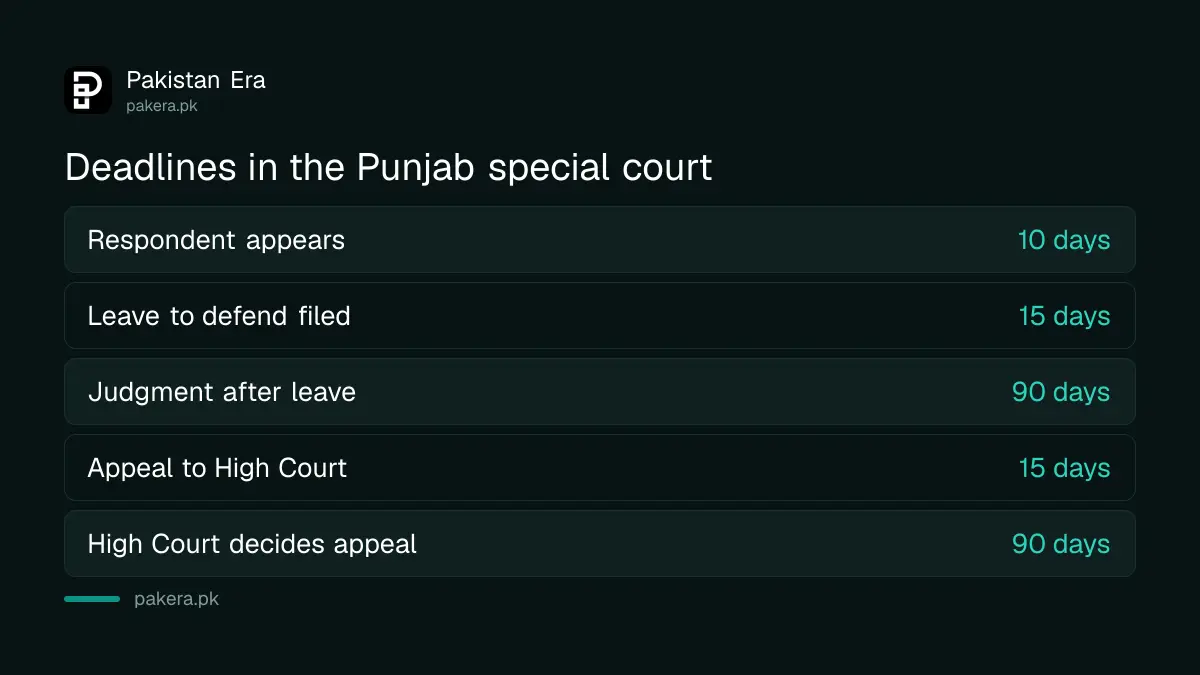
The Act gives the respondent ten days to appear after notice, fifteen days to apply for leave to defend, and the court fifteen days to decide that application. Judgment must follow within 90 days of granting leave, and adjournments cannot run past seven days.
| Stage | Deadline | Section |
|---|---|---|
| Respondent must appear after notice | Within 10 days | 6(1) |
| Second notice if the respondent stays away | Within 7 days | 6(3) |
| Respondent applies for leave to defend | Within 15 days | 7(2) |
| Court decides the leave application | Within 15 days of filing | 7(8) |
| Judgment | Within 90 days of granting leave | 9(1) |
| Appeal to the Lahore High Court | Within 15 days | 10(1) |
| High Court decides the appeal | Within 90 days of filing | 10(3) |
Leave to defend is the key gate. If the respondent does not apply within fifteen days, the facts in your petition are treated as admitted and the court can pass a decree. If leave is granted, the court can make the respondent deposit security of at least ten per cent of the property's market value.
How to file an overseas Pakistani property petition in Punjab
Section 4(2) lists what the petition must contain: the ownership position, who holds the property unlawfully, its estimated market value, any rent or profit they have taken, and the relief you want. Prepare those facts with papers before a lawyer drafts it.
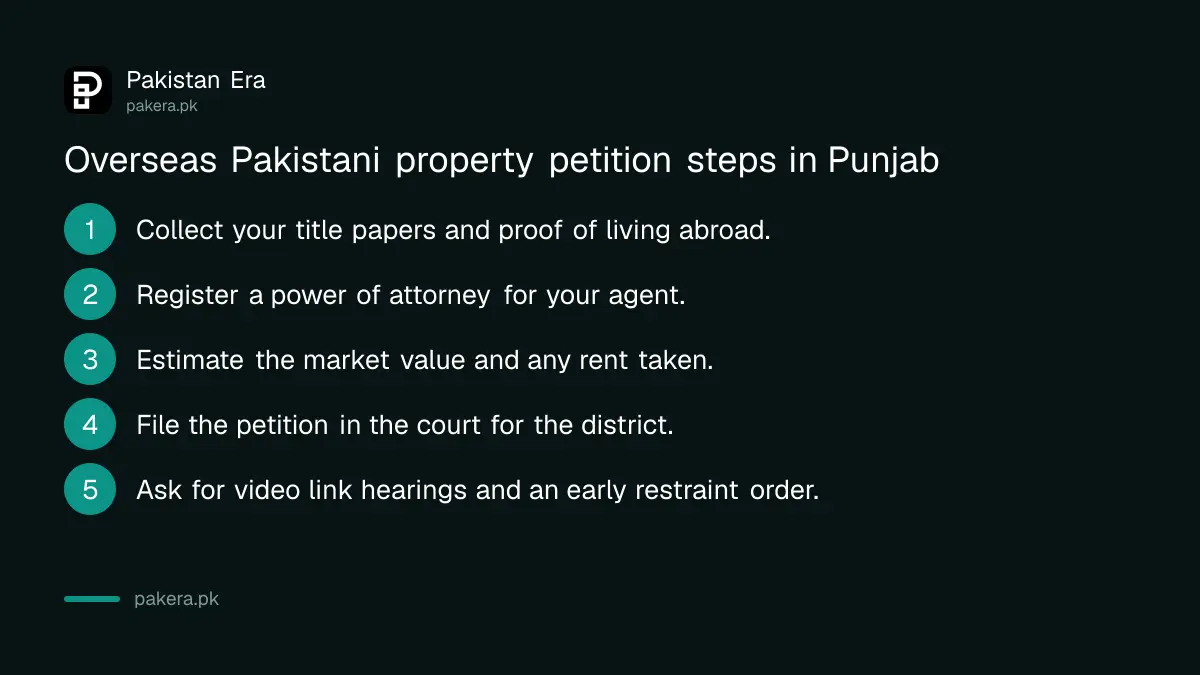
- Gather proof of title: registered deed, fard or mutation, allotment letter or transfer letter.
- Gather proof you are an overseas Pakistani: NICOP or passport with visa or residence permit, and travel dates if you have them.
- Register a power of attorney in favour of the person who will act for you in Pakistan.
- Estimate the market value and any rent the occupant has collected, with evidence.
- File the petition in the special court with jurisdiction over the property, by e-filing where the Lahore High Court rules allow it.
- Ask the court for video link hearings and, if needed, to record your evidence at the embassy.
Before you file, check the land record. The steps to verify land records show whether the property was quietly transferred while you were away, which changes what you ask the court for.
The court can freeze, attach or hand over the property early
Section 12 lets the special court stop the respondent from selling or mortgaging the property, attach it, appoint a receiver, or even transfer possession to you before the final judgment. It can do this on its own or on your application.
These orders can reach a third party too, if the property was sold in breach of the Act or is held benami, meaning in someone else's name for the respondent. Section 15 adds a freeze of its own: once notice is published, any transfer by the respondent is void.
Ask for these orders in your first application. A respondent who knows a case is coming often tries to sell fast, and an early restraint order is what stops that.
Hearings by video link and evidence at the embassy
Section 8(5) says the court shall arrange for an overseas litigant to join proceedings by video link on request. Section 8(6) lets you or a witness give evidence through the Pakistani High Commission, embassy or consulate, supervised by a notified official.
The court treats a party's affidavit as their main evidence, and each side gets at most two chances to produce evidence. Cause lists and short orders are meant to be posted on a web portal set up for these cases, so you can follow the case from abroad.
Once a decree is issued, section 11 turns the case into execution automatically after fifteen days. You do not need a separate execution petition, and the court can call in the police to enforce it.
Common questions
Who can file in the Punjab special court for overseas Pakistanis?
An overseas Pakistani, as defined in section 2(c), or anyone they authorise. The property must be immovable property in Punjab.
How long does a case take in the special court?
Judgment is due within 90 days of the court granting leave to defend. If the respondent never seeks leave, a decree can come sooner.
Do I need to travel to Pakistan for the case?
Not necessarily. The Act provides for an attorney, video link hearings and evidence recorded at a Pakistani embassy or consulate.
Can the decision be appealed?
Yes, to the Lahore High Court within 15 days. No appeal lies against an order on leave to defend or other interim orders.
Is there a similar court in other provinces?
Balochistan has one. See how to file an overseas Pakistani property case in Balochistan.
What if someone has grabbed my plot while I was abroad?
You can use this special court. Punjab's 2025 ownership law also makes qabza a crime, with complaints going to the Punjab Property Tribunal.
How we verified this
What we checked, where we read it, and what we could not confirm.
We read the Punjab Establishment of Special Courts (Overseas Pakistanis Property) Act 2025 (Act IX of 2025) on the Punjab Code portal of the Law and Parliamentary Affairs Department on 28 October 2026. It was passed on 20 January 2025 and published in the Punjab Gazette on 29 January 2025. We could not open the Lahore High Court website from our connection, so we have not verified which courts are notified as special courts, the e-filing rules, the court fee or the web portal for cause lists. Ask the district judiciary where your property sits before filing.
About the author

Tax, Bills and Technology Writer
Ali Akhtar is a young and curious voice here at Pakistan Era. He is currently pursuing his A-Levels and has a growing interest in Pakistan’s changing industrial landscape and educational trends. Ali likes to write in a way that helps him explain and explore the world around him. His writing reflects the perspective of the new generation navigating the evolving trends of Pakistan where technology, youth innovation, and shifting opportunities are reshaping the country’s future.