Overseas Pakistani Property Case in Islamabad: Special Court, 90 Day Judgment and Every Deadline
Overseas Pakistanis can take an Islamabad property dispute to a special court: who qualifies, what to file, all 10 deadlines, video link hearings and OPF help.
If you are an overseas Pakistani and someone has taken or blocked your house, plot or shop in Islamabad, the case goes to a special court under the Establishment of Special Court (Overseas Pakistanis Property) Act, 2024. The court must decide within 90 days of granting the other side leave to defend. The respondent gets 10 days to appear, and you can join hearings by video link from abroad. Appeals go to the Islamabad High Court within 15 days.
We read the full text of the Act, Act No. XXVIII of 2024 dated 28 October 2024, on the federal government's Pakistan Code website on 10 November 2026. It has 23 sections and covers the whole Islamabad Capital Territory. Below we explain who can use it, what to file, every deadline in it, and who to contact. Punjab and Balochistan have their own versions, which we cover in our guides to the Punjab special court and the Balochistan special court.
Who counts as an overseas Pakistani under the Islamabad law
Section 2 says an overseas Pakistani is anyone holding a Pakistani passport, CNIC, NICOP, Pakistan Origin Card (POC) or OPF membership card who lives, works or studies abroad for more than 182 days in a tax year. You do not have to come home to file.
The petitioner can be you or anyone you authorise. In practice that means a relative or lawyer acting under a power of attorney. If you still need one, read our guide to registering a power of attorney for Islamabad property from abroad.
- Property covered: immovable property as defined in the Registration Act, 1908. That means land, houses, flats, shops and plots.
- Area covered: the Islamabad Capital Territory only. A plot in Rawalpindi falls under the Punjab law instead.
- Cases covered: section 4(3) says every case in which one or more parties is an overseas Pakistani is heard only by the special court.

The special courts are already designated in Islamabad
The Act lets the federal government, in consultation with the Chief Justice of the Islamabad High Court, set up new special courts or designate existing district courts as special courts. Judges serve three year terms and must be serving or former district judges, or advocates of 10 years' standing.
The Pakistan Consulate in Los Angeles published a notice on 18 September 2025 saying special courts for overseas Pakistanis "have been established in Islamabad". It says two District and Sessions Judges were designated in the district judiciary and one Islamabad High Court judge was nominated for appeals. We could not find the designation notification itself on the Islamabad High Court website, so we cannot give the court room or judge names here.
What your petition must contain
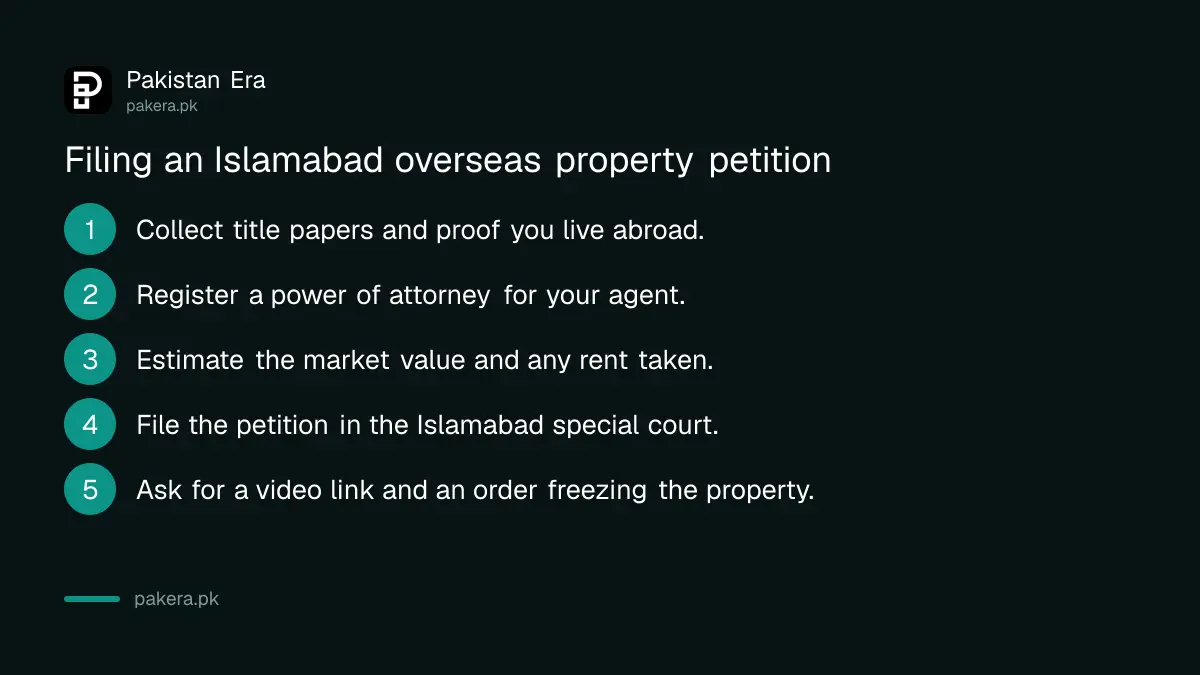
Section 4(2) lists what the petition needs. A weak petition slows the case, so collect these papers before your lawyer files.
- A short statement of facts showing who owns the property and who is in unlawful possession or control.
- The estimated market value of the property.
- Details of any rent or profit the occupier has taken.
- The relief you want, such as possession, removal of the occupier or a stop on any sale.
- Proof of your status abroad: passport, NICOP or POC, plus a visa, residence card or work contract.
- Your title papers, such as the sale deed, allotment letter, transfer letter or mutation.
Section 5 tells the Islamabad High Court to make rules for e-filing, electronic hearings and online payment of court fees. We did not find published e-filing rules, so ask the court registry or your lawyer which filing route is open today.
Every deadline in the Islamabad Act
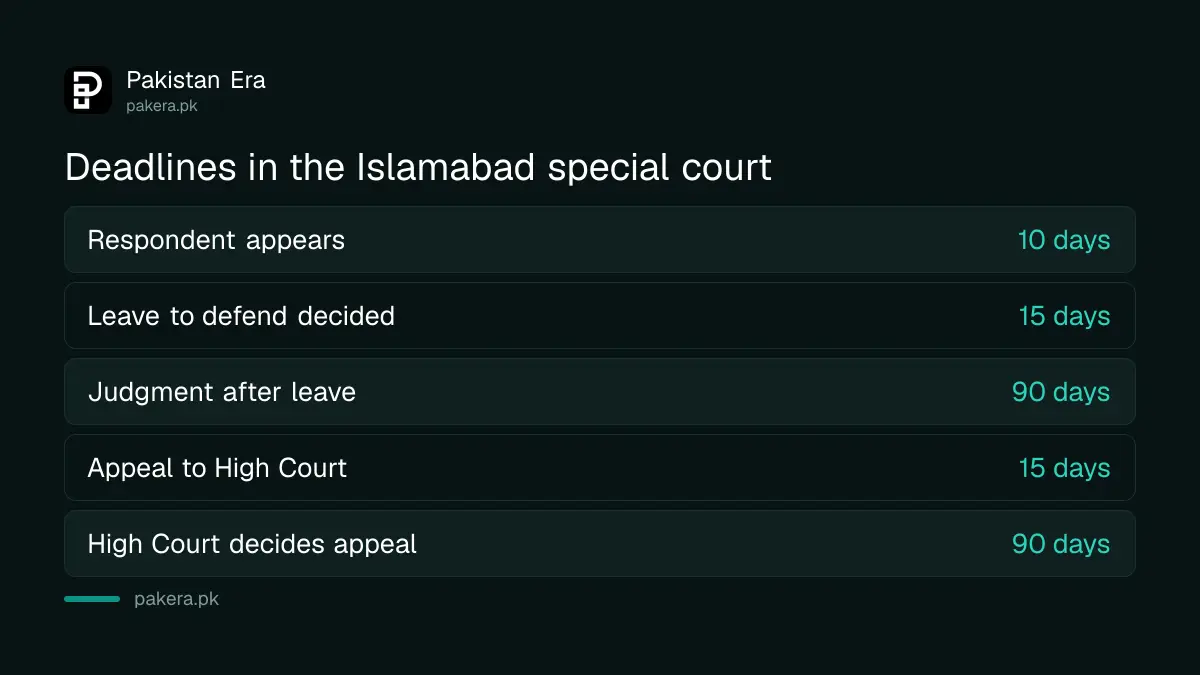
The law sets short, fixed deadlines at each stage. These are the numbers to quote if the case starts to drift.
| Stage | Deadline | Section |
|---|---|---|
| Respondent must appear after notice | Within 10 days | 6(1) |
| Second notice if the respondent stays away | Within 7 days | 6(3) |
| Respondent asks to set aside an ex parte order | 10 days from knowing of it | 6(5) |
| Court decides leave to defend | 15 days from filing | 7(8) |
| Judgment | 90 days from grant of leave | 9(1) |
| Any single adjournment | No more than 7 days | 9(4) |
| Appeal to the High Court | Within 15 days | 10(1) |
| High Court decides the appeal | 90 days from filing | 10(3) |
| Stay of execution in appeal | Lapses after 2 months | 10(6) |
| Decree goes to execution | Automatically after 15 days | 11(1) |
The occupier must earn the right to defend
Section 7 is the strongest part of the law for an owner abroad. The respondent cannot defend at all unless the court grants "leave to defend". If they do not apply, the facts in your petition are treated as admitted and the court can decree in your favour.
- The application must come with an affidavit, all relevant documents and affidavits of no more than two witnesses. One that misses these is rejected unless there is good cause.
- The court grants leave only if real questions of law or fact need evidence.
- It can order the respondent to deposit security of at least 10 per cent of the property's market value.
- No appeal, review or revision lies against an order granting or refusing leave.
If the case runs past 90 days and the delay is the respondent's fault, section 9 lets the court demand more security. If none is paid, it passes judgment.
You can give evidence from abroad by video link
Section 8(5) says the court "shall" arrange a video link when an overseas Pakistani litigant asks for one. Section 8(6) lets you or your witnesses record evidence through the Pakistani embassy, high commission or consulate in your country, under the supervision of an official notified for the purpose.
Affidavits count as examination in chief, and each side gets no more than two chances to produce evidence. Section 8(7) also requires cause lists and short orders to go on a web portal. Until that portal is clearly live, use our guide to IHC case status for the appeal stage.
The court can freeze the property while the case runs
Once the first notice is published, section 15 makes any sale, transfer, mortgage or handover by the respondent void. Section 12 lets the court go further, on its own or on your application.
- Stop the respondent or anyone else from selling or dealing with the property.
- Attach the property.
- Hand possession to you.
- Appoint a receiver to manage it.
These orders also reach a third party who bought in breach of the Act, or a benami holder, meaning someone holding the property in their name for the respondent. At execution, section 11 lets the court call in the police, and it can fine anyone who files objections only to delay.
Old cases move to the special court automatically
Section 13 transfers every pending suit, petition and execution in Islamabad where an overseas Pakistani is a party to the special court, from the stage it had reached. Appeals and revisions go to a special bench of the High Court. You do not need to start again, but check that your file has actually moved.
The Limitation Act, 1908 still applies to new cases, so an old dispute can be time barred. Talk to a lawyer before you assume a 15 year old claim is still alive. For family property after a death, see our guide to an overseas Pakistani inheritance claim.
Who to contact for help with an Islamabad property case
The Overseas Pakistanis Foundation (OPF) coordinates these cases. The consulate notice names Mr Ghaffar Ali, Senior Law Officer at OPF, as the focal person.
- Mobile: +92 300 5729283
- Office: +92 51 9048251
- Email: legal@opf.org.pk
OPF asks overseas Pakistanis to send details of property cases anywhere in Pakistan to this desk. You can also raise the matter through the Islamabad High Court overseas cell or the OPF complaint cell.
Common questions
Which law covers overseas Pakistanis' property cases in Islamabad?
The Establishment of Special Court (Overseas Pakistanis Property) Act, 2024, Act No. XXVIII of 2024. It covers the whole Islamabad Capital Territory and came into force at once.
How long does the Islamabad special court take to decide a property case?
The law says judgment within 90 days from the day the court grants the respondent leave to defend. Leave itself must be decided within 15 days of the application.
Do I have to come to Pakistan for the hearing?
No. The court must arrange a video link if you ask, and evidence can be recorded through a Pakistani embassy or consulate abroad.
Can a relative file the case for me?
Yes. The Act defines the petitioner as the overseas Pakistani or anyone authorised by them, usually through a registered power of attorney.
Can the occupier sell my property while the case is pending?
No. After the first notice is published, any sale, transfer or mortgage by the respondent is void, and the court can also attach the property.
Where do I appeal against the special court's decision?
To the Islamabad High Court within 15 days. The High Court must decide within 90 days, and any stay it grants lapses after two months.
Last checked 10 November 2026 against the text of Act No. XXVIII of 2024 on pakistancode.gov.pk and the Pakistan Consulate Los Angeles notice of 18 September 2025.
About the author

Global Affairs & Political Economy Writer
Muhammad Hatim is a book lover who started writing because he enjoys it. At Pakistan Era he writes about international relations, geopolitics and the global economy, with a particular interest in South Asia and the forces behind current events.