Gas Pipe, Stove or LPG Cylinder on Fire in Pakistan: What to Do, per NDMA and SSGC
Gas pipe, stove hose or LPG cylinder on fire in Pakistan: close the valve if safe, no switches, no water, never move the cylinder, call 1122 and 1199. NDMA.
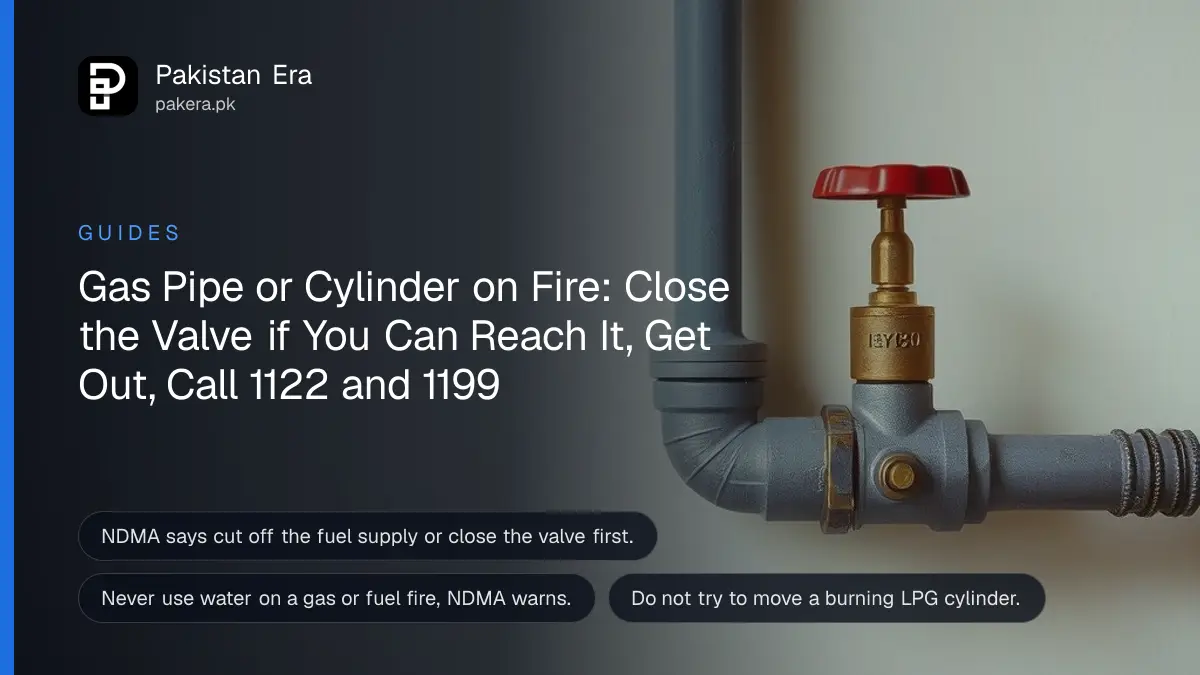
If a gas pipe, stove hose or LPG cylinder catches fire: close the gas valve if you can reach it without touching the flame, get everyone out, and call 1122 or 16, then your gas company on 1199. Never throw water, and never try to move a burning cylinder. Those are the Class B rules in NDMA's fire guidelines. If the valve is in the flames, leave it and get out.
Sui gas and LPG fires are Class B fires, the same class as petrol and paint, in NDMA's Urban Fire Safety Guidelines of 16 March 2026. The fuel keeps flowing until someone shuts it off, which is why the valve matters more than the extinguisher. This page covers the stove, the pipe, the cylinder and the gas meter, with the gas companies' own safety rules.
Shut off the gas supply first, because the fire needs the fuel
NDMA's first instruction for a gas or fuel fire is to cut off the fuel supply or close the valves. A gas flame dies when the gas stops. Fight it only after that, with foam, CO2 or a dry chemical extinguisher, never with water.
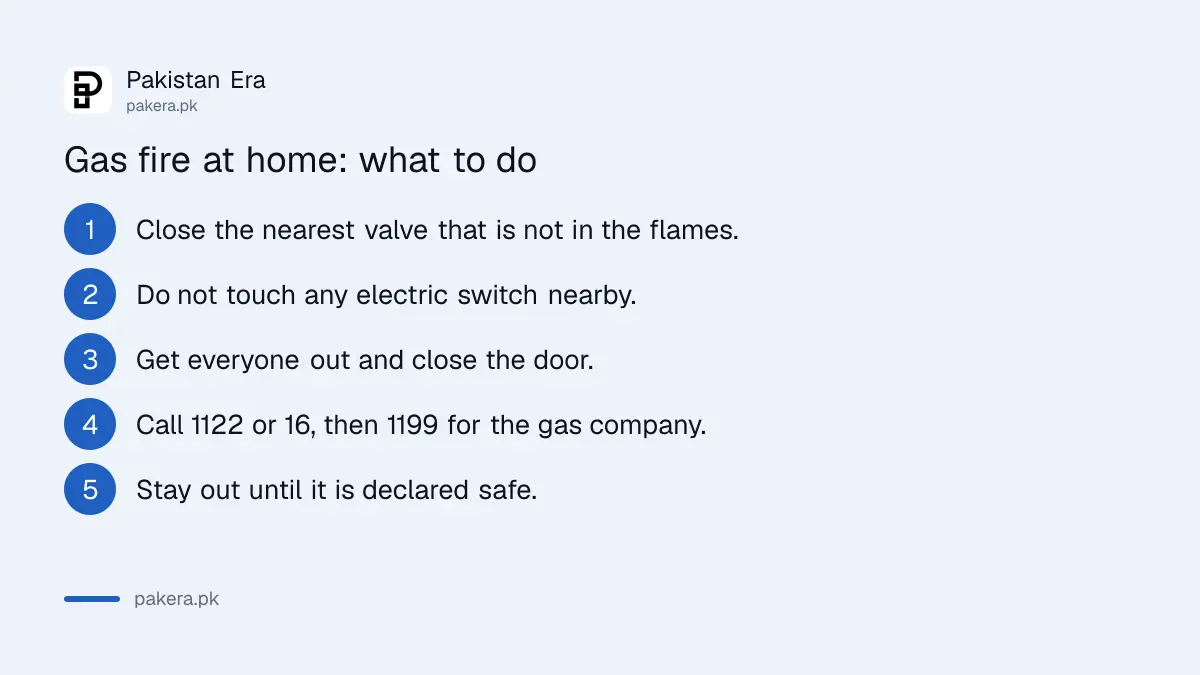
- Close the nearest valve that is not in the flames: the stove knob, the appliance valve, the main valve after the meter, or the cylinder valve.
- Do not touch electric switches nearby. NDMA's rule: no spark, no flame.
- Get everyone out of the room, then the house, and close the door behind you.
- Call 1122 or 16 from outside, then call 1199 for SNGPL or SSGC.
- Stay out until the fire brigade and the gas company say it is safe.
If a small flame stays after the valve is closed, a CO2 or dry chemical extinguisher can put it out. NDMA lists foam, CO2 and dry chemical for Class B, and an ABC powder extinguisher covers it. If the flame is at the valve itself and you cannot close it, do not try to put the flame out. Leave, because unburned gas escaping into the room is more dangerous than a steady flame.
Each gas fire has a different valve to close
Where the fire is tells you which valve to reach for. The aim is always the same: stop the gas at a point upstream of the fire, without putting your hand in the flame.
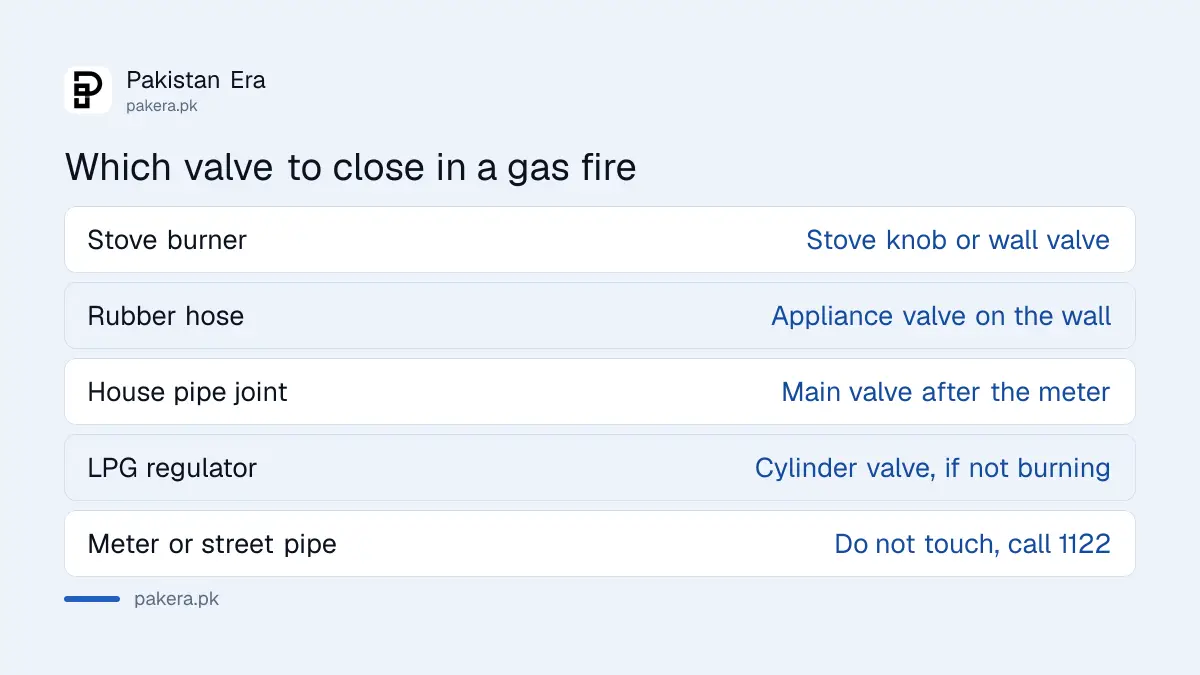
| Where the fire is | Valve to close | Then |
|---|---|---|
| Stove burner or knob | Stove knob, or the appliance valve on the wall pipe | Let the burner cool; check the hose |
| Rubber hose to stove or heater | Appliance valve on the wall pipe | Replace the hose with a GI pipe |
| Joint on the house pipe | Main valve after the gas meter | Call 1199; use an approved fitter |
| LPG cylinder regulator | Cylinder valve, only if not in the flame | Get out; call 1122 |
| Gas meter or street pipe | Do not touch it | Get out; call 1122 and 1199 |
SSGC's safety poster says never use a rubber pipe for gas and use a GI (galvanised iron) pipe instead. A cracked rubber hose behind a heater is a common source of both leaks and fires. The meter and the pipe up to it belong to the gas company, so leave those to its staff. See checking a house gas line for leaks for the soap test.
Water spreads a gas or fuel fire
NDMA's chart says "Never use water" on flammable liquid and gas fires, because it spreads them. NDMA also lists water and foam extinguishers as dangerous for Class B, C and K fires. Use CO2 or dry chemical, and only on a small flame.
NDMA's other don'ts for Class B fires:
- Do not operate electric switches nearby if you smell gas.
- Do not try to move a burning container, such as a cylinder.
- Do not ignore small spills or a faint gas smell.
- Do not allow static sparks or open flames near a leak.
- Keep ignition sources away from the fuel.
For a small spill of petrol or kerosene that has not caught fire, NDMA says to use sand or dirt to soak it up. That is a spill rule, not a way to fight a gas flame.
An LPG cylinder fire is a get-out fire
NDMA tells people not to move a burning container and to move everyone away from the fire zone. A burning LPG cylinder can fail suddenly, so once the valve is out of reach, clear the house and street nearby and wait for 1122.
Tell the 1122 operator it is an LPG cylinder fire, and how many cylinders are in the building. Keep people, especially children, well away until the fire brigade arrives.
Most cylinder fires start at a leaking regulator or hose. Buying a cylinder from an OGRA-licensed seller and checking the valve and seal are covered in LPG cylinder safety.
The gas companies' rules stop most gas fires before they start
SSGC's safety rules ask households to turn off stoves and heaters when not in use, close all valves before sleeping, use only PSQCA approved gas appliances, use GI pipe instead of rubber, and call 1199 for any leak.
- Before lighting a heater or stove, check there is no gas smell and open a window.
- Keep the matchbox or lighter ready before turning the valve on.
- Never leave a gas heater burning while you sleep or are out.
- Get leaking pipes inside the house fixed by an approved technician.
More on heaters and geysers is in SSGC's winter rules for gas heaters and geysers. If a gas fire damaged your home and the fault was on the company's side, see claiming compensation for a gas leak or fire.
Common questions
What should I do first if the gas stove pipe catches fire?
Close the appliance valve on the wall pipe if you can reach it without touching the flame. Then get out and call 1122 and 1199.
Can I put water on a gas fire?
No. NDMA says never use water on gas and fuel fires, because it spreads them. Shut off the gas and use a CO2 or dry chemical extinguisher on a small flame.
Should I carry a burning LPG cylinder outside?
No. NDMA says do not try to move a burning container. Close the cylinder valve only if it is out of the flame, then clear the area and call 1122.
Why should I not put out the flame if the valve cannot be closed?
Gas would keep escaping into the room without burning, and the next spark could cause an explosion. Leave the steady flame to the fire brigade.
What is the SNGPL and SSGC emergency number?
1199 for both companies. Call it from outside the house, after calling 1122 for the fire.
Can I fix the gas pipe myself after the fire?
No. SSGC asks for an approved technician for pipes inside the house, and the meter and service line belong to the gas company.
How we verified this
What we checked and where we read it.
We checked the NDMA Urban Fire Safety Guidelines, dated 16 March 2026, on the NDMA guidelines page on 25 November 2026 (Class B: use foam, CO2 or dry chemical, never water, cut off fuel supply or close valves, no electric switches if gas smell, do not move a burning container, sand or dirt for small spills, evacuate). Household gas rules are from SSGC's safety education poster, and the 1199 line is listed on the SSGC website. Last checked 25 November 2026.
Free on WhatsApp
Get last dates and rule changes on WhatsApp
We post new last dates, fee changes and fixes for common problems, a few short posts a day.
Follow Pakera on WhatsAppOther followers cannot see your number.
Pakera Solves It
Which online process wasted your time this week?
A portal that will not load, a form nobody explains, a complaint that went nowhere. Tell us. Every week we pick one, solve it step by step and publish the answer.
About the author

Lifestyle & Clothing Writer
Mahnoor Siddiqui is a lifestyle and clothing writer at Pakistan Era, joining the new lifestyle desk in November 2026.