Claim Compensation From SNGPL or SSGC After a Gas Leak, Fire or Explosion in Pakistan: File Within 10 Days
Claim compensation from SNGPL or SSGC after a gas leak, fire or explosion: who can claim, the 10 day deadline, documents, exclusions and how to appeal.
If a gas leak, fire or explosion from the SNGPL or SSGC network kills, injures or damages property, the registered gas consumer can claim compensation by filing a claim form with the company within 10 days of the incident. The claim is assessed by the company's insurer, National Insurance Company (NIC), under a compensation procedure approved by OGRA. A leak in your own house line is not covered.
Most families never hear of this procedure until after a blast, and by then the 10 day window is half gone. Read the conditions below first, because they decide whether a claim can succeed at all. The same rules apply to Sui Northern Gas (SNGPL) in Punjab, Khyber Pakhtunkhwa and Islamabad, and Sui Southern Gas (SSGC) in Sindh and Balochistan.
OGRA's procedure lets a registered consumer claim for death, injury or property loss
The procedure covers registered gas consumers, and their legal heirs, who suffer loss of life, physical injury or loss of property because of the gas company's regulated work. That means its transmission, distribution and sale of gas through its own pipelines and network.
The claimant must be the person in whose name the connection is installed and the bills are issued, or a legal heir of that person. A tenant whose name is not on the account is not a claimant under the procedure. So a name change after buying a house is not just paperwork; it also decides who can claim. The steps for that are in updating the CNIC on your gas account, done at the same counter.
Four conditions must all be met before the company pays
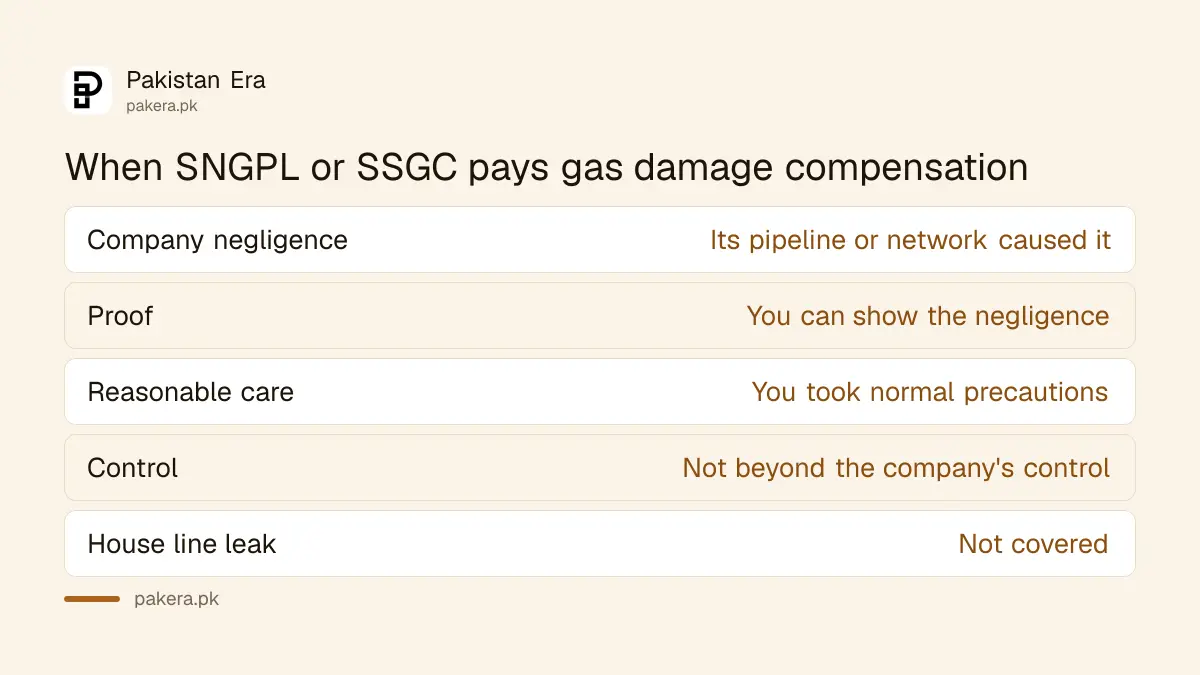
A claim succeeds only when the harm came from the company's negligence, the claimant can prove that negligence, the claimant took reasonable care, and the cause was not beyond the company's control. Missing any one of these ends the claim.
| Condition | What it means in practice |
|---|---|
| Company negligence | Poor construction, maintenance or operation of a pipeline, or a gas escape, fire or hazard from the company's network |
| Proof of negligence | Photos, the complaint number, witness names, the police report and any inquiry finding |
| Reasonable care by you | You reported the smell, closed the valve and did not ignore warnings |
| Within the company's control | Not an event the company could not have prevented |
Proof is where most claims fail. If you smelled gas near the street main and called 1199, that complaint number is your best evidence that the company knew. Note it down every time.
Six situations are excluded from compensation
The company is not liable when the harm came from a leak in your internal house line, an unauthorised connection, ignoring normal safety precautions, collateral damage, terrorism or sabotage, or damage to the pipeline by someone other than the company's own staff.
- Your internal house line. Everything after the meter is the consumer's responsibility, so a leak inside the house is not the company's fault under this procedure.
- An unauthorised connection. An illegal or extended line removes any claim.
- Ignoring safety. For example, lighting a match to look for a leak.
- Collateral damage. Indirect losses beyond the incident itself.
- Terrorism or sabotage on the network.
- Third-party damage. A contractor or another agency digging into the pipeline.
The house line exclusion is the big one for homes. Most kitchen and room heater blasts start inside the house, so check your pipes before winter. The two tests SSGC recommends take one night and a cup of soapy water. Safe heater use is covered in using a gas heater or geyser safely.
File the claim form within 10 days
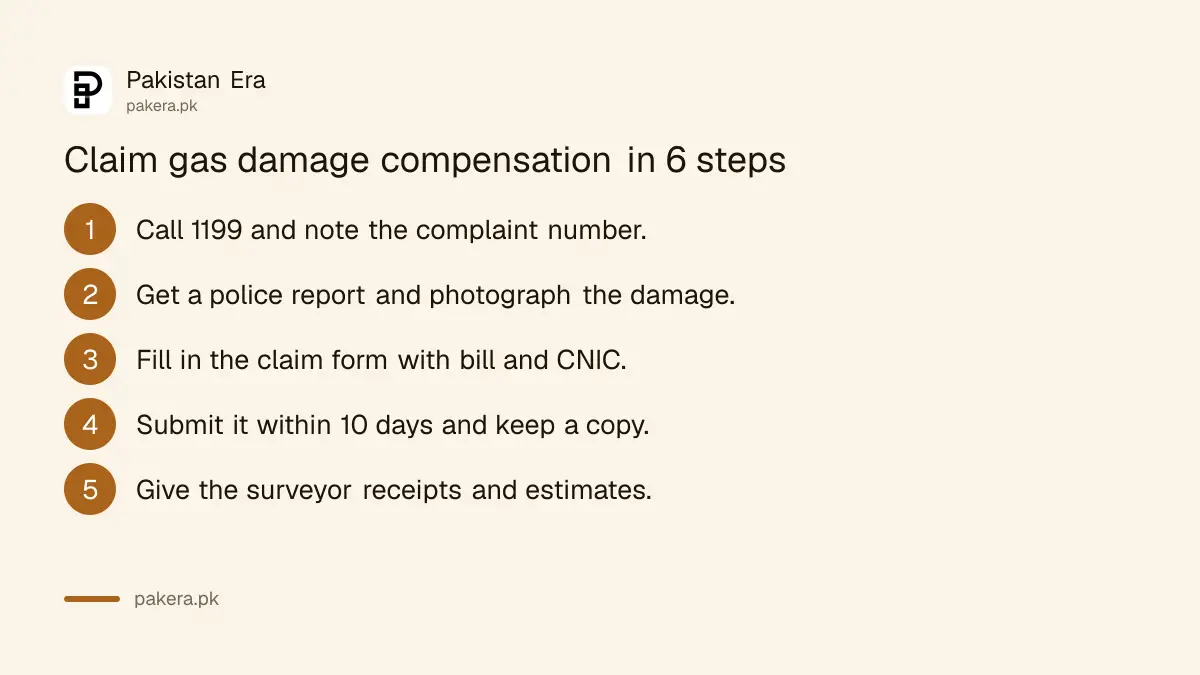
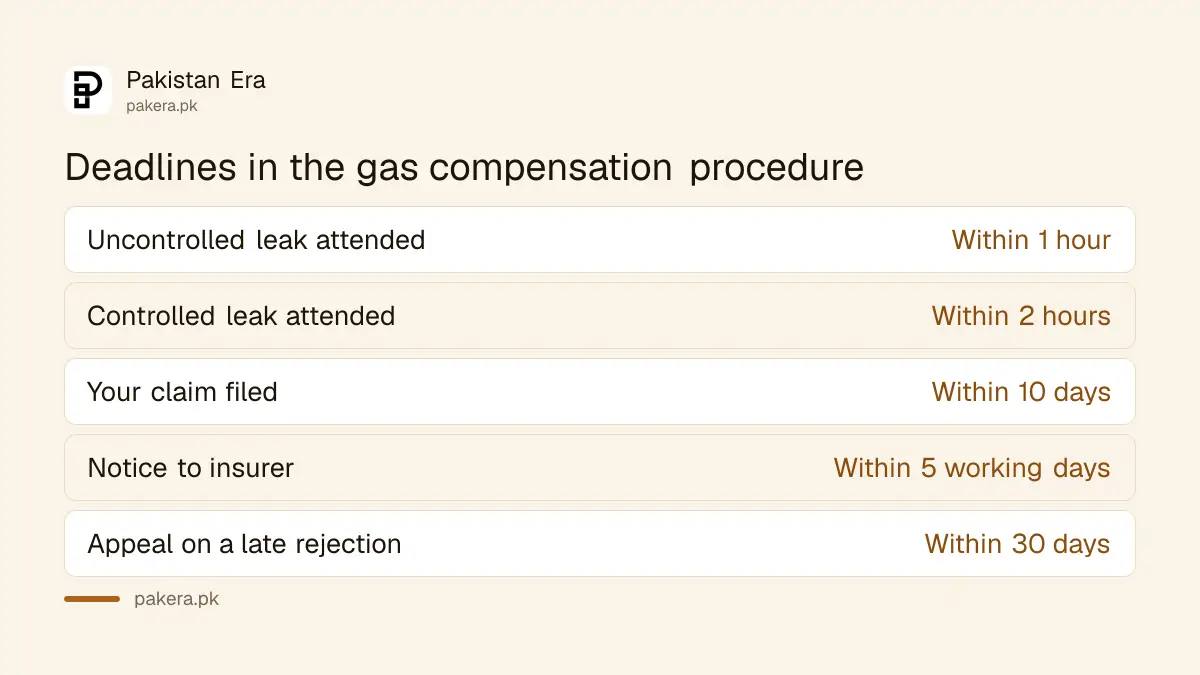
Submit the company's claim form within 10 days of the incident, with your last paid gas bill, a CNIC copy and the police report reference. The company then has 5 working days to serve formal notice of the claim on its insurer, and the insurer's surveyor inspects the site.
- Call 1199 at once. OGRA's service standards require the company to attend uncontrolled gas escapes within one hour and controlled escapes within two hours.
- Get an FIR or police report where the incident involves death, injury or a fire.
- Photograph the damage before clearing anything, and keep damaged items if you can.
- Fill in the claim form and attach the last paid gas bill and a CNIC copy.
- Submit it to the company within 10 days and keep a stamped copy.
- Give the surveyor receipts, repair estimates and a statement of loss.
The claim form asks for the consumer reference number, father's name, CNIC number, phone, date and time of the incident, the FIR reference and the nature of the incident. It then has separate parts for loss of life, the injured list, property loss and the amount claimed. In a death case, the applicant must be a genuine legal heir of the deceased.
The insurer's assessment decides the amount
NIC's surveyor assesses the loss and the insurer issues a loss voucher. Once you accept it, NIC issues the cheque through the company. The company's liability is limited to what its public liability insurance covers, and NIC's assessment is final.
The paperwork the surveyor usually asks for is listed in the procedure:
| Document | Who prepares it |
|---|---|
| Claim form | Claimant, then signed by the company department |
| Copy of FIR, where required | Claimant |
| Statement of loss | Claimant |
| Departmental inquiry report | Gas company |
| Details of repair work | Claimant or company |
| Cash memos and receipts for expenses | Claimant |
Proving the nature and size of your loss is your job. A pile of receipts beats a round figure every time. When the cheque is handed over, you sign an acknowledgement and an undertaking that you will not claim from any other forum. Read that line before signing, especially in a death or serious injury case.
A rejected claim can go to the review committee or OGRA
If NIC rejects the claim as time-barred because the company was late with its documents, you can appeal to the company within 30 days. A review committee hears it, and you have the right to appear in person. Other disputes go through OGRA's complaint process.
The review committee does not reopen a claim that NIC accepted and valued, or one rejected for other reasons. For those, the procedure sends disputes to OGRA's Complaint Resolution Procedure Regulations 2003. Start with the company, then lodge a complaint with OGRA, and follow it as set out in tracking an OGRA complaint. The company helpline and complaint channels are in SNGPL and SSGC gas complaints.
Common questions
How long do I have to claim compensation from SNGPL or SSGC?
10 days from the date of the incident. File the claim form with the company within that period.
Can a tenant claim for a gas explosion?
Not under this procedure. The claimant must be the registered consumer or a legal heir. A tenant should ask the registered owner to file.
Is a leak inside my house covered?
No. The company is not responsible for damage caused by a leak in the internal house line, which belongs to the consumer.
Who decides how much I get?
The surveyor appointed by National Insurance Company assesses the loss, and NIC's assessment is final.
What if my claim is rejected for being late?
If the delay was caused by the company's late documents, appeal to the company within 30 days. A review committee hears it and you can attend.
Do I need an FIR?
Where required, yes. The procedure lists a copy of the FIR among the claim documents, and the claim form has a space for its reference.
How we verified this
What we checked and where we read it.
We checked the procedure on 15 November 2026 in the SSGC Consumer Service Manual, which reproduces OGRA's "Procedure to Deal With Compensation" for both SNGPL and SSGC: scope and definitions (clauses 1 to 3.1), conditions (3.2), exclusions (3.3), the NIC public liability limit (3.4), the 10 day filing rule and claim process (4.1 to 4.3), appeals (4.4 and 4.5), dispute resolution (5) and the claim form (Annexure-A). The one hour and two hour emergency attendance times are from OGRA's performance and service standards (Gazette of Pakistan, 19 March 2019), printed in the same manual. OGRA's complaint route is on its lodge complaints page.
About the author

Tax, Bills and Technology Writer
Ali Akhtar is a young and curious voice here at Pakistan Era. He is currently pursuing his A-Levels and has a growing interest in Pakistan’s changing industrial landscape and educational trends. Ali likes to write in a way that helps him explain and explore the world around him. His writing reflects the perspective of the new generation navigating the evolving trends of Pakistan where technology, youth innovation, and shifting opportunities are reshaping the country’s future.