SZABIST Admission Spring 2027 in Karachi: Last Date 5 January, Test 6 January, 12 Programmes and Fees
SZABIST Karachi Spring 2027 admissions open 16 November 2026. Forms close 5 January, test 6 January. See all 12 programmes, eligibility, fees and how to apply.
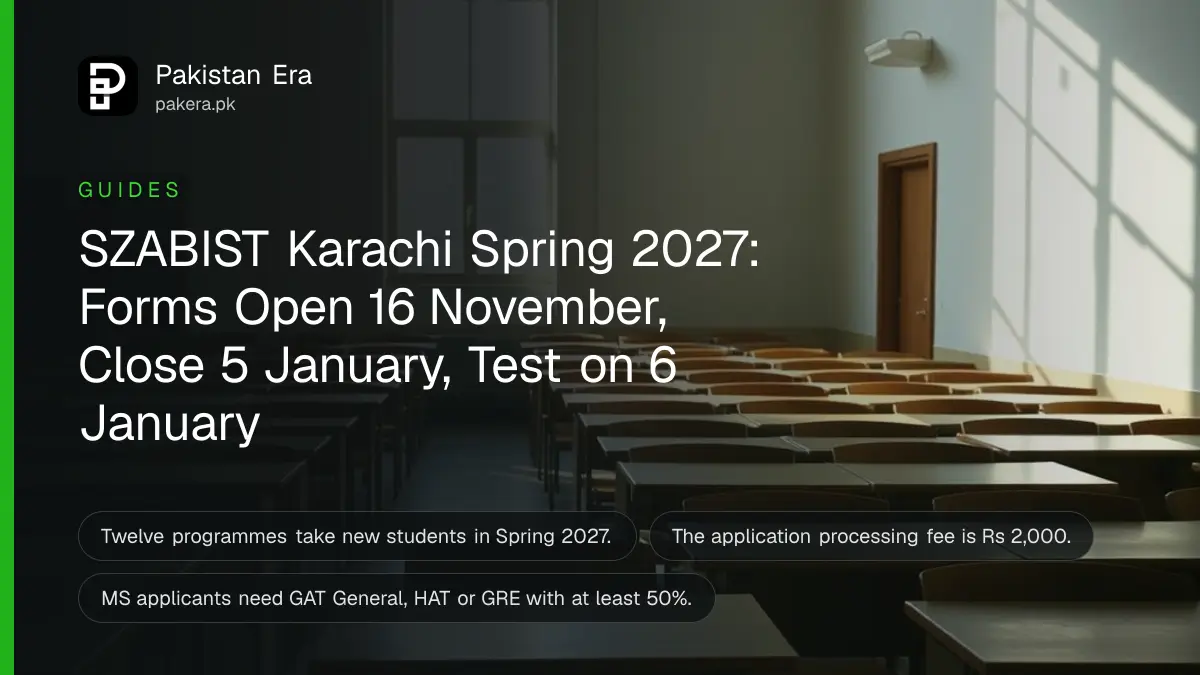
SZABIST University Karachi opens Spring 2027 admissions on Monday 16 November 2026. The last date to submit the form is Tuesday 5 January 2027, the entry test is on 6 January, and classes start on 15 February 2027. The application processing fee is Rs 2,000, and you apply on the SZABIST Karachi admissions portal.
Spring intake is small. Only 12 programmes take new students this time, mostly in life sciences, education and law. If your subject is not on the list below, you will have to wait for Fall 2027.
SZABIST Spring 2027 admission dates
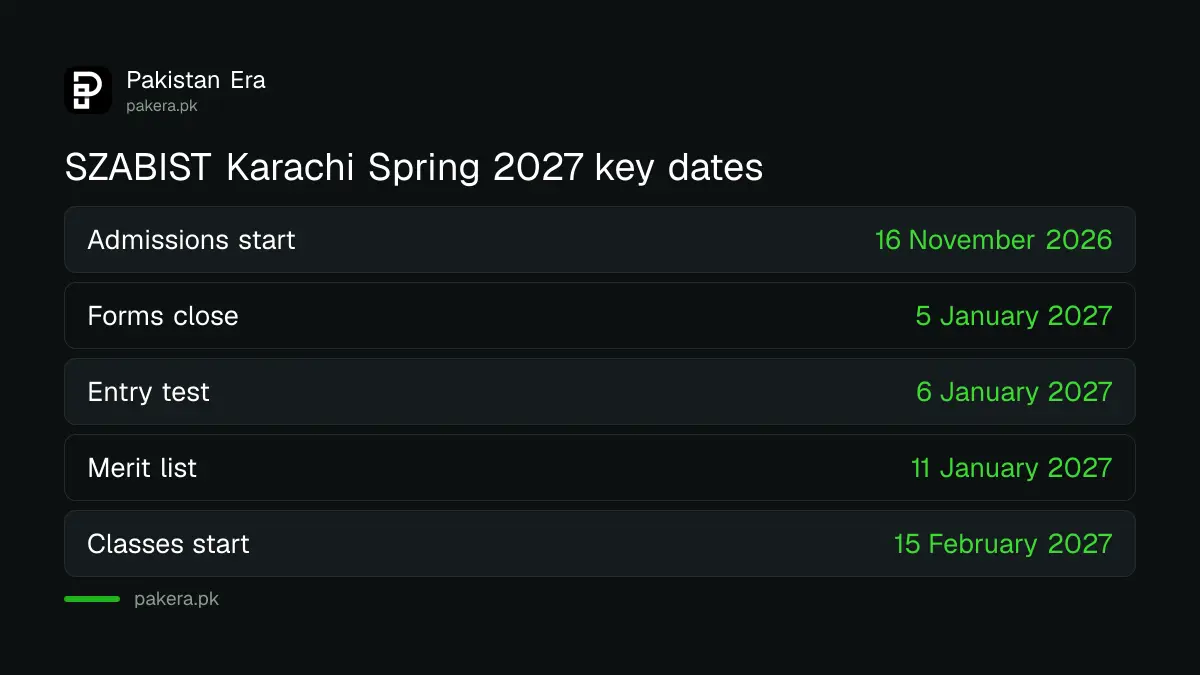
The Spring 2027 cycle at SZABIST Karachi runs from 16 November 2026 to 15 February 2027. Forms close on 5 January, the test is the next day, interviews follow on 8 January, and the merit list comes out on 11 January.
| Step | Date |
|---|---|
| Admissions start | Monday 16 November 2026 |
| Form submission deadline | Tuesday 5 January 2027 |
| Entry test | Wednesday 6 January 2027 |
| Interviews | Friday 8 January 2027 |
| Merit list and waiting list | Monday 11 January 2027 |
| Fee submission deadline | Friday 22 January 2027 |
| Orientation and first classes | Monday 15 February 2027 |
The gap between the form deadline and the test is one day. So do not leave the form to the last evening, because you also need the test details in hand before 6 January.
Programmes open for Spring 2027 at SZABIST Karachi
SZABIST Karachi lists 12 programmes for Spring 2027: six bachelor's degrees, two education programmes, a diploma, law and two MS degrees. Popular subjects such as BBA, BS Computer Science and MBA are not in the spring list.
- Bachelor's: BS Food Science and Technology, BS Computational Biology with Artificial Intelligence, BS Biotechnology, BS Nutrition and Dietetics, BS Public Health.
- Law: LLB (University of London) and CertHE in Common Law.
- Education: Diploma in Early Childhood Education and Development (ECED), B.Ed (1.5 years), M.Phil Education.
- MS: MS Biosciences and MS Biotechnology.
If you also want a Lahore or Islamabad option, COMSATS spring admissions close on 18 December, and Air University and IIUI also take spring students.
SZABIST eligibility for each Spring 2027 programme
Most bachelor's programmes need 50% marks in Intermediate or A Levels. MS programmes need 16 years of education with 50% or a 2.0 CGPA, plus a GRE, GAT General or HAT score of at least 50%. Everyone also sits SZABIST's own test and interview.
| Programme | Minimum requirement |
|---|---|
| BS Biotechnology, Food Science, Computational Biology, Public Health | 50% in FSc Pre-Medical or Pre-Engineering, or A Levels with two of Biology, Chemistry, Physics |
| BS Nutrition and Dietetics | 50% in FSc Pre-Medical, Pre-Engineering or Home Economics, or A Levels as above |
| ECED Diploma | Intermediate with 45% |
| B.Ed (1.5 years) | 16 years of education, second division or 2.0 CGPA |
| M.Phil Education | 16 years in education with second division or 2.0 CGPA, plus GRE 300 or GAT/HAT 50% |
| MS Biosciences, MS Biotechnology | 16 years in life or biological sciences, 50% or 2.0 CGPA, plus GRE 300 or GAT/HAT 50% |
Students still waiting for results can apply. Intermediate students need their SSC and HSSC papers attested by IBCC, and O and A Level students need an IBCC equivalence. For MS, your last degree must be verified by HEC.
The LLB is a University of London programme taught at SZABIST. It needs three A Level subjects (one at grade D or better), or a bachelor's degree, plus an English score such as IELTS 6.0. The CertHE needs Intermediate with 55% and you must be 18 or older.
No GAT score yet? The NTS GAT General test on 13 December gives results on 21 December, which is before the 5 January form deadline.
SZABIST fee for Spring 2027 programmes
You pay Rs 2,000 to apply. On joining you pay a Rs 30,000 admission fee once and a Rs 15,000 refundable security deposit. Tuition for the spring bachelor's programmes is about Rs 1.07 lakh to Rs 1.11 lakh a semester after SZABIST's own subsidy.
We checked the fee table on the SZABIST Karachi fee page. These are net figures for Pakistani students, after the subsidy shown on that page.
| Programme | Per credit hour | Per semester |
|---|---|---|
| BS Biotechnology (17 credit hours) | Rs 6,510 | Rs 110,670 |
| BS Food Science and Technology | Rs 5,950 | Rs 107,100 |
| BS Public Health, Nutrition, Computational Biology | Rs 5,950 | Rs 107,100 |
| ECED Diploma (12 credit hours) | Rs 3,400 | Rs 40,800 |
| B.Ed 1.5 years (18 credit hours) | Rs 4,000 | Rs 72,000 |
| M.Phil Education | Rs 7,600 | Rs 98,800 |
| MS Biosciences, MS Biotechnology (13 credit hours) | Rs 6,180 | Rs 80,340 |
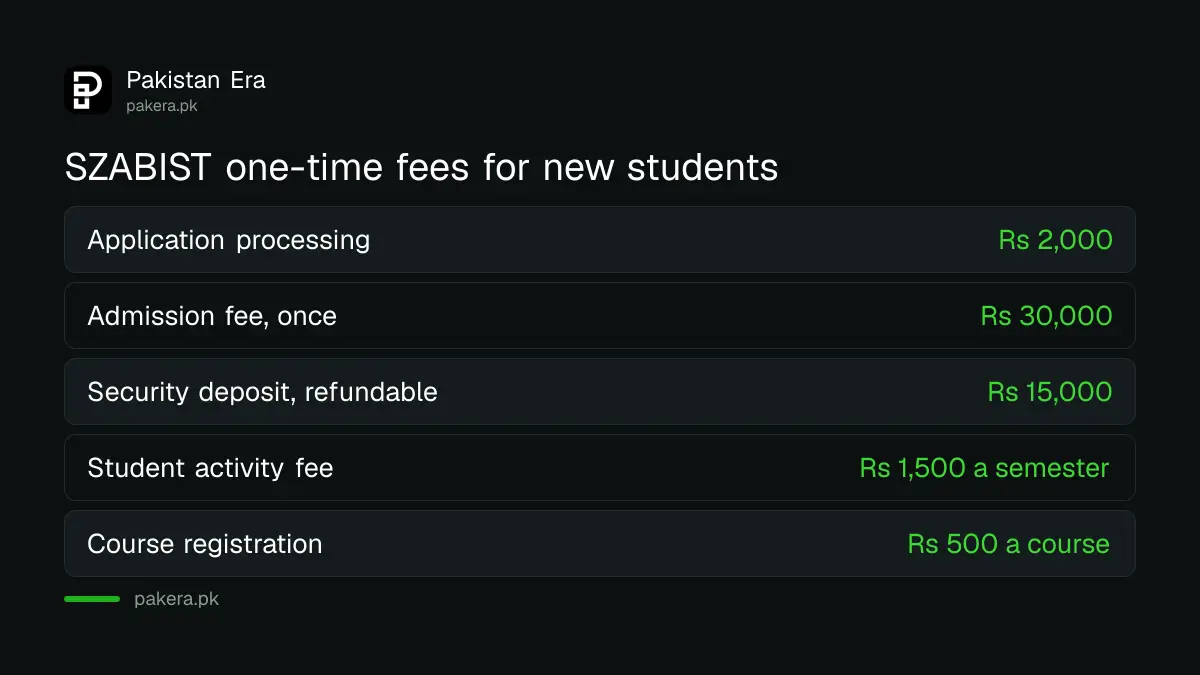
Other charges sit on top of tuition: Rs 1,500 student activity fee each semester, Rs 500 course registration and Rs 500 exam fee per course, and lab charges of Rs 3,000 a semester for most undergraduate programmes or Rs 2,000 for MS. The LLB fee is split between SZABIST and the University of London, and London's part is paid in pounds.
How to apply for SZABIST Spring 2027
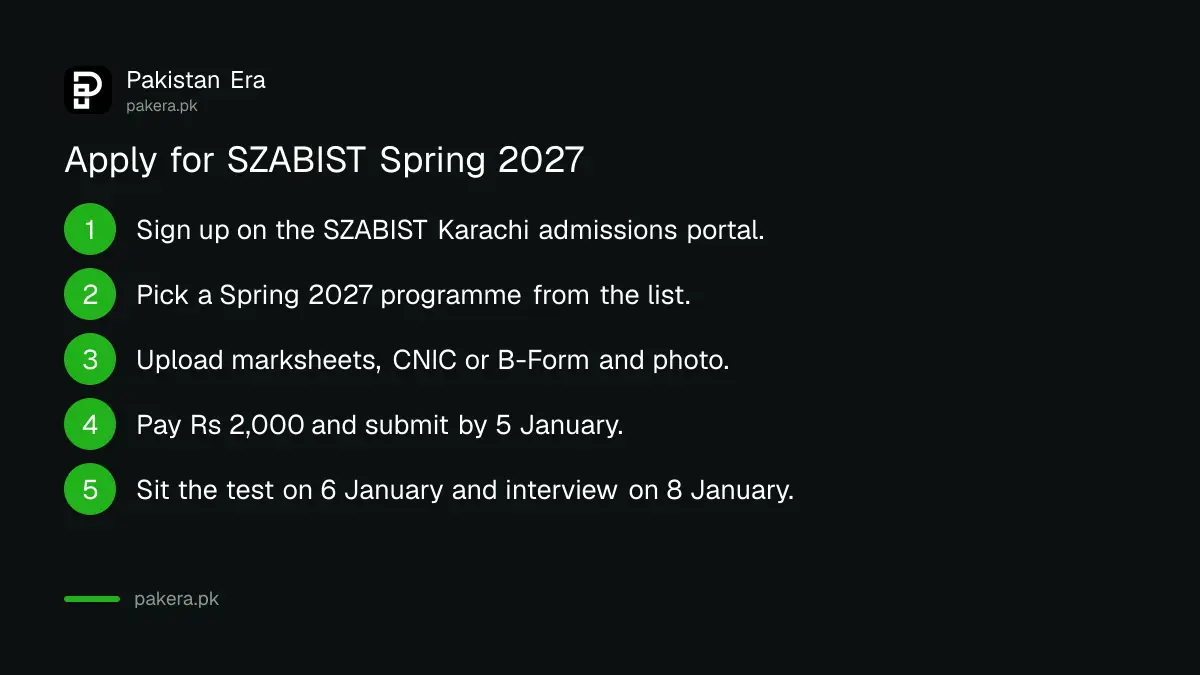
Apply online at the SZABIST Karachi admissions portal: register with your email, choose a Spring 2027 programme, fill the form, pay the Rs 2,000 processing fee, then sit the test on 6 January and the interview on 8 January.
- Open admissions.szabist.edu.pk and click New Applicants Sign up Here. Use an email you check often.
- Pick your programme from the Spring 2027 drop-down and read its requirement.
- Fill in your details. Use your name exactly as it is on your matric certificate.
- Upload your marksheets, CNIC or B-Form and photograph, and your GAT, HAT or GRE result for MS.
- Pay the Rs 2,000 application processing fee and submit before 5 January 2027.
- Sit the entry test on 6 January and the interview on 8 January.
- Check the merit list on 11 January and pay your fee by 22 January.
Money tight? SZABIST runs a need-based scholarship for families earning under Rs 1.5 million a year, and the Ihsan Trust interest-free loan is open to SZABIST students. The Sindh Education Endowment Fund scholarship also covers students with a Sindh domicile.
Common questions
What is the last date for SZABIST Spring 2027 admission?
Tuesday 5 January 2027 is the last date to submit the form for SZABIST Karachi. The entry test is the next day, 6 January.
Is BBA or BS Computer Science open at SZABIST in Spring 2027?
No. The Spring 2027 list at SZABIST Karachi covers life sciences, education, law and two MS programmes only. BBA and computing admissions run in the fall.
Do I need GAT for MS at SZABIST?
Yes. MS and M.Phil applicants need GRE 300, or GAT General or HAT with at least 50%. SZABIST lists this as mandatory for every MS programme.
How much is the SZABIST admission fee?
The admission fee is Rs 30,000, paid once. You also pay a Rs 15,000 security deposit, which is refundable, and Rs 2,000 to apply.
Can I apply before my Intermediate result?
Yes. SZABIST says students waiting for results can apply. You must still meet the 50% requirement when the result comes.
When do Spring 2027 classes start at SZABIST?
Orientation and the first classes are both on Monday 15 February 2027.
How we verified this
What we checked and where we read it.
We checked these SZABIST Karachi pages on 15 November 2026: the admission schedule (Spring 2027 dates and the 12-programme list), the admission requirements page (eligibility, IBCC and HEC rules, GRE and GAT scores), the fee structure page (one-time fees and per-programme tuition), and the admissions portal at admissions.szabist.edu.pk. The portal's Spring 2027 drop-down showed 10 programmes and did not include BS Nutrition and Dietetics, which the schedule page lists. Check the drop-down when you apply. Fees are for Pakistani students and can change each year.
About the author

Public Services and Education Journalist
Fajr Riaz is a journalist and content writer at Pakistan Era, based in Lahore. She covers the questions people meet in everyday life in Pakistan: how a public service works, what a change in the rules means, and where to find a reliable answer.