SEEF Scholarship Sindh: 2026 Deadline Passed 31 August, Eligibility and Documents for Next Round
The SEEF scholarship 2026 window closed on 31 August. See who can apply in Sindh, the 2.5 GPA or 60 per cent rule, documents to prepare and the next-round plan.
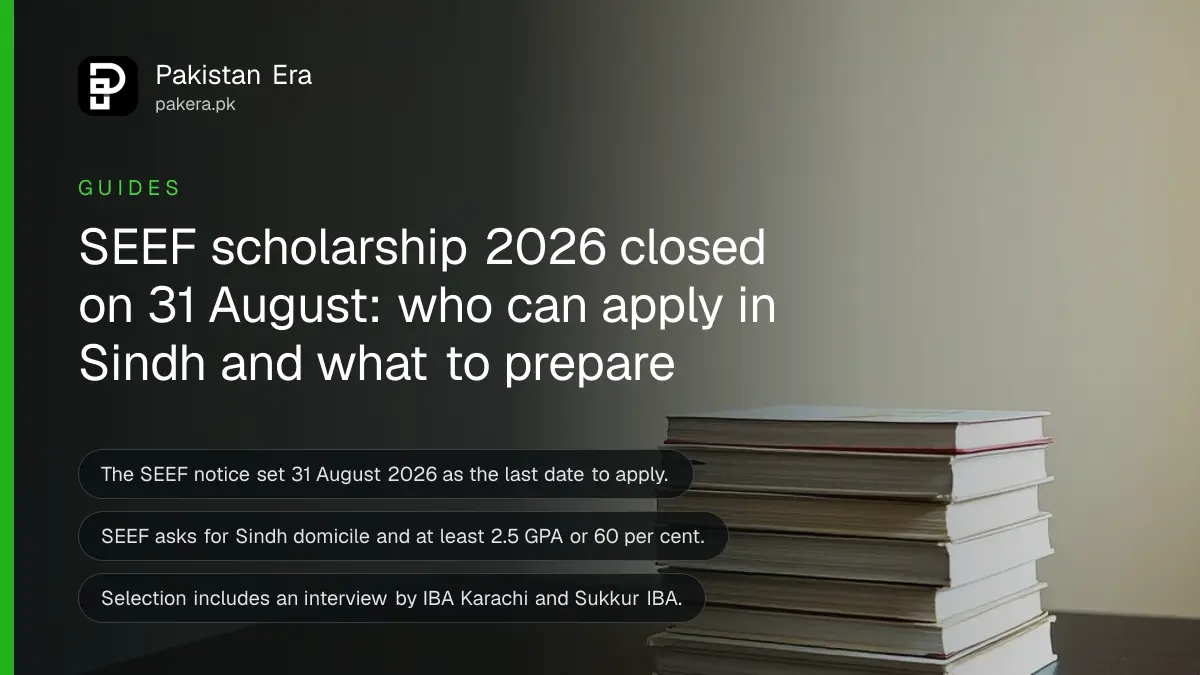
Short answer: The Sindh Educational Endowment Fund (SEEF) 2026 application window closed on 31 August 2026, according to the fund's own notice dated 2 July 2026. Next year's round has not been announced. You need Sindh domicile, a recognised institution on the SEEF panel, at least 2.5 GPA or 60 per cent, and proof of need.
If you are searching for the SEEF scholarship in October, you are probably late. We read the fund's website on 12 October 2026 and found a closed deadline, an old FAQ that still quotes 2024 dates, and a "typically" in most answers. This page sorts out what is firm and what is not, so you can prepare for the next round without guessing.
The 2026 deadline has passed
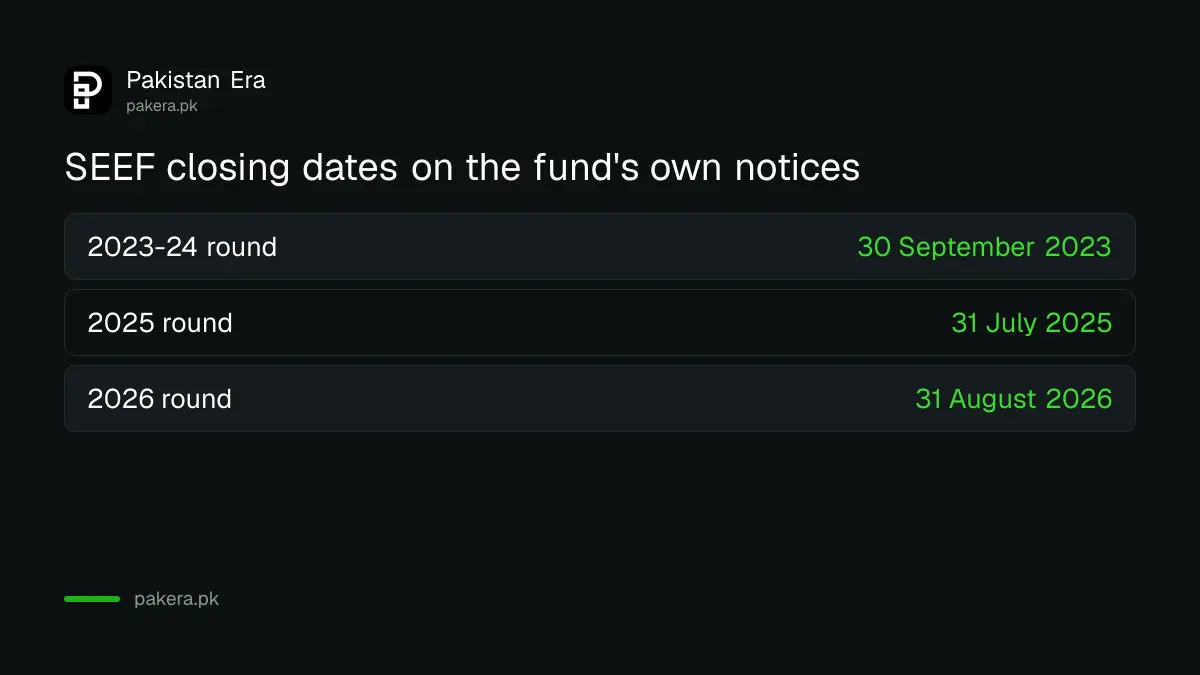
The SEEF notice titled "Apply Online Seef Scholarship Program 2026" was posted on 2 July 2026. It says the last date to apply was 31 August 2026. The fund's earlier notices show the same pattern: 31 July in 2025 and 30 September in 2023.
No newer notice reopens the window. If you missed it, do not pay anyone who says they can still file for you. Use only the fund's own channels. Its FAQ says forms are accepted once a year.
Plan on a window that opens around July and closes late in the summer, but treat that as a pattern and not a promise. Watch the Announcements page of the SEEF website for the 2027 notice.
Who can apply
SEEF is a government-funded scheme for poor, needy and meritorious students from Sindh. It was created in 2002-03 and is run through a trust. The fund's FAQ lists four general conditions.
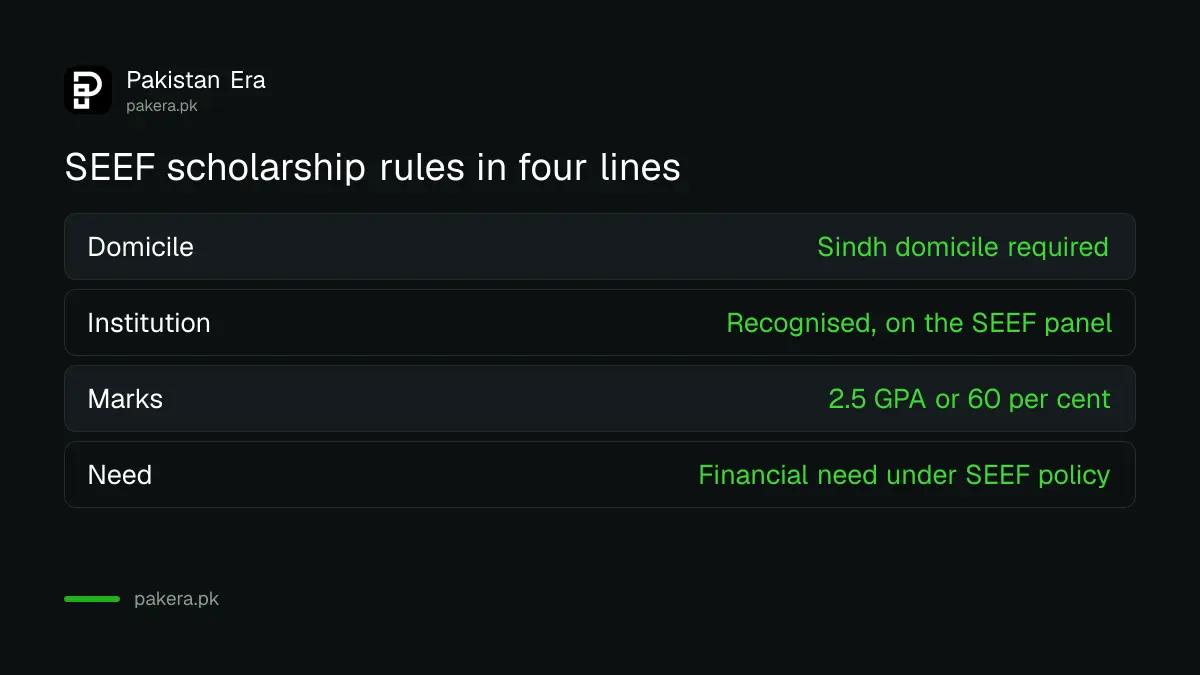
| Condition | What the FAQ says |
|---|---|
| Domicile | Student must hold Sindh domicile |
| Institution | Enrolled in a recognised institution on the SEEF Trust panel |
| Marks | Minimum 2.5 GPA or 60 per cent |
| Need | Financial need as set in the SEEF Trust policy |
The FAQ says the exact criteria "may vary each year", so check the notice for the year you apply. The fund also keeps a list of universities in the Sindh endowment scholarship panel. If your university is not on it, you are not eligible, whatever your marks.
Documents to keep ready
The FAQ says the papers "typically" asked for are the application form, CNIC, transcripts showing your GPA or percentage, an income certificate, proof of residence and utility bills. Keep scanned copies in one folder so you can upload them quickly when the window opens.
- Your CNIC, front and back.
- Academic transcripts that show GPA or percentage.
- An income certificate that proves your family's need.
- Proof of residence and recent utility bills.
- Your Sindh domicile certificate. If you lack one, the steps are in how to apply for a domicile certificate.
Keep a note of every file name. A mismatch between the name on your transcript and your CNIC is the kind of small mistake that slows a file down.
How the selection and renewal work
The FAQ says selection involves a review of applications, academic records and financial need, and an interview conducted by IBA Karachi and Sukkur IBA. Successful students are usually told through their university.
The scholarship can be renewed each year if you keep at least 2.5 GPA or 60 per cent, stay enrolled and still show need. It is meant for study inside Pakistan. You can apply if you already hold another award, but you will keep only one of them if selected.
- Check the SEEF Announcements page every month from June.
- Confirm your university is on the panel list.
- Collect the documents and scan them.
- Submit the online form before the closing date and save the confirmation.
- Prepare for the interview by IBA Karachi or Sukkur IBA.

What to do in the meantime
You do not have to wait idle. The Higher Education Commission runs a need-based programme with its own calendar, set out in how to apply for the HEC need-based scholarship. The two schemes are separate, and their forms and deadlines are different.
For SEEF questions, the fund lists its office at Old KDA Building No. 3, third floor, Sindh Secretariat, Karachi. Its phone is 021-99211221 and its email is sindhendowmentfund@gmail.com. Office hours are 9:00 am to 5:00 pm.
Common questions
Is the SEEF scholarship 2026 still open?
No. The fund's notice says the last date was 31 August 2026. Watch its Announcements page for the next round.
What marks do I need for SEEF?
The FAQ says a minimum of 2.5 GPA or 60 per cent. It also says criteria may vary each year, so read the current notice.
Can students from outside Sindh apply?
The FAQ lists Sindh domicile as a requirement, so students without it are not eligible.
Is the SEEF scholarship renewable?
Yes, if you keep the minimum marks, stay enrolled in a recognised institution and continue to show financial need.
Can I use SEEF to study abroad?
The FAQ says the scholarship is generally for studies within Pakistan.
How much is the SEEF scholarship amount?
The FAQ says the amount varies with level of study, performance and need. It gives no single figure, so we do not quote one.
How we verified this
What we checked, where we read it, and what we could not confirm.
We read the home page, the 2026 programme notice, the introduction and the FAQs on the Sindh Educational Endowment Fund website on 12 October 2026. The FAQ still carries an old line with 2024 dates, so rely on the dated notices. The scholarship amount was not stated.
About the author

Public Services and Education Journalist
Fajr Riaz is a journalist and content writer at Pakistan Era, based in Lahore. She covers the questions people meet in everyday life in Pakistan: how a public service works, what a change in the rules means, and where to find a reliable answer.