HEC Need-Based Scholarship 2026-27: How to Apply Through Your University
HEC need-based scholarship pays full tuition and Rs 6,000 a month. See who qualifies, the documents on the form and how to apply through your university.

The HEC Need-Based Scholarship pays your full university tuition plus Rs 6,000 a month, but you never apply to HEC. You apply to the financial aid office of your own public university, on HEC's form, by the date that university sets. HEC says plainly that it does not announce start or closing dates.
We read HEC's scholarship pages, its application form and two university notices from last year's round on 29 September 2026. Those notices show the timing. NED University in Karachi took fresh forms from 21 November to 1 December 2025. Government College University Faisalabad (GCUF) called fresh students on 12 March 2026 and extended its deadline to 15 April 2026.
So the 2026-27 round will not arrive as one national announcement. It arrives university by university, usually weeks or months after university admissions close. If you just joined a public university this fall, your job now is to find your financial aid office and get your papers ready.
The 2026-27 round is run by each university, not HEC
HEC funds the Need-Based Scholarship, but each participating university decides when to open applications, how many slots to fill and who gets them. There is no single HEC deadline for 2026-27. Watch your university's notices.
| Example from the 2025-26 round | Who could apply | Window |
|---|---|---|
| NED University, Karachi | First to final year students | Fresh forms 21 November to 1 December 2025 |
| GCUF, Faisalabad | Fresh bachelor's students admitted in fall 2025 | Notice 12 March 2026, extended to 15 April 2026 |
| HEC | Sets no dates | "It is the responsibility of participating university" |
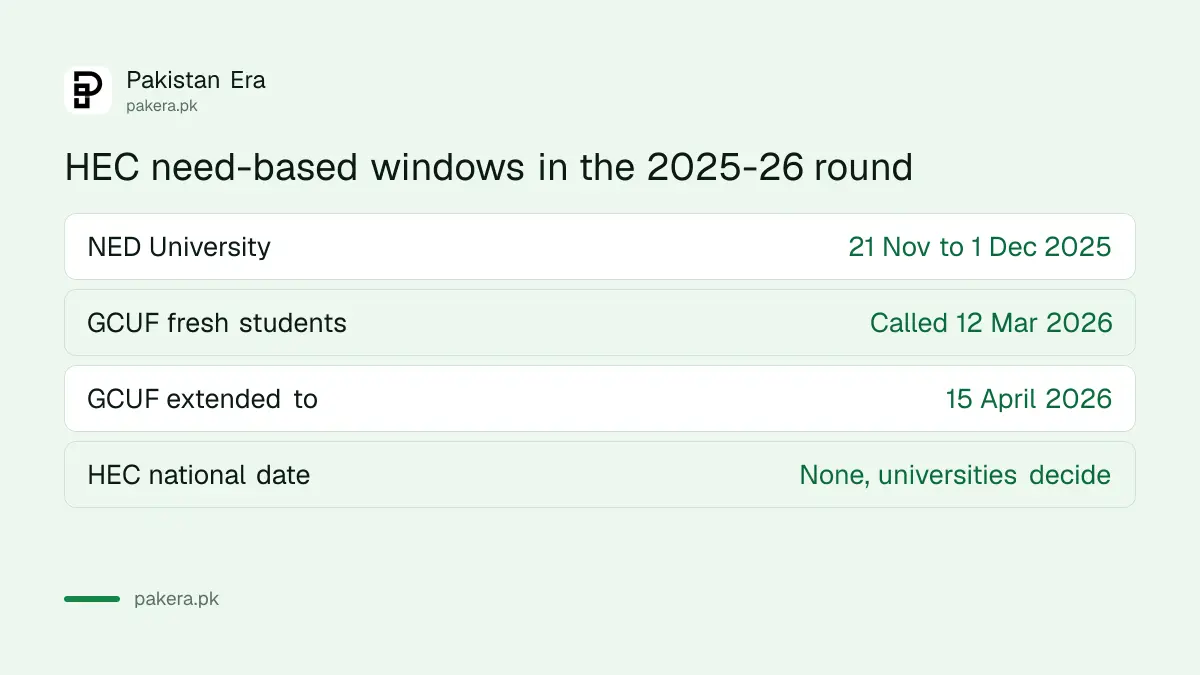
Those two windows were five months apart. That is why asking your financial aid office directly beats waiting for a date to appear online.
Who can get the HEC Need-Based Scholarship
You must be an undergraduate in a four or five year programme at a participating public sector university, admitted on merit and not on self-finance, with a family income your university's committee judges as financial need.
- Level: undergraduate only, in four to five year programmes. HEC's own answer to a Matric student is no.
- Institution: a public sector university or its campus that gets HEC's annual grant. Affiliated colleges are not covered.
- Admission type: open merit. Students admitted on self-finance cannot apply.
- Year of study: new and already enrolled students can both apply. A third semester student is eligible, HEC says.
- No other aid: students already getting a university or institute scholarship are not eligible.
HEC sets no national income ceiling. The Institutional Scholarship Award Committee at each university judges need. Universities do set their own limits, though: GCUF's 2025-26 notice capped monthly family income at Rs 45,000 from all sources. Your university's notice is where the real number sits.
Private university students are outside this scheme. For them, and for anyone whose university is not on HEC's list, the BISP undergraduate scholarship and provincial funds are the places to look.
What the scholarship pays
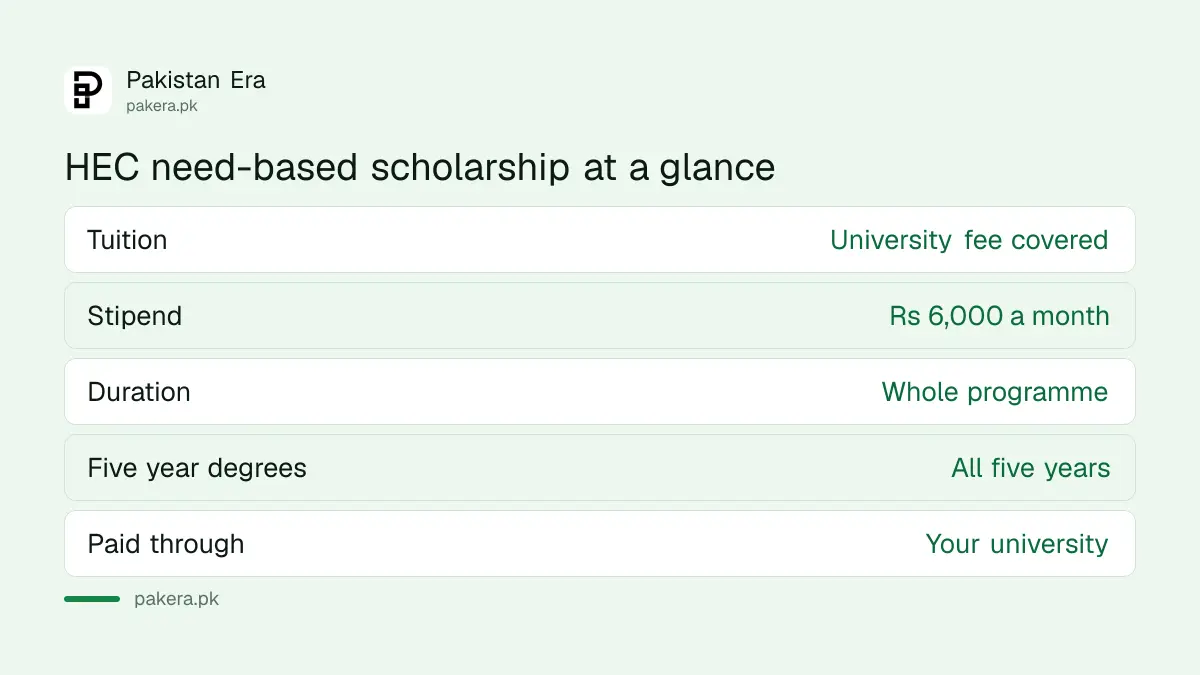
The HEC Need-Based Scholarship covers the university tuition fee and pays a Rs 6,000 monthly stipend for the whole programme. For MBBS, Pharm-D and other five year degrees, funding runs for all five years.
The money goes to the university, not to you. HEC says it does not transfer funds to students directly, and the university passes the stipend on. It also pays from the date of the award, not the date you enrolled, so it will not clear fees you already owe.
Once selected, you do not reapply each year. HEC's answers say the award continues for the degree. It cannot move with you, though: HEC says a scholarship cannot be transferred to another university.
How to apply through your financial aid office
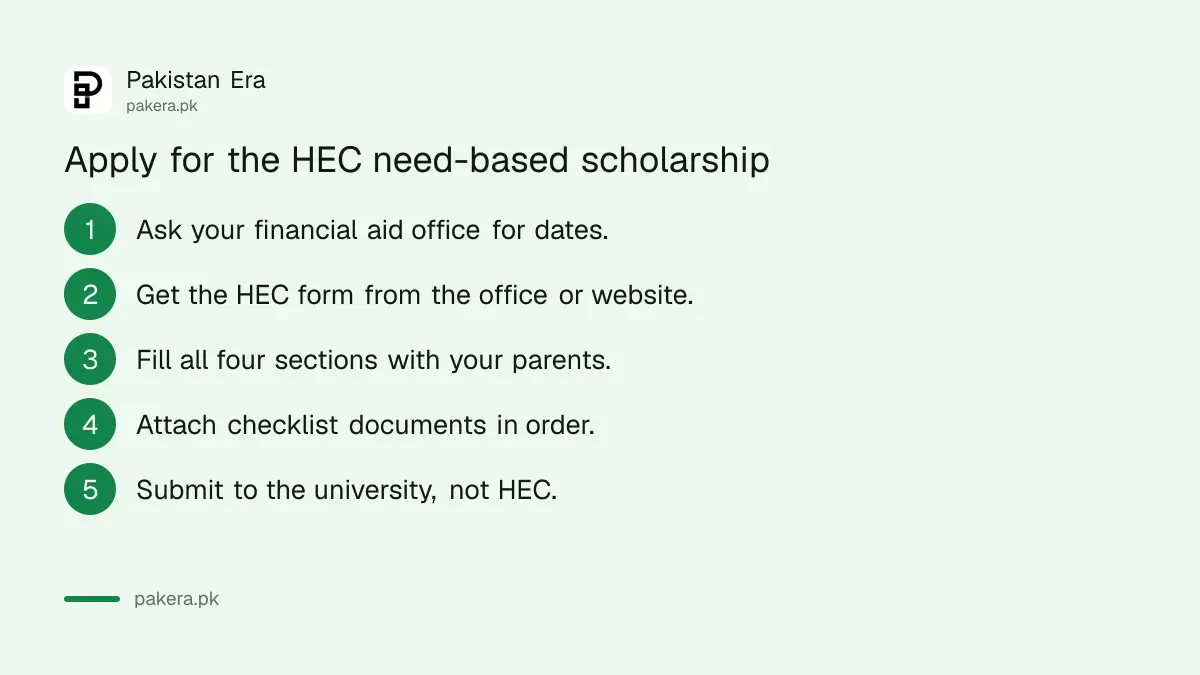
Take HEC's form from your university's financial aid office or the HEC website, fill all four sections with your parents, attach the checklist documents, and hand the file to the same office by its deadline. HEC will not accept a form sent to it directly.
- Visit your university's Student Financial Aid Office and ask when the 2026-27 need-based round opens.
- Download the form from HEC's Need-Based Scholarship downloads page, or collect it from the office.
- Fill in all four sections: personal and family details, family assets, this year's financial arrangements, and education record. Write N/A where something does not apply.
- Attach every item on the form's checklist, in the order the form lists them.
- Submit by hand or post to your university's financial aid office before its deadline, then prepare for an interview.
The committee that decides is headed by the Vice Chancellor and includes outside members. It sends its recommended list and meeting minutes to HEC, and the university then pays the selected students.
Documents the HEC form asks for
HEC's form checklist asks for parents' or guardian's CNIC copies, a salary certificate, six months of utility bills, and fee receipts for you and your brothers and sisters. A rent agreement, medical bills and past scholarships are added only if they apply.
- Copies of the CNIC of your father, mother or guardian.
- Salary certificate of your father, mother or guardian.
- Copies of the last six months of electricity, gas, telephone and water bills.
- Attested rent agreement, if you live in a rented house.
- Latest fee receipts for you and for siblings in education.
- Medical bills, and any previous scholarship letters, if they apply.
- A statement of purpose.
The form is detailed. It asks for every earning family member, rent or land income, the size of your house, and even the number of air conditioners. Fill it honestly. GCUF's notice lists what follows false information: cancelled admission, rustication, criminal proceedings and repayment of everything received plus an equal penalty.
If you get stuck, HEC's scholarship desk is on 051-90808079 and at hnbs@hec.gov.pk. For degree papers after you graduate, HEC degree attestation is a separate service.
Common questions
What is the last date for the HEC Need-Based Scholarship 2026-27?
There is no single date. HEC says each participating university announces its own start and closing dates, so check your university's financial aid office.
How much does the HEC Need-Based Scholarship pay?
Full university tuition plus Rs 6,000 a month for the complete programme. Some universities, such as NUMS, exclude exam and admission fees.
Can I apply if I am already in my second or third year?
Yes. HEC says students already enrolled at a participating university can apply, and the award then runs from the date it is granted.
Can self-finance students apply?
No. HEC says students admitted on self-finance are not eligible, and neither are students of affiliated colleges.
Do I send the form to HEC?
No. HEC does not accept forms directly. Submit it to the financial aid office of the university where you study.
Is there an income limit?
HEC does not publish one. Each university's committee judges need, and some set a limit, such as Rs 45,000 a month at GCUF in 2025-26.
How we verified this
What we checked, where we read it, and what we could not confirm.
Last checked on 29 September 2026. Eligibility, the Rs 6,000 stipend, coverage of five year programmes, the award process, the no-direct-application rule, and the answers on dates, transfers, self-finance, affiliated colleges and back fees are read on HEC's Need-Based Scholarship pages at hec.gov.pk. The document checklist and form sections are read in HEC's application form PDF. The NED dates are read in NED University's notice dated 17 November 2025. The GCUF dates, the Rs 45,000 limit and the penalties are read in GCUF's notice of 12 March 2026. The NUMS exclusion of exam and admission fees is read on its HEC Need-Based Scholarship Phase VI page. We did not submit a form. HEC's list of participating universities returned an error page when we tried it.
About the author

Tax, Bills and Technology Writer
Ali Akhtar is a young and curious voice here at Pakistan Era. He is currently pursuing his A-Levels and has a growing interest in Pakistan’s changing industrial landscape and educational trends. Ali likes to write in a way that helps him explain and explore the world around him. His writing reflects the perspective of the new generation navigating the evolving trends of Pakistan where technology, youth innovation, and shifting opportunities are reshaping the country’s future.