How to Get Your Degree Attested by HEC Online
HEC attestation is fully online now. Register at eportal.hec.gov.pk with your CNIC, upload documents, then book an appointment after scrutiny.
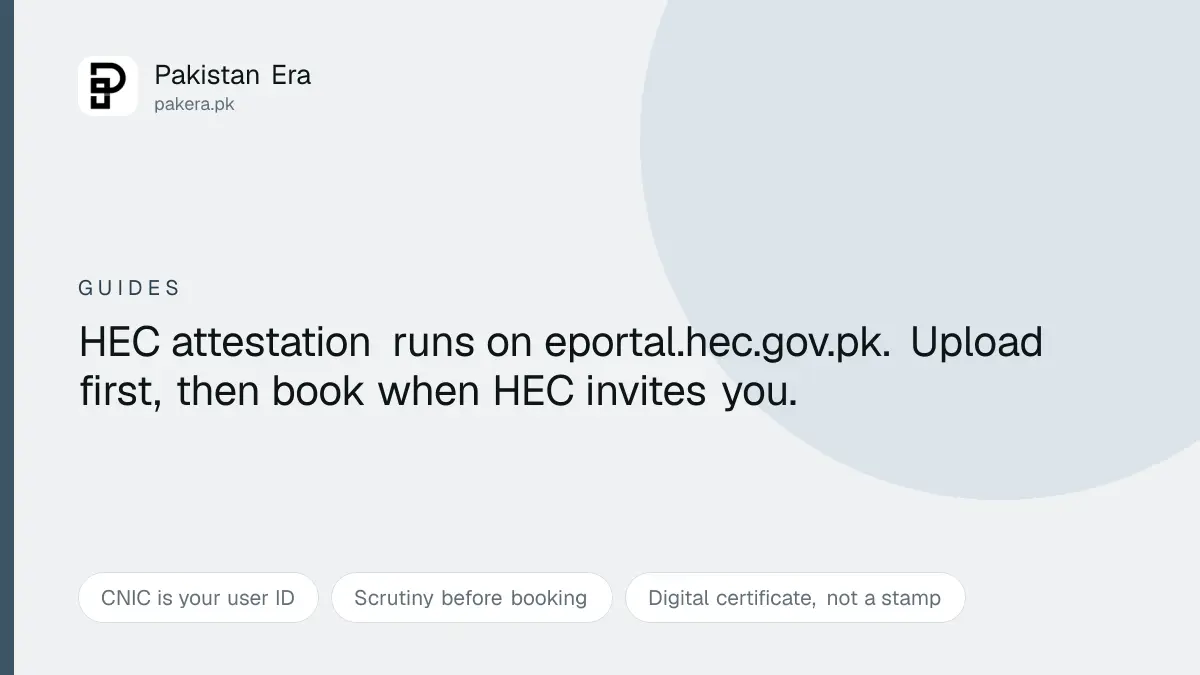
HEC degree attestation now starts with an account, not a queue. We opened eportal.hec.gov.pk and it is live: you sign in with your CNIC as the user ID, in the thirteen digit format with no dashes, or with a username, and there is a registration link if you do not have an account yet.
Update, 11 October 2026: HEC has an alert on a fake degree attestation site; use the portal address on HEC's own pages.
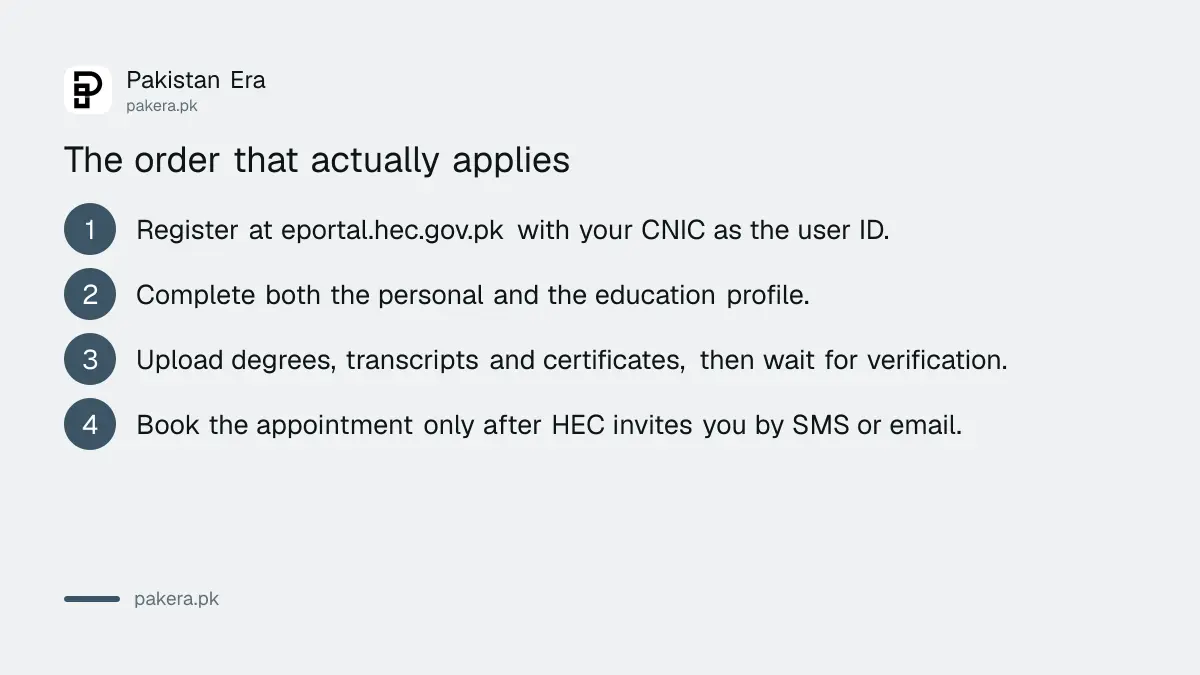
The order of operations is what people get wrong. You do not book an appointment first. You upload, HEC scrutinises, and only then are you invited to book.
The process, in the order it actually happens
- Create an account at eportal.hec.gov.pk. Your user ID is your CNIC without dashes.
- Complete your personal profile and your education profile. Both. An incomplete education profile is the most common reason an application sits.
- Upload your documents, the final certificates, degrees and transcripts you want attested.
- Wait for scrutiny. The HEC attestation team verifies your degree or transcript against the awarding institution. This is reported to take roughly 8 to 10 days.
- Receive the SMS or email telling you the documents have cleared verification and you may now schedule.
- Book your appointment date and time from the portal.
- Pay the fee through the system's payment route.
Step four is the part nobody plans for. Verification runs against your university, so the speed of your application depends partly on how quickly your institution responds to HEC, which is outside both your control and HEC's.
What the new system changed
HEC has moved to a revamped Degree Attestation System, described as fully online and paperless, with the launch announced in May 2026 by the HEC Chairman. Two changes matter to you.
You are not expected to hand over original documents. The process runs on uploads and verification rather than on surrendering your degree at a counter.
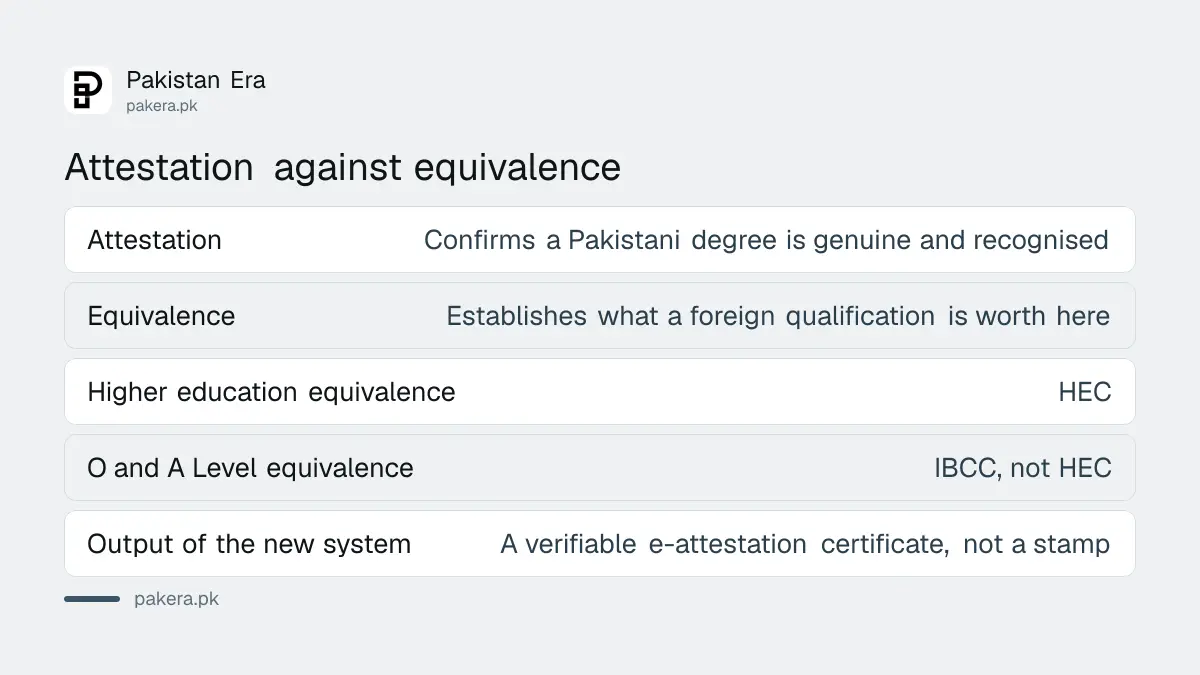
The output is not an ink stamp. Instead of a physical attestation mark on the back of your degree, the system issues a verifiable e-attestation certificate that you download from your portal account.
That second change has a practical consequence worth thinking about before you deal with a foreign employer or embassy: some receiving institutions still expect to see a stamped page. If yours does, ask them explicitly whether a downloadable verifiable certificate is acceptable, before you assume either way. A verifiable digital record is stronger evidence than a stamp, but only if the person receiving it knows how to verify it.
The fee, and why we are not stating it as fact
The attestation fee is reported at Rs 3,000 per document, with a document meaning each degree, transcript, provisional certificate or HEC equivalence letter, and payment through 1Link.
We are labelling that as reported rather than confirmed. HEC's own site requires JavaScript to render its service pages, so we could not read the fee schedule directly from the Commission, and we do not publish a fee as verified when we have not seen it on the authority's own page.
Take the amount from the challan the portal generates for your application. That figure is definitionally correct for what you are applying for, and per-document pricing means your total depends on how many documents you submit.
Which leads to the obvious saving: work out how many documents you actually need attested. A degree plus a transcript is two. If an employer or university only requires the degree, submitting three documents costs three times as much for no benefit.
Equivalence is a different service
HEC's site lists degree attestation and equivalence certificate as separate services, and confusing them wastes weeks.
Attestation confirms that a Pakistani degree is genuine and recognised. Equivalence establishes what a foreign qualification is worth here.
And note the division of labour in Pakistan: HEC handles higher education equivalence, while school level qualifications, O and A Levels and their equivalents, go through the Inter Boards Coordination Commission instead. We set out that side, including the full grade conversion table, in the IBCC equivalence guide. Sending an A Level certificate to HEC or a foreign bachelor's degree to IBCC is a common and entirely avoidable delay.
Who needs this and when
| Why you need it | What usually asks for it |
|---|---|
| Employment abroad | Gulf employers and their labour ministries, before a work visa is processed |
| Further study overseas | Universities, as part of credential verification |
| Embassy and visa processes | Often the first link in a chain running on to the Ministry of Foreign Affairs and the destination mission |
| Public sector jobs and promotion | Standard verification of qualifications inside Pakistan |
If your route ends at a foreign mission, the passport is the other document in the same file, and we set out its fees and the process in the passport fee guide. For Gulf employment specifically, attestation usually sits alongside the visa steps we cover in the Saudi visa guide.
If your route goes on to the Ministry of Foreign Affairs and an embassy after HEC, sequence matters. Each stage attests the stage before it, so starting at the wrong end means doing it twice.
Practical points before you start
- Use a working mobile number and email. The invitation to book an appointment arrives by SMS or email, and a wrong number means you wait for something that already happened.
- Upload clean scans. Blurred or cropped documents are the routine cause of a rejected upload.
- Start before you need it. Between profile completion, institutional verification and an appointment slot, this is a weeks process, not a days one.
- Keep your portal login. The e-attestation certificate lives in that account, and you will want it again.
Questions readers are asking
How do I get my degree attested by HEC?
Register at eportal.hec.gov.pk using your CNIC as the user ID, complete your personal and education profiles, upload your documents, wait for HEC's verification, then book an appointment when you are invited to and pay the fee.
Do I need to visit an HEC office?
The revamped system is described as fully online and paperless, with an appointment stage after verification. Confirm what your appointment requires when you are invited to book.
How long does HEC attestation take?
Scrutiny by the attestation team is reported to take about 8 to 10 days, after which you are invited to schedule. Total time depends on how quickly your awarding institution responds to verification.
How much is the HEC attestation fee?
Reported at Rs 3,000 per document, covering each degree, transcript, provisional certificate or equivalence letter. We could not read the fee schedule on HEC's own site, so take the amount from the challan the portal generates.
What is the login format for the HEC portal?
Your CNIC as thirteen digits without dashes, or a username in firstname.lastname format. There is a registration link for new users.
Does HEC still stamp the degree?
The new system issues a verifiable e-attestation certificate downloaded from your portal account rather than a physical stamp. If your receiving institution expects a stamped page, ask them whether the digital certificate is acceptable.
Is attestation the same as equivalence?
No. Attestation confirms a degree is genuine and recognised. Equivalence establishes what a foreign qualification is worth in Pakistan. HEC handles higher education equivalence; O and A Levels go to IBCC.
About the author

Public Services and Education Journalist
Fajr Riaz is a journalist and content writer at Pakistan Era, based in Lahore. She covers the questions people meet in everyday life in Pakistan: how a public service works, what a change in the rules means, and where to find a reliable answer.