DUHS FCPS-II, MS and MD Admission Session 2027-A in Karachi: Last Date 28 November, Rs 5,000, Test 20 December
DUHS Karachi takes FCPS-II, MCPS, MS and MD forms for Session 2027-A until 28 November for Rs 5,000. See specialties, track rules, documents and the test.
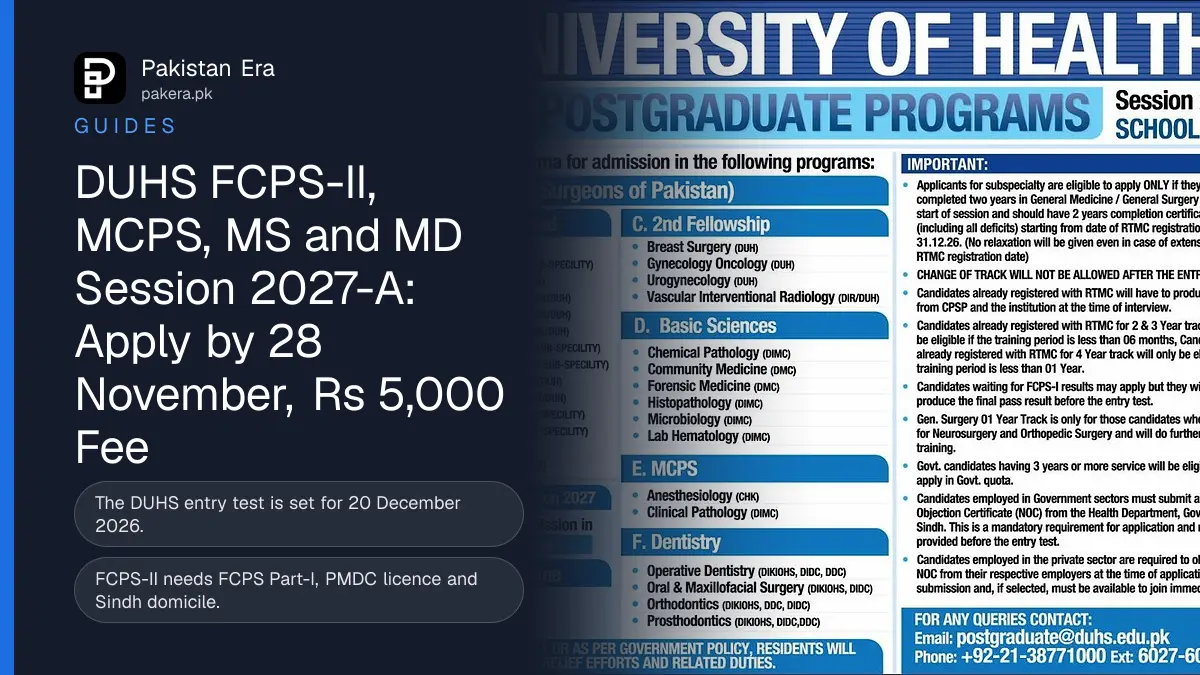
Dow University of Health Sciences (DUHS) Karachi is taking online applications for FCPS-II, MCPS, MS and MD training for Session 2027-A (January). The last date is Saturday, 28 November 2026, the fee is Rs 5,000, and the entry test is set for Sunday, 20 December 2026. You need FCPS Part-I (for FCPS-II), a valid PMDC licence and a Sindh domicile.
This is the January intake at the DUHS School of Postgraduate Studies. Training runs at Civil Hospital Karachi, Dow University Hospital, Dow International Medical College, the Ojha Institute of Chest Diseases and the DUHS dental institutes. Read the track rules below before you pick a specialty, because DUHS will not let you change track after the entry test.
DUHS Session 2027-A key dates and fee
Apply online through the DUHS admission portal by Saturday, 28 November 2026. The Rs 5,000 entry test and processing fee is paid online and is not refunded, even if you are later found ineligible. The entry test is tentatively on 20 December 2026.
| Item | Detail |
|---|---|
| Session | 2027-A (January) |
| Last date to apply | Saturday, 28 November 2026 |
| Entry test | Sunday, 20 December 2026 (tentative) |
| Fee | Rs 5,000, online only, non-refundable |
| Test venue and time | On the admit card |
| Queries | postgraduate@duhs.edu.pk, 021-38771000 ext 6027 to 6029 |
FCPS-II and MCPS specialties on offer
DUHS lists FCPS-II seats in medicine, surgery, basic sciences, dentistry and second fellowships, plus MCPS in Anaesthesiology and Clinical Pathology. Several are sub-specialties, which need two years of general training first.
| Group | Specialties |
|---|---|
| Medicine and allied | Cardiology*, Clinical Haematology*, Dermatology*, Family Medicine, General Medicine (2 or 4 years), Nephrology*, Neurology*, Nuclear Medicine, Paediatrics, Psychiatry, Pulmonology* |
| Surgery and allied | Anaesthesiology, Cardiac Surgery*, General Surgery (1, 2 or 4 years), Gynaecology and Obstetrics, Neurosurgery*, Ophthalmology*, Orthopaedic Surgery, ENT (Otorhinolaryngology), Paediatric Surgery*, Plastic Surgery*, Radiology, Urology* |
| Second fellowship | Breast Surgery, Gynaecological Oncology, Urogynaecology, Vascular Interventional Radiology |
| Basic sciences | Chemical Pathology, Community Medicine, Forensic Medicine, Histopathology, Microbiology, Laboratory Haematology |
| MCPS | Anaesthesiology, Clinical Pathology |
| Dentistry | Operative Dentistry, Oral and Maxillofacial Surgery, Orthodontics, Prosthodontics |
* Sub-specialty. The one-year General Surgery track is only for candidates who will go on to four more years in Neurosurgery or Orthopaedic Surgery.
MS and MD for Session 2027
DUHS also offers Master of Surgery (MS) in Cardiac Surgery and Plastic Surgery, and Doctor of Medicine (MD) in Neurology and Psychiatry, all at Civil Hospital Karachi.
Eligibility and documents for FCPS-II at DUHS
You need an FCPS Part-I pass certificate, an MBBS or BDS degree, a valid PMDC registration and a Sindh domicile. Candidates already registered with CPSP must attach that certificate, and second fellowship candidates need their FCPS-II certificate.
- FCPS Part-I pass certificate
- Sindh domicile
- MBBS or BDS degree, as applicable
- Current CPSP registration certificate, if already registered
- Valid PMDC registration certificate
- FCPS-II certificate, for second fellowship candidates
- NOC from the parent institute, if already registered elsewhere
- Experience certificate for previous training
Waiting for your FCPS-I result? You can still apply, but you must show the final pass result before the entry test. If your PMDC licence is near expiry, renew it first, using the steps in PMDC licence renewal online.
Track and training rules
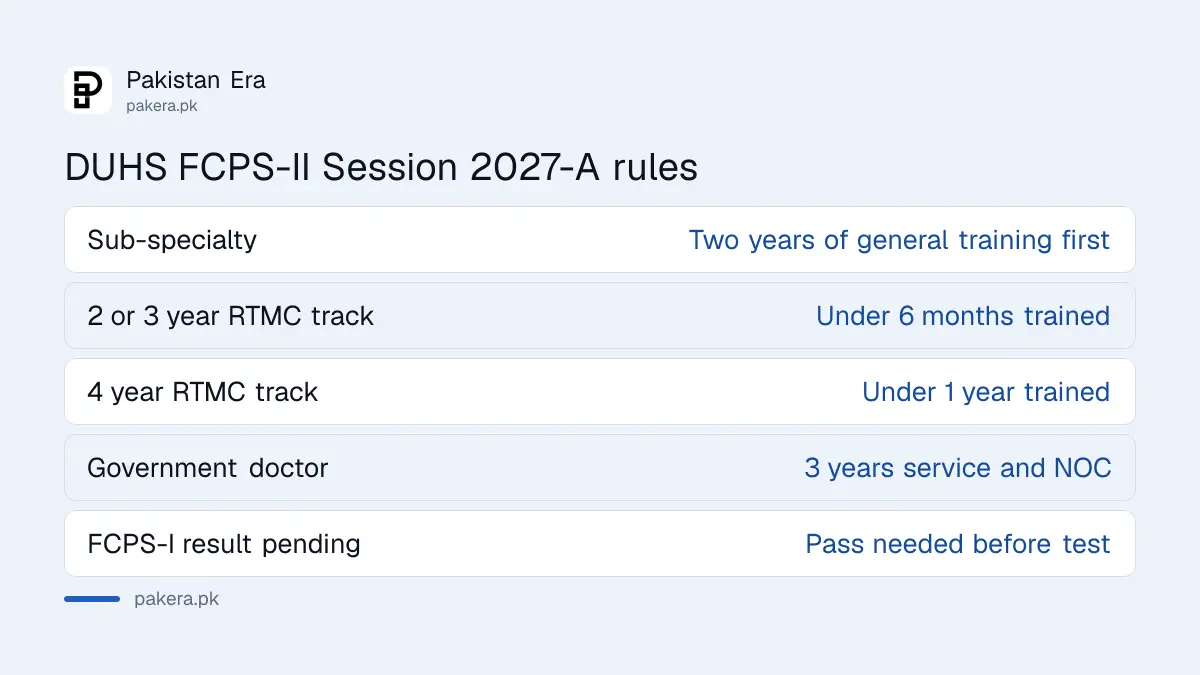
- Sub-specialty: you must have finished two years in General Medicine or General Surgery before the session starts, with a two-year completion certificate counted from your RTMC registration date, all deficits included, before 31 December 2026. DUHS gives no relaxation, even if your RTMC registration date is extended.
- Already on an RTMC track: for a 2 or 3 year track you qualify only if your training so far is under 6 months. For a 4 year track, it must be under 1 year. You also need an NOC from CPSP and your institution at the interview.
- Government doctors: 3 or more years of service lets you apply under the government quota, with an NOC from the Sindh Health Department before the entry test.
- Private sector doctors: bring an NOC from your employer when you apply, and be ready to join at once if selected.
RTMC is the CPSP's Registration, Training and Monitoring Cell, which records your supervised training. To check that your planned qualification is recognised for later practice, see PMDC recognised postgraduate qualifications.
MS and MD entry test needs 50% in two parts
MS and MD applicants must pass two tests: the DUHS entrance test and the GAT (General). DUHS wants at least 50% in each one separately. A 50% aggregate across both is not enough.
The MS and MD criteria also ask for a CNIC, an MBBS from a PMDC or HEC recognised institution with proof of a one-year house job, a Sindh domicile and a valid PMDC licence. Government doctors need 3 years of service and an NOC. DUHS employees need an NOC from the DUHS HR department. If two candidates tie, the older one ranks higher, under Sindh Government rules. Email for MS and MD is ms.md@duhs.edu.pk, and DUHS asks for no personal visits.
If your house job hospital is in doubt, check it in PMDC approved house job hospitals before you apply.
How to apply for DUHS postgraduate training
Apply online through the DUHS admission portal, pay the Rs 5,000 fee online, and keep your documents ready for the entry test and interview. Applications after 28 November will not be accepted.
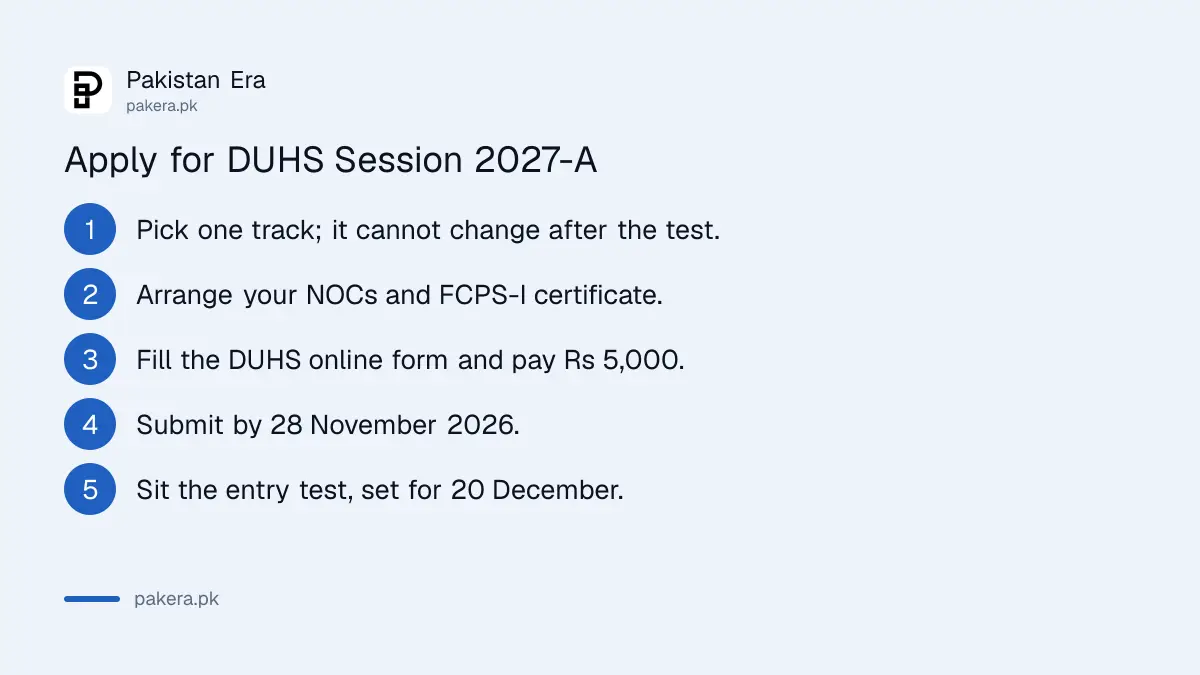
- Read the detailed criteria on the DUHS website and pick one track. You cannot change it after the entry test.
- Arrange NOCs: Sindh Health Department for government doctors, your employer for private sector doctors, CPSP and your institute if already registered.
- Fill the online form at the DUHS admission portal and pay the Rs 5,000 fee online.
- Submit before Saturday, 28 November 2026.
- Download the admit card for the venue and time of the 20 December test.
- Bring all original documents to the interview. Travel costs are not paid.
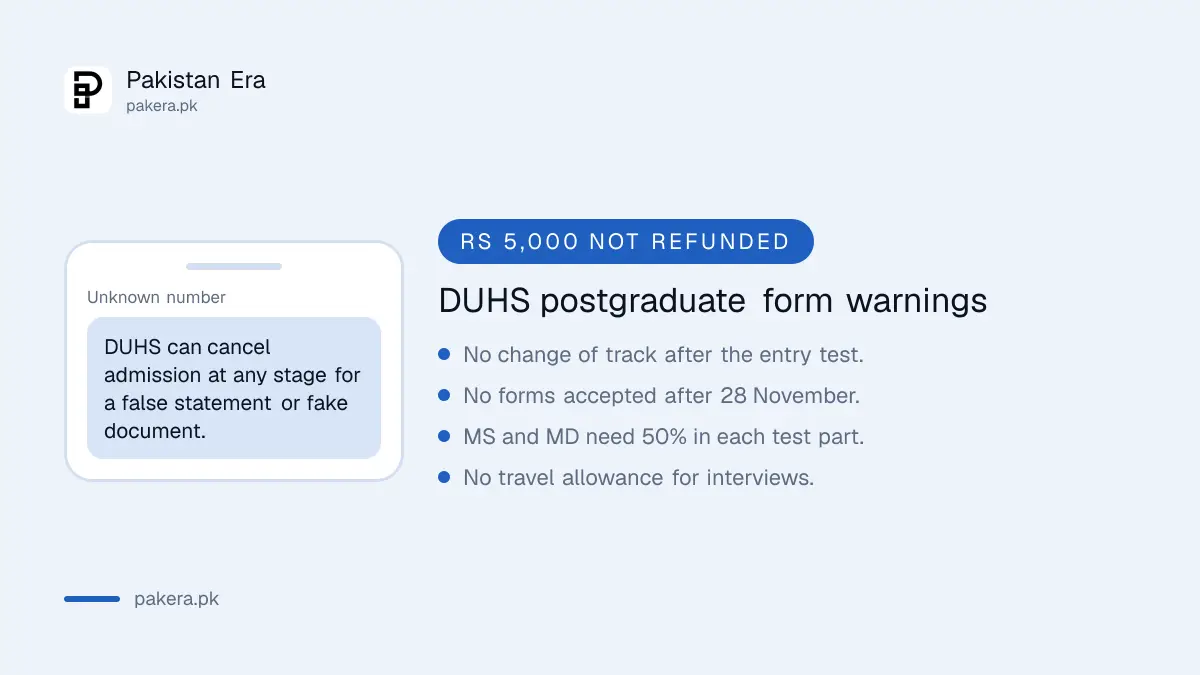
DUHS warns that a false statement, fake document or hidden fact can cancel your admission at any stage. It also says residents may be called to relief duties in a mass disaster or health emergency.
Common questions
What is the last date for DUHS FCPS-II Session 2027-A?
Saturday, 28 November 2026. DUHS says no forms will be accepted after that.
When is the DUHS postgraduate entry test?
Sunday, 20 December 2026, as a tentative date. The venue and time come on the admit card.
How much is the DUHS postgraduate application fee?
Rs 5,000, paid online. It is not refunded, even if your form is rejected after scrutiny.
Can I apply if my FCPS Part-I result is pending?
Yes, but you must produce the pass result before the entry test.
Do I need a Sindh domicile?
Yes. Both the FCPS-II list and the MS and MD criteria require a Sindh domicile.
What do MS and MD applicants need to pass?
At least 50% in the DUHS entrance test and at least 50% in the GAT (General), each on its own.
How we verified this
What we checked and where we read it.
We checked the DUHS notice "Admissions Postgraduate Courses FCPS II, MCPS, MS/MD, Master of Surgery and Doctor of Medicine Session 2027 A" on the DUHS website, posted 14 November 2026, on 15 November 2026. We read its advertisement image and the attached PDF "Eligibility and Criteria of MS, MD Applicant Session 2027". The advertisement shows the 20 December test date as tentative. Neither document gives seat numbers or tuition fees.
About the author

Public Services and Education Journalist
Fajr Riaz is a journalist and content writer at Pakistan Era, based in Lahore. She covers the questions people meet in everyday life in Pakistan: how a public service works, what a change in the rules means, and where to find a reliable answer.