Restaurant Bill Tax in Punjab and Sindh 2026-27: 8% by Card, 16% or 15% in Cash
Restaurant sales tax in Punjab and Sindh for 2026-27: 8% by card, wallet or QR, 16% cash in Punjab, 15% in Sindh, with bill examples and how to check a bill.
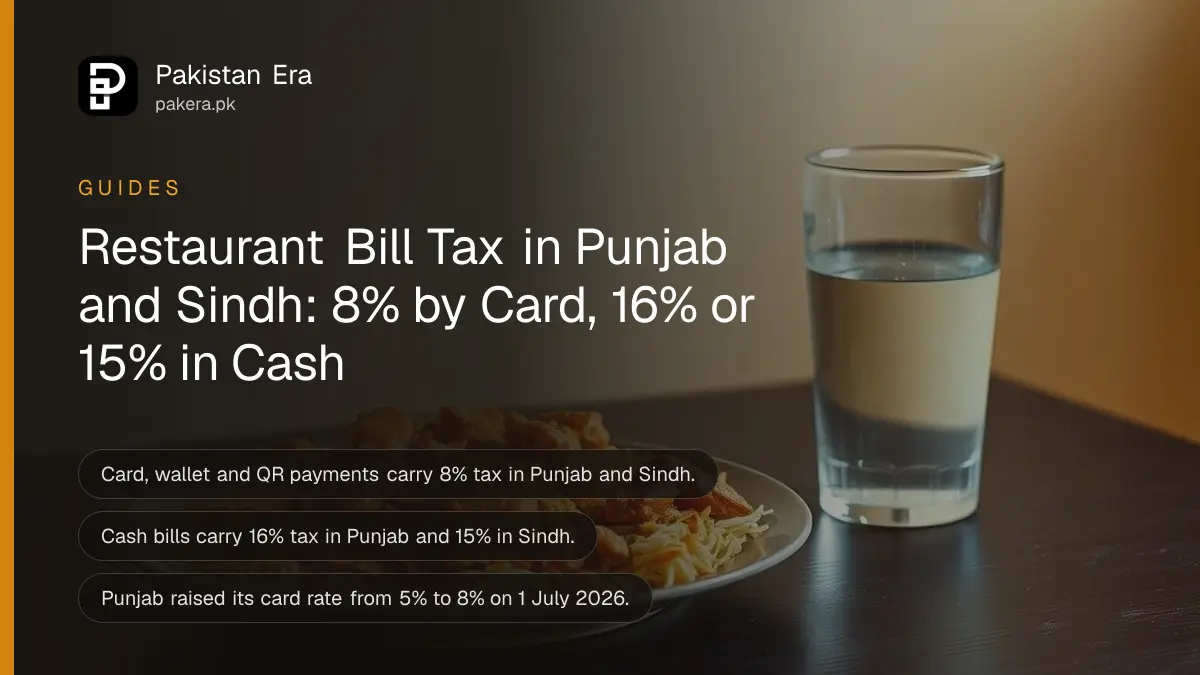
Pay your restaurant bill by card, mobile wallet or QR code and the sales tax is 8% in both Punjab and Sindh. Pay cash and it is 16% in Punjab and 15% in Sindh. On a Rs 5,000 dinner, that is Rs 400 of tax by card against Rs 800 in cash in Lahore, or Rs 750 in cash in Karachi.
Restaurant tax is a provincial tax. The Punjab Revenue Authority (PRA) collects it in Punjab, and the Sindh Revenue Board (SRB) collects it in Sindh. Both laws were changed on 1 July 2026, and the Punjab card rate went up from 5% to 8% that day.
Restaurant tax rates in Punjab and Sindh for 2026-27
Both provinces now charge 8% when you pay by debit card, credit card, mobile wallet or QR scan. The cash rate is 16% in Punjab and 15% in Sindh. The same card and cash split applies to hotel rooms in Punjab, and to restaurants inside hotels in Sindh.
| How you pay | Punjab (PRA) | Sindh (SRB) |
|---|---|---|
| Debit or credit card | 8% | 8% |
| Mobile wallet (JazzCash, Easypaisa and others) | 8% | 8% |
| QR code scan, including Raast QR | 8% | 8% |
| Cash or any other way | 16% | 15% |
| Hotel room, card or wallet | 8% | Not on the reduced list |
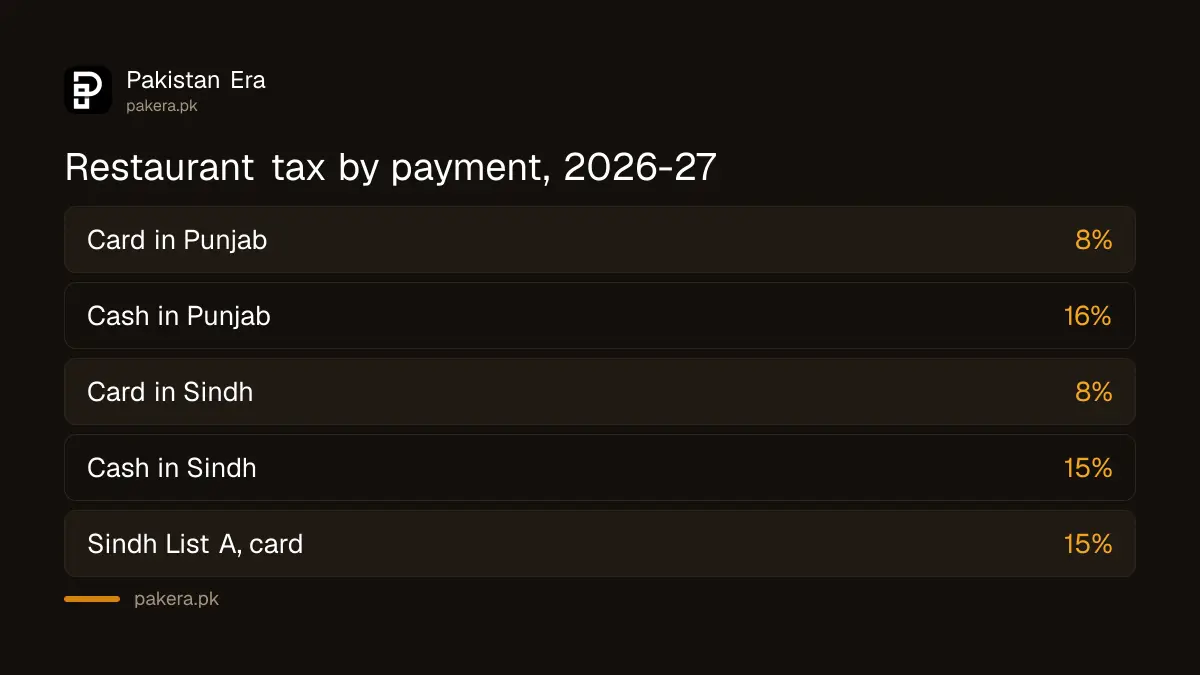
In Punjab, the 8% card rate is charged "without input tax adjustment". That means the restaurant cannot subtract the tax it paid on its own purchases. In Sindh, the 8% rate follows the same rule.
What the card rate saves on a typical bill
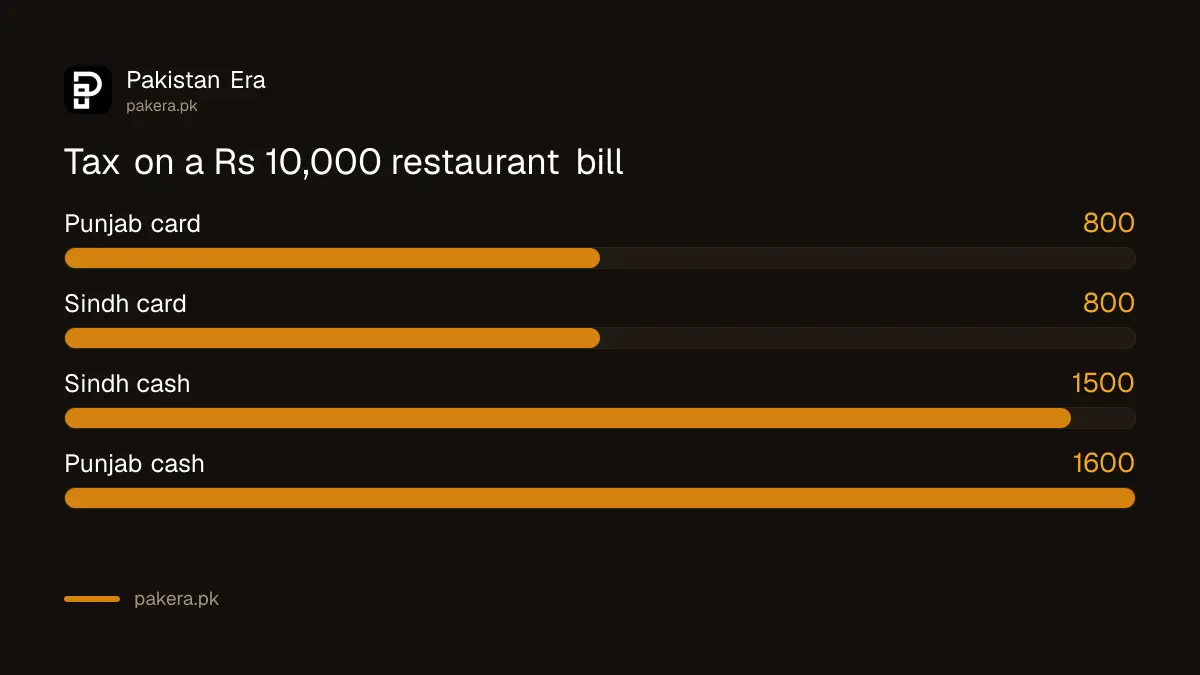
The saving is the gap between the two rates. In Punjab it is 8% of the bill, and in Sindh it is 7%. On a Rs 10,000 family dinner, paying by card saves Rs 800 in Lahore and Rs 700 in Karachi.
| Bill before tax | Punjab card (8%) | Punjab cash (16%) | Sindh cash (15%) |
|---|---|---|---|
| Rs 2,000 | Rs 160 | Rs 320 | Rs 300 |
| Rs 5,000 | Rs 400 | Rs 800 | Rs 750 |
| Rs 10,000 | Rs 800 | Rs 1,600 | Rs 1,500 |
| Rs 25,000 | Rs 2,000 | Rs 4,000 | Rs 3,750 |
Punjab's rules also say the tax is charged on the full bill, including any service charge for waiting at the table. So a 10% service charge raises the tax too. If a bank discount is on offer, the reasons it exists are covered in why banks give restaurant discounts.
Some Sindh restaurants can still charge 15% on cards
SRB lets a restaurant apply to keep charging 15% even on card payments, if its billing machine is linked to SRB's system. SRB publishes two lists: List A may charge 15% on cash and cards, and List B must charge 8% on cards.
In return, a List A restaurant can claim back the tax it paid on its own purchases. This is a choice made branch by branch. So two outlets of the same chain can charge different rates.
Before you pay a large bill in Karachi or Hyderabad, check which list the restaurant is on. The lists sit on SRB's restaurant page. If the restaurant is on List B and still adds 15% to a card payment, keep the bill and complain to SRB.
How to check your restaurant bill in 5 steps
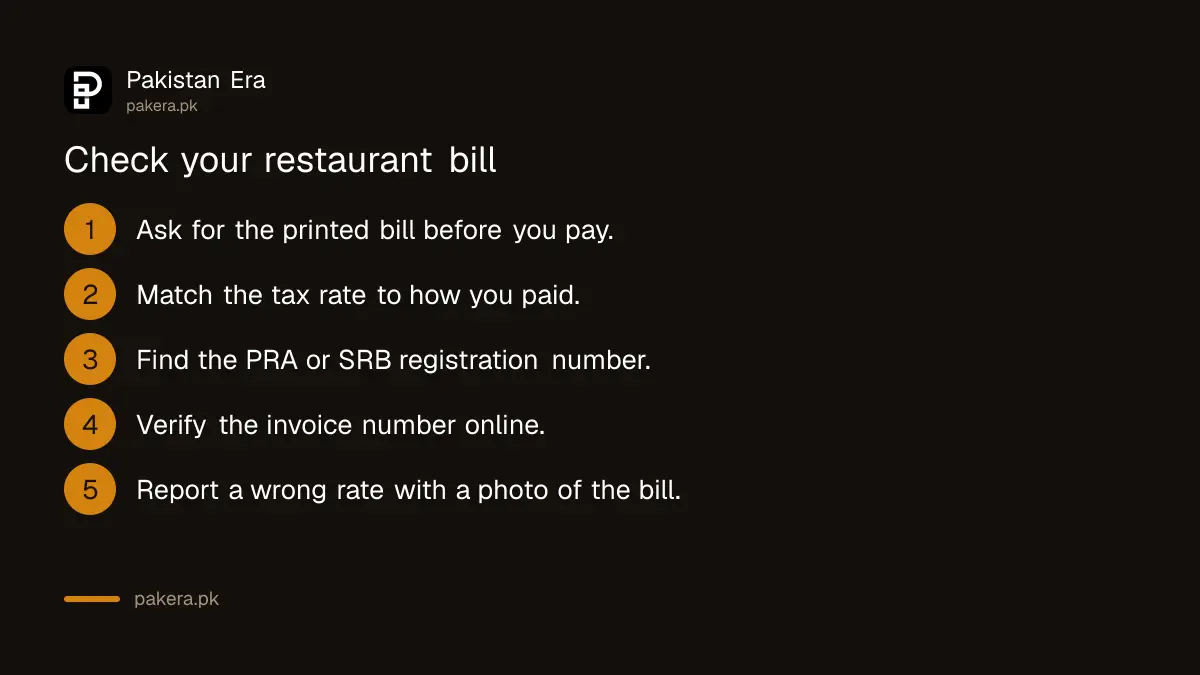
A proper bill shows the restaurant's tax number, the tax rate and the tax amount on separate lines. Check the rate against how you paid, then verify the invoice number with the provincial authority. It takes about two minutes.
- Ask for the printed bill before paying, and tell the cashier you will pay by card or wallet.
- Check the tax line: 8% for a card, wallet or QR payment, 16% cash in Punjab, 15% cash in Sindh.
- Find the tax registration number. In Punjab, a restaurant already registered with FBR uses its FBR number with a capital P in front.
- Verify the invoice number. In Punjab, use the PRA's invoice check or the Tax Asaan app. In Sindh, use SRB's Verify POS Invoice service.
- If the rate is wrong, photograph the bill and report it to the PRA or SRB, quoting the invoice number.
Punjab's rules also let you ask the restaurant to write your name and CNIC or NTN on the bill, stamp it and sign it. In Sindh, a verified invoice can also go into SRB's prize draw, explained in claiming an SRB POS invoice prize.
Rules every Punjab restaurant has to follow
Punjab's restaurant rules require registration with the PRA, a menu showing that prices are subject to tax, a numbered bill showing the tax separately, and the registration certificate displayed near the cash counter. Marriage hall food counts as restaurant service too.
- Menu card: prices must be printed, and the menu must say clearly that prices are subject to tax.
- Bill: serial numbered, showing the tax amount separately and the restaurant's registration number.
- Certificate: a non-corporate restaurant must display its PRA certificate where customers can read it.
- Payment: restaurants must also display a Raast QR code, set out in the PRA Raast QR rule.
Punjab's rules define restaurant service widely. Cafes, coffee shops, ice cream parlours, deras, food huts and banquet halls serving food are all covered. The rules for live invoice reporting are in Punjab's EIMS receipt rules.
Small restaurants in Sindh may not charge any tax
Sindh exempts restaurants and caterers with annual turnover up to Rs 5 million. The exemption is lost if the place is air-conditioned, sits in a mall or hotel, is a franchise, has more than one branch, or pays utility bills above Rs 40,000 a month.
So a small roadside dhaba in Karachi may legally charge no sales tax at all. An air-conditioned cafe in a shopping mall must charge it, whatever its size. If a small place adds tax to your bill, it should also show an SRB registration number.
Common questions
Is the 8% card rate the same in Punjab and Sindh?
Yes. Both provinces charge 8% on restaurant bills paid by debit card, credit card, mobile wallet or QR scan in 2026-27. The difference is the cash rate: 16% in Punjab and 15% in Sindh.
When did the Punjab card rate go up from 5% to 8%?
On 1 July 2026, through the Punjab Finance Act 2026. Before that, card payments at Punjab restaurants carried 5% tax.
Does paying through a bank app transfer count as a card payment?
The schedules name debit and credit cards, mobile wallets and QR scanning. A Raast QR scan from a bank app is a QR payment. Ask the cashier to ring it up as a digital payment before you pay.
Is tax charged on the service charge too?
In Punjab, yes. The rules charge tax on the gross bill, including service charges for waiting at the table.
Why did a Karachi restaurant charge me 15% on my card?
It may be on SRB's List A, which allows 15% on card payments for restaurants whose billing is linked to SRB. If it is on List B, the card rate must be 8%.
Does this tax apply in Islamabad, Khyber Pakhtunkhwa or Balochistan?
No. This page covers Punjab and Sindh only. Islamabad, Khyber Pakhtunkhwa and Balochistan each have their own sales tax on services laws and rates.
How we verified this
What we checked and where we read it.
We checked the rates on 15 November 2026 in the Punjab Sales Tax on Services Act 2012, 17th edition for 2026-27, from the PRA downloads page: Second Schedule Part III, serial 1 (hotels) and serial 4 (restaurants), both changed by the Punjab Finance Act 2026, and rules 65 to 70 of the Specific Provisions Rules 2012. For Sindh we read the consolidated Sindh Sales Tax on Services Act 2011, updated to the Sindh Finance Act 2026, from SRB's acts page: section 8 (15% standard rate), Second Schedule Part II serial 4, and First Schedule serial 4 for the Rs 5 million exemption. The List A and List B arrangement is from SRB's restaurant page. The worked examples are our own arithmetic.
About the author

Tax, Bills and Technology Writer
Ali Akhtar is a young and curious voice here at Pakistan Era. He is currently pursuing his A-Levels and has a growing interest in Pakistan’s changing industrial landscape and educational trends. Ali likes to write in a way that helps him explain and explore the world around him. His writing reflects the perspective of the new generation navigating the evolving trends of Pakistan where technology, youth innovation, and shifting opportunities are reshaping the country’s future.