Why Banks Give 20% Off at Restaurants in Pakistan, and Who Pays for It
Restaurants pay up to 2.5% on each card swipe and your bank earns a small cut, so a 20% deal rarely saves 20%. See who funds it and how to get it in full.
A bank card discount at a Pakistani restaurant is a sales deal between three parties. The restaurant gives up part of the bill to fill tables. Your bank pays for its share out of marketing money to win your card spending. And the State Bank's rules let the restaurant's card fee reach 2.5% of every swipe.
So "20% off" is real, but it is rarely 20% of what you pay. The cap, the day of the week, the card type and the tax line all cut into it. On a Rs 10,000 dinner in Punjab, a 20% deal capped at Rs 2,000 leaves you paying about Rs 8,640 to Rs 8,800 by card, against Rs 11,600 in cash with no deal.
We read the State Bank of Pakistan's card fee circulars, the Sindh Revenue Board's restaurant tax page and Standard Chartered Pakistan's live dining offers on 25 September 2026. The Punjab card tax rate we could not read on the Punjab Revenue Authority's own site, and we say so where it matters.
Banks pay for restaurant discounts to win your card spending
Banks fund dining deals because they want their card to be the one you pull out. Every swipe earns the bank a small fee, and a card you use often is a customer who keeps a salary account, pays an annual fee and may borrow.
The fee your bank earns has a name. It is the interchange fee, the share of the card charge that goes to the bank that issued your card. The State Bank caps it.
Under SBP's circular letter of 17 March 2023, interchange on a card issued in Pakistan, used on a local card machine, can be no more than 0.2% for debit and prepaid cards and 0.7% for credit cards.
Now do the sum. On a Rs 10,000 credit card bill, your bank earns at most Rs 70 in interchange. A Rs 2,000 discount is almost thirty times that. So the swipe fee alone cannot pay for the deal. Banks treat the discount as advertising. It brings in new cardholders, it keeps old ones from switching, and it tells the bank where you eat and spend.
Credit cards matter most here, because the bank earns more on them. A credit card customer who pays late also pays markup and a mark on the credit report, and annual card fees and other bank charges add up over a year. That is why the biggest discounts in the offers we read sit on premium credit cards, not on debit cards.
Restaurants pay a card fee of up to 2.5% on every swipe
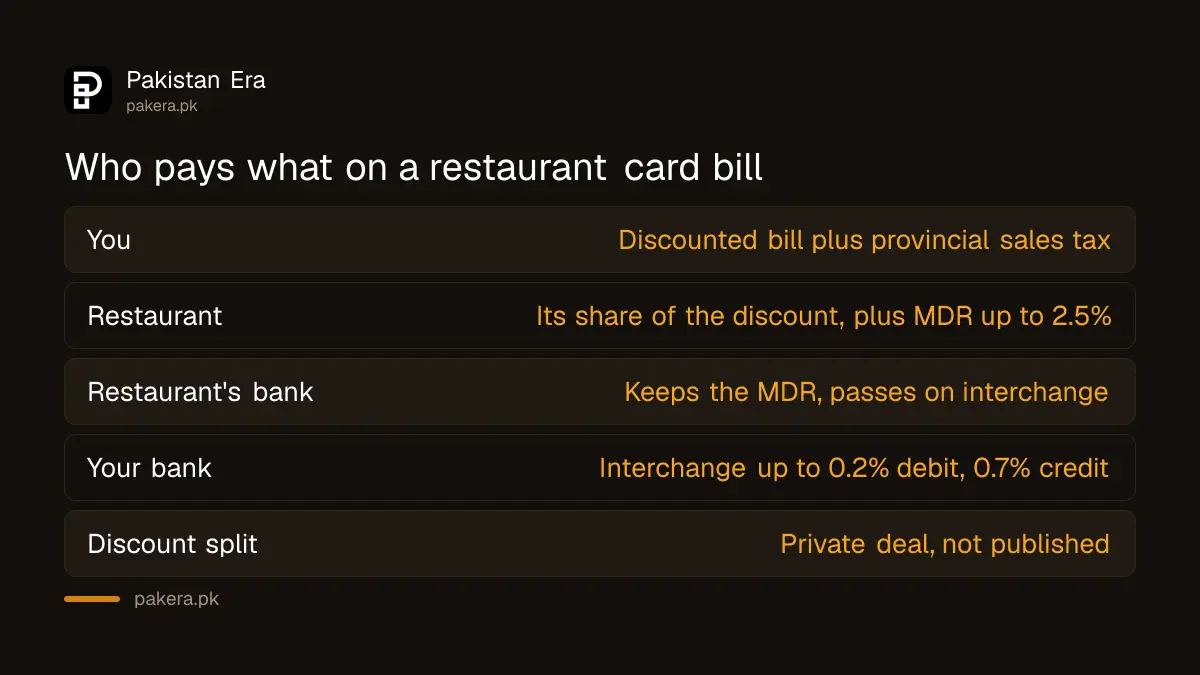
When you pay by card, the restaurant does not receive the full bill. The bank that gave it the card machine keeps a fee called the merchant discount rate, or MDR. SBP's rules put the upper limit at 2.5% of the payment.
SBP's circular of 31 January 2020 set MDR on card machines in a range of 1.5% to 2.5%. The March 2023 letter scrapped the 1.5% lower limit and kept all other instructions. So banks can now charge a restaurant less than 1.5%, but the 2.5% top of the range still stands.
Restaurants are not on SBP's list of exempt merchants. That list covers government payments, utilities, schools and fuel stations. A café in Lahore pays the ordinary card fee.
| Who | What they pay or earn on a card bill | The rule |
|---|---|---|
| You, the customer | The discounted bill, plus provincial sales tax on services | Card bills are taxed at a lower rate than cash in Sindh, and reportedly in Punjab |
| The restaurant | Gives up the part of the discount it agreed to carry, and pays the card fee (MDR) | MDR up to 2.5%, SBP circular of 2020 and letter of 2023 |
| The acquiring bank (it gave the restaurant its card machine) | Keeps the MDR and passes interchange to your bank | Same SBP rules |
| Your bank (it issued your card) | Earns interchange, and funds its share of the discount | Interchange up to 0.2% debit, 0.7% credit |
| The split of the discount | Agreed privately between bank and restaurant | Not published by any bank we read |
That last row is the honest gap. We found no bank or restaurant that publishes how a discount is split between them. The deal pages name the bank, the percentage and the cap. The split stays inside the contract.
Restaurants agree because a discount brings in tables on slow days
A restaurant accepts a bank deal because a full table at a lower price beats an empty one. Discounts limited to certain days fill the quiet nights. And the bank advertises the restaurant to its cardholders for free.
Look at when the deals run. In the Standard Chartered offers we read, Kababjees gives its discount on Fridays and Saturdays only, and Burger O'Clock on Thursdays and Fridays. Other deals run every day but only at one branch.
Group size helps the restaurant too. A family of six that came for the discount orders drinks and dessert that sit outside the cap, and the service charge is usually paid in full.
There is one more reason, and it is newer. Tax authorities want restaurant sales on the record. Punjab now requires every restaurant bill to come through its electronic invoice system, and handwritten restaurant bills are banned in Punjab. A card payment leaves a trail either way, so a restaurant that has to report its sales anyway loses less by taking cards.
Standard Chartered's current dining deals show how caps work
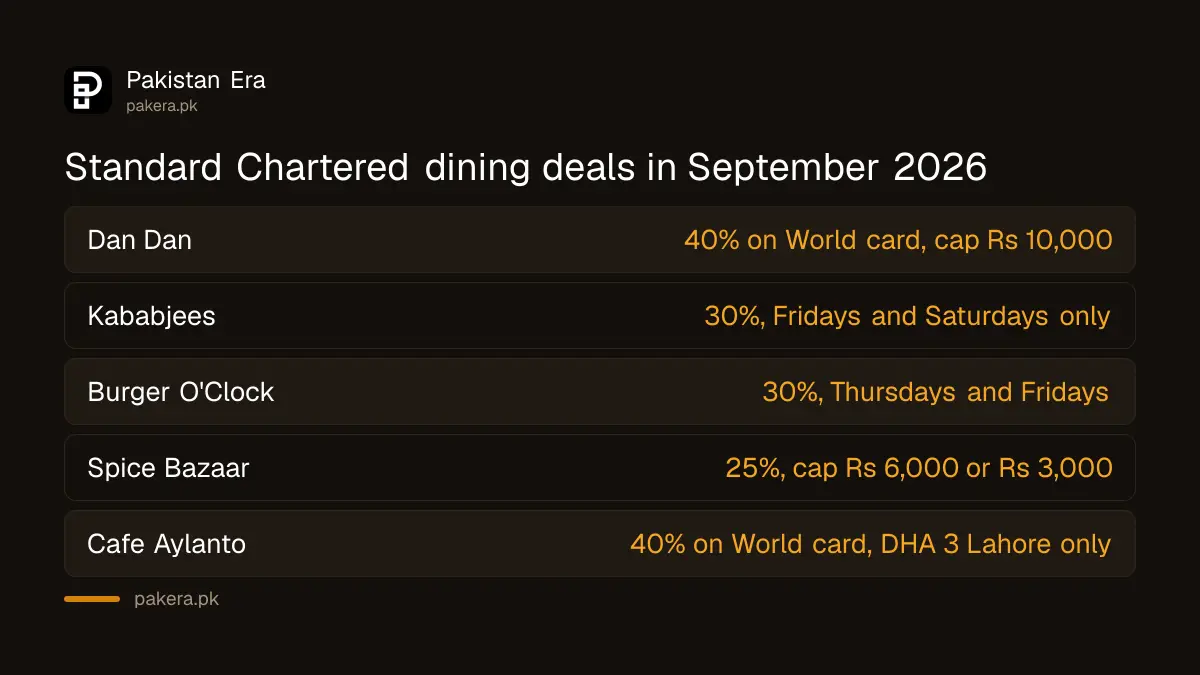
The real deals carry a percentage, a rupee cap, a card type and often a day or a city. We read these from Standard Chartered Pakistan's offer list on 25 September 2026. Each is listed as valid until 31 December 2026.
| Restaurant | Mastercard World credit card | Mastercard Platinum credit card | Limits |
|---|---|---|---|
| Dan Dan | 40%, capped at Rs 10,000 | 20%, capped at Rs 3,000 | All outlets |
| Kababjees | 30%, capped at Rs 5,000 | 30%, capped at Rs 2,000 | Fridays and Saturdays only |
| Burger O'Clock | 30%, capped at Rs 3,000 | 30%, capped at Rs 2,000 | Karachi and Lahore, Thursdays and Fridays |
| Spice Bazaar | 25%, capped at Rs 6,000 | 25%, capped at Rs 3,000 | All outlets |
| Café Aylanto | 40%, capped at Rs 7,000 | 20%, capped at Rs 3,000 | DHA Phase 3, Lahore only |
The same page states that, unless an offer says otherwise, all privileges exclude service charges and taxes, and cannot be combined with the restaurant's own promotions. Every one of these deals is for credit cards. A debit card holder at the same bank does not qualify.
One listing did not match itself. Bamboo Union's headline says 25%, while its own terms say 40% on the World card and 20% on Platinum. When a headline and its terms disagree, read the terms and confirm with the restaurant before you order.
We also tried the deal pages of HBL, Bank Alfalah, Meezan Bank and MCB. All four load their offers through a map tool that asks for your city in a browser, and it did not load for us. We have left their deals out rather than copy them from lists we cannot check.
Paying by card also cuts the sales tax on your bill
Paying a restaurant by card lowers the tax on the bill in Sindh, and reportedly in Punjab. The sales tax on restaurants is a provincial tax on services, not the federal GST, even when the bill prints "GST".
Sindh is clear on its own page. The Sindh Revenue Board charges 15% on restaurant bills paid in cash. If you pay by debit card, credit card, mobile wallet or QR scan, the rate drops to 8%.
There is a catch. SRB lets some restaurants, whose card machines are linked to its system, charge 15% even on card payments. It keeps two lists: List A, restaurants allowed to charge 15% on cash and card, and List B, restaurants that must charge 8% on card. Check which list your restaurant is on before you argue at the counter.
In Punjab, the card rate was 5% until June 2026. It rose to 8% from 1 July 2026, according to a PRA spokesman quoted in news reports, who cited the Punjab Finance Act 2026. The cash rate is reported at 16%. We could not read either figure on PRA's website, which does not publish its rate schedule on its public pages, so treat both as reported.
A 20% deal on a Rs 10,000 bill saves less than you think
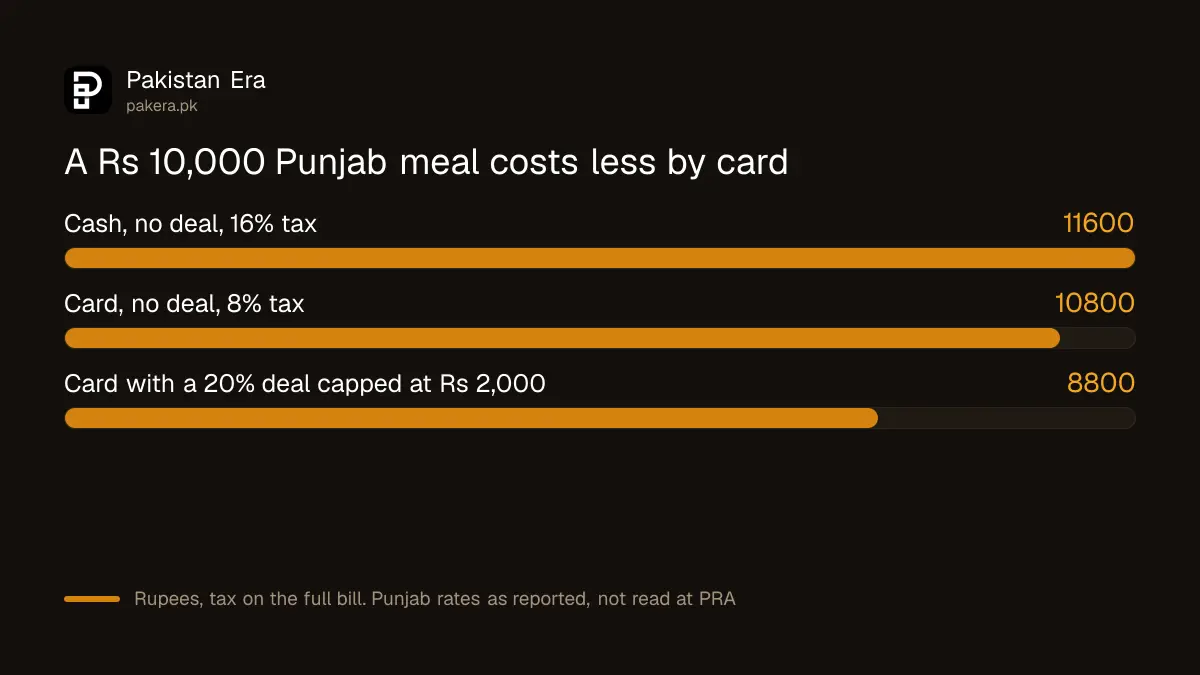
Take a Rs 10,000 food bill in Punjab, a 20% bank deal capped at Rs 2,000, and the reported 8% card tax. You pay between Rs 8,640 and Rs 8,800 by card. The difference depends on whether tax is worked out before or after the discount.
| How you pay | Food | Discount | Tax | You pay |
|---|---|---|---|---|
| Cash, no deal (16% reported) | Rs 10,000 | Rs 0 | Rs 1,600 | Rs 11,600 |
| Card, no deal (8% reported) | Rs 10,000 | Rs 0 | Rs 800 | Rs 10,800 |
| Card with deal, tax on the full bill | Rs 10,000 | Rs 2,000 | Rs 800 | Rs 8,800 |
| Card with deal, tax after the discount | Rs 10,000 | Rs 2,000 | Rs 640 | Rs 8,640 |
Three things stand out. First, the card alone saves Rs 800 here, before any deal. Second, the discount is Rs 2,000 and no more, because the cap is reached at exactly Rs 10,000. Order Rs 15,000 of food and 20% would be Rs 3,000, but you still get Rs 2,000, which is only 13.3%.
Third, the tax line. Some bills charge tax on the full amount before the discount, and some on the amount after it. We found no PRA or SRB ruling on this that we could read, so check your printed bill. A service charge, if added, is usually outside the discount too.
Seven checks get you the full discount
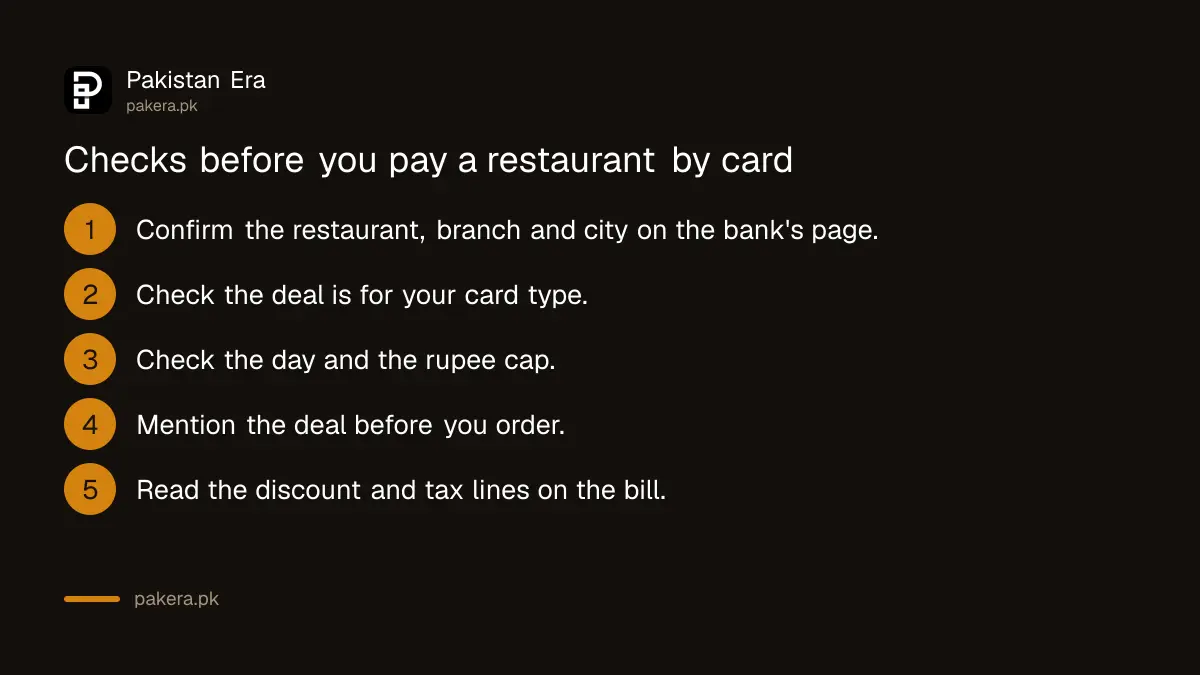
Most lost discounts come from the wrong card, the wrong day or a promotion that cancels the bank deal. Check these before you order, not when the bill arrives.
- Open your bank's own deal page or app and confirm the restaurant, branch and city.
- Check the card type. Many deals are for credit cards only, or give more on premium cards.
- Check the day. Some deals run only on set days of the week.
- Note the rupee cap, and split a large group bill only if the terms allow it.
- Tell the waiter about the deal before you order, and skip the restaurant's own promotions, which usually cannot be combined with a bank deal.
- Pay with the card on the restaurant's machine. A Raast QR payment or wallet payment may not count as a card deal.
- Read the printed bill: the discount line, the tax rate and the PRA or SRB invoice number.
If the discount is missing, raise it at the table. Once you have paid, you are dealing with the bank's complaint line, and a card deal is hard to claim back later. If the machine takes the money but the payment fails, a failed card payment with money deducted has its own fix and timeline.
Common questions
Who pays for a bank card discount at a restaurant?
The bank and the restaurant share it, under a private agreement. No bank we read publishes the split. The restaurant also pays a card fee of up to 2.5% on every swipe under SBP rules.
Does the bank discount apply to tax and service charge?
Usually not. Standard Chartered's terms say its privileges exclude service charges and taxes unless an offer says otherwise. Check the bill to see whether tax was worked out before or after the discount.
Do debit cards get restaurant discounts?
Some do, but many dining deals are for credit cards only. All five Standard Chartered deals we listed are for Mastercard World or Platinum credit cards. Banks earn more interchange on credit cards, up to 0.7% against 0.2% on debit.
Is sales tax lower if I pay a restaurant by card?
Yes, in Sindh it is 8% by card against 15% in cash, unless the restaurant is on SRB's List A. In Punjab, the card rate is reported at 8% from July 2026 against 16% in cash.
Why did the restaurant give me less than 20% off?
Almost always because of the cap. A 20% deal capped at Rs 2,000 stops growing once the bill passes Rs 10,000. Wrong day, wrong branch and wrong card type are the other common reasons.
Can a restaurant charge extra for paying by card?
The card fee is the restaurant's cost under its agreement with its bank, not a charge SBP sets for customers. If a surcharge appears, ask for it in writing and raise it with your bank.
How we verified this
What we checked, where we read it, and what we could not confirm.
We read these on 25 September 2026: the SBP circular letter of 17 March 2023 on interchange and MDR, the SBP circular of 31 January 2020 it amends, and the Sindh Revenue Board's restaurant tax page. Deal terms come from Standard Chartered Pakistan's Good Life offers, and banks change them often. The Punjab card and cash rates are reported, not read at PRA, and the split of any discount between bank and restaurant is not published.
About the author

Public Services and Education Journalist
Fajr Riaz is a journalist and content writer at Pakistan Era, based in Lahore. She covers the questions people meet in everyday life in Pakistan: how a public service works, what a change in the rules means, and where to find a reliable answer.