Best Credit Cards in Pakistan 2026: Top 5 From 8 Banks, Compared on Fees
We read eight banks' 2026 schedules of charges. Bank Al Habib lists 25% markup, others 42% to 49.99%. Compare annual fees, late fees and foreign charges.
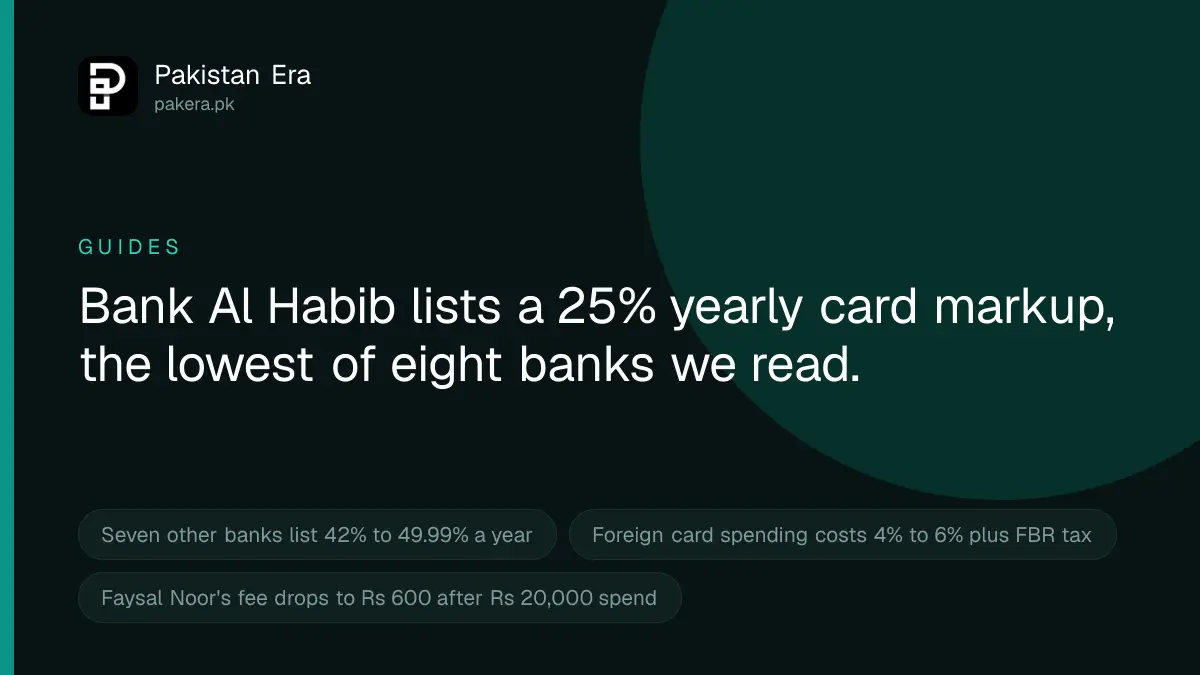
Bank Al Habib charges 25 per cent a year on an unpaid credit card balance. The other seven banks we checked list between 42 and 49.99 per cent. That single line decides which is the best credit card in Pakistan for anyone who does not clear the bill every month.
For people who do pay in full, the markup never applies, and the annual fee and foreign transaction charge matter more. So there is no one best card. There is a best card for how you use it.
We read the current Schedule of Charges, the official price list every bank must publish, for eight banks on 25 September 2026. Most cover 1 July to 31 December 2026. Every figure below comes from those documents, and the tables say which one.
Our top 5 credit cards in Pakistan, and why
We ranked on five open tests: lowest markup if you carry a balance, lowest cost if you pay in full, an Islamic option with a low income bar, foreign spending, and an annual fee you can get back. Each winner below won one test.
| Rank | Card | Won on | Key figure from the bank's own document |
|---|---|---|---|
| 1 | Bank Al Habib Green, Gold or Platinum | Carrying a balance | APR 25% a year; Green card fee Rs 5,600 |
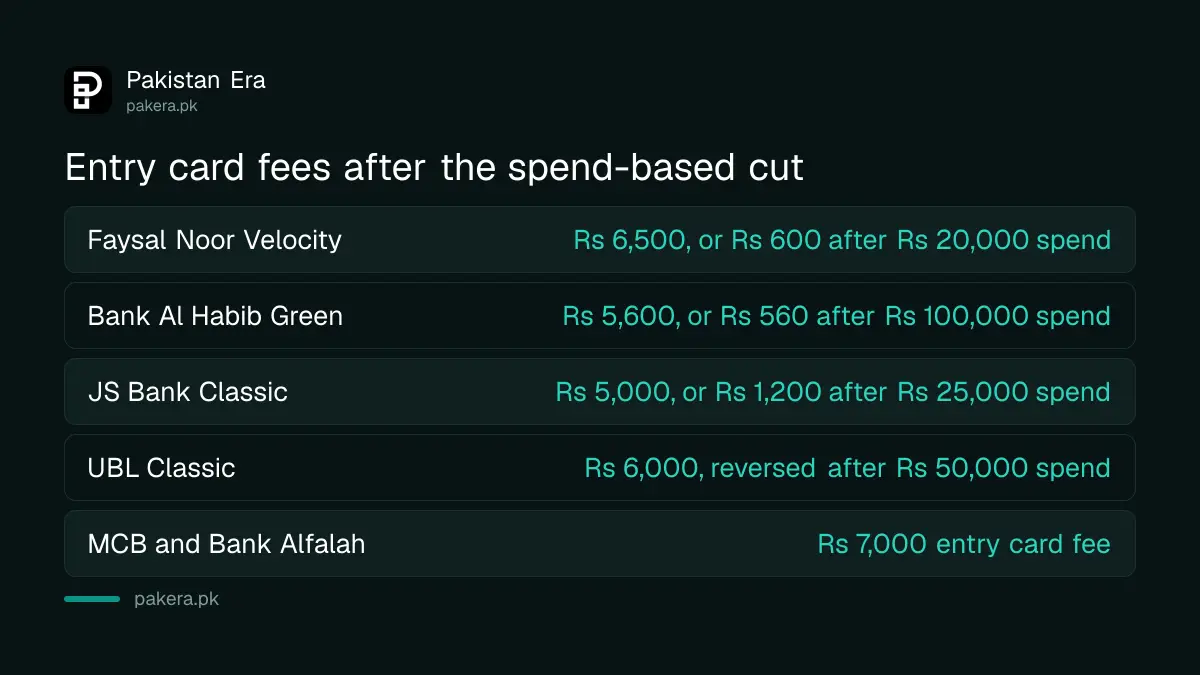
| 2 | Faysal Islami Noor Velocity | Islamic option, low income bar | Rs 6,500 fee, cut to Rs 600 after Rs 20,000 spend in 60 days |
| 3 | JS Bank Classic | Lowest cost if you pay in full | Rs 5,000 fee, cut to Rs 1,200 after Rs 25,000 spend in the first month |
| 4 | HBL CreditCard | Foreign spending | 4% foreign transaction charge, maximum markup 42% a year |
| 5 | UBL Visa Classic | Fee you can get back in full | Rs 6,000 fee, reversed after Rs 50,000 spend in 60 days |
Bank Al Habib's lead is not small. On the same unpaid bill, its markup is a little over half of what most rivals charge. It also cuts the Green card fee to Rs 560 after Rs 100,000 of spending in 60 days, and reverses it fully after Rs 150,000 in 90 days.
Faysal's Noor card works on Musawamah, an Islamic sale contract, so the bank calls its charge "profit" instead of markup. Its salaried income floor is Rs 40,000 a month for employees of approved companies, the lowest we found published.
JS Bank wins on sticker price only. Read the section on cards to be careful with before you choose it.
Annual fees at eight banks, side by side
Entry cards cost between Rs 5,000 and Rs 7,000 a year at the banks we checked. Top cards run from Rs 19,000 to Rs 30,000. Several banks cut or reverse the fee once you spend a set amount soon after activation.
| Bank | Entry card fee | Gold tier | Top tier | Document read |
|---|---|---|---|---|
| JS Bank | Rs 5,000 (Classic) | Rs 8,500 | Rs 20,000 (Signature) | SOC July to Dec 2026 |
| Bank Al Habib | Rs 5,600 (Green) | Rs 8,000 | Rs 20,000 (Platinum) | SOC 1 July to 31 Dec 2026 |
| UBL | Rs 6,000 (Classic) | Rs 12,000 | Rs 30,000 (Signature, former Silkbank card) | SOC July to Dec 2026 |
| HBL | Rs 6,500 (Green) | Rs 14,000 | Rs 22,000 (Platinum) | SOC 1 July to 31 Dec 2026 |
| Faysal Islami Noor | Rs 6,500 (Velocity) | Rs 11,000 | Rs 26,000 (World) | Key Facts Statement July to Dec 2026 |
| MCB | Rs 7,000 | Rs 14,000 | Rs 22,000 | SOC July to Dec 2026 |
| Bank Alfalah | Rs 7,000 (Classic) | Rs 14,000 | Rs 30,000 (Signature) | SOC 1 July to 31 Dec 2026 |
| Standard Chartered | Rs 9,000 (Easy Credit) | Rs 13,500 to Rs 14,500 (Titanium, Cashback) | Rs 30,000 (World Elite) | SOC 1 July to 31 Dec 2026 |
Bank documents list fees before FED, the federal excise duty, and provincial sales tax where those apply. Your statement will show a slightly higher figure.
MCB's schedule lists three card fees without a readable card name beside each, so we show them from lowest to highest. MCB offers Classic, Gold and Platinum Visa cards. Check the tier with the bank before you apply.
Markup on unpaid balances runs from 25 to 50 per cent a year
Markup, also called the service fee, is the charge on any amount you do not clear by the due date. It is shown as APR, the yearly rate. The State Bank's policy rate is 11.5 per cent, so most cards cost almost four times that.
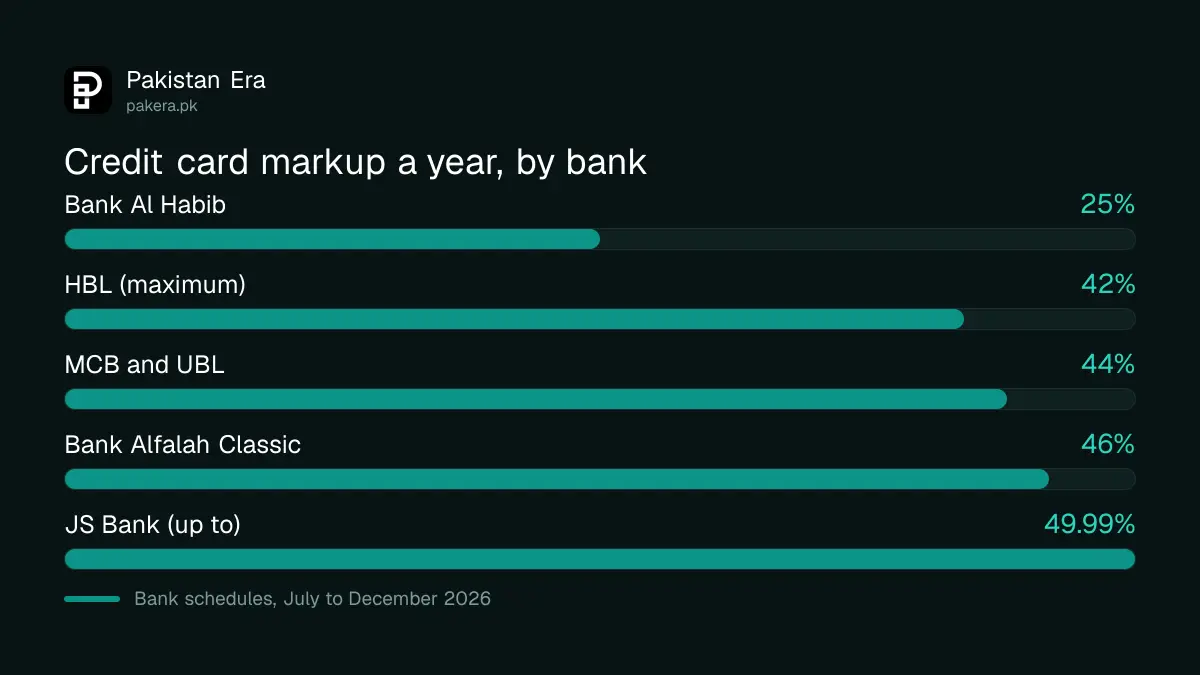
| Bank | Yearly rate (APR) | Monthly | Late payment fee |
|---|---|---|---|
| Bank Al Habib | 25% | About 2.08% | Rs 2,300 |
| HBL | Maximum 42% | 3.5% | Rs 2,500 on Platinum; Rs 1,250 to Rs 1,500 listed for other HBL cards |
| Faysal Islami Noor | 43% to 45%, by applicant type | 3.58% to 3.75% | Rs 2,500 per instance |
| MCB | 44% | 3.67% | Rs 2,500 |
| UBL | 44% | About 3.67% | Rs 2,200 |
| Bank Alfalah | 46% Classic, 45% other cards | 3.83% and 3.75% | Rs 2,500 flat |
| Standard Chartered | Up to 46% | About 3.83% | Rs 2,000 or 10% of minimum due, whichever is higher |
| JS Bank | Up to 49.99% | 4.16% | Rs 2,400 or 10% of minimum amount, whichever is higher |
The State Bank held the policy rate at 11.5 per cent on 14 September, and that decision on the policy rate moves home and car financing faster than cards. Card rates barely follow it.
How markup works, with a worked example
Pay the full bill by the due date and you pay no markup at all. Pay anything less, even the minimum, and markup is charged on the whole purchase from the day you made it, not just on what is left.
UBL and Faysal both describe an interest free period of up to 50 days. That window exists only while you clear the full amount each month.
- You spend Rs 50,000 on a card with a 44% APR.
- Your statement asks for a minimum of Rs 2,500. UBL's minimum, for example, is Rs 500 or 5% of the balance, whichever is higher.
- You pay only Rs 2,500 on the due date, 35 days after the purchase.
- Markup runs on the full Rs 50,000 for those 35 days. That is Rs 50,000 × 44% ÷ 365 × 35, or about Rs 2,110.
- The next month, Rs 47,500 is still unpaid. Another 30 days adds about Rs 1,718.
- After two months you have been charged about Rs 3,828 in markup, and you still owe most of the original Rs 50,000.
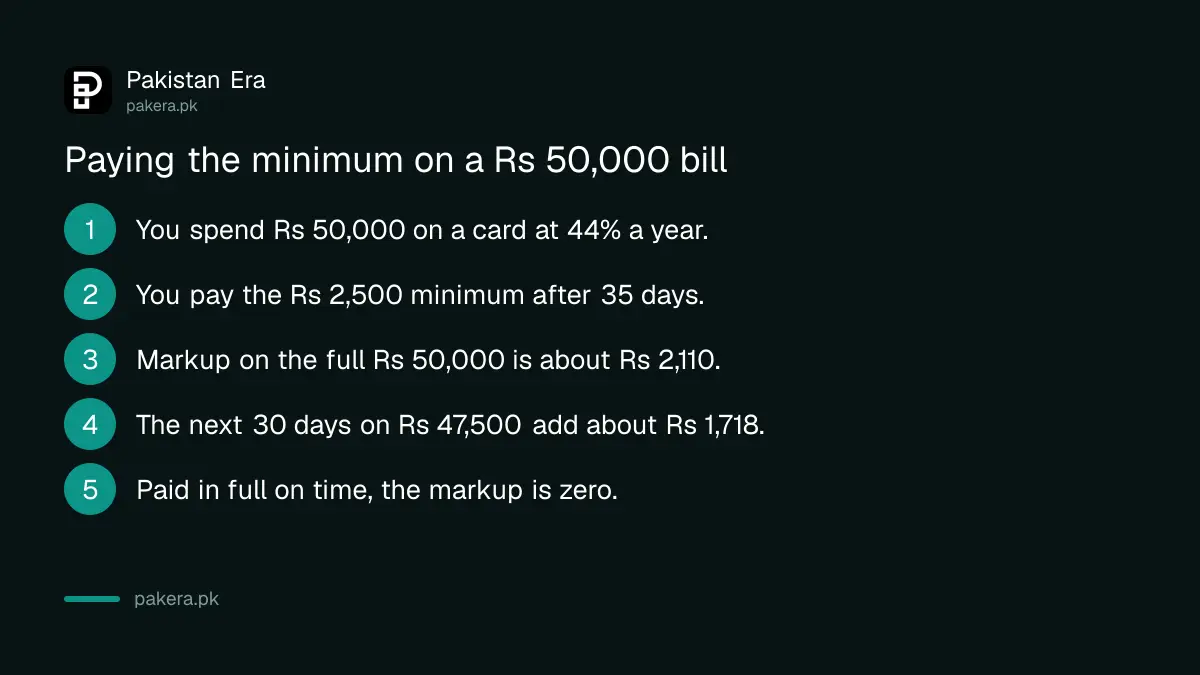
The same two months at Bank Al Habib's 25% come to about Rs 2,175. These figures are before any tax on the charge, and your bank's exact billing dates will shift them a little.
That is the minimum payment trap. The minimum keeps your record clean, but it barely touches the debt.
Foreign spending costs 4 to 6 per cent, plus FBR tax
Paying abroad or on a foreign website adds a bank charge of 4% to 6% of the amount. On top of that, FBR's advance tax on card payments abroad is now 0.5% for active taxpayers and 1% for others.
| Bank | Foreign transaction charge | On a Rs 20,000 purchase |
|---|---|---|
| HBL | 4% of the amount | Rs 800 |
| MCB | Rs 100 or 4%, whichever is higher | Rs 800 |
| UBL | Rs 100 or 4.5%, whichever is higher | Rs 900 |
| Bank Alfalah | 4.5% or Rs 125, whichever is higher | Rs 900 |
| Bank Al Habib | 4.5% | Rs 900 |
| Faysal Islami Noor | 4.5%, including purchases billed in rupees by foreign merchants | Rs 900 |
| JS Bank | Rs 450 or 5%, whichever is higher | Rs 1,000 |
| Standard Chartered | Spread of Re 1 per US dollar and up to 6% | Up to Rs 1,200, plus the spread |
The tax is Section 236Y of the Income Tax Ordinance. FBR's Withholding Tax Rate Card, updated for the Finance Act 2026, lists 0.5% for people on the Active Taxpayers List and 1% for those who are not. FBR's budget summary says the rate was cut from 5% to 0.5%.
Bank Alfalah's July to December 2026 schedule still prints the older 5% for filers and 10% for non filers. FBR's card is the authority on tax, so check your own statement. If you are unsure of your status, you can check your filer status before your next foreign payment, since a non filer pays double.
MCB and Standard Chartered also warn that some foreign payments are settled at the open market dollar rate, and the difference is billed separately.
Cards and features to be careful with
These are published charges, not judgements on any bank. Each one costs real money if you fall into it. The figures are from each bank's July to December 2026 schedule, read on 25 September 2026.
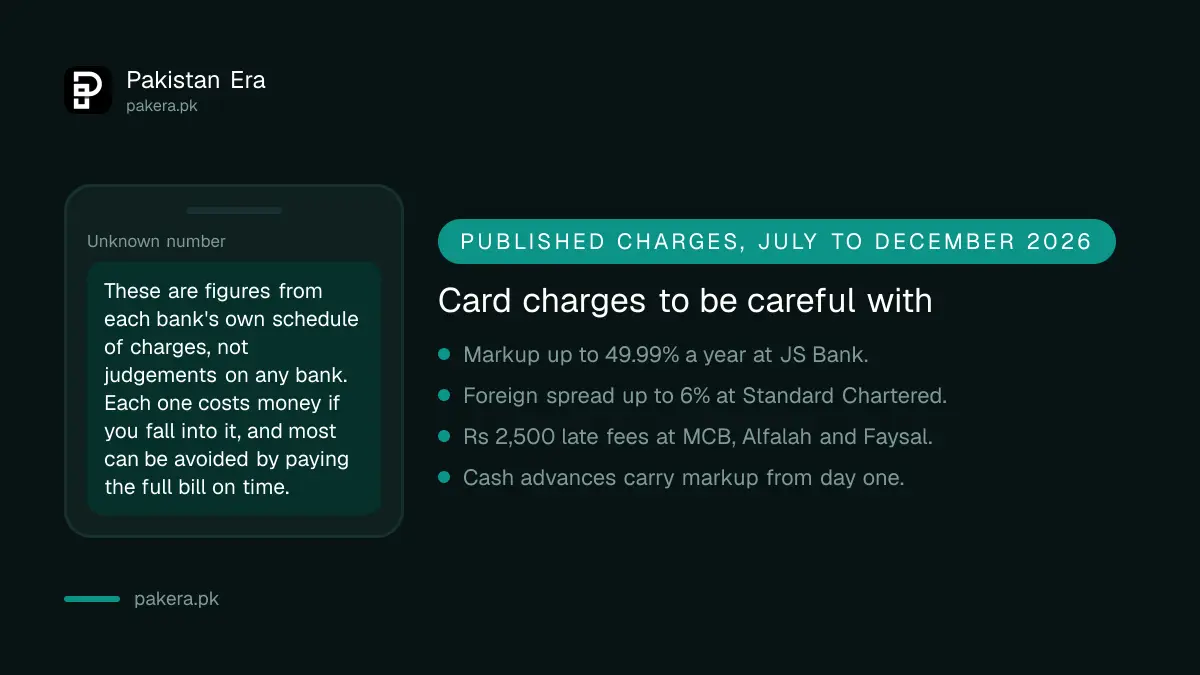
- High markup if you carry a balance. JS Bank's schedule lists up to 49.99% a year. Bank Alfalah's Classic card is at 46%, and Standard Chartered lists up to 46%. A cheap annual fee does not help if you pay these rates for a year.
- High foreign charges. Standard Chartered's spread of up to 6% plus Re 1 per dollar, and JS Bank's Rs 450 or 5%, are the highest we read. For regular online subscriptions in dollars, that adds up.
- Late fees of Rs 2,500. MCB, Bank Alfalah, Faysal Noor and HBL Platinum all charge Rs 2,500 for a missed payment. A missed payment also goes on your credit record.
- Cash advances. Most banks charge Rs 1,200 or 3%, whichever is higher, and markup starts the same day, with no free period. JS Bank's fee is 3.5% or Rs 1,800. Bank Al Habib charges a flat Rs 1,200.
- Top tier fees that stay if you do not spend. Bank Alfalah's Signature card is Rs 30,000, reduced to Rs 5,000 only after meeting a spend target. UBL lists Rs 30,000 for the Signature card it took over from Silkbank.
A missed or late payment is reported to the State Bank's credit database, and your eCIB credit report is what the next lender reads. Set up an automatic full payment from your account where the bank offers it.
How to choose a credit card in 4 steps
Start with one honest question: will you clear the full bill every month? If not, choose the lowest markup and ignore rewards. If you will, choose the lowest net fee and the lowest foreign charge for how you spend.
- Check the income floor. Bank Alfalah's Classic card asks for Rs 50,000 a month salaried, or Rs 75,000 self employed. Faysal Noor asks Rs 40,000 for approved employers, Rs 50,000 for others, and Rs 100,000 self employed.
- Ask for the Key Facts Statement before you sign. It is a short summary every bank must give, with the APR, fees and minimum payment on one page.
- Look at the fee reversal rule and whether your normal spending meets it. Utility bill payments do not count at Faysal, and cash advances do not count at UBL.
- Keep a copy of the schedule of charges on the day you apply. Banks revise it every January and July.
If a charge appears that is not in the schedule, the first step is a written complaint to the bank. If the bank does not resolve it, the Banking Mohtasib handles complaints about banks for free. For a disputed transaction you did not make, the deadlines for a fraud complaint are short and worth knowing now. Everyday account fees are a separate list, covered under what your bank charges you.
This is general information, not financial advice. Charges change every six months, so confirm the current schedule of charges with your bank before you apply.
Common questions
Which bank has the lowest credit card markup in Pakistan?
Bank Al Habib, at 25% a year, in its schedule of charges for 1 July to 31 December 2026. The other seven banks we checked list between 42% and 49.99%.
Which is the best credit card for a first card?
If you will pay in full every month, a card with a low net fee: Faysal Noor Velocity, JS Bank Classic or Bank Al Habib Green. If you might carry a balance, Bank Al Habib, because its markup is the lowest by a wide margin.
Is there an Islamic credit card in Pakistan?
Yes. Faysal Bank's Islami Noor card runs on a Musawamah contract and charges profit of 43% to 45% a year on unpaid amounts, with a Rs 2,500 charge for a late payment.
What is the minimum salary for a credit card?
It depends on the bank. Faysal Noor asks for Rs 40,000 a month from employees of approved companies, and Bank Alfalah's Classic card asks for Rs 50,000. Self employed applicants face higher floors at both.
How much tax is charged on foreign card payments?
FBR's current rate card lists 0.5% for people on the Active Taxpayers List and 1% for others, under Section 236Y. This is on top of the bank's own foreign transaction charge of 4% to 6%.
Can I get my annual fee waived?
Often, yes. UBL reverses its Classic fee after Rs 50,000 of spending in 60 days. Bank Al Habib, Faysal Noor, JS Bank and Bank Alfalah's Signature card cut the fee after a set spend.
How we verified this
What we checked, where we read it, and what we could not confirm.
Last checked 25 September 2026. Fees, APRs, late fees, cash advance and foreign transaction charges are read from each bank's own schedule of charges: HBL (1 July to 31 December 2026, plus its separate Platinum CreditCard sheet), MCB (July to December 2026), UBL (July to December 2026), Bank Alfalah (1 July to 31 December 2026), Standard Chartered (1 July to 31 December 2026), JS Bank (July to December 2026) and Bank Al Habib (1 July to 31 December 2026), and from Faysal Bank's Islami Noor Card Key Facts Statement for July to December 2026. UBL's fee reversal rule and 50 day free period are from its Credit Card Summary Box for January to June 2026; its July to December schedule repeats the same fee. Income floors are from the Bank Alfalah and Faysal card pages. The 236Y rate is from FBR's Withholding Tax Rate Card. We could not read Askari Bank's or NBP's current schedules, and Meezan Bank is not included. Some schedules print tables that did not map cleanly to card names; where that happened we say so above. Nothing here judges the service of any bank. If a figure is wrong, tell us and we will correct it openly.
About the author
Public Services and Education Journalist
Fajr Riaz is a journalist and content writer at Pakistan Era, based in Lahore. She covers the questions people meet in everyday life in Pakistan: how a public service works, what a change in the rules means, and where to find a reliable answer.