State Bank Holds Pakistan's Policy Rate at 11.5 Per Cent
Seven of ten members voted to hold at 11.5 per cent as inflation rose to 11.1. What the State Bank said, and what it means for loans and savings.
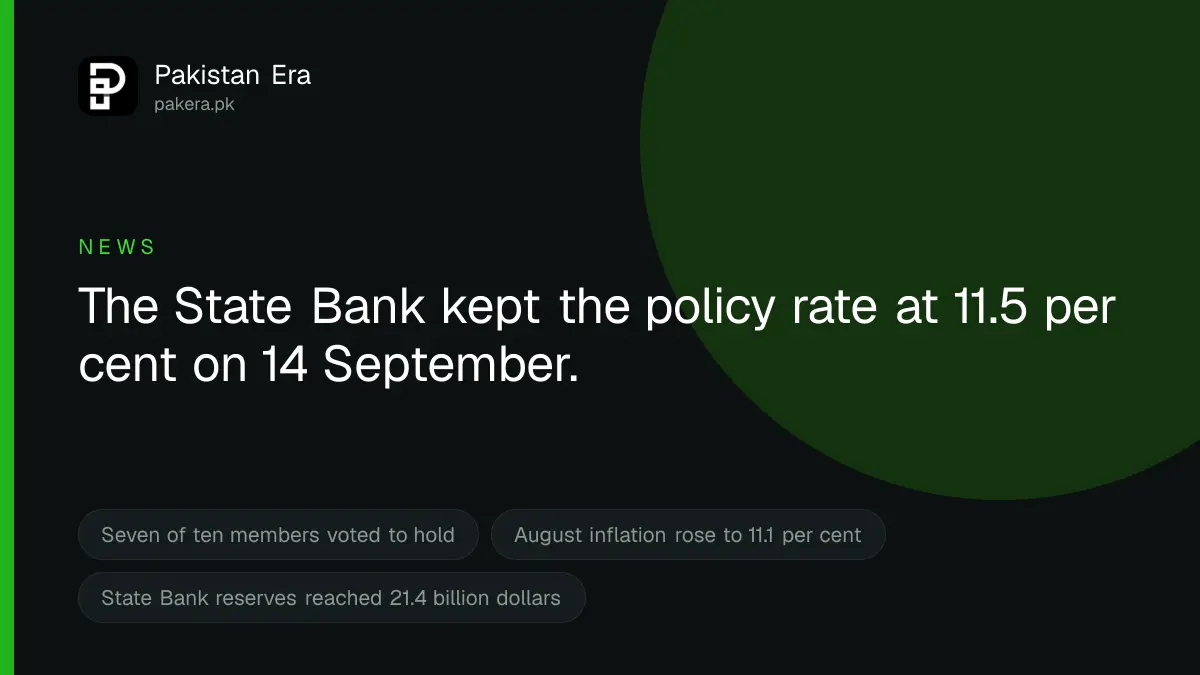
The State Bank of Pakistan kept its policy rate at 11.5 per cent on 14 September 2026. Seven of the ten members of its Monetary Policy Committee voted for the hold, as inflation rose to 11.1 per cent in August.
It is the second decision in a row with no change. The rate was also held at 11.5 per cent on 27 July.
We read the State Bank's Monetary Policy Statement of 14 September 2026 on sbp.org.pk. The figures below come from that statement unless we say otherwise.
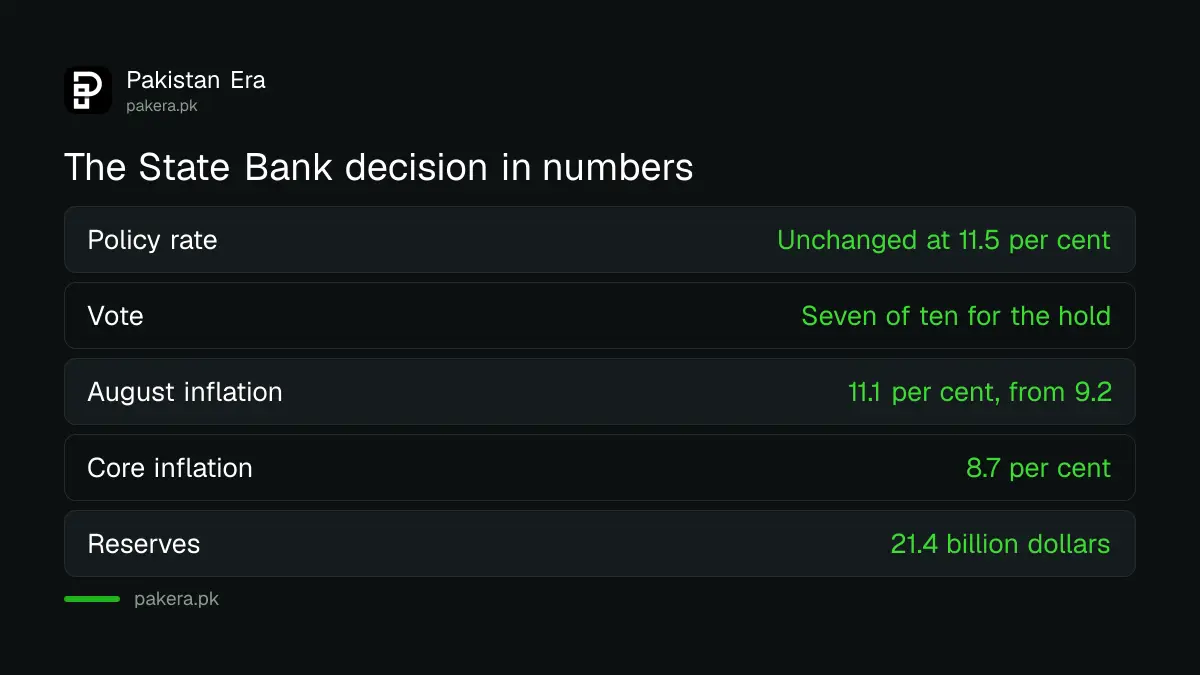
The decision in numbers
| Measure | What the statement says |
|---|---|
| Policy rate | Unchanged at 11.5 per cent |
| Vote | Seven of ten members for the hold |
| Inflation, August | 11.1 per cent, up from 9.2 per cent in July |
| Core inflation | 8.7 per cent |
| Inflation target | 5 to 7 per cent over the medium term |
| FX reserves at the State Bank | 21.4 billion dollars |
| Growth forecast, FY27 | 3.5 to 4.5 per cent |
A seven to three vote means the committee was not unanimous. The statement did not say what the other three members wanted. The minutes, published on 9 October, show they voted to raise the rate by 100 basis points to 12.5 per cent. Read what the minutes say.
Why the State Bank held
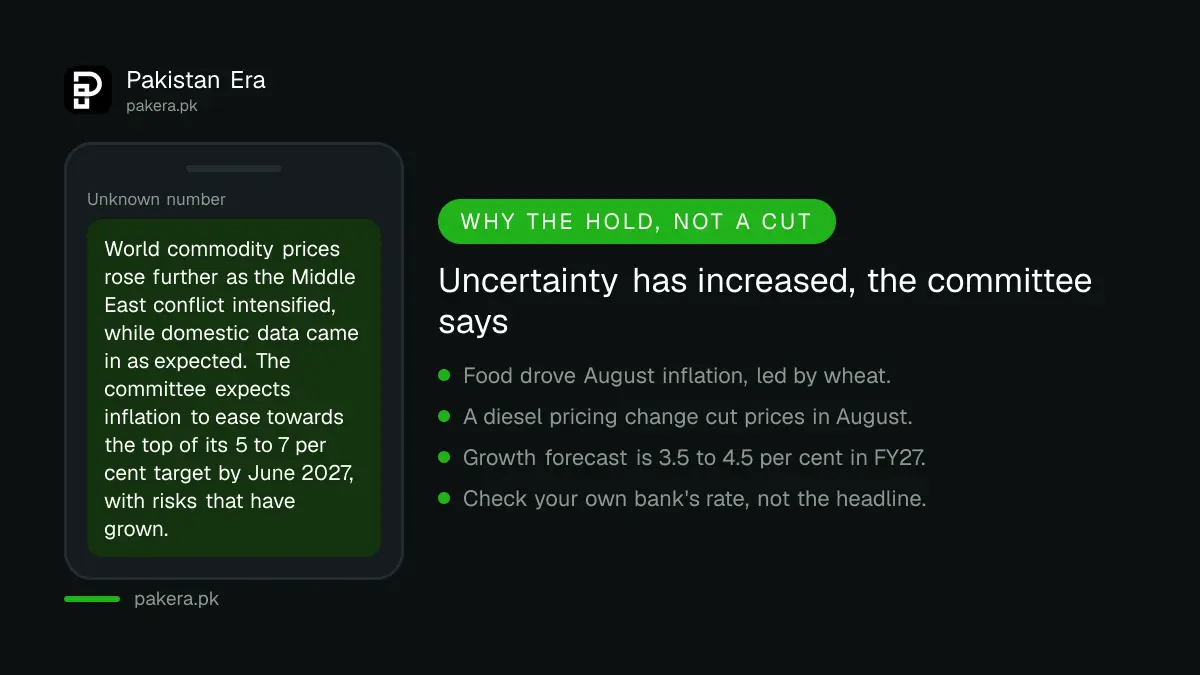
The statement gives two reasons pulling in opposite directions.
On one side, the conflict in the Middle East has intensified. That has pushed already high world commodity prices higher, and supply chain problems have continued.
On the other side, Pakistan's own economic data came in roughly as the committee expected. Core inflation was slightly lower than expected, and pressure on the external account stayed under control because of strong remittances from workers abroad and higher financial inflows.
So the committee judged that the current rate is still the right one to bring inflation back towards its target. It also said plainly that uncertainty about the outlook has increased, mainly because the geopolitical situation has become worse.
What is pushing prices up
Inflation jumped from 9.2 per cent in July to 11.1 per cent in August. The statement names food as the main driver, especially wheat and wheat products, and perishable items.
Energy prices have also stayed high because of the Middle East conflict. Higher fuel prices raised transport costs, and the statement says that pushed core inflation, which leaves out food and energy, up to 8.7 per cent.
One item worked the other way. The statement says a recent change in the way high speed diesel is priced led to a sharp fall in diesel prices in August, and that partly offset higher world prices. Our report on how often fuel prices changed this year covers the move to frequent pricing behind that.
Households and businesses both expect higher inflation than before, according to the State Bank's latest surveys, and their confidence has weakened.
The better news in the statement
- Moody's upgraded Pakistan's credit rating to B3 with a stable outlook.
- Pakistan raised 3 billion dollars by selling Eurobonds in international markets.
- State Bank reserves rose to 21.4 billion dollars, helped by those bonds and its own dollar purchases.
- The government cut its deficit by more than its budget target in FY26.
- The State Bank paid the government a profit of Rs 1.9 trillion, against Rs 1.4 trillion expected in the budget.
The statement also expects reserves to approach three months of import cover by the end of June 2027, and the current account deficit to stay between zero and one per cent of GDP in FY27. Our report on record remittances in FY26 covers the money from workers abroad that the statement leans on.
What a hold means for your money
A hold means this decision itself does not push borrowing costs or savings returns up or down. Rates that banks link to the policy rate have no new reason to move from it.
Here is a simple way to see where savers stand. The policy rate is 11.5 per cent and August inflation was 11.1 per cent, a gap of 0.4 of a percentage point. That subtraction is ours and looks backwards. The State Bank's own view is that the real interest rate is positive when you look ahead, because it expects inflation to ease.
For borrowers, the statement says private sector credit grew 13.4 per cent year on year, with more lending across business loans, investment and consumer financing. It expects that growth to strengthen.
If you are deciding about a loan or where to keep savings, our guides on how banks decide a home loan, car financing rates and limits, National Savings profit rates and tax on bank profit cover the details. Check your own bank's rate, because the policy rate is a starting point, not the price you pay.
What comes next
The committee expects inflation to ease slowly towards the upper end of its 5 to 7 per cent target by June 2027. It says the risks to that view have grown a lot.
It lists the main risks: swings in world commodity prices, how far electricity and gas tariffs are raised, supply disruptions, and sudden moves in food prices as El Nino conditions worsen.
The statement also notes that growth picked up in July after a slowdown, with better prospects for rice, sugarcane and cotton. Large scale manufacturing fell 3.5 per cent in June, but grew 5.0 per cent across FY26 as a whole.
Our earlier piece on the July hold at 11.5 per cent explains how a hold affects loans and deposits in more detail. With the petrol relief scheme now running, our guide to getting petrol relief on 9771 covers the fuel support side.
Common questions
What is Pakistan's policy rate now?
11.5 per cent, kept unchanged by the State Bank on 14 September 2026.
Why did the State Bank not cut rates?
World commodity prices rose further because of the Middle East conflict and uncertainty increased, while domestic data was in line with expectations.
What was inflation in August 2026?
11.1 per cent year on year, up from 9.2 per cent in July, according to the statement.
Was the decision unanimous?
No. Seven of the ten committee members voted for the hold. The other three voted to raise the rate by 100 basis points, the minutes of 9 October show.
Will my loan instalment change?
Not because of this decision, since the rate did not move. Your bank's own terms decide your actual rate.
When does the State Bank expect inflation to fall?
It expects inflation to ease towards the upper end of the 5 to 7 per cent target by June 2027.
How we verified this
What we checked, where we read it, and what we could not confirm.
Last checked 15 September 2026. We downloaded the State Bank of Pakistan's Monetary Policy Statement dated 14 September 2026 from its monetary policy page at sbp.org.pk and read it. The following are taken from that statement: the decision to keep the policy rate unchanged at 11.5 per cent by a majority of seven out of ten members; headline inflation of 11.1 per cent year on year in August and 9.2 per cent in July; core inflation of 8.7 per cent; the medium term target range of 5 to 7 per cent; the reasons given, including the intensification of the Middle East conflict, higher global commodity prices, continuing supply chain disruptions, domestic data broadly in line with expectations, core inflation slightly below expectations, and external pressures contained by workers' remittances and financial inflows; the drivers of inflation, including wheat and allied products, perishable items, energy and transport costs; the statement that a change in the high speed diesel pricing mechanism led to a sharp reduction in its prices in August; higher inflation expectations and weaker confidence among consumers and businesses; the Moody's upgrade to B3 with a stable outlook; 3 billion dollars raised through Eurobonds; State Bank reserves of 21.4 billion dollars; fiscal consolidation above target in FY26; the State Bank profit transfer of Rs 1.9 trillion against a budgeted Rs 1.4 trillion; large scale manufacturing down 3.5 per cent in June with FY26 growth of 5.0 per cent; FY27 growth projected at 3.5 to 4.5 per cent; the current account deficit expected at 0 to 1 per cent of GDP in FY27; reserves projected to approach three months of import cover by end June 2027; broad money growth of 11.6 per cent and private sector credit growth of 13.4 per cent; the forward looking real interest rate described as positive; the expectation that inflation eases towards the upper bound of the target range by June 2027; and the listed risks. The earlier hold at 11.5 per cent on 27 July 2026 was confirmed on the State Bank's site for our article of 5 August 2026. The 0.4 percentage point gap between the policy rate and August inflation is our own subtraction. The statement did not say what the three dissenting members proposed. The minutes published on 9 October show they voted for a 100 basis point rise. Nothing here is financial advice.
About the author

Tax, Bills and Technology Writer
Ali Akhtar is a young and curious voice here at Pakistan Era. He is currently pursuing his A-Levels and has a growing interest in Pakistan’s changing industrial landscape and educational trends. Ali likes to write in a way that helps him explain and explore the world around him. His writing reflects the perspective of the new generation navigating the evolving trends of Pakistan where technology, youth innovation, and shifting opportunities are reshaping the country’s future.