The State Bank Held Rates at 11.5 Per Cent. A Hold Is Still a Decision With a Monthly Cost.
The State Bank held the policy rate at 11.5 per cent on 27 July. What that does to loans, deposits and the real return on your savings.
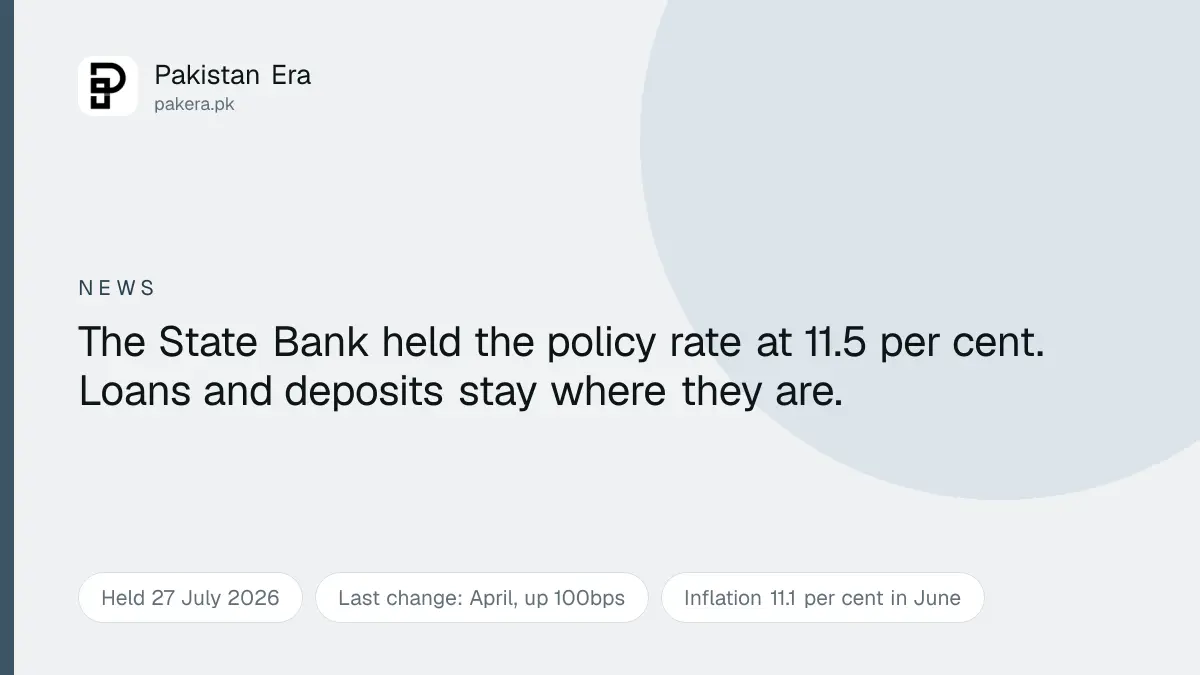
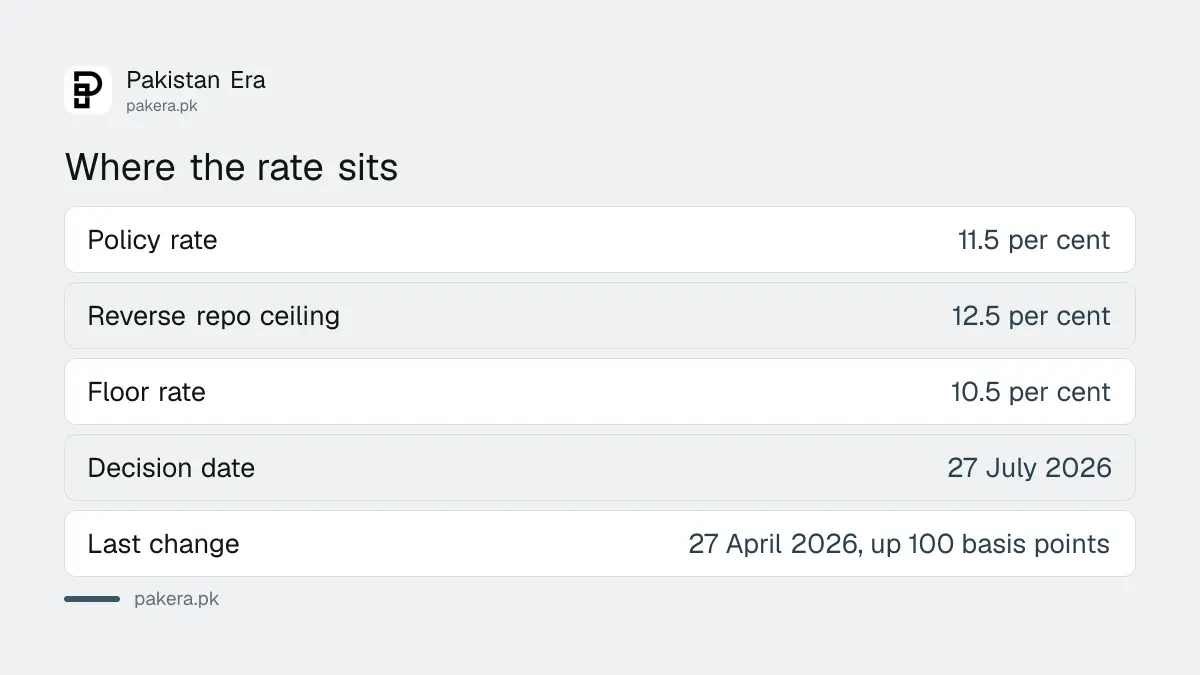
The State Bank of Pakistan left the policy rate at 11.5 per cent on 27 July 2026. It has not moved since 27 April, when the Monetary Policy Committee raised it by 100 basis points.
We checked sbp.org.pk directly: 11.5 per cent is the current rate, the corridor sits at a 12.5 per cent overnight reverse repo ceiling and a 10.5 per cent floor, and the decision is published as a press release dated 27 July 2026.
A hold sounds like nothing happened. For anyone with a loan priced off KIBOR, a hold is a decision with a monthly cost, and it is worth understanding what it is telling you.
What the policy rate actually does
The policy rate is what the central bank charges banks. Banks price everything else off it, which is why one number in Karachi changes a car instalment in Multan.
Most business and consumer lending in Pakistan is priced as KIBOR plus a spread. KIBOR tracks the policy rate closely. So when the MPC holds, borrowers on floating rates keep paying roughly what they were paying, and savers keep earning roughly what they were earning. Neither side gets relief and neither gets squeezed.
Why they held
Inflation is falling, but not fast enough to be finished with.
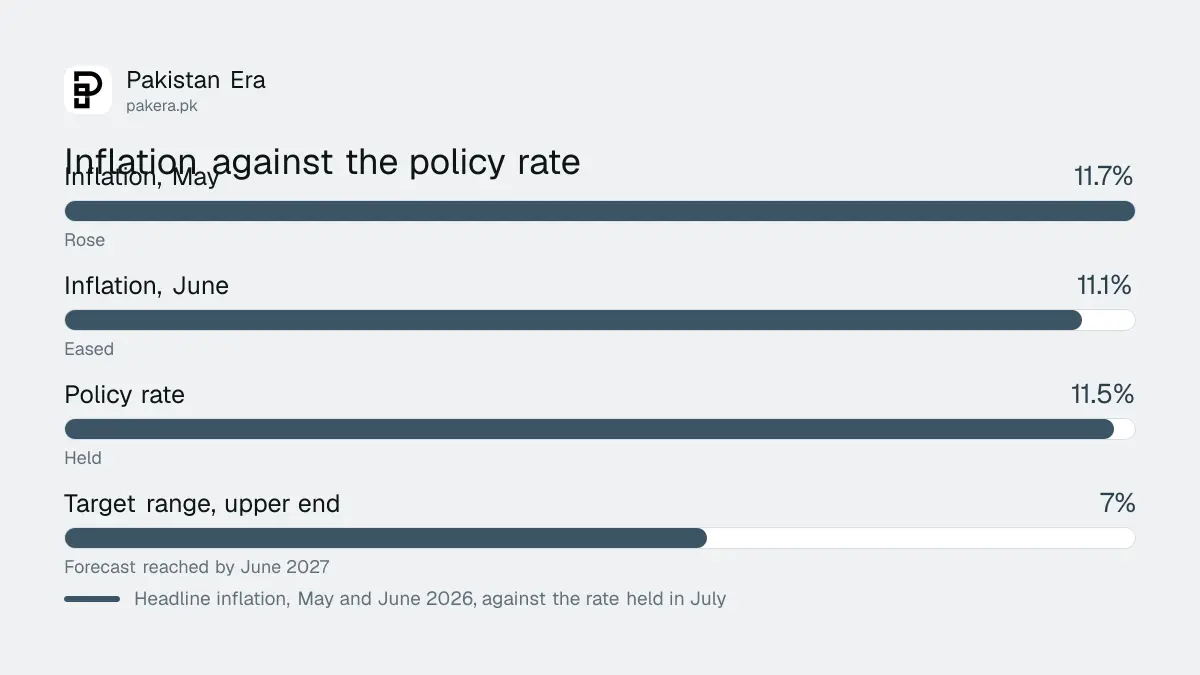
Headline inflation rose to 11.7 per cent in May and eased to 11.1 per cent in June. Against a policy rate of 11.5 per cent, that leaves the real rate barely positive, which is a thin margin for a central bank that spent 2025 and 2026 trying to establish that it will not let inflation run.
The State Bank's own forecast, as reported from the July decision, is that inflation eases gradually toward the upper end of its 5 to 7 per cent target range by June 2027. That is not a promise. The stated risks are geopolitical tension, weather including El Niño effects, and fiscal slippage.
Read plainly: the committee thinks it is winning, and does not think it has won.
What a hold means for you
| If you are | What the hold means |
|---|---|
| On a floating rate loan | Your instalment stays broadly where it is. No relief this quarter. |
| Planning to borrow | Borrowing costs are not falling yet. A cut is a forecast, not a schedule. |
| Holding savings or a term deposit | Deposit rates stay near current levels. Barely above inflation. |
| Running a business on working capital | Finance costs are stable, which at least makes them plannable. |
| Waiting to buy a car or house on finance | Waiting has a cost too, and the forecast for cuts runs into 2027. |
The part that gets misread
A hold is not neutral. With inflation at 11.1 per cent and the rate at 11.5 per cent, the real return on savings is a fraction of a per cent, which means money sitting in an ordinary account is close to standing still in purchasing power terms.
That is the honest position, and it is why the deposit rate on offer matters more than usual right now. It is also worth remembering that a headline inflation figure is a national average across a basket. Food and energy do not move with it, which is why an 11.1 per cent number can feel wrong against your own grocery bill.
What to watch next
Three things decide whether the next move is a cut.
- Monthly inflation prints. A clear run below 11 per cent gives the committee room. A reversal takes it away.
- The energy import bill. Fuel and gas costs feed straight into the index, which is why we keep writing about RLNG pricing and daily fuel prices.
- Fiscal slippage. The committee named it as a risk. Revenue shortfalls against target are the mechanism, which is what makes monthly FBR collection worth following even if tax is not your subject.
The Monetary Policy Committee publishes its calendar on sbp.org.pk, and the decision itself is issued as a press release the same day. If a rate decision affects your borrowing, take it from there rather than from a headline, because the statement usually explains the reasoning that the headline drops.
Questions readers are asking
What is the State Bank of Pakistan policy rate right now?
11.5 per cent, held at the Monetary Policy Committee meeting of 27 July 2026. The interest rate corridor runs from a 10.5 per cent floor to a 12.5 per cent ceiling.
When did the rate last change?
On 27 April 2026, when the committee raised it by 100 basis points to 11.5 per cent.
Will interest rates come down in Pakistan?
The State Bank's reported forecast is that inflation eases toward the upper end of its 5 to 7 per cent target range by June 2027, which is the condition that would allow cuts. That is a forecast subject to geopolitical, weather and fiscal risks, not a schedule.
How does the policy rate affect my loan?
Most lending is priced as KIBOR plus a spread, and KIBOR tracks the policy rate. A hold means floating rate instalments stay broadly unchanged.
Is my savings account keeping up with inflation?
Barely. With inflation at 11.1 per cent in June and the policy rate at 11.5 per cent, the real return on ordinary deposits is close to zero before tax.
Where is the official decision published?
On sbp.org.pk as a Monetary Policy Statement press release, issued on the day of the decision, alongside the monetary policy calendar.
About the author

Senior Writer, Public Services and Technology
Shahid joined us in 2024 as an author. He is a senior contributor to Pakistan's leading technology websites. He writes detailed articles, mostly covering his expertise in the latest tech, mobiles, apps, gadgets, and step-by-step guides. His ideology is to help people understand the latest trends and explain complex methods through very easy-to-understand guides.