Check Your Gas House Line for a Leak in Pakistan: SSGC's 2 Free Home Tests, and Who Pays for the Lost Gas
Check your gas house line for a leak with SSGC's overnight meter test and soap test, what to do about a strong smell, and who pays for gas lost after the meter.
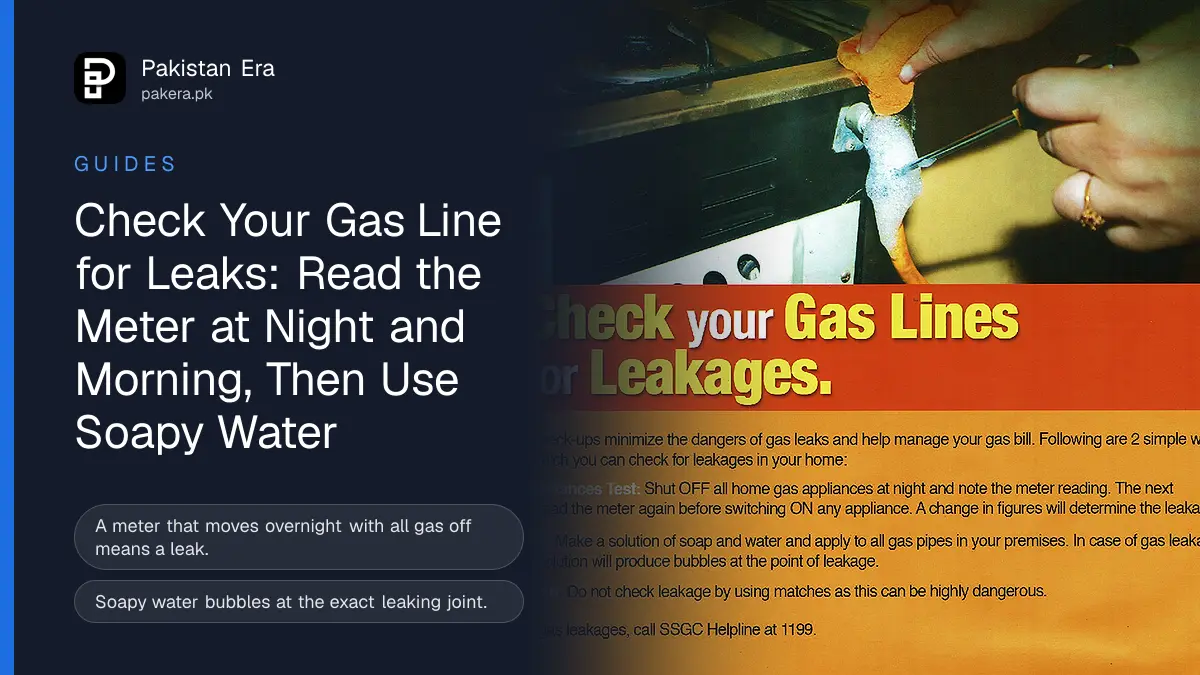
To check your gas house line for a leak, switch off every gas appliance at night, note the meter reading, and read it again in the morning before lighting anything: if the figures moved, gas is escaping. Then brush soapy water on the pipes and joints; bubbles show exactly where. Never use a match. Report the leak on 1199, and remember that gas lost through pipes after the meter is billed to you.
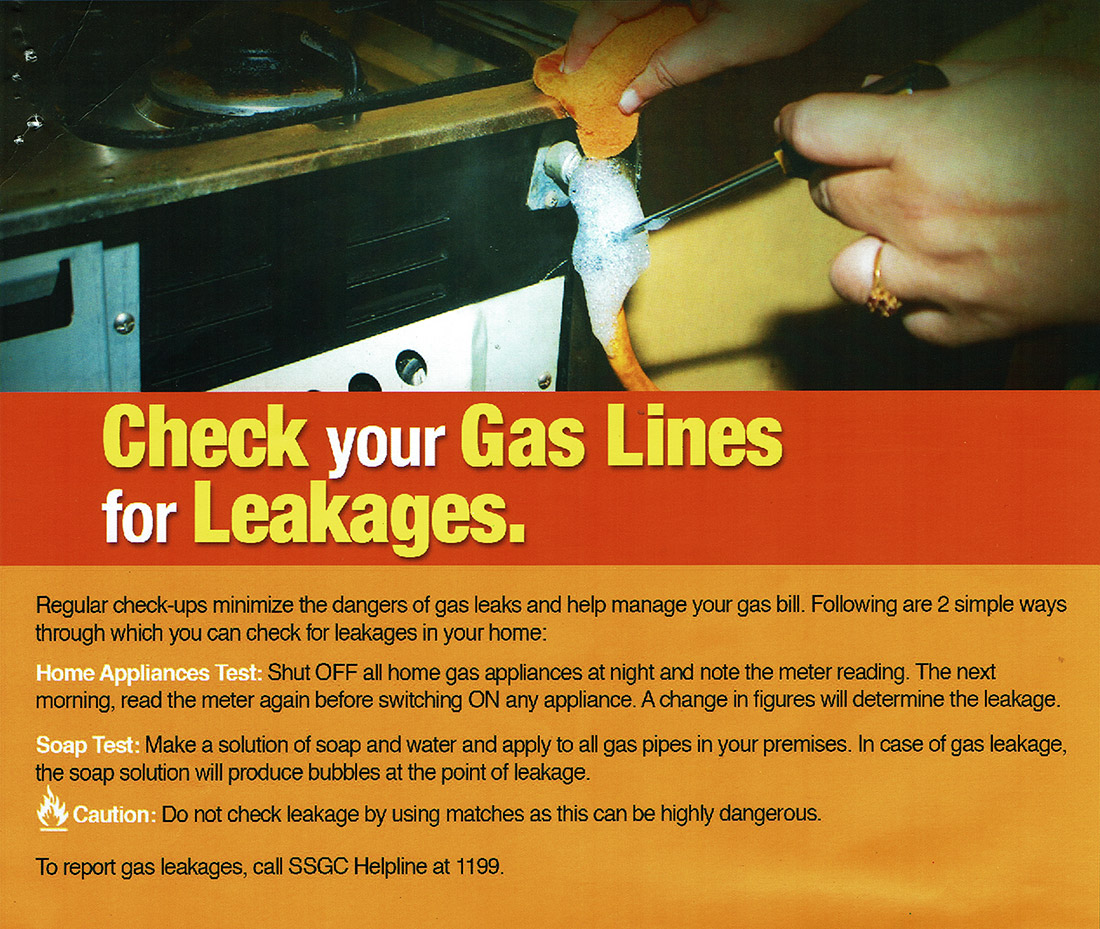
These are the two tests SSGC itself tells customers to use, shown in its public safety notice below. They cost nothing, take one night, and work the same on an SNGPL line in Lahore as on an SSGC line in Karachi. In winter, when heaters run for hours, they are worth doing before the first cold week.
The overnight meter test shows whether gas escapes at all
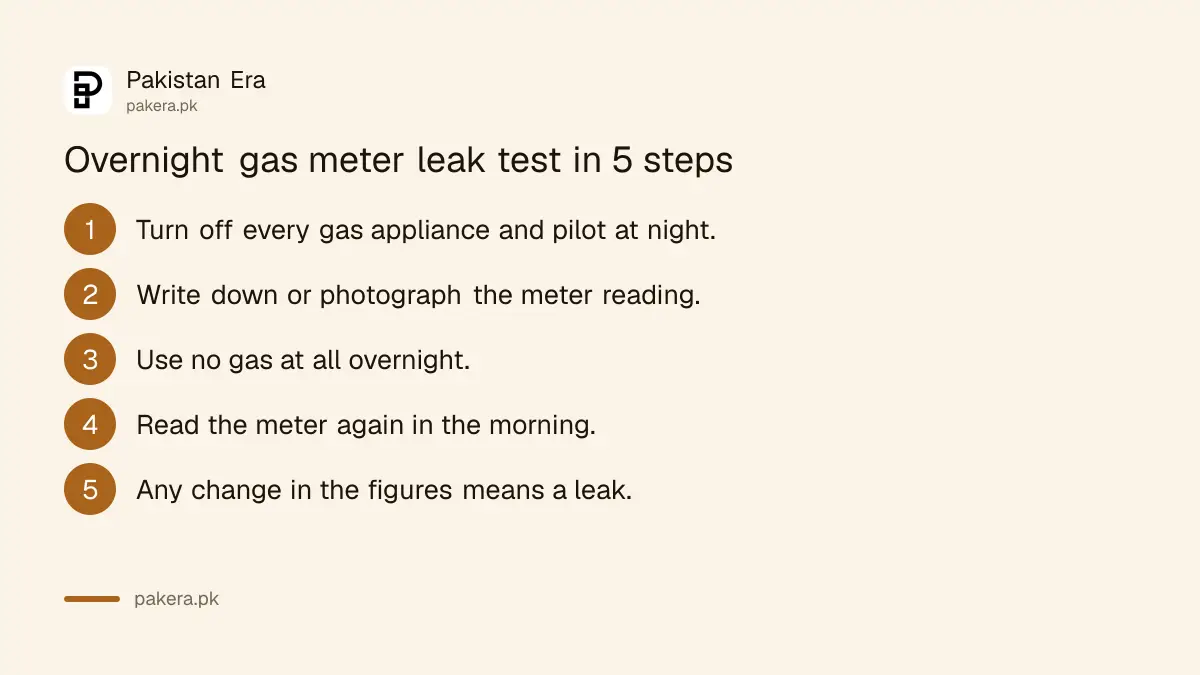
Turn off every gas appliance at night, including pilot lights, and write down the meter reading. Next morning, before switching anything on, read the meter again. If the number has changed, gas has flowed with nothing burning, so there is a leak somewhere after the meter.
- At night, turn off the stove, oven, geyser, room heaters and any pilot flame.
- Write down every digit on the meter, or take a clear photo of it.
- Do not use any gas appliance overnight.
- In the morning, before lighting anything, read the meter again.
- Compare. Any change means a leak; the same reading means the line held.
This test finds a leak but not its place. It also catches the slow seep that never smells strongly yet adds cubic metres to every bill. The geyser pilot is the one people forget; leave it on and the meter will move even on a sound line.
The soap test finds the exact joint
Mix soap or washing liquid in water and brush it over the gas pipes, joints, valves and rubber hoses in the house. Where gas escapes, the solution forms bubbles that grow. That is the point to repair. SSGC warns never to look for a leak with a match.
Start where leaks are most common: the joint behind the cooker, the rubber pipe to a heater, the valve on each appliance and any point where the pipe enters a wall. Do it in daylight with windows open. If you find a bubbling joint, close the main valve at the meter and do not light anything until it is fixed.
| Test | What it tells you | Time needed |
|---|---|---|
| Overnight meter test | Whether gas is escaping at all | One night |
| Soap test | Exactly which joint or pipe leaks | 15 to 30 minutes |
| Smell | A strong leak needing action now | Immediate |
A strong gas smell is an emergency, not a test
If the house smells strongly of gas, do not test anything. Close the main valve, open doors and windows, do not switch lights or fans on or off, leave the house and call 1199 from outside. OGRA's standards require the company to attend an uncontrolled escape within one hour.
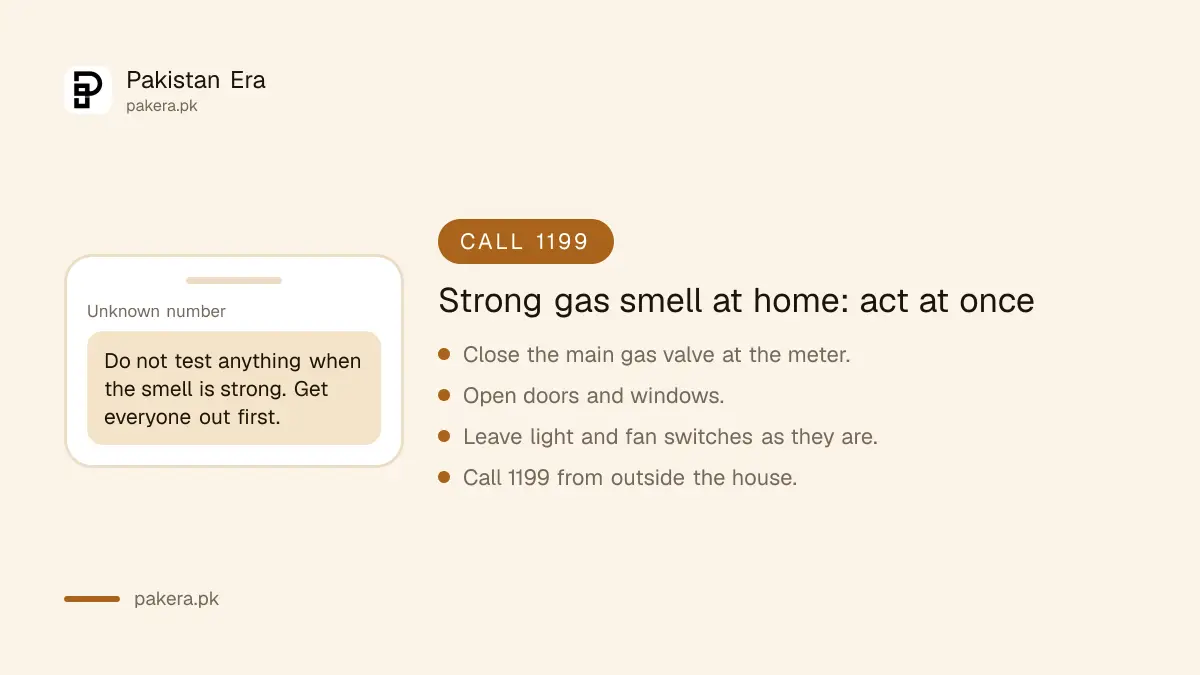
A spark from a switch can ignite a room full of gas. That is why the advice is to leave switches exactly as they are. For a controlled leak, the company has up to two hours. The wider safety rules for heaters and geysers are in using a gas heater or geyser safely, and what to do if fire breaks out is in escaping a house fire and calling 1122.
The pipes after the meter are yours to fix and pay for
SSGC says the customer is solely responsible for repairing and maintaining the internal piping and gas installations after the meter. Gas lost through an internal leak is billed to the customer. The company looks after the service line, valve, regulator, inlet pipe and the meter itself.
| Part of the line | Who is responsible |
|---|---|
| Main in the street and service line | Gas company |
| Service valve and regulator | Gas company |
| Meter inlet pipe and meter | Gas company |
| House line after the meter | Customer |
| Appliances and their hoses | Customer |
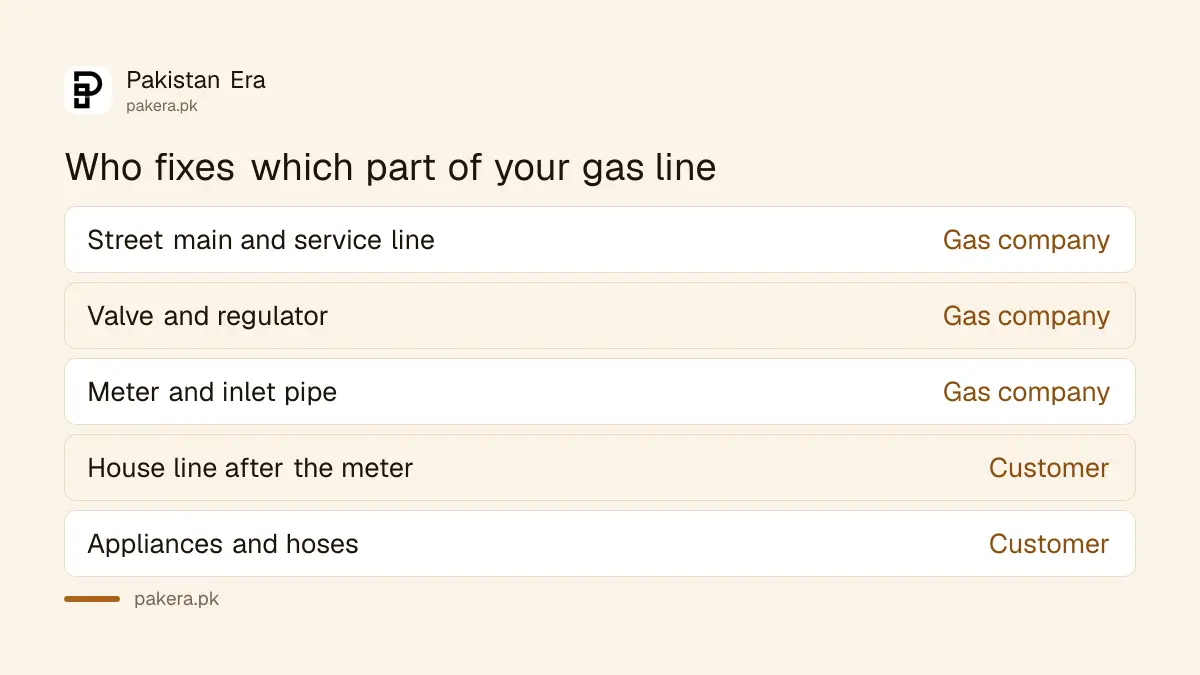
This split matters three ways. A leak before the meter is not your gas, so report it and the company should fix it. A leak after the meter is your bill, so every week of delay costs money. And the compensation procedure for gas incidents excludes damage from a leak in your internal house line.
SSGC replaces a leaking house line against a quotation
When an SSGC customer reports a house line leak, the case goes to the relevant department for rectification and the premises are surveyed urgently. SSGC lists the material and labour needed, issues a quotation, and after payment its team replaces the damaged section on priority.
You can also use a private plumber for your own pipes. If you do, choose one who works on gas, use proper gas fittings rather than water pipe, and repeat the soap test afterwards. In SNGPL areas, house line work for a connection is done by approved contractors; how that works is in getting the SNGPL house line certificate.
If you think a high bill came from a leak you have now fixed, raise it as a billing complaint and attach your meter photos. The routes are in SNGPL and SSGC gas complaints. The company may still bill the lost gas, because the meter recorded it, but a record helps.
Common questions
How can I check a gas leak at home?
Turn off all gas appliances at night, note the meter reading, and check it next morning before lighting anything. If it moved, there is a leak. Then use soapy water on the joints to find it.
Can I check for a gas leak with a match or lighter?
No. SSGC warns this is highly dangerous. Use soapy water instead.
Who pays for gas lost through a leak in my house?
You do. Leaks in the internal piping after the meter are the customer's responsibility, and the lost gas is billed to the customer.
Who fixes a leak at the meter or regulator?
The gas company. The service valve, regulator, meter inlet pipe and meter are kept in repair by the company.
What number do I call for a gas leak?
1199, for both SNGPL and SSGC. For a strong smell, leave the house first and call from outside.
How fast must the company come?
Within one hour for an uncontrolled gas escape and two hours for a controlled one, under OGRA's service standards.
How we verified this
What we checked and where we read it.
We checked these rules on 15 November 2026. The two home tests, the match warning and the 1199 number are from SSGC's notice on its Check Gas Line for Leakages page, shown above. Customer responsibility for internal piping and billing of leaked gas is from SSGC's frequently asked questions (Q15). The company's responsibility for the service valve, regulator, inlet pipe and meter, and the one hour and two hour emergency times, are from OGRA's performance and service standards (Gazette of Pakistan, 19 March 2019, items 1, 31 and 36), printed in the SSGC Consumer Service Manual, which also sets out house line leakage replacement (clause 6.2.2) and the compensation exclusion for internal house line leaks.
About the author

Tax, Bills and Technology Writer
Ali Akhtar is a young and curious voice here at Pakistan Era. He is currently pursuing his A-Levels and has a growing interest in Pakistan’s changing industrial landscape and educational trends. Ali likes to write in a way that helps him explain and explore the world around him. His writing reflects the perspective of the new generation navigating the evolving trends of Pakistan where technology, youth innovation, and shifting opportunities are reshaping the country’s future.