Sindh Sales Tax on Doctor Fees, Hospital Rooms and School Fees: 3% Above Rs 3,000, Rs 25,000 and Rs 500,000
Sindh charges 3% sales tax on doctor fees above Rs 3,000 a visit, hospital rooms above Rs 25,000 a day and school fees above Rs 500,000 a year. Examples inside.
In Sindh, a doctor's fee above Rs 3,000 a visit, a hospital room above Rs 25,000 a day and a school fee above Rs 500,000 a year each carry 3% sales tax in 2026-27. Below those limits, the service is exempt. So a Rs 5,000 consultation in Karachi carries Rs 150 of tax, and a Rs 2,500 one carries none.
This is the Sindh Sales Tax on Services, collected by the Sindh Revenue Board (SRB). The limits sit in two places in the law: the First Schedule, which lists exempt services, and Part II of the Second Schedule, which lists the 3% rate for everything above the limit.
The three limits for health and education in Sindh
The limits are Rs 3,000 per consultation, Rs 25,000 per day for a hospital bed or room including fixed charges, and Rs 500,000 a year per student for school, college and university fees. Above each limit the rate is 3%.
| Service | Exempt up to | Rate above the limit |
|---|---|---|
| Doctor or consultant fee | Rs 3,000 per session or visit | 3% |
| Hospital bed or room | Rs 25,000 per day, including all fixed charges | 3% |
| Pre-primary to university fee | Rs 500,000 a year per student | 3% |
| Coaching, tuition centres and other training | No limit | 3% |
| Educational support services | No limit | 5% |
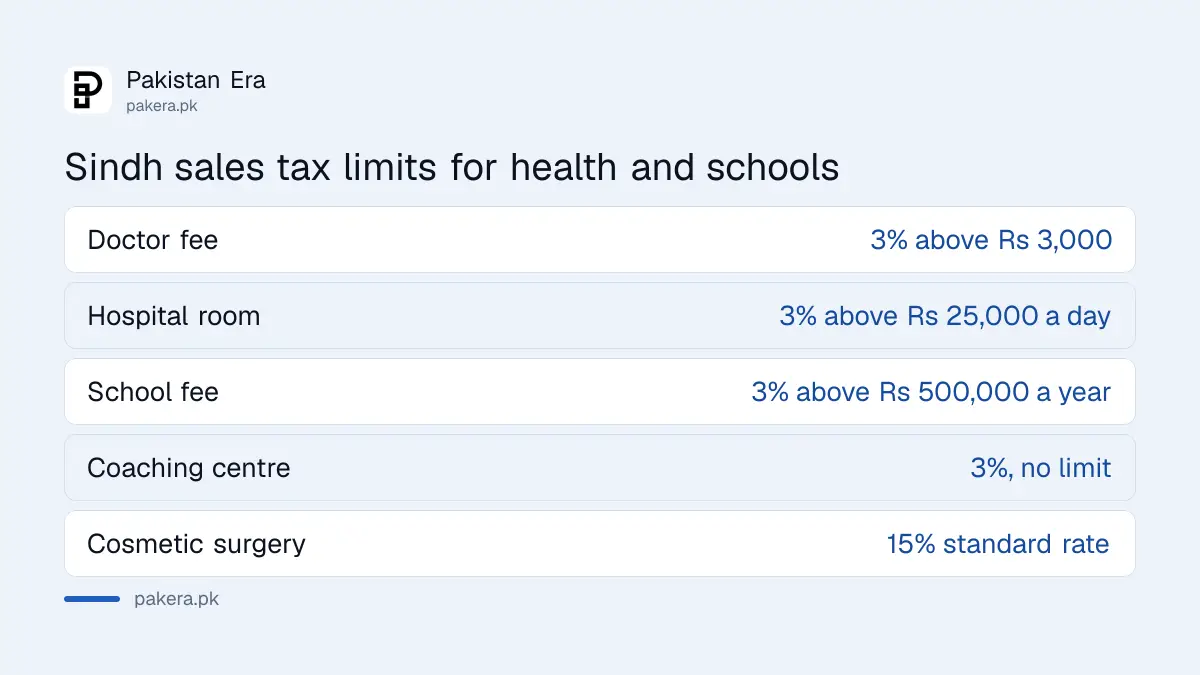
The 3% is a reduced rate, so the doctor, hospital or school cannot claim back the tax on its own purchases. The standard rate in Sindh is 15%, so the 3% line is a large concession.
How much tax you pay, with examples
The 3% is charged on the fee itself once it crosses the limit. A Rs 4,000 consultation carries Rs 120 of tax. A hospital room at Rs 30,000 a day carries Rs 900 a day. A school fee of Rs 600,000 a year carries Rs 18,000.
| Bill | Amount | Sales tax |
|---|---|---|
| Consultation | Rs 2,500 | None, below Rs 3,000 |
| Consultation | Rs 5,000 | Rs 150 |
| Private room, 3 nights | Rs 30,000 a night | Rs 2,700 |
| School fee | Rs 450,000 a year | None, below Rs 500,000 |
| School fee | Rs 600,000 a year | Rs 18,000 |
| Coaching centre | Rs 20,000 a month | Rs 600 a month |
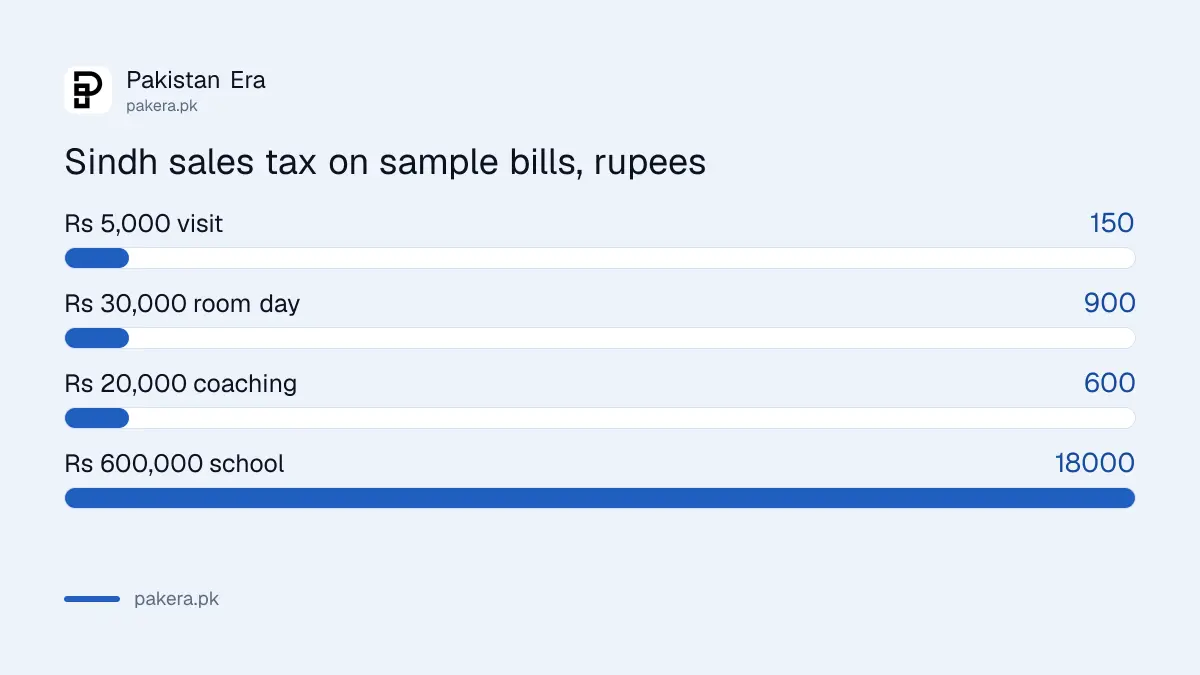
The limit is tested on the fee for that visit, that day's room charge, or that student's annual fee. Two children at the same school are counted separately, so each child's fee is checked against Rs 500,000 on its own.
Cosmetic and plastic surgery is not covered
The health exemption and the 3% rate both leave out cosmetic and plastic surgery for looks. That service is outside both lines, so it falls to the 15% standard rate in Sindh, whatever the fee.
Other health related services sit elsewhere in the law. Small beauty parlours and slimming clinics with turnover up to Rs 2.5 million are exempt if they meet conditions. Larger ones pay 8%. Residential care for the elderly and disabled is exempt.
- Health insurance for individuals: exempt
- Life insurance for individuals: exempt up to Rs 3.5 million of cover
- Special education for children with special needs: exempt
- Sports coaching by an individual who is not an employee: exempt
- School trips organised by educational institutions: exempt
How Punjab treats the same fees
Punjab works differently. General education is tax-free there. Public hospital care is tax-free. Private doctor fees above Rs 1,500 and rooms above Rs 6,000 a day are listed at 0%. Coaching and training outside general education pay 16%.
| Service | Sindh (SRB) | Punjab (PRA) |
|---|---|---|
| School and university fees | Exempt to Rs 500,000 a year, then 3% | General education tax-free |
| Doctor fee | Exempt to Rs 3,000, then 3% | 0% above Rs 1,500 |
| Hospital room | Exempt to Rs 25,000 a day, then 3% | 0% above Rs 6,000 a day |
| Coaching and training | 3% | 16%, IT training 0% |
| Cosmetic surgery, laser, hair transplant | 15% | 5% |
Registration for Punjab service providers is covered in PRA e-registration.
How to check the tax on your bill
A hospital or school that charges this tax must be registered with SRB and show the tax on its invoice. Check the amount against the limit, then check the registration number. It takes a few minutes.
- Look at the fee for the single visit, the single day or the single student.
- Compare it with the limit: Rs 3,000, Rs 25,000 or Rs 500,000.
- If it is above the limit, the tax should be 3% of the fee.
- Find the SRB registration number on the invoice and check it on SRB's taxpayer search.
- If tax is charged below the limit, ask the billing office in writing to correct it.
The registration check is explained in verifying an SRB registration. A fee increase itself is a separate matter; for that, see complaining about a private school fee increase in Sindh.
Common questions
Is there sales tax on doctor fees in Karachi?
Only above Rs 3,000 per visit. Below that, consultations are exempt. Above it, the rate is 3% of the fee. Cosmetic and plastic surgery is not exempt.
Is sales tax charged on school fees in Sindh?
Only where the fee exceeds Rs 500,000 a year per student. Then the rate is 3%. Most schools charge less and are exempt.
Do tuition and coaching centres charge sales tax in Sindh?
Yes. Other education and training services, which include coaching, are on the 3% line with no fee limit.
Does the hospital room limit include nursing and fixed charges?
Yes. The Rs 25,000 limit is the per day charge for the room or bed, including all fixed charges attached to it.
Did the Sindh Finance Act 2026 change these limits?
The limits stayed the same. The 2026 Act rewrote the education wording and added educational support services at 5%.
Who pays the tax, the patient or the hospital?
The hospital or doctor is liable to pay it to SRB, and it is normally added to your invoice. It should be shown as a separate line.
How we verified this
What we checked and where we read it.
We read the consolidated Sindh Sales Tax on Services Act 2011, updated to the Sindh Finance Act 2026, on 15 November 2026, from SRB's acts page: First Schedule serials 30 (education), 31 (health), 32 (beauty and slimming) and 33 (residential care), and Second Schedule Part II serials 38 (education) and 39 (health). The Punjab column comes from the Punjab Sales Tax on Services Act 2012, 17th edition 2026-27, on the PRA downloads page: First Schedule serials 1 to 3 and Second Schedule Part III serials 9, 24 and 26. The examples are our own arithmetic.
About the author

Tax, Bills and Technology Writer
Ali Akhtar is a young and curious voice here at Pakistan Era. He is currently pursuing his A-Levels and has a growing interest in Pakistan’s changing industrial landscape and educational trends. Ali likes to write in a way that helps him explain and explore the world around him. His writing reflects the perspective of the new generation navigating the evolving trends of Pakistan where technology, youth innovation, and shifting opportunities are reshaping the country’s future.