How to Complain About a Private School Fee Increase in Sindh: Rule 7 Explained
How to complain about a private school fee increase in Sindh: what Rule 7 says, the 5% cap and the High Court ruling, the proof to collect and the steps.
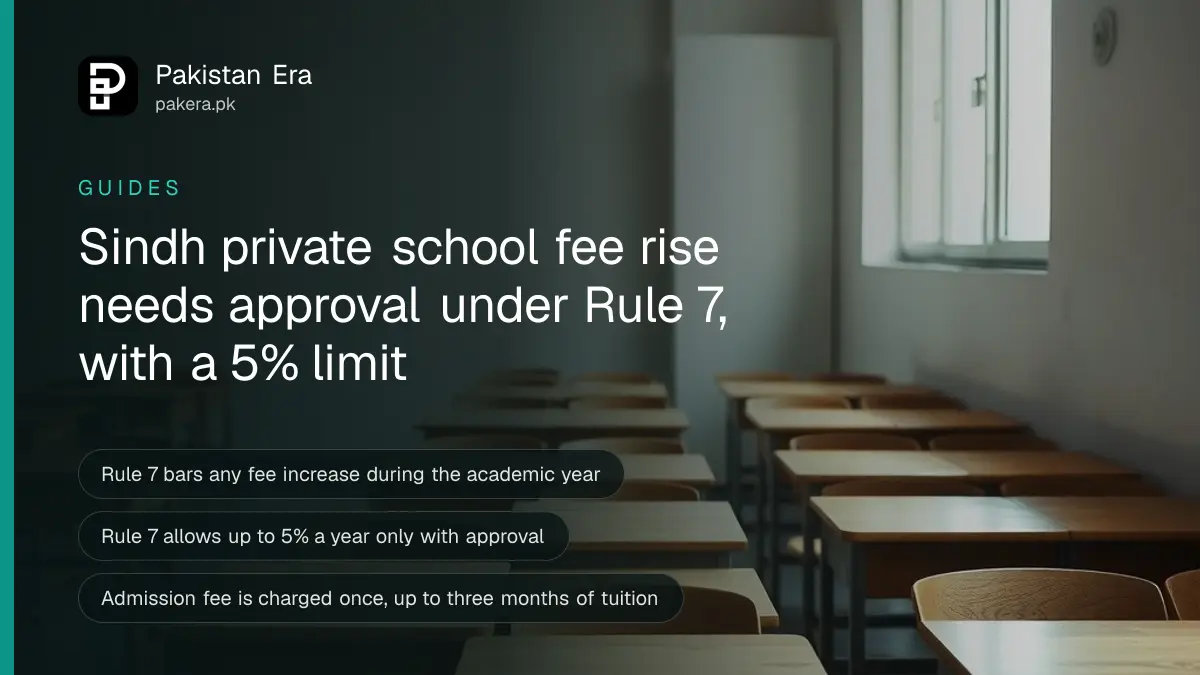
In Sindh, a private school cannot raise fees during the school year, and any increase between years needs approval from the registering authority. The Sindh Private Educational Institutions Rules 2005 set the limit at 5% of the last fee schedule. The High Court has questioned how that cap works, so check the current position before you rely on it.
Parents get a fee notice, pay it, and find out later that it was never approved. This guide sets out what the rules say, what the High Court decided, and the steps to complain. It is for private schools in Sindh. Punjab and Islamabad have their own rules.
Read what Rule 7 of the 2005 Rules actually says
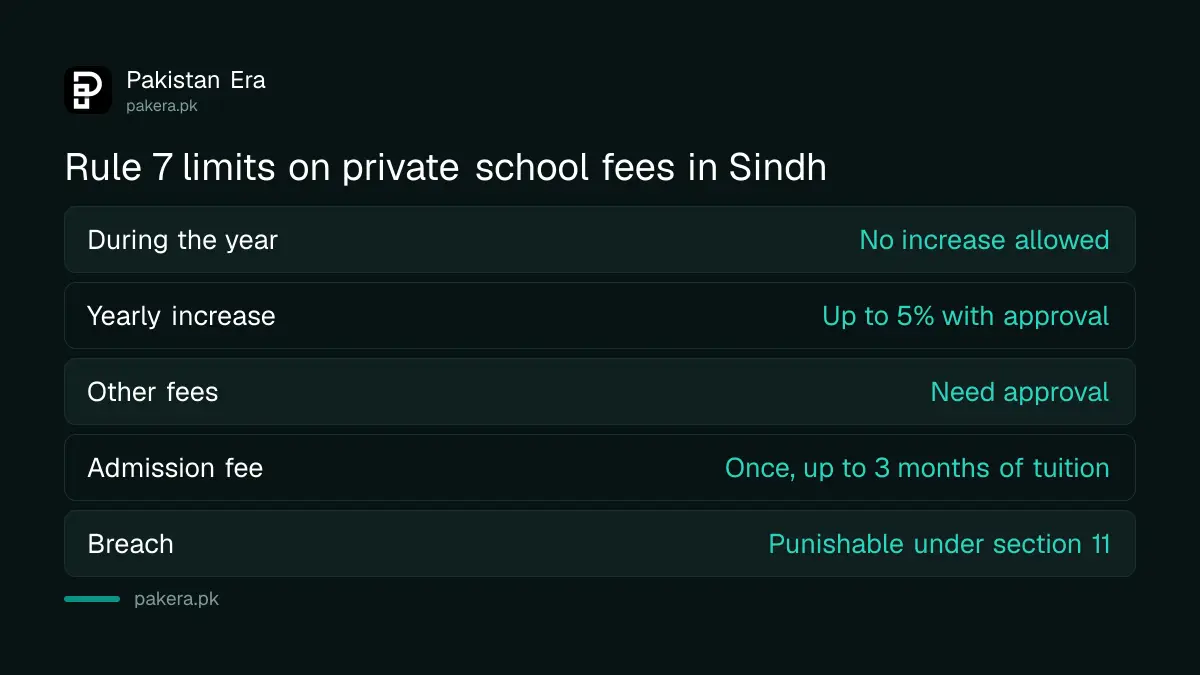
Rule 7 of the Sindh Private Educational Institutions (Regulation and Control) Rules 2005 covers fees. It bars a mid-year increase, caps a yearly increase at five percent with approval, requires approval for any other fee, and limits the admission fee to three months of tuition.
We read the text of Rule 7 as quoted in the Sindh High Court judgment in CP D-5812 of 2015 and connected petitions. The key sub-rules are below.
| Rule 7 sub-rule | What it says |
|---|---|
| 7(2) | An approved fee schedule cannot be increased during the academic year |
| 7(3) | The fee may rise up to five percent of the last schedule, with justification and approval |
| 7(4) | Any fee other than tuition needs approval, and no donation for development |
| 7(5) | Admission terms and the approved fee schedule must be given to parents at admission |
| 7(6) | A complaint about fees against the rules can be punished under section 11 |
| 7(7) | Admission fee is charged once, at first admission, and not above three months of tuition |
Know what the High Court decided about the 5% cap
The court held that the state can regulate school fees, and that the setting of the first fee structure is lawful. But it held that Rule 7(3), as written, was beyond the Constitution because it used a one-stage process. It asked the province to frame new rules within 90 days.
The judgment kept Rule 7(3) alive for those 90 days, and said a late application could extend it. We could not find a source that tells us what rule applies today, and the Sindh department's pages did not open for us. A report in July 2026 said the directorate that registers private schools warned schools against charging unapproved fees and cited the 2001 Ordinance and the 2005 Rules, so the department still treats the rules as live. Treat the 5% figure as reported until the department confirms it in writing.
Whatever the cap, the points that need approval stay clear: no mid-year rise, and no new fee without approval. That is where most complaints start.
Gather proof before you complain
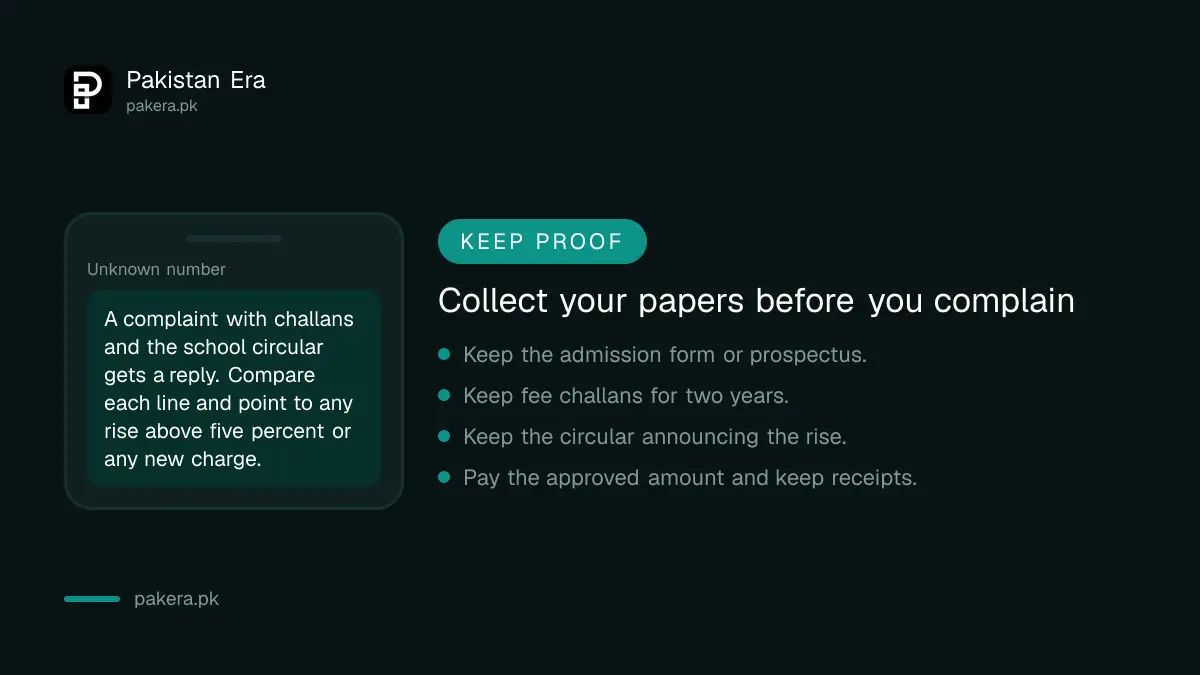
A complaint with papers gets a reply. One without them gets ignored. Collect the documents below from your own file, and ask the school for any you do not have.
- The admission form or prospectus, which should list the approved fees.
- Fee challans for the last two years, to show the change.
- The school's circular or message announcing the new fee.
- Any receipt for charges that are not tuition, such as a building or activity fund.
- The school's registration number, if it is shown on its papers.
Compare the challans line by line. A rise of more than five percent in tuition, a new charge, or a rise in the middle of the year is what to point out.
Follow these steps to complain
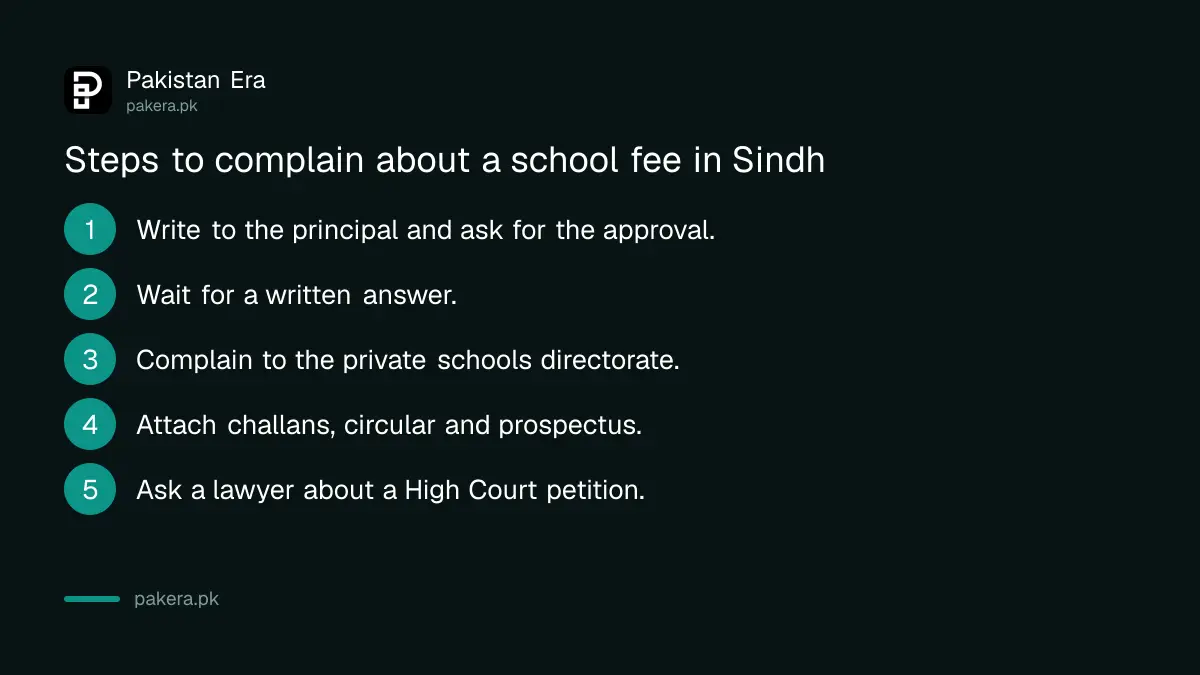
Write to the school first, so there is a paper record. Then go to the body that registers private schools in Sindh. The department can inspect the school and, under the Ordinance, take action against registration. Keep copies of everything you send.
- Write to the principal and ask for the approval for the new fee.
- Ask for the answer in writing within a set time, such as 10 days.
- If there is no approval, write to the Directorate of Inspection and Registration of Private Institutions in Sindh.
- Attach your challans, the circular and the prospectus.
- Ask the directorate to inspect and to order a refund of any unapproved amount.
- If nothing happens, ask a lawyer about a petition in the High Court.
The directorate's address and email did not load for us, so look them up on the Sindh education department's official site before you send anything. Our guide to complaining about a private school fee in Islamabad and the guide to school fee increase rules in Punjab show how other regions do it.
Protect your child while the complaint runs
Parents often fear that the school will punish the child. Pay the amount you accept in time, state in writing that you pay the rest under protest, and keep the receipt. Do not stop paying the approved tuition.
A school that refuses a child's exam entry over a disputed fee is a separate matter. Tell the directorate at once. If your child is changing schools, our guide to getting a school leaving certificate shows what the paper is for, though the process in Sindh may differ.
Common questions about private school fees in Sindh
Can a private school in Sindh raise fees during the year?
No. Rule 7(2) says an approved fee schedule cannot be increased during the academic year. The text is quoted in the Sindh High Court judgment.
Is the yearly limit 5% in Sindh?
Rule 7(3) says up to five percent with approval, and a report in July 2026 says the directorate still cites the rules. The High Court found the rule defective, so ask the department to confirm the current limit in writing.
Can a school charge extra fees on top of tuition?
Only with approval from the registering authority, and not as a donation for development work, under Rule 7(4). Ask to see the approval.
How much can a school charge as an admission fee?
Rule 7(7) says the admission fee is charged once, at first admission, and must not exceed three months of tuition for that class.
Who do I complain to?
Start with the school in writing, then the directorate that registers private schools in Sindh. Look up its current address on the Sindh education department's site.
How we verified this
What we checked, where we read it, and what we could not confirm.
Last checked 8 October 2026. The rule text comes from the Sindh High Court judgment in CP D-5812 of 2015 and connected petitions, which quotes the 2005 Rules. We could not open the Sindh department's own pages or the current notified rules, and we do not know whether the Rules were amended after the court gave its directions. The July 2026 warning from the directorate is a press report that we could not read at source. Confirm all of this with the department before you act.
About the author

Tax, Bills and Technology Writer
Ali Akhtar is a young and curious voice here at Pakistan Era. He is currently pursuing his A-Levels and has a growing interest in Pakistan’s changing industrial landscape and educational trends. Ali likes to write in a way that helps him explain and explore the world around him. His writing reflects the perspective of the new generation navigating the evolving trends of Pakistan where technology, youth innovation, and shifting opportunities are reshaping the country’s future.