Add a Gas Heater or Extend Your House Line With SSGC: Survey, Quotation and a Deposit From Rs 500, Not a Disconnection
Add a room heater, second geyser or new pipe to your SSGC gas line the approved way: survey, quotation, a Rs 500 to Rs 2,000 deposit and disconnection risks.
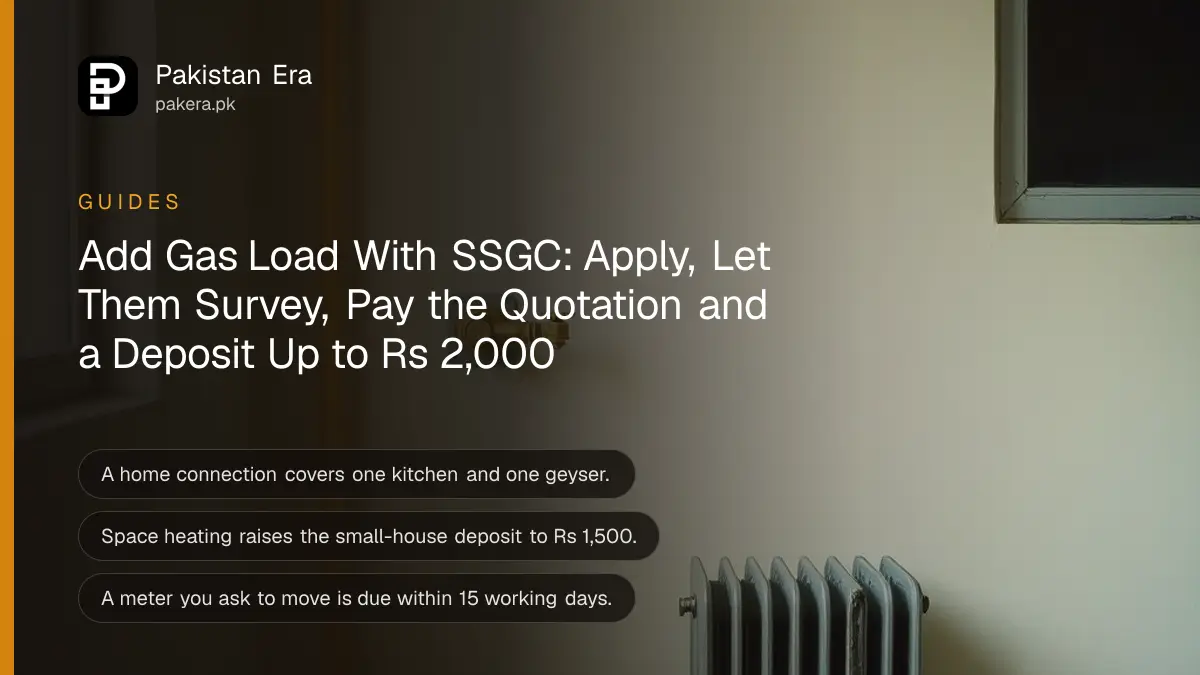
An SSGC home connection is sanctioned for one kitchen and one geyser, so adding a room heater, a second kitchen or a pipe to a new room needs SSGC's approval first. Apply at a Customer Facilitation Centre. SSGC surveys the house, works out the material, labour and a higher Gas Supply Deposit, and issues a quotation. Doing the extension without approval can get the gas disconnected under the gas theft procedure.
Most families extend the line themselves when they build an upper floor or buy a heater, and never tell SSGC. It usually goes unnoticed until a survey team visits. The approved route is cheaper than it sounds for a home: the deposit for the largest domestic tier in SSGC's manual is Rs 2,000. Here is how it works in Karachi, the rest of Sindh and Balochistan.
A home connection covers one kitchen and one geyser
SSGC's gas sale terms allow a domestic connection to use one meter for one kitchen and one geyser, for purely domestic purposes. Anything beyond that, such as space heaters, a second kitchen or a supply to another portion, is outside the sanctioned use unless SSGC approves it.
SSGC also asks customers to keep their appliance and usage details up to date with the company. So if you have added appliances over the years, the honest fix is the same application described below, made before a survey finds it.
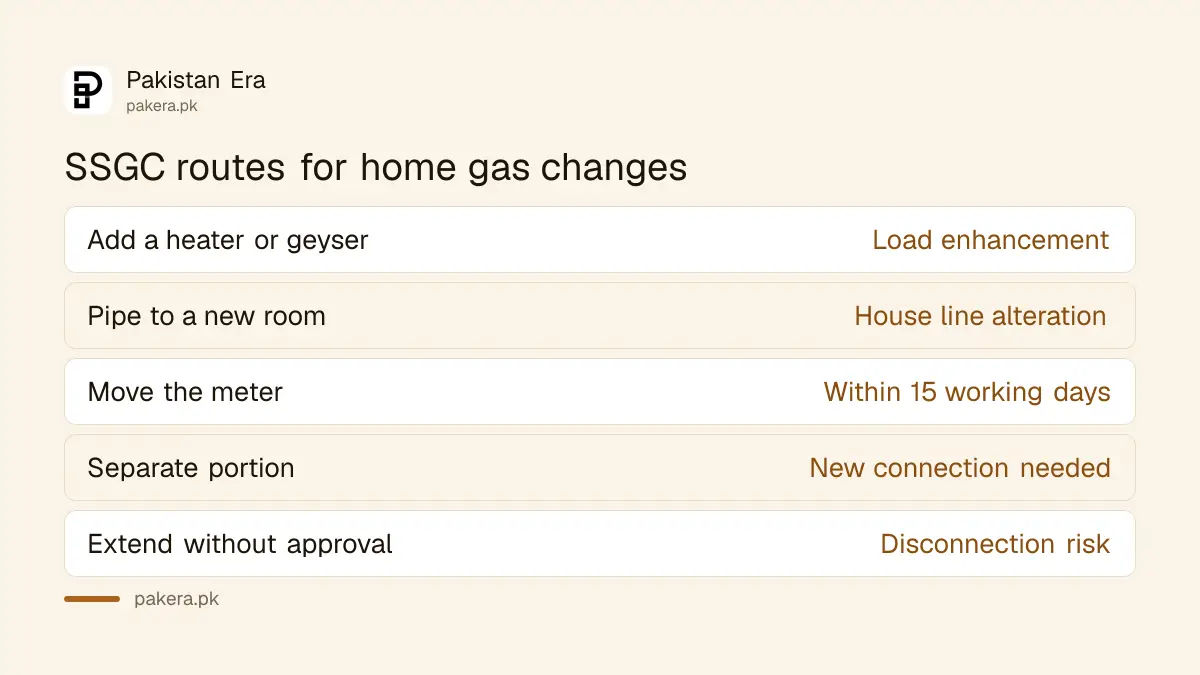
| What you want to do | What SSGC treats it as | Route |
|---|---|---|
| Add a room heater or second geyser | Addition or enhancement of gas load | Survey, quotation, higher deposit |
| Run the pipe to a new room | Alteration or re-routing of house line | Survey if feasible, quotation |
| Move the meter | Meter alteration at your request | Done within 15 working days of payment |
| Supply a separate portion or house | Additional meter | New connection on turn and merit |
| Extend without telling SSGC | Unauthorised extension | Disconnection |
Apply for extra gas load in five steps
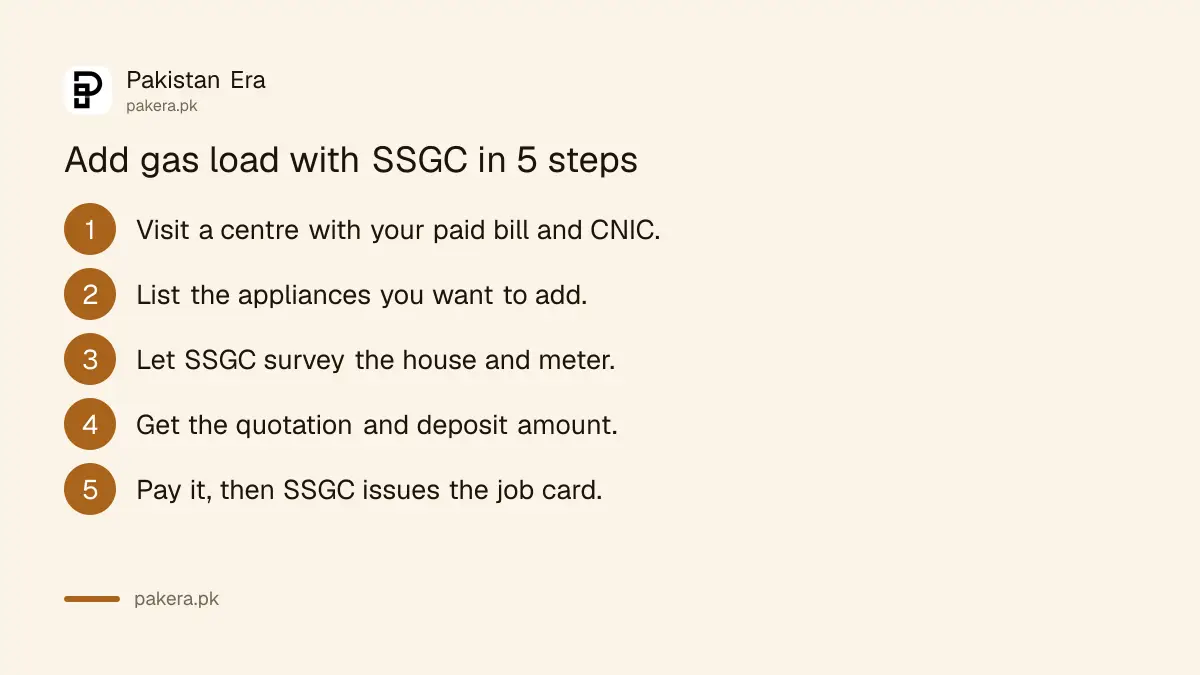
Ask for an addition or enhancement of gas load at your SSGC centre. Staff survey the house to record the current appliances, the house line size, the meter and regulator type and the load you want. Then SSGC sets the cost and deposit and sends you a quotation.
- Visit an SSGC Customer Facilitation Centre with your latest paid bill and the registered customer's CNIC.
- List the appliances you want to add, such as two room heaters or a second geyser.
- Let SSGC's team survey the house. They check connected load, the number and type of appliances, the house line size, the meter and regulator, and the proposed load.
- Receive the quotation for material, labour and any extra Gas Supply Deposit.
- Pay it. SSGC then sends a job card for the work to be carried out.
The nearest office is in the list of SSGC Customer Facilitation Centres. A bigger load may need a bigger meter. If so, the meter rent changes to the rate for the new meter size.
The deposit rises with the appliances you add
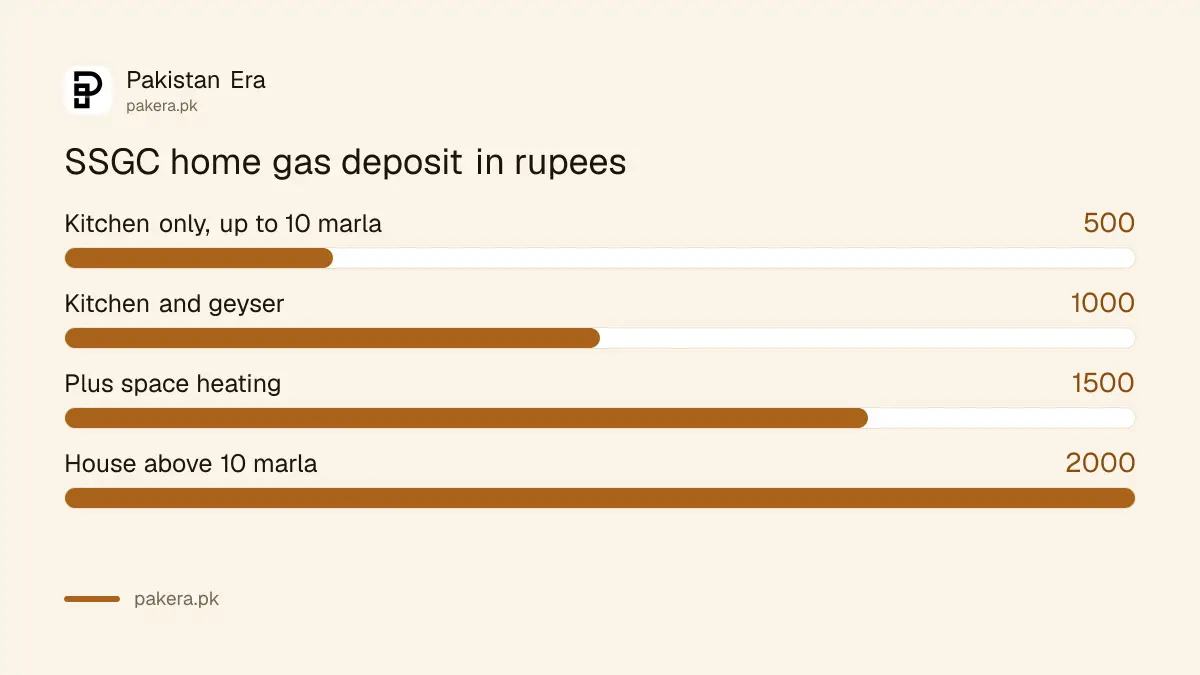
SSGC's manual ties the domestic Gas Supply Deposit to house size and use. For a house of up to 10 marla or 300 square yards, it is Rs 500 for one kitchen, Rs 1,000 with a geyser and Rs 1,500 with space heating too. A larger house pays Rs 2,000.
| House and use | Gas Supply Deposit |
|---|---|
| Up to 10 marla, one kitchen only | Rs 500 |
| Up to 10 marla, kitchen and geyser | Rs 1,000 |
| Up to 10 marla, kitchen, water heating and space heating | Rs 1,500 |
| More than 10 marla or 300 square yards | Rs 2,000 |
The manual also says the deposit must be topped up whenever the connected load increases. So a family moving from kitchen and geyser to kitchen, geyser and heaters should expect to pay the difference, Rs 500 on those figures, plus the cost of the pipe work in the quotation.
House line changes are surveyed and quoted
For an alteration or re-routing of the house line, SSGC surveys the premises wherever it is technically feasible and issues a quotation for payment. A meter alteration you ask for must be done within 15 working days of accepting and paying the charges, under OGRA's service standards.
Plan this before construction, not after. A pipe buried in a new wall is hard to survey and harder to fix. If you are rebuilding, ask SSGC where the line and meter should go first, then build around it. A leak found during the work should be reported on 1199 straight away.
A separate portion needs its own connection
Running SSGC gas from your meter into another house, or into a separate portion let to tenants, counts as an unauthorised extension to other premises. An additional meter is treated as a new connection, processed on its turn and merit like any fresh applicant.
That queue can be long, and SSGC's website now takes new domestic applications as RLNG connections. The current route is in how to apply for an SSGC RLNG domestic connection. Sharing a meter informally saves the wait but risks the whole house losing gas.
Unauthorised extensions can lead to disconnection
SSGC's manual says it will disconnect a customer using gas at a higher load than sanctioned, or with unauthorised extensions within or beyond the premises, under OGRA's procedure for gas theft cases. For extensions inside the house, SSGC may first give notice by mail.
Where SSGC finds an unauthorised extension of load and it is technically feasible and allowed by policy, it can issue a quotation to regularise it: material, labour and the deposit. That quotation must be paid within the period given, with a clear warning that otherwise the gas will be cut. If a disconnection does happen, the steps back are in restoring a gas connection.
Common questions
Can I add a gas heater to my SSGC connection?
Yes, with approval. Apply for addition or enhancement of gas load, let SSGC survey the house, and pay the quotation and any higher deposit.
What does an SSGC home connection cover?
One meter for one kitchen and one geyser, for domestic use only, under SSGC's gas sale terms.
How much is the SSGC gas deposit with space heating?
Rs 1,500 for a house of up to 10 marla with kitchen, water heating and space heating. A larger house pays Rs 2,000.
Can I give gas from my meter to an upstairs portion?
No. A supply to other premises is an unauthorised extension. The portion needs its own connection, treated as a new application.
How long does SSGC take to move my meter?
Within 15 working days of accepting and paying the charges, under OGRA's service standards.
What happens if SSGC finds an unapproved extension?
It can disconnect the gas, or where feasible issue a quotation to regularise the load, which must be paid by the date given.
How we verified this
What we checked and where we read it.
We checked SSGC's rules on 15 November 2026 in the SSGC Consumer Service Manual: addition, alteration and enhancement of gas load for domestic customers (clauses 6.1.1 and 6.1.2), house line alteration and re-routing (6.2.3), unauthorised extension of load (6.2.4 and 6.2.5), disconnection for unauthorised load and extensions (4.1.6 to 4.1.8), deposit top-up when load increases (3.4.2), meter rent on a changed meter (3.2.19) and the domestic deposit table. The 15 working day meter alteration standard and the additional meter rule are OGRA's performance and service standards (Gazette of Pakistan, 19 March 2019, items 12 and 18), printed in the manual. The one kitchen and one geyser rule and the request to update appliance details are on SSGC's frequently asked questions (Q18 and Q20).
About the author

Tax, Bills and Technology Writer
Ali Akhtar is a young and curious voice here at Pakistan Era. He is currently pursuing his A-Levels and has a growing interest in Pakistan’s changing industrial landscape and educational trends. Ali likes to write in a way that helps him explain and explore the world around him. His writing reflects the perspective of the new generation navigating the evolving trends of Pakistan where technology, youth innovation, and shifting opportunities are reshaping the country’s future.