How to Get Fair Rent Fixed in Sindh: 10% a Year Cap and a 3 Year Wait
Get fair rent fixed by the Rent Controller in Karachi or urban Sindh. Rises wait 3 years after fixing and stay within 10% a year. See the 4 factors and steps.
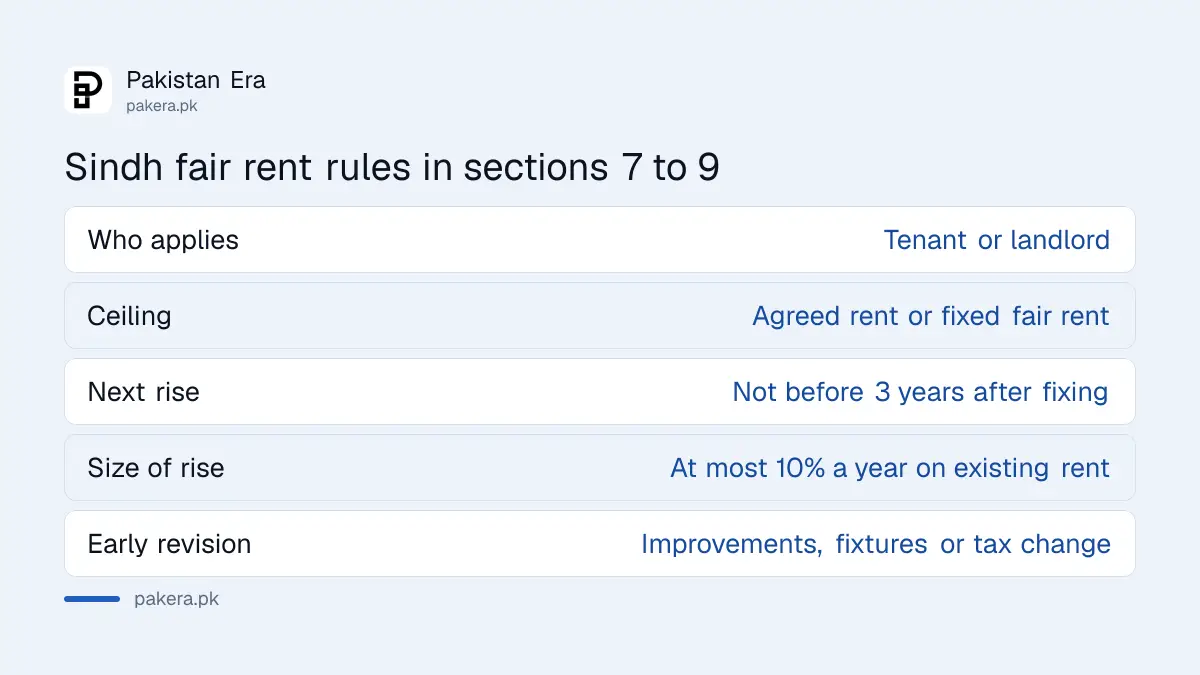
In Karachi and other urban areas of Sindh, a tenant or landlord can apply to the Rent Controller to fix a fair rent under section 8 of the Sindh Rented Premises Ordinance 1979. Once fixed, it cannot be raised for three years, and any increase is capped at 10 per cent a year on the existing rent. No landlord may charge more than the agreed rent or the fixed fair rent.
A sudden demand for 25 or 30 per cent more, with a threat to leave, is a familiar Karachi story. The law gives both sides a referee. We read the Sindh Rented Premises Ordinance 1979 on the Sindh Code on 20 October 2026. The figures below are from sections 7, 8 and 9 of that text.
Fair rent is the rent the Rent Controller fixes for your premises
The Ordinance defines fair rent as the rent determined by the Controller. Either the tenant or the landlord can apply. After it is fixed, section 7 bars the landlord from charging or receiving anything above it, and above the rent agreed between the two sides.
The law covers buildings and open land let out on rent in urban areas of Sindh, which means areas under a town committee, municipal committee or corporation. Hotels are not covered, and nor are premises owned or requisitioned by the federal or Sindh government.
The Controller weighs four factors when fixing fair rent
Section 8(1) lists them: the rent of similar premises in the same or nearby locality, the rise in construction and repair costs, any new taxes imposed after the tenancy began, and the annual value used for property tax, if any. Bring evidence on each one.
| Factor in section 8(1) | Evidence that helps |
|---|---|
| Rent of similar premises nearby | Attested agreements or receipts for flats or shops of the same size in the same block |
| Rise in construction and repair costs | Repair bills, contractor quotes, dates of work done |
| New taxes after the tenancy began | Property tax challans before and after |
| Annual value for property tax | The Excise property tax assessment for the premises |
Neighbours' rent is often the deciding factor, and also the hardest to prove. A landlord who says "everyone in this street pays Rs 80,000" should be asked to show one attested agreement. A tenant who says rents are lower should do the same.
After fair rent is fixed, the next rise waits three years and stays within 10 per cent a year
Section 9 says no increase can be made until three years have passed from the date of fixation. And section 9(2) says the increase shall not, in any case, exceed 10 per cent per annum on the existing rent. These two limits work together.
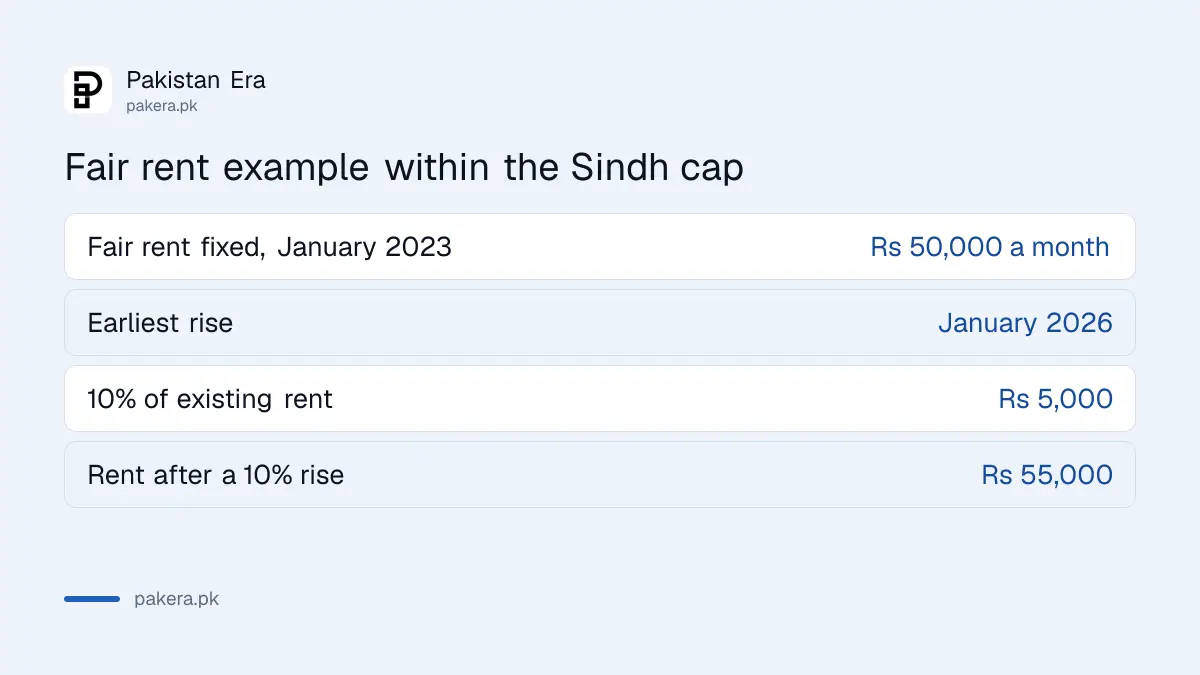
Take a shop where the Controller fixed fair rent at Rs 50,000 a month in January 2023. By our arithmetic, a 10 per cent rise is Rs 5,000, so Rs 55,000. The law speaks of 10 per cent per annum but does not spell out how a rise after three years is worked out, so if the landlord asks for more than 10 per cent in one step, let the Controller decide it.
There is one exception. Under section 8(2), the Controller can revise fair rent early if the landlord has added to or improved the premises, fitted a lift or electrical fittings, or a tax or public charge on the premises has gone up or down. The three year gap does not block that revision.
How to apply to the Rent Controller for fair rent
File a written application with the Rent Controller who has jurisdiction where the premises are. The Controller sends notice to the other side, who has up to 15 days to reply. Evidence comes by affidavit with cross examination, and the order can be appealed to the District Judge within 30 days.
- Gather the tenancy agreement. Section 5 says it must be in writing and attested by the Controller, a Civil Judge or a First Class Magistrate, unless it is a registered deed.
- Collect rent receipts, property tax papers and examples of rent nearby.
- File the application before the Rent Controller for your area, naming the rent you say is fair.
- Keep paying the current rent by the 10th of each month and keep receipts.
- Answer the other side's reply and file witness affidavits.
- Read the order. If you disagree, appeal to the District Judge within 30 days.
Keep paying while the case runs. A tenant who stops paying hands the landlord an eviction ground under section 15, and tenant rights on eviction and rent are worth knowing before the first hearing. If the landlord refuses your rent to build a default, send it by money order or deposit it, as set out in paying rent when a Sindh landlord refuses it.
A landlord cannot cut services or skip repairs to force a rise
Section 11 bars a landlord from cutting electricity, gas or water without the tenant's consent, an authority's requisition or the Controller's direction. The punishment is up to six months' simple imprisonment, a fine, or both. The Controller can order the service restored at the landlord's cost.
Section 12 deals with repairs. If the landlord does not carry out needed repairs or whitewashing, the Controller can let the tenant do the work and deduct the cost from the rent. So a landlord who lets the building decay to push a tenant out does not win by it.
Other provinces set different limits. Khyber Pakhtunkhwa caps a fair rent rise at 25 per cent, as in fixing fair rent in Khyber Pakhtunkhwa, so do not apply one province's number to another.
Common questions
How much can a landlord increase rent in Sindh?
Section 9(2) caps any increase at 10 per cent a year on the existing rent. Where fair rent has been fixed, no increase is allowed until three years have passed.
Who can apply for fair rent in Karachi?
Either the tenant or the landlord. The application goes to the Rent Controller for the area where the premises are.
Can the landlord charge more than the agreed rent?
No. Section 7 bars charging or receiving more than the agreed rent, or more than the fair rent once the Controller has fixed it.
Can fair rent change before three years?
Yes, under section 8(2), if the landlord makes additions or improvements, adds fixtures such as a lift, or a tax on the premises changes.
Does the tenancy agreement need to be attested in Sindh?
Yes. Section 5 says it must be in writing and attested by the Controller, a Civil Judge or a First Class Magistrate, unless it is a registered deed.
What can I do if my landlord cuts my electricity?
Apply to the Rent Controller under section 11 for restoration. Cutting electricity, gas or water without consent or an order can bring up to six months' simple imprisonment or a fine.
How we verified this
What we checked, where we read it, and what we could not confirm.
We read sections 2, 3, 5, 7 to 12, 19 and 21 of the Sindh Rented Premises Ordinance 1979 on the Sindh Law Department's Sindh Code site on 20 October 2026, in the copy with amendments up to 2001. The Rs 50,000 example is our arithmetic. We could not check court fees, how long fair rent cases take, or any later amendment to sections 8 and 9.
About the author

Senior Writer, Public Services and Technology
Shahid joined us in 2024 as an author. He is a senior contributor to Pakistan's leading technology websites. He writes detailed articles, mostly covering his expertise in the latest tech, mobiles, apps, gadgets, and step-by-step guides. His ideology is to help people understand the latest trends and explain complex methods through very easy-to-understand guides.