Pay for Private Hajj 2027 Only Through a Government Account: 6 Protections in Pakistan's Policy
Pakistan's Hajj Policy 2027 to 2030 bans cash and bars private operators from holding your money. See six protections and five checks before you pay a deposit.
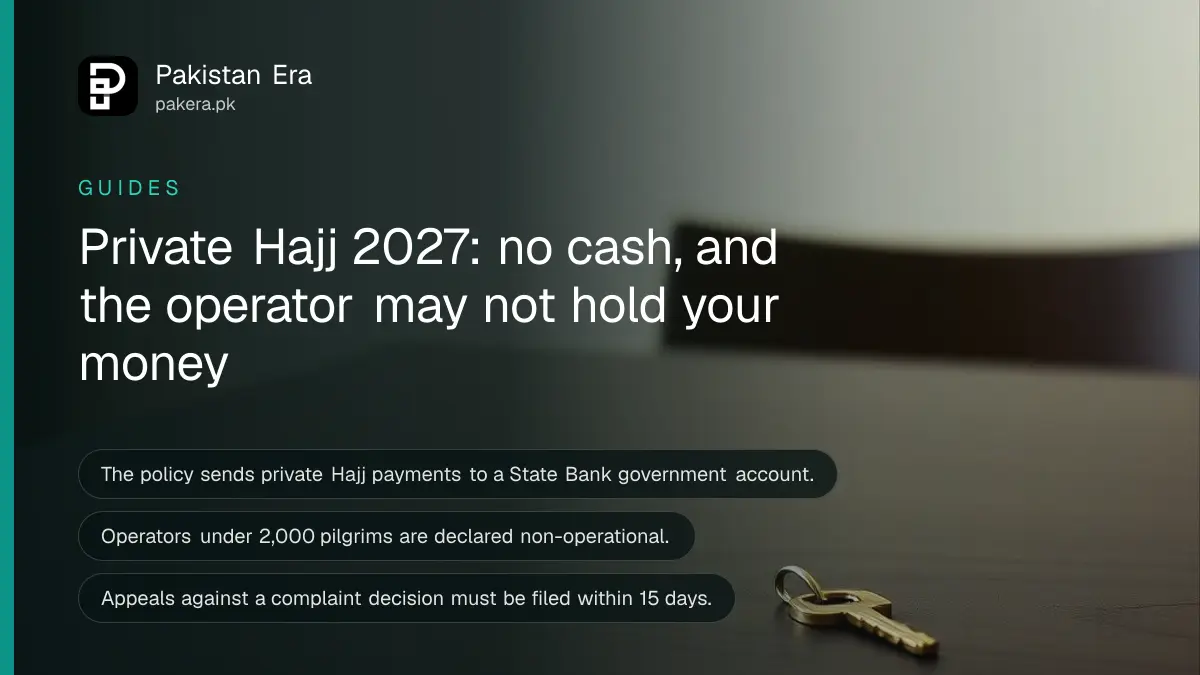
Short answer: Under Pakistan's Hajj Policy 2027 to 2030, a private Hajj operator may not collect your money. You pay into a government account at the State Bank of Pakistan through a portal, and the policy bans cash. If an operator asks you to pay cash or to its own bank account, do not pay.
Private Hajj packages cost more than the government scheme, so a lost payment hurts. Past seasons saw complaints about operators who took money and did not deliver. The new policy tries to close that gap.
We read the full policy on the Ministry of Religious Affairs website on 13 October 2026. The rules below are the policy's plan. We could not confirm that every system it describes is already live for Hajj 2027, so we mark that where it matters.
All Hajj money must go through formal banking
Part I, clause 6(2) covers both schemes. All Hajj dues must go into bank accounts notified by the ministry, through formal banking channels only, under State Bank rules. The policy says "no cash or informal channel payments shall be accepted".
That one sentence is your first test. A person who asks for cash, a wallet transfer to a personal number or a deposit into an office account is outside the policy.
The private scheme uses one government account
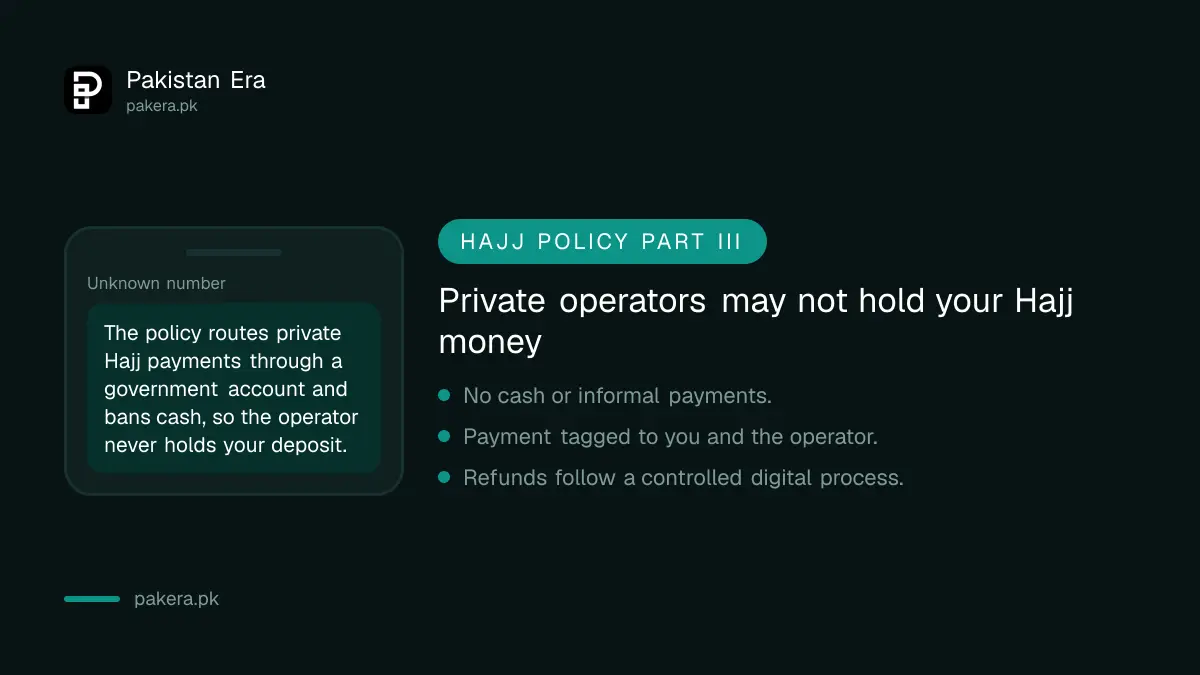
The private scheme section goes further. All private Hajj transactions are to be made only through a government account maintained with the State Bank. Payments are tagged to the operator and to you.
The policy says funds go directly to Saudi service providers under verified agreements. Operators are "prohibited from collecting, holding, or transferring funds independently". Refunds follow a controlled digital process too.
Each pilgrim gets a Unique Hajj Identification Number. It links your identity to your payment record, and the system is joined to the company regulator, NADRA and the State Bank.
Operators must be registered and large enough
The policy says private operators must be incorporated under the Companies Act 2017, registered with the SECP and licensed under the Hajj and Umrah (Regulation) Act 2024. Licences last three years and are reviewed each year.
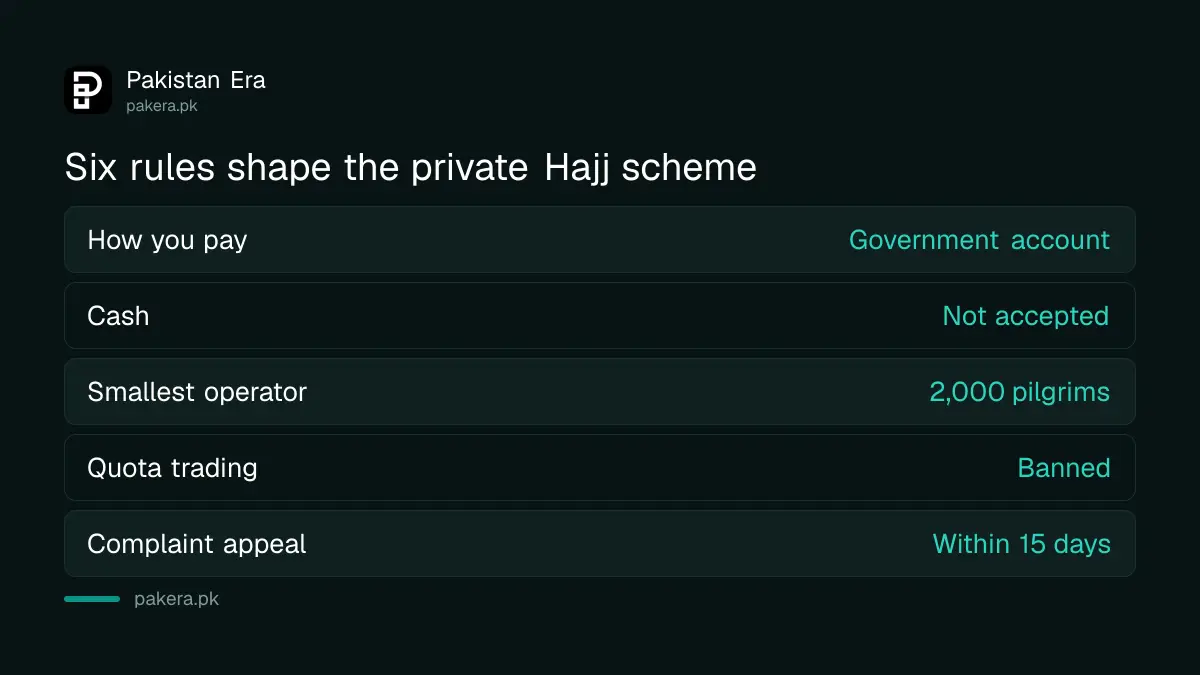
An operator that books fewer than 2,000 pilgrims is declared non-operational. Its pilgrims are moved to other operators, and half of its security deposit is forfeited. This protects you if a small company cannot deliver.
The policy also bans selling, reselling or subletting quotas. Check who will actually serve you, using our guide to checking that a Hajj or Umrah agent is licensed.
Operators must put up real money
The policy sets financial tests for the 3,000 pilgrim category. It lists paid-up capital of Rs 300 million, authorised capital of Rs 600 million and a performance guarantee of Rs 150 million. The figures assume Rs 1 million of business per pilgrim, and a guarantee is money the ministry can reach if the operator fails you.
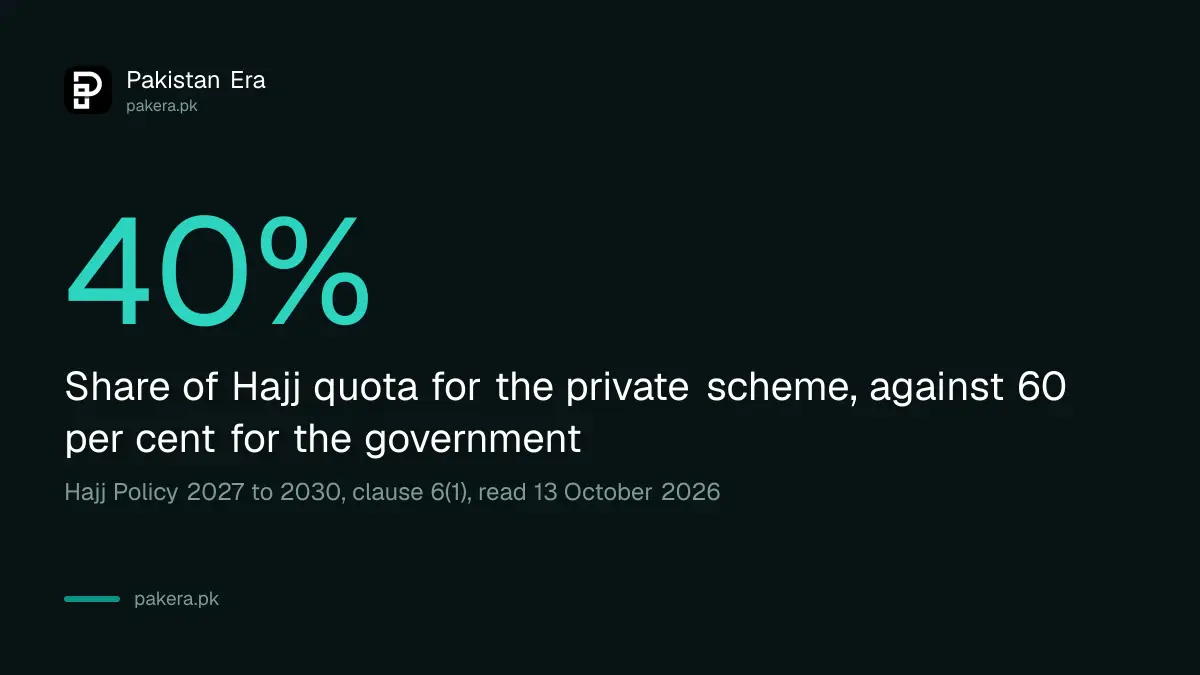
The private scheme also gets a fixed share. The policy splits Hajj quota 60 per cent to the government scheme and 40 per cent to the private scheme, with any change needing federal cabinet approval. The private share is sold first come, first served through the portal, not by ballot.
| Protection | What the policy says |
|---|---|
| How you pay | Government account at the State Bank, no cash |
| Who holds the money | Not the operator |
| Your record | Unique Hajj Identification Number |
| Minimum operator size | 2,000 pilgrims or reallocation |
| Quota trading | Banned |
| Complaints | Digital committee, then an appeal |
How to complain if something goes wrong
Complaints go to a Complaint Disposal Committee, handled digitally through the private Hajj portal. A decision can be appealed to an Appellate Committee within 15 days of the committee's decision.
For the general complaint process under the 2024 law, read our guide to complaining against a Hajj or Umrah operator. The current private Hajj 2026 window is in the page on the 20 October complaint deadline.
Five steps before you pay a private operator
- Ask for the operator's SECP registration and Hajj licence, and verify them.
- Ask how payment works. It should be a portal or government account, not the operator's own account.
- Ask for the written agreement that covers refunds, medical and insurance cover.
- Keep every receipt and the Unique Hajj Identification Number.
- Walk away if you are asked for cash.
Common questions
Can a private Hajj operator take my money directly?
No. The policy bars operators from collecting, holding or moving funds on their own. Payment goes through a government account.
Can I pay cash for Hajj?
No. The policy says no cash or informal channel payments are accepted for either scheme.
What happens if my operator cannot reach 2,000 pilgrims?
It is declared non-operational for that year. Its pilgrims are moved to other operators through the portal.
How long do I have to appeal a complaint decision?
15 days from the date of the Complaint Disposal Committee's decision, per the policy.
Is the private Hajj portal already working for 2027?
We could not confirm that. The policy says the portal is mandatory. Ask the ministry how to pay before you transfer anything.
How we verified this
What we checked, where we read it, and what we could not confirm.
Last checked on 13 October 2026, Pakistan time. We read the Ministry of Religious Affairs' Hajj Policy and Plan 2027 to 2030, Part I clause 6 and Part III, and the ministry's home page. We did not verify that the portal and government account are running for Hajj 2027 bookings, or the private package prices.
About the author

Global Affairs & Political Economy Writer
Muhammad Hatim is a book lover who started writing because he enjoys it. At Pakistan Era he writes about international relations, geopolitics and the global economy, with a particular interest in South Asia and the forces behind current events.