How to Size a Home Solar System in Pakistan From Your Monthly Units
Size a home solar system in Pakistan from your bill: 1 kW makes about 117 units a month in Lahore, 131 in Karachi, 151 in Quetta. City table and worked steps.
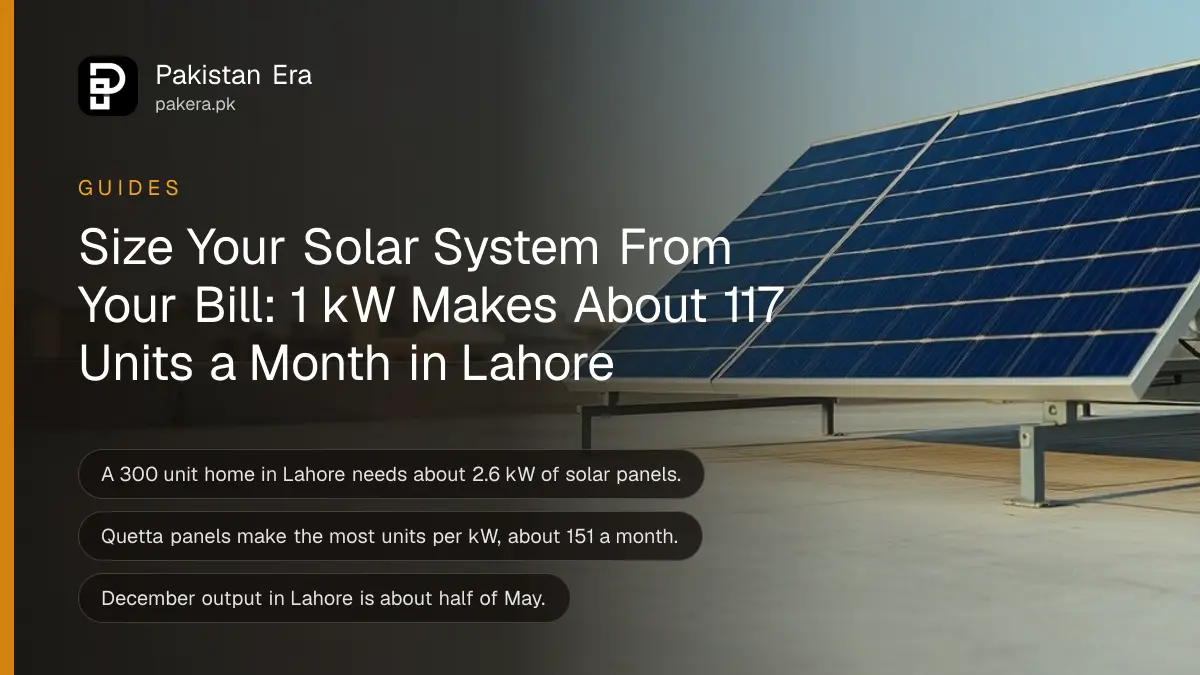
To size a home solar system in Pakistan, divide your average monthly units by the units one kilowatt (kW) makes in your city each month: about 117 in Lahore and Multan, 119 in Islamabad, 131 in Karachi, 132 in Peshawar and 151 in Quetta. A home using 300 units a month in Lahore needs about 2.6 kW, so a 3 kW system.
Those figures are our own estimates from NASA's 25-year solar data for each city, with panels facing south at a normal roof tilt and 25% lost to heat, dust, wiring and the inverter. They are yearly averages. Winter months make far less, which is why the steps below start with your bills, not an installer's quote.
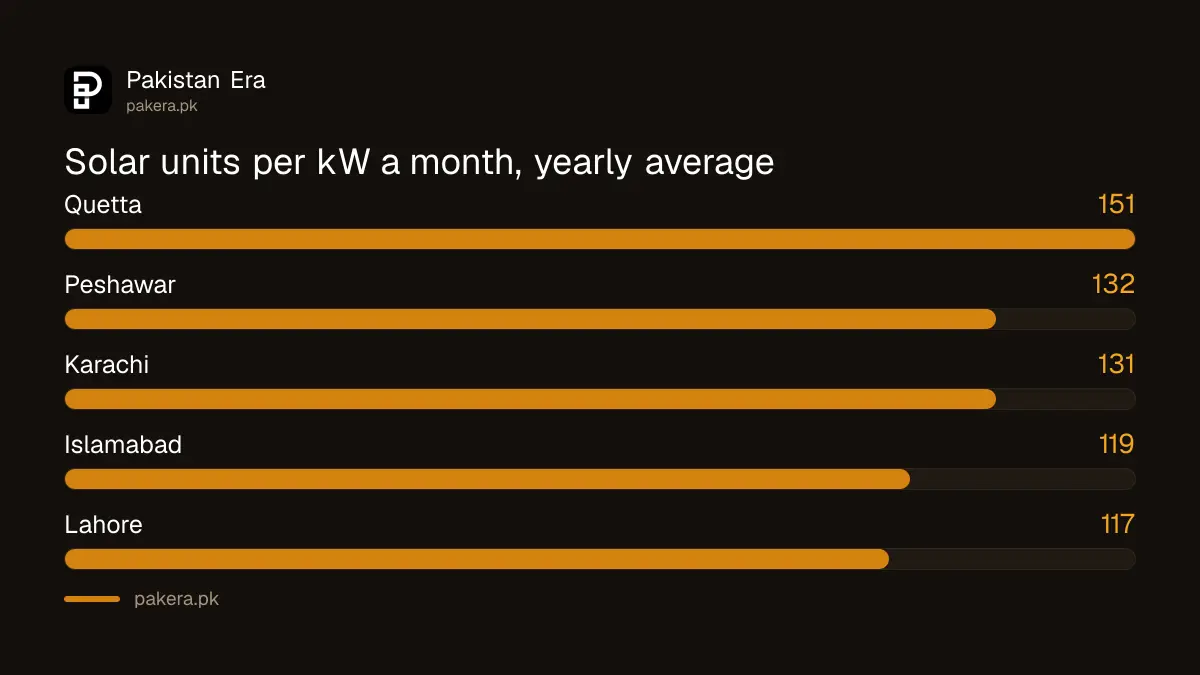
One kilowatt of solar makes about 112 to 151 units a month in Pakistan
One kW of panels in Pakistan makes about 3.7 to 5 units a day on average across the year, or 112 to 151 units a month. Quetta gets the most sun, Faisalabad the least of the big cities. Use your own city's figure in the sum.
| City | Units per kW a day (year average) | Units per kW a month | Units per kW a year |
|---|---|---|---|
| Quetta | 4.98 | 151 | 1,816 |
| Peshawar | 4.35 | 132 | 1,587 |
| Karachi | 4.30 | 131 | 1,568 |
| Hyderabad | 4.24 | 129 | 1,547 |
| Islamabad and Rawalpindi | 3.93 | 119 | 1,434 |
| Lahore | 3.86 | 117 | 1,409 |
| Multan | 3.86 | 117 | 1,409 |
| Faisalabad | 3.68 | 112 | 1,342 |
A unit is one kilowatt hour (kWh), the same unit printed on your electricity bill. So a 5 kW system in Lahore makes about 5 x 117 = 585 units in an average month.
Size the system in five steps from your own bills
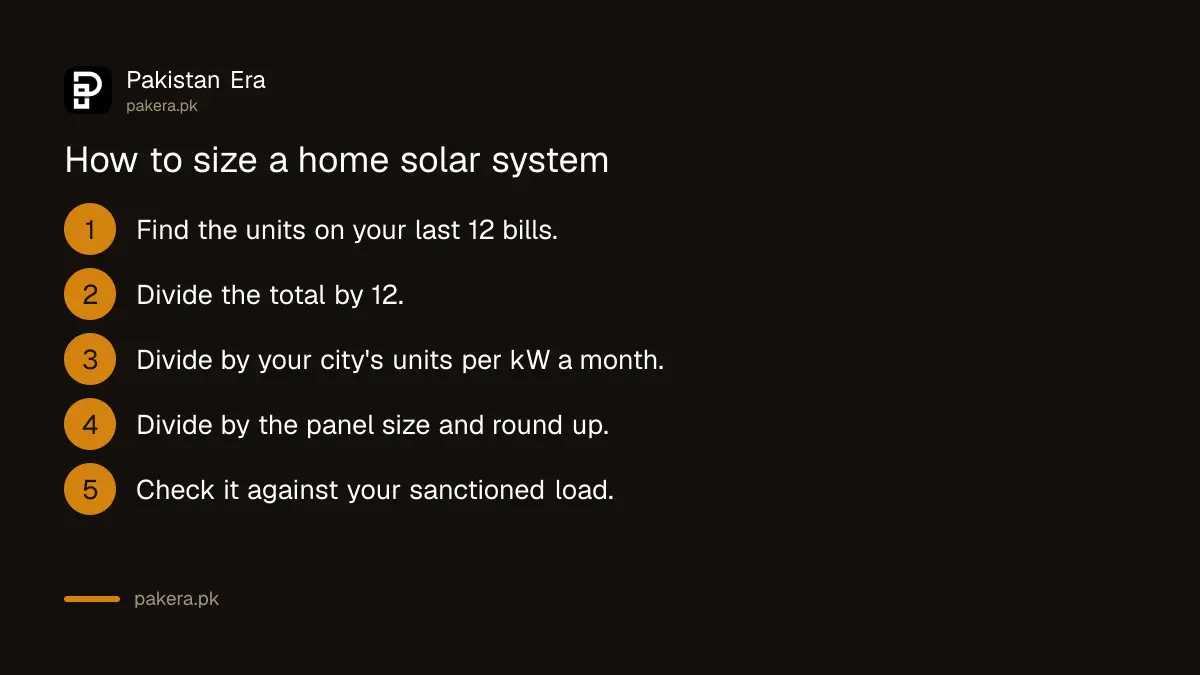
Add up the units on your last 12 bills, divide by 12, then divide by your city's units per kW a month. Round up to the next panel. Check the answer against your sanctioned load before you buy anything.
- Find the units on your last 12 electricity bills. The bill history on the back of most bills, or a duplicate bill online, shows them.
- Add them and divide by 12 to get your average monthly units.
- Divide that by your city's units per kW a month from the table. The answer is the system size in kW.
- Divide the kW by the panel size in kW and round up. For 550 watt panels, divide by 0.55.
- Check that the final size is not above your sanctioned load, which is printed on your bill.
Worked example for a Lahore home: 3,600 units a year is 300 a month. 300 divided by 117 is 2.56 kW. With 550 watt panels, 2.56 divided by 0.55 is 4.7, so 5 panels, which is 2.75 kW. If you want the winter months covered too, read the winter section below before you settle on the number.
Common sizes for 200, 300 and 500 units a month
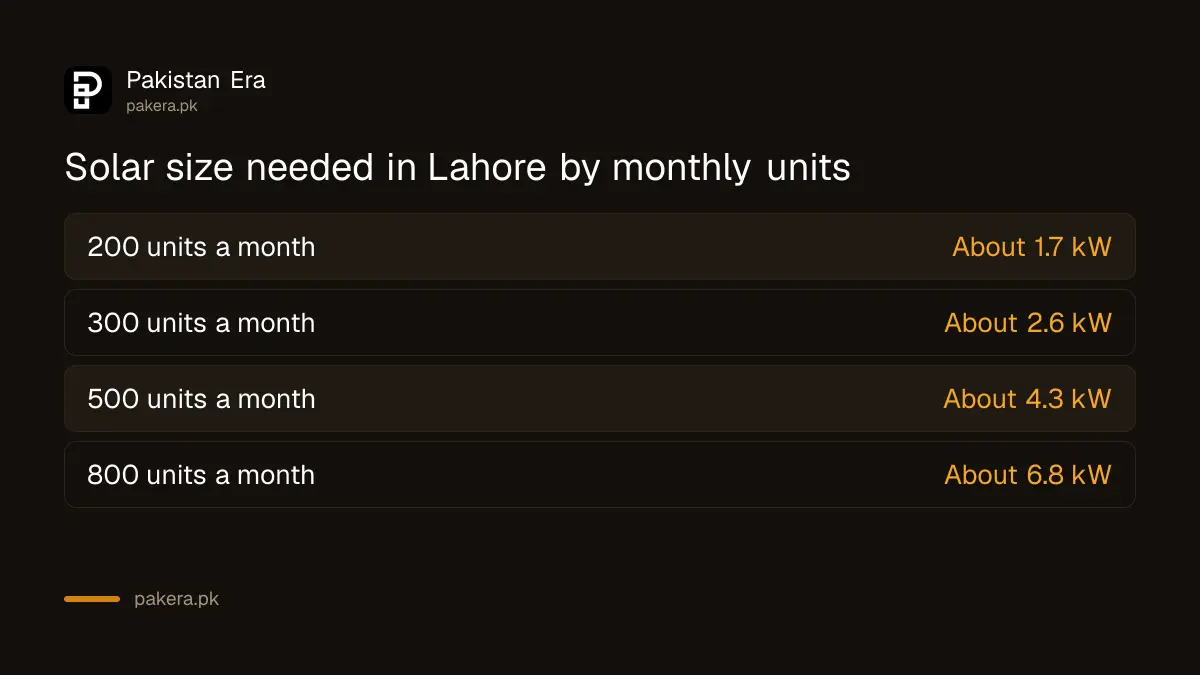
A home using 200 units a month needs about 1.5 to 1.8 kW, 300 units needs 2.3 to 2.7 kW, and 500 units needs 3.8 to 4.5 kW, depending on the city. Karachi and Quetta need smaller systems than Lahore or Faisalabad for the same bill.
| Monthly units | Lahore | Karachi | Islamabad | Peshawar | Quetta |
|---|---|---|---|---|---|
| 200 | 1.7 kW | 1.5 kW | 1.7 kW | 1.5 kW | 1.3 kW |
| 300 | 2.6 kW | 2.3 kW | 2.5 kW | 2.3 kW | 2.0 kW |
| 500 | 4.3 kW | 3.8 kW | 4.2 kW | 3.8 kW | 3.3 kW |
| 800 | 6.8 kW | 6.1 kW | 6.7 kW | 6.1 kW | 5.3 kW |
These are the sizes that cover the bill over a full year. They do not mean the system covers every month. If your home uses most of its power at night, a bigger system will not help unless you add batteries or can export to the grid.
Your sanctioned load and phase set the legal limit
Under NEPRA's 2026 prosumer regulations, a grid-connected system cannot be larger than your sanctioned load, and only three-phase or 11 kV consumers can apply for net billing. A single-phase home can still use solar, but cannot sell units to the grid.
The sanctioned load is the kW figure on your bill. If your sum says 6 kW and your sanctioned load is 5 kW, you either install 5 kW or apply for a load extension first. NEPRA approval is not needed for systems of 25 kW or less, and its fee in that band is nil, as set out in the rules on solar systems up to 25 kW.
Two more limits catch people out. Your DISCO will not take a new application once solar on your transformer reaches 80% of its capacity, explained in the steps to check your transformer's solar capacity. And units you export earn only the national average energy purchase price, reported at about Rs 11 a unit, while most homes pay Rs 22.44 to Rs 38.95 a unit to import. The full picture is in the 2026 net billing rules.
Winter output is about half of May, so size for your goal
In Lahore, 1 kW makes about 82 units in December and 158 in May. If you size for the yearly average, expect winter bills to still need the grid. Sizing to cover December fully needs almost twice the panels.
Pick the goal before you buy. Most homes in Punjab use the most power in summer, when panels also make the most. So sizing to the yearly average usually matches your real use well. Sizing for winter makes sense only if you have high winter use, such as electric heaters or geysers, and a way to use or export the summer surplus.
Export pays far less than import, so an oversized system on a net billing contract earns little on its extra units. A system sized to what you use in daylight gives the best return.
Check these four things before you pay an installer
Before you pay, confirm the system size in kW, the panel and inverter ratings on the datasheets, the installer's registration, and that the inverter size suits your panels. A written quote should list all four.
- Panel wattage and count, and the total in kW. Multiply them yourself.
- Inverter rating in kW. It is usually close to the panel total. A much smaller inverter wastes midday output.
- The installer's certification, which you can check on the PPIB certified solar installer list.
- Whether the price includes the mounting frame, wiring, earthing and the DISCO application.
For battery backup during load shedding, size the battery separately from the panels. The method for watts, hours and amp-hours is set out in the steps to size a UPS battery for load shedding.
Common questions
How many solar panels do I need for 300 units a month in Pakistan?
About 2.3 to 2.7 kW, depending on the city. With 550 watt panels that is 5 panels in Lahore or Islamabad and 5 in Karachi, rounding up from 4.2 to 4.7.
How many units does a 5 kW solar system make in a month?
On a yearly average, about 585 units in Lahore, 655 in Karachi, 595 in Islamabad and 755 in Quetta. In December it makes about 410 units in Lahore.
How many units does a 10 kW solar system make a day?
About 37 to 50 units a day on a yearly average, depending on the city. In Lahore it is about 39 units a day, falling to about 26 in December.
Can I install more solar than my sanctioned load?
Not on a grid-connected net billing system. NEPRA's 2026 regulations cap the system at your sanctioned load. Apply for a load extension first if you need a bigger system.
Can a single-phase house get net metering?
No new net billing connection is allowed on single phase under the 2026 regulations, which require a three-phase 400 V or 11 kV connection. Older agreements keep their terms until they expire.
Does a 1 kW system really give 4 units a day?
On a yearly average, close to it: 3.7 to 5 units across the main cities. In winter it is about 2.4 to 3.7 units a day, and less on foggy days.
How we verified this
What we checked and where we read it.
On 24 November 2026 we downloaded NASA's POWER climatology data (January 2001 to December 2025) for Lahore, Karachi, Islamabad, Peshawar, Quetta, Multan, Faisalabad and Hyderabad from the NASA POWER project, using solar irradiance on a south-facing panel at the yearly best angle. We multiplied by 0.75 for losses and by days in the month. That loss figure is our assumption; real systems vary. The legal limits come from NEPRA's Prosumer Regulations 2026 and their amendments, listed on the NEPRA legal page, and the slab rates from the federal tariff notified on 12 February 2026.
About the author

Tax, Bills and Technology Writer
Ali Akhtar is a young and curious voice here at Pakistan Era. He is currently pursuing his A-Levels and has a growing interest in Pakistan’s changing industrial landscape and educational trends. Ali likes to write in a way that helps him explain and explore the world around him. His writing reflects the perspective of the new generation navigating the evolving trends of Pakistan where technology, youth innovation, and shifting opportunities are reshaping the country’s future.