Check a Solar Installer Is Certified in Pakistan: PPIB's 13 November 2026 Lists for C-1, C-2 and C-3
Check a solar installer in Pakistan on PPIB's certified lists of 13 November 2026: search the name, match the certificate number, validity date and province.
To check a solar installer in Pakistan, open PPIB's list of certified installers, pick the category file (C-1, C-2 or C-3), search the company name, and confirm three things: the certificate number, a validity date that has not passed, and your province in the area column. The current lists are dated 13 November 2026. They hold 311 numbered entries in C-1, 144 in C-2 and 344 in C-3.
This check matters because your net metering application cannot go through without one. Every electricity company asks for an inspection certificate signed by an engineer of a certified company, and the online application on PITC's net billing portal names the installer and asks the installer to verify it. An uncertified installer can take your money and leave you with a system the DISCO will not connect.
The Private Power and Infrastructure Board (PPIB) runs the certification under the AEDB (Certification) Regulations, 2021. AEDB is the Alternative Energy Development Board, whose name is still on the regulations and on many DISCO forms.
PPIB's lists of 13 November 2026 cover three installer categories
PPIB publishes three separate lists, one per category, all dated 13 November 2026. The category sets the largest system an installer may handle: C-3 up to 250 kW, C-2 up to 500 kW and C-1 up to and above 500 kW.
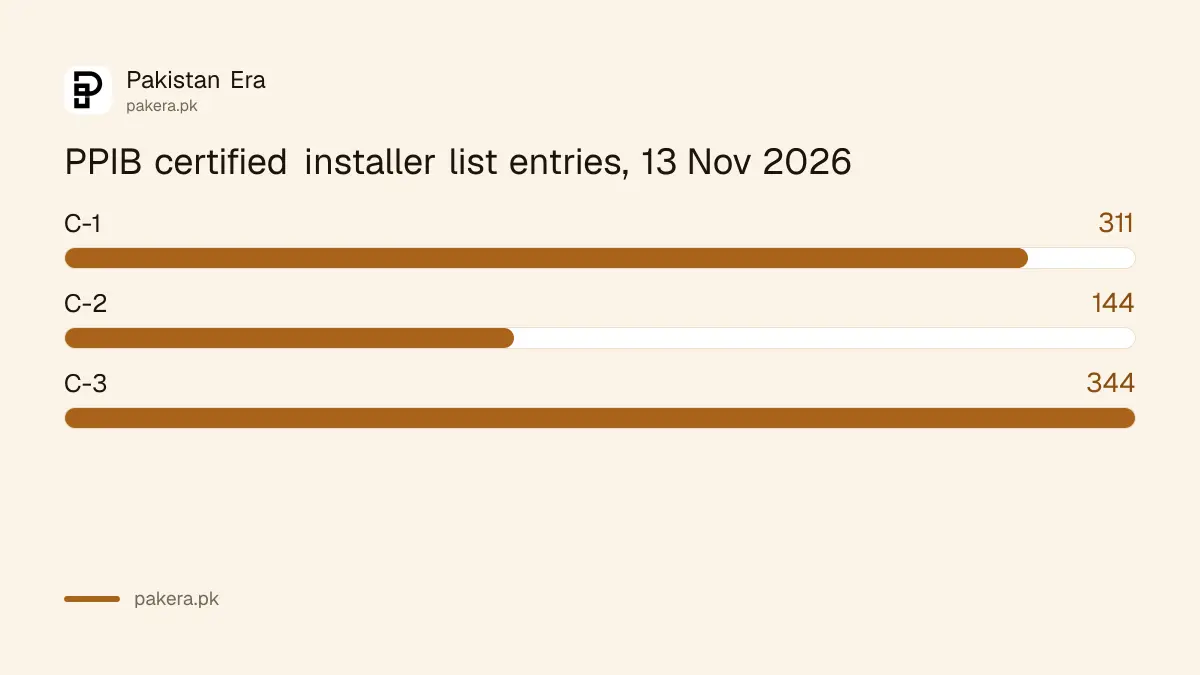
| Category | Largest system | Numbered entries (13 Nov 2026) | Good for a home? |
|---|---|---|---|
| C-3 | Up to 250 kW | 344 | Yes |
| C-2 | Up to 500 kW | 144 | Yes |
| C-1 | Up to and above 500 kW | 311 | Yes |
A home system of 5 to 25 kW sits well inside C-3, so any of the three categories can install it. A factory planning 400 kW needs a C-2 or C-1 company. The entry counts are the serial numbers printed on each list, so they include some certificates that have already expired.
How to check your installer on the PPIB list in 6 steps
The check takes about five minutes on a phone or laptop. You need the installer's company name and, ideally, the certificate number from their own copy. Then you match both against PPIB's file for the right category.
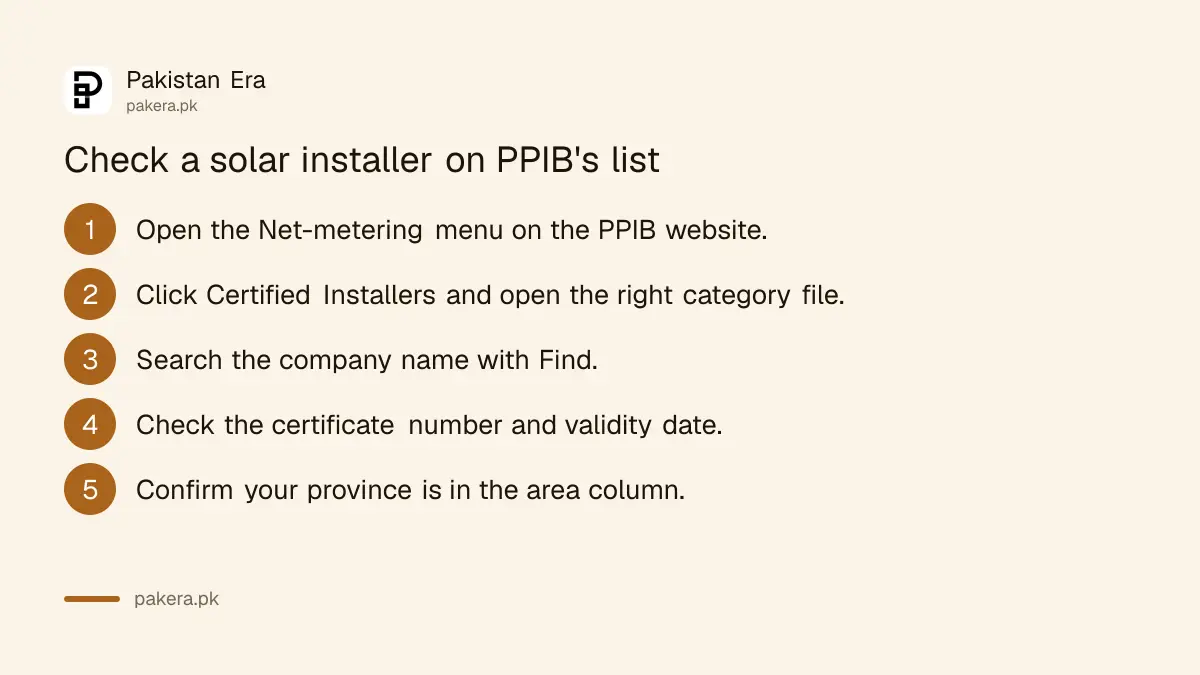
- Open the PPIB website at ppib.gov.pk and go to the Net-metering menu.
- Click Certified Installers. It opens a shared folder with the three lists, each named with its date, for example "List of Certified Installer C-3 (13-11-2026)".
- Open the file for the category your system needs. For most homes that is C-3, but check C-2 and C-1 too if the name is missing.
- Search the company name with the find function (Ctrl+F on a laptop, "Find in page" on a phone). Try one key word, as names are often split across two lines.
- Read the row: certificate number, validity of certificate, technology (solar, or solar and wind) and the areas it covers.
- Ask the installer for a copy of the certificate and match the number. Keep that copy with your application file.
Read the validity date and the area column before you sign
A name on the list is not enough. The lists still carry many certificates whose validity ended on 30 June 2024 or 30 June 2025. Check that the date in the validity column is still in the future, and that your province appears in the area column.
Certificates run to 30 June of a given year. On the 13 November lists, the most common end dates are 30 June 2026 and 30 June 2027, with a few running to 2028. A row showing 30 June 2025 means the certificate has lapsed unless the installer shows you a renewed one.
The area column lists where the company may work: ICT (Islamabad), Punjab, Sindh, KPK and Balochistan, in different mixes. A Lahore company certified for "ICT and Punjab" cannot sign the inspection certificate for a house in Hyderabad. Some newer rows also show the provincial tax registration, such as PRA for Punjab.
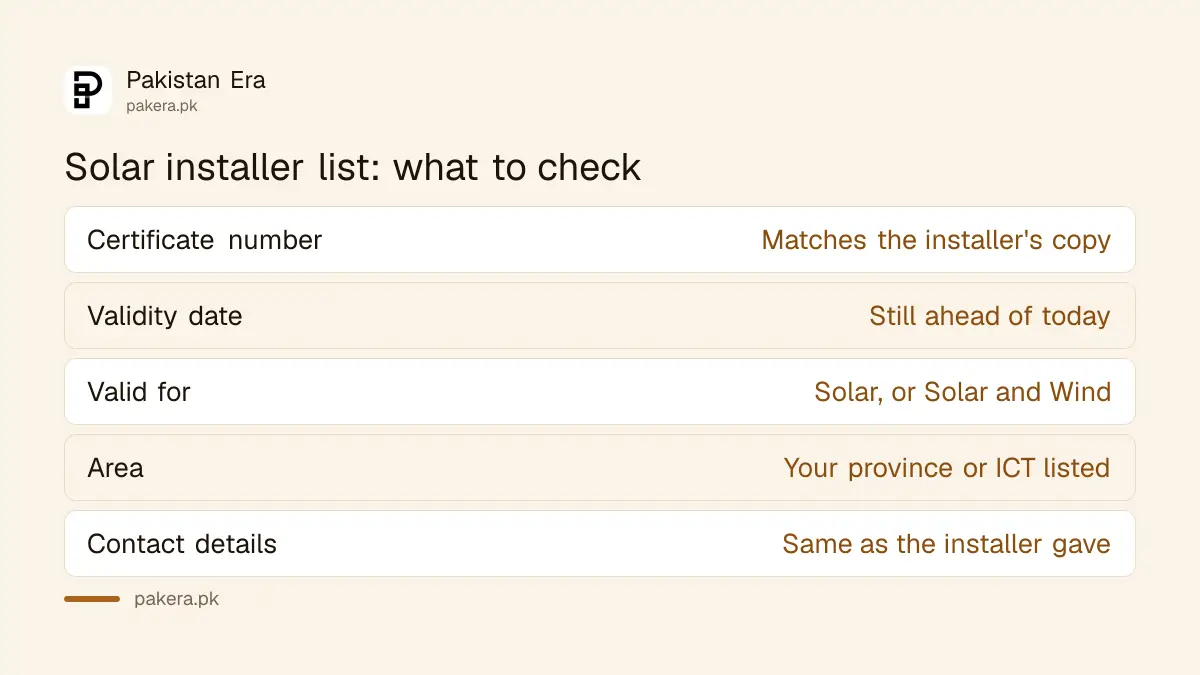
| Column on the list | What to check | Red flag |
|---|---|---|
| Certificate No. | Matches the installer's copy, for example CR/26/001/C-1 | Number missing or different |
| Validity of Certificate | Date still ahead of today | 30-06-2024 or 30-06-2025 |
| Valid for | Solar (or Solar and Wind) | Wind only, for a solar job |
| Area | Your province or ICT is listed | Your province is absent |
| Contact details | Same phone or email the installer gave you | Different numbers |
Why the certified installer matters for your net metering file
The installer is part of your application, not just your supplier. On PITC's net billing portal the installer either files the application or verifies yours with a password. The DISCO also needs an inspection certificate signed by an authorised engineer of a certified company.
The installer's side of the file has several pieces. There is a customer agreement between you and the installer under Schedule 3 of the AEDB (Certification) Regulations, 2021. There is the inspection certificate, which records tests such as DC and AC earthing, insulation, cable colour coding, an outside lockable disconnect switch and the inverter's anti-islanding feature. Anti-islanding stops the inverter feeding a dead line while linemen repair it.
You still need the basics on your side. The rules on size, the 3 phase connection and the deadlines are in the net metering rules for 2026, and you can follow the file afterwards with a net metering application status check.
What to do if your installer is not on the list
Stop before you pay the balance. Ask the installer for its PPIB certificate and check the number against the list. If it is missing or expired, ask for a written explanation, or choose a certified company. PPIB handles installer registration on 051-9222360-61, extension 212.
- Name differs slightly: many companies trade under a short brand but are listed under their registered name. Ask for the registered name on the certificate.
- Expired date: ask for the renewed certificate. A renewal shows a new date and often a "RN" or "Rev" mark in the number.
- Sub-contractor: some sellers hand the job to a certified company. Then that company must sign the agreement and the inspection certificate, not the seller.
- Panels already fitted: the inspection form has a box for systems already installed, so a certified company can still inspect and sign.
Check the hardware too. If you bought LONGi or Jinko modules, the maker's own serial check is set out in how to check a LONGi or Jinko panel is original.
Common questions
Who certifies solar installers in Pakistan?
PPIB, under the AEDB (Certification) Regulations, 2021. It publishes the lists of certified installers on its website, and the net billing portal directs installer registration queries to PPIB.
How many certified solar installers are there?
The lists dated 13 November 2026 carry 311 numbered entries in C-1, 144 in C-2 and 344 in C-3. Some of those certificates have expired, so the number of currently valid installers is lower.
Which category do I need for a home system?
Any category. C-3 covers systems up to 250 kW, which includes every normal home. C-2 and C-1 companies may also install home systems.
Is an AEDB certificate the same as a PPIB certificate?
Yes, for this purpose. The certificates are issued under the AEDB (Certification) Regulations, 2021, and PPIB now publishes and renews them, so forms still say "AEDB certified".
Can I apply for net metering without a certified installer?
No. The DISCO needs an inspection certificate signed by an engineer of a certified company, and the online application names the installer.
Does a certified installer guarantee my panels are genuine?
No. Certification covers the company and its work. Check the panel and inverter serial numbers with the maker as well.
How we verified this
What we checked and where we read it.
Checked on 15 November 2026. We read the three PPIB lists of certified installers under the AEDB (Certification) Regulations, 2021, each dated 13 November 2026 (C-1, C-2 and C-3), linked from the Net-metering menu on the PPIB website; the counts are the highest serial number printed on each list. We also read PPIB's checklist for enlistment of installers and its fee notice for 2026. On PITC's net billing portal we read the installer guidelines, the consumer application form and the AEDB inspection certificate template. The PPIB website's menu still holds older lists dated October 2024 in its page code; the November 2026 files are the ones it links.
About the author

Tax, Bills and Technology Writer
Ali Akhtar is a young and curious voice here at Pakistan Era. He is currently pursuing his A-Levels and has a growing interest in Pakistan’s changing industrial landscape and educational trends. Ali likes to write in a way that helps him explain and explore the world around him. His writing reflects the perspective of the new generation navigating the evolving trends of Pakistan where technology, youth innovation, and shifting opportunities are reshaping the country’s future.