How to Size a UPS and Battery for Load Shedding in Pakistan: 300 Watts Needs About 180 Ah
Size a UPS for load shedding in Pakistan in 10 minutes: add your watts, multiply by the hours, divide for battery Ah. Worked for fans, lights, a TV and an AC.
To size a UPS for load shedding in Pakistan, add up the watts of what you must keep running, multiply by the hours the power is off, and divide by 12 volts, by the share of the battery you can safely use, and by the inverter's efficiency. For two fans, four LED bulbs, a TV and a laptop, about 300 watts for three hours, that works out at roughly a 180 Ah lead acid battery and a 1,000 VA inverter. Add an air conditioner and the same sum points to lithium or solar, because no single lead acid battery carries it.
Most UPS purchases in Pakistan go wrong at the shop counter, where the salesman asks "kitne fans?" and picks a box. The arithmetic below takes ten minutes and uses appliance wattages published by K-Electric in its energy calculator, which we read on 19 October 2026. The hours come from your own area's schedule.
Start with the watts of what you actually need during a cut
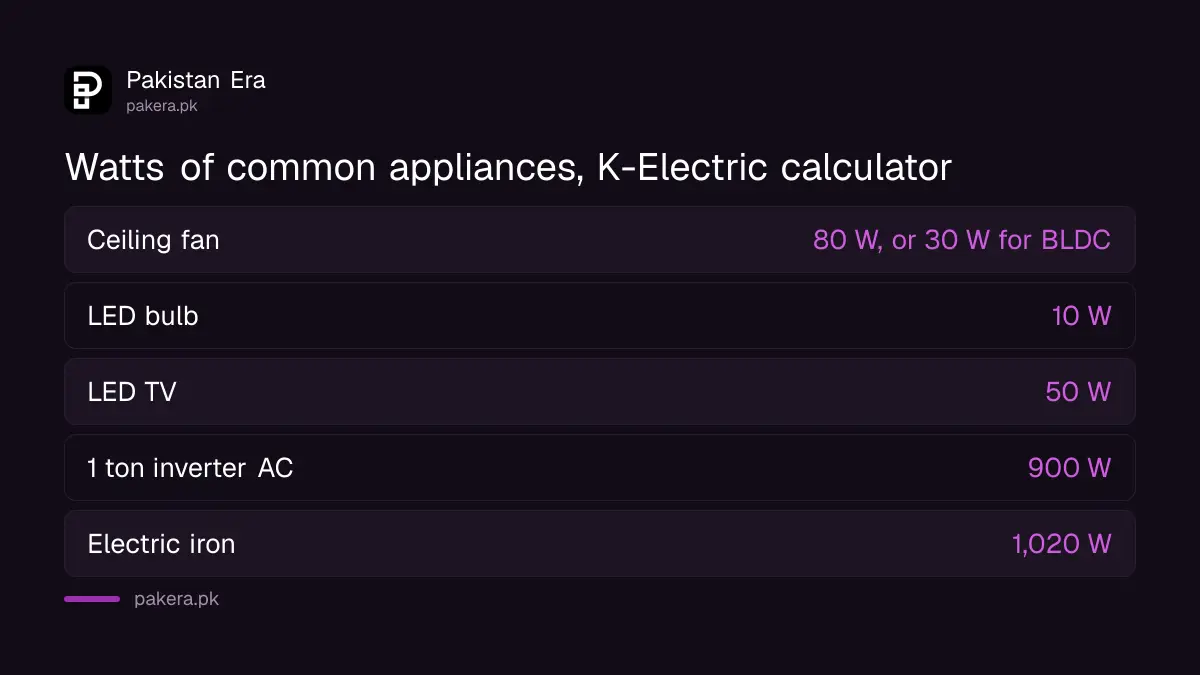
List only what must run while the power is off: fans, lights, the router, a TV, phone chargers. Leave out the iron, the kettle, the water motor and the geyser, which draw 750 to 2,000 watts each and would empty any home battery in minutes. Use the maker's label where you can, and K-Electric's calculator figures where you cannot.
| Appliance | Watts in K-Electric's calculator | Keep it on the UPS? |
|---|---|---|
| Ceiling fan | 80, or 30 for a BLDC fan | Yes |
| LED bulb | 10 | Yes |
| LED TV | 50 | Yes |
| Laptop | 50 | Yes |
| Single door refrigerator | 90 to 180 | Only on a larger system |
| 1 ton inverter AC | 900 | Only on lithium or solar |
| Electric iron | 1,020 | No |
| Electric kettle | 1,500 | No |
| 1 HP water motor | 750 | No |
| Electric geyser | 2,000 | No |
A typical essential load is two ceiling fans at 80 watts, four LED bulbs at 10 watts, one LED TV at 50 watts and a laptop at 50 watts. That is 300 watts. Swap the fans for BLDC models and it drops to 200 watts, which is the single cheapest way to shrink the battery you have to buy. The same wattage list drives the guide to estimating your monthly units.
Multiply by the hours of your longest cut, not the average
Size for the longest cut you actually get, because a battery that runs flat at hour three is useless at hour four. In October 2026 the reported shortfall put unannounced cuts at up to four hours in some areas. Check your own company's published schedule and use its longest window.
The rule for planned work is in NEPRA's performance standards, which allow a limited number of scheduled interruptions a year; the figures are in our page on the planned power cut limit. Unplanned load shedding is another matter, and the report on October's power shortfall explains why it has returned. Karachi households can read their windows in the K-Electric load shedding schedule.
With 300 watts for three hours the energy you need is 900 watt hours. For four hours it is 1,200. Write that number down; everything else follows from it.
Divide by 12, by 0.5 and by 0.85 to get the battery size in Ah
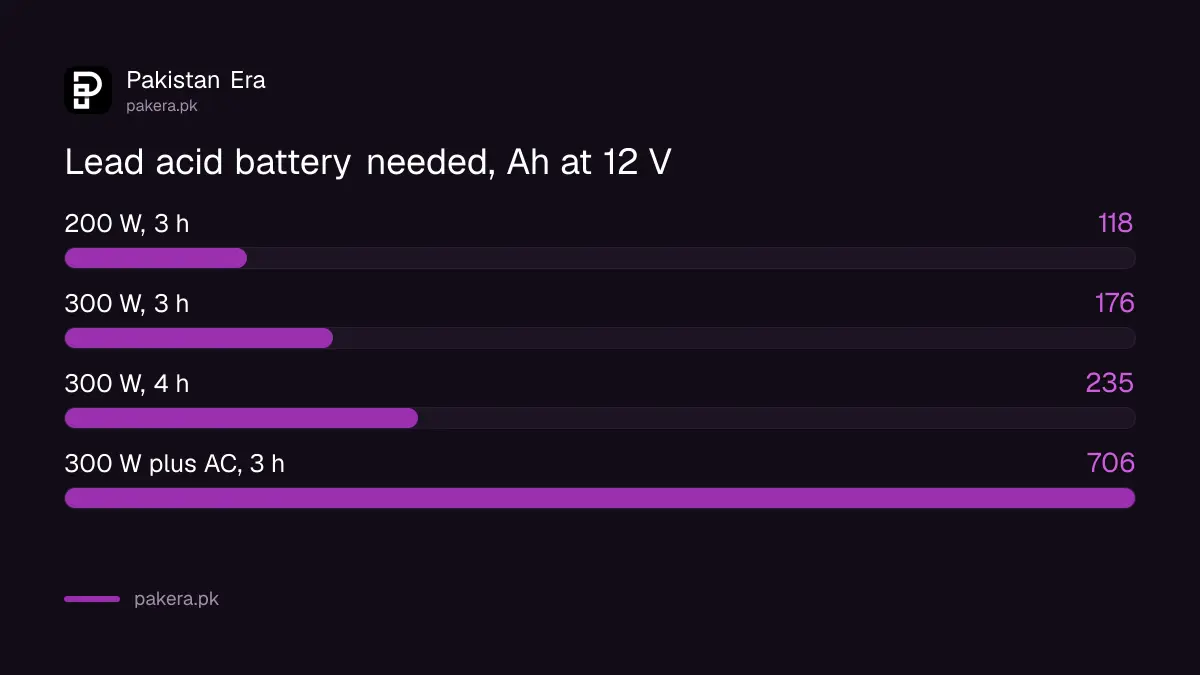
A lead acid battery is rated in ampere hours at 12 volts, you should not drain it below half, and the inverter wastes about 15 per cent turning 12 volts DC into 220 volts AC. So the battery you need is watt hours divided by 12, then by 0.5, then by 0.85. For 900 watt hours that is 176 Ah.
| Load and hours | Watt hours | Lead acid at 50% depth, 85% efficiency | Lithium at 80% depth, 90% efficiency |
|---|---|---|---|
| 200 W for 3 hours | 600 | 118 Ah at 12 V | 69 Ah at 12 V |
| 300 W for 3 hours | 900 | 176 Ah at 12 V | 104 Ah at 12 V |
| 300 W for 4 hours | 1,200 | 235 Ah at 12 V | 139 Ah at 12 V |
| 300 W plus a 900 W inverter AC for 3 hours | 3,600 | 706 Ah at 12 V | 417 Ah at 12 V, or 104 Ah at 48 V |
These are our calculations from stated assumptions, and the depth and efficiency figures are the usual engineering rules of thumb rather than anything a regulator fixes. The point they make is plain: a 300 watt essential load fits one 180 to 200 Ah lead acid battery or two 100 Ah units, while an air conditioner needs a 48 volt lithium bank or solar input. Pakistan imported 4.6 GWh of batteries in a year largely for that reason, as covered in the piece on solar battery storage.
Pick an inverter rated at least double your running watts
Inverters are sold in VA. Fans and refrigerators draw two to three times their running watts for a moment when they start, so an inverter sized exactly to 300 watts will trip. A 1,000 VA unit covers a 300 watt load with room to spare; a 1,500 VA unit covers 500 watts with a small fridge.
Check three things on the box. The continuous rating in watts, not just VA. Whether it is a pure sine wave model, which matters for inverter ACs and some electronics. And the charging current, because a 200 Ah battery charged at 10 amps needs most of a day to refill after a deep cut, which is a real problem when cuts come twice a day.
Buy a battery with a PSQCA licence and size the wiring to match
Lead acid batteries sold in Pakistan should carry a Pakistan Standards and Quality Control Authority licence, and you can check the brand against the list before paying. A 200 Ah battery weighs over 50 kg and sits on a stand away from bedrooms, because it vents gas while charging.
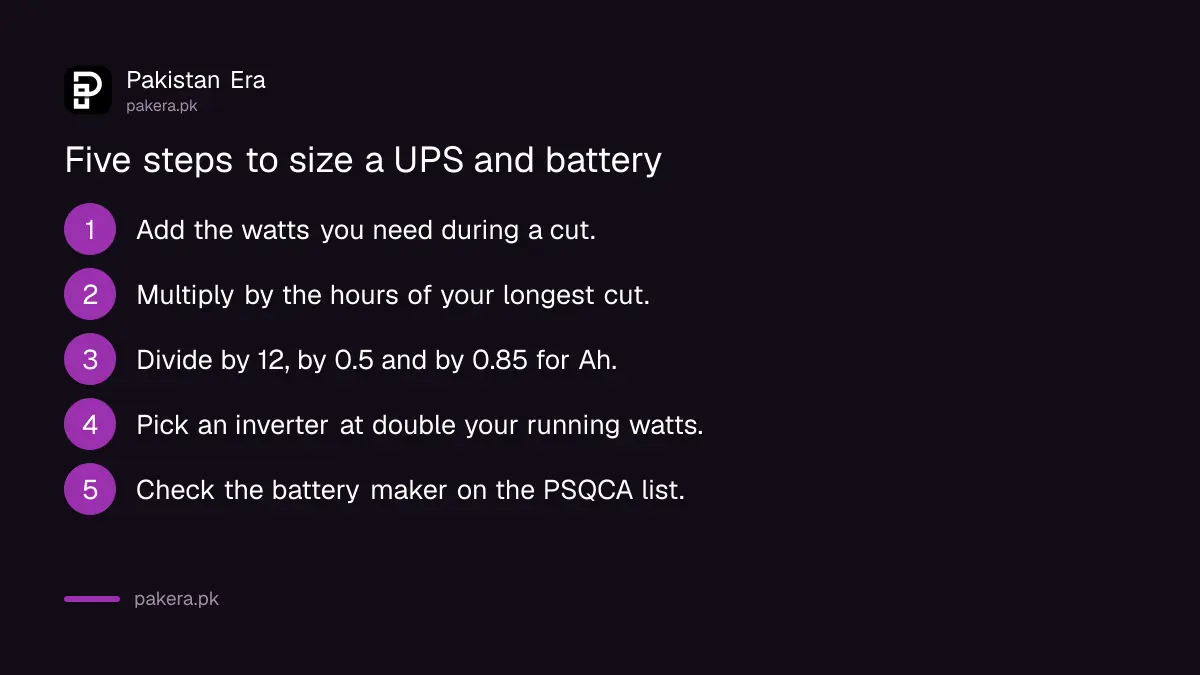
- Add up the watts of the fans, lights, router, TV and chargers you need during a cut.
- Multiply by the hours of your longest cut to get watt hours.
- Divide by 12, then by 0.5, then by 0.85 for a lead acid battery in Ah; use 0.8 and 0.9 for lithium.
- Choose an inverter rated at least twice your running watts, pure sine wave if an AC or electronics are on it.
- Confirm the battery's maker is on the PSQCA list, using the steps to check a UPS battery for a PSQCA licence, and have an electrician wire the changeover.
One last check. A UPS does not create electricity; it stores what the grid sold you, with losses. On the 201 to 300 unit home slab of Rs 33.10, refilling 1.2 kWh after a four hour cut costs about Rs 47 including the losses, by our arithmetic. That is cheap compared with a generator, and it is the reason a correctly sized UPS pays for itself.
Common questions about sizing a UPS
What size UPS do I need for two fans and four lights?
About 200 watts. For three hours that is 600 watt hours, which a 120 Ah lead acid battery and a 600 to 1,000 VA inverter cover, using the assumptions above.
Can a UPS run a 1 ton AC?
Not on a single 12 volt lead acid battery. A 900 watt inverter AC for three hours needs about 700 Ah of lead acid or a 48 volt lithium bank of around 100 Ah.
How many hours will a 200 Ah battery last?
About 1,020 usable watt hours at 50 per cent depth and 85 per cent efficiency. That is roughly three hours at 300 watts or five hours at 200 watts.
Why does my battery die in a year?
Deep discharges past 50 per cent, slow or incomplete recharging between cuts, and poor quality cells. Check the maker holds a PSQCA licence before you buy the next one.
Is a 1,000 VA inverter enough for 300 watts?
Yes. It leaves room for the starting surge of fans and a small fridge. Match the VA to at least double the running watts.
Does a UPS reduce my electricity bill?
No. It adds a little, because charging has losses. It replaces generator fuel, which is where the saving comes from.
How we verified this
What we checked, where we read it, and what we could not confirm.
Last checked 19 October 2026. Appliance wattages come from K-Electric's energy consumption calculator at ke.com.pk, which we read on 19 October 2026; the calculator lists two figures for a single door refrigerator, 90 and 180 watts, and we give both. Battery depth of discharge, inverter efficiency and the surge rule are standard engineering assumptions stated in the text, not figures from any authority, and every Ah and cost figure is our own arithmetic from them. The home slab rate of Rs 33.10 is from S.R.O. 279(I)/2026. We did not test any UPS or battery for this guide. Cut lengths vary by company and area, so use your own schedule.
About the author

Senior Writer, Public Services and Technology
Shahid joined us in 2024 as an author. He is a senior contributor to Pakistan's leading technology websites. He writes detailed articles, mostly covering his expertise in the latest tech, mobiles, apps, gadgets, and step-by-step guides. His ideology is to help people understand the latest trends and explain complex methods through very easy-to-understand guides.